

Food delivery dates back to the Edo period!
Before the advent of food delivery services like Uber Eats, from the 1950s to the 1970s, “demae” meant the delivery of soba, udon, ramen, sushi, and other store-bought foods.
The history of demae is surprisingly old, and as evidenced by the Kabuki play “Fukuyama no Katsugi,” which features a delivery man as the main character, it appears to have already existed in the mid-Edo period, during the Kyoho era (1716-1736). At the time, the demae meant soba noodles, beloved by the common people of Edo.

“Sukeroku” is a popular classical Edo Kabuki play. It usually runs for two hours, but if performed fully, it can run for three hours. It consists of only the “Miuraya Kashikosaki” scene, without any scene changes. One of the highlights is “Fukuyama no Katsugi,” in which Fukuyama no Katsugi and Kuwanpera Monbei clash and get into an argument. Edo’s most handsome man, Sukeroku (whose true identity is Soga no Goro Tokimune, who seeks revenge for his father), comes to the rescue, but in the end, Sukeroku ends up pouring udon noodles over Kuwanpera Monbei’s head.
At that time, soba restaurants were staffed by specialized craftsmen with different titles, including the “itamae” (making the soba), the “kamamae” (boiling and plating), the “nakadai” (preparing the toppings), the “hanaban” (serving customers), and the “gaiban” (outsiders) who were in charge of delivery. Among these, the “gaiban” were a professional group independent of the restaurant, and these craftsmen were called “katsugi.” They were dispatched at the request of restaurants looking for “gaiban” after forming a relationship with the employment agency in the form of a “yori-oya” (master-servant relationship similar to that of parent and child in medieval Japan).
Soba is a fresh food. When freshly boiled, it has a chewy texture and a smooth, easy-to-swallow taste, but if left for a while, it becomes soggy and inedible. While it is possible to adjust the taste somewhat by changing the boiling time and the amount of binding agent used, delivery is inevitably at a disadvantage in terms of taste compared to “oyado” (a restaurant where customers come in). The role of the soba delivery man was to compensate for this as much as possible, and delivery speed was given the utmost importance.
At the time, soba restaurants’ main customers were entertainment districts and merchants, and they sometimes had to deliver large orders at once, so the job of a “carrier” was truly a test of physical strength. What was required of them was not only strong legs but also strong arms, as well as the skilled technique to carry the food without spilling the soup or damaging the presentation.

“Fukuyama Soba Shop in Edo’s Fukiyacho” (1771) by Kitao Shigemasa. The picture depicts a “carrying man” with a okamochi (a man carrying a noodle) hanging from a pole.
The work uniform of the “Katsugi” was similar to that of Sukeroku in “Fukuyama no Katsugi,” and consisted of a bean-dyed tenugui towel, a headband, a red belly wrap, a traditional Japanese kimono, and sandals on bare feet, creating a dashing appearance. Many of them had beautiful tattoos on their backs, typical of the craftsmen of the time. When making deliveries, they would sprint through the streets of Edo with a carrying pole slung at the end of their shoulders, sprinting with the speed of a sprinter.

A wooden okamochi used by “katsugi” (carriers) during the Edo period. Sometimes people call delivery machines okamochi, but this is a misuse of the term.
They were very proud of their craftsmen, and would refuse to deliver to other stores even if they were requested to do so by their neighbors, and would take a detour to avoid passing in front of other stores’ shop curtains, no matter how urgent the delivery, and they worked while adhering to the code of honor among their fellow craftsmen. Many of them were short-tempered, show-offy, good-natured, reckless, and quick to fight, typical of Edo people. Since it was even featured in a Kabuki play, it must have been seen by the people of Edo as a manly and cool job, on a par with carpenters, plasterers, and roofers (who also served as firefighters).
Has delivery evolved with the advent of civilization? A
man carrying a high-rise rice bowl and a steamer in one hand and a bicycle handlebar in the other.
The work of the soba deliverymen did not change significantly during the Meiji period, but from the Taisho period onwards, soba restaurants also began to see a gradual wave of rationalization and mechanization. With the arrival of noodle-making machines and mixing machines, the division of labor among multiple craftsmen broke down, and it became common for one craftsman to perform multiple roles. Accordingly, the soba deliverymen also became the work of directly hired employees. Around this time, bicycles gradually became more common among the general public, and deliveries by foot soon disappeared.

Yukio Kubo of Kasuga Soba Soba Restaurant in Higashi-Kanda continues to carry on the work of the outcall service that began before the war. His delivery work as a young man was photographed by the late photojournalist Itaru Kurita and was featured in TIME magazine and other publications.
However, the work of these “carriers” remained as physically demanding as ever. Photographs from the Taisho and Showa periods show them riding bicycles with one hand, carrying bowls and steamers stacked high on trays for delivery, as they raced through big cities like acrobatic performers.

Yukio Kubo worked as a “cartridge” 40 years ago, when he was training at Sobadokoro Mikasa in Kanda Izumicho. An interview article in which Kubo talks about “cartridge” can be read in the February 2021 issue of Moto Champ.
ADVERTISEMENT
 Moto Champ February 2021 issue
50-250cc 2021 All Catalog
The February 2021 issue of Moto Champ is available to read as an e-book.
This was a time when family restaurants and fast food joints did not yet exist, and Western-style restaurants were rare outside of Tokyo’s downtown areas of Ginza, Nihonbashi, and Asakusa. The main ways to eat out were takeout from restaurants or delivery of soba or udon noodles. At lunchtime in the office district, more than 100 men carrying piles of soba or rice bowls weighing 40-50 kg on their shoulders, roughly the height of an adult man, would cycle smoothly between the buildings, steering with one hand.
Of course, such acrobatic feats could not be mastered overnight. The newcomers practiced and honed their skills under the guidance of their seniors whenever they had free time, gradually increasing the number of steps before delivery and the number of steamers and bowls they carried.
After World War II, the “Katsugi” was caught up in a traffic war…
Fast forward a little to the time just after the end of the Pacific War. At the time, food and supply shortages continued even after the long and painful war, and staple foods like rice and flour were still rationed. The controlled economy, which required designated staple foods like rice, wheat, and noodles, and dishes made with them, could not be sold anywhere other than designated restaurants, had not yet been lifted. During this time, eating out was only permitted at government-designated “eating out coupon restaurants” (restaurants where customers could dine by presenting government-issued “eating out coupons” to the restaurant), and any other dining out was illegal and illegal.

Peace returned to Japan with the defeat on August 15, 1945, but food and supply shortages continued for some time after the war ended (photo shows Foreign Minister Shigemitsu Mamoru signing the Instrument of surrender aboard the USS Missouri on September 2 of the same year).
As the food situation gradually improved, the restrictions were lifted in 1951, and eating out was liberalized. Around this time, soba restaurants began to reopen one by one. At the same time, men carrying loads of steamers and rice bowls could once again be seen on street corners at lunchtime, delivering them by bicycle.

Immediately after the war, staple foods such as rice and flour remained scarce, and eating out was only permitted at government-designated “eating out ticket restaurants.” However, in reality, black markets were set up in the ruins of urban areas, where, although illegal, people could eat out and buy controlled goods such as rice, wheat, and sugar as long as they had money (the photo shows police officers and MPs confiscating black market goods, taken in 1949).
Immediately after the end of the war, when war damage and poor harvests caused food shortages in Japan, the United States provided emergency aid in the form of wheat flour, which the Japanese people at the time mainly ate by processing it into noodles. Due to this background, noodles were particularly popular among the common people at the time, and soba restaurants, which were a casual place to eat out, were so busy they needed all the help they could get. Due to this situation, there was a shortage of “katsugi” workers at every store. It seems that some of them were unscrupulous, looking down on their owners and demanding exorbitant wages.
However, this was the post-war reconstruction period. Due to the special demand caused by the Korean War, traffic on Tokyo’s roads, mainly trucks, suddenly increased. Furthermore, paved roads were still rare even within the 23 wards. With a lack of transportation infrastructure, legal systems, and public safety awareness, it was only natural that the number of traffic accidents was on the rise.

With the outbreak of the Korean War on June 25, 1950, Japan assumed the role of a rear logistics base for the United Nations forces, which led to a boom in domestic demand. This enabled Japan to successfully rebuild after the war.
Of course, the men who carried goods were no exception to the casualties of accidents. In 1951, in Tokyo alone, the owner of a soba noodle restaurant was hit by a truck while making a delivery in Ota Ward and killed instantly. Soba noodle restaurant employees were also killed in similar traffic accidents in Bunkyo Ward and Shinjuku Ward, making for three tragic accidents reported in the newspapers. Including accidents that went unreported, it’s likely that a considerable number of people across the country were killed or injured in accidents while making deliveries.
No matter how skilled a “carrying man” may be, driving with one hand and carrying a delivery meal on his shoulder blocks his view to one side, making it difficult to even avoid an emergency even if he notices danger. The days when a single, honed technique could get the job done were over. Now, delivery services, which had existed since the Edo period, were facing a crisis that threatened their very existence.
The owner of a soba restaurant, heartbroken by a series of accidents, aims to mechanize delivery!
One soba noodle chef was deeply troubled by this situation and set out to improve it. His name was Touma Shoji. He was the second-generation owner of the soba restaurant “Oasahi” (now closed) in Yutenji, Meguro Ward. In July 1951, he revived the soba restaurant that his father had run before the war.

Daiasahi, a soba restaurant in Yutenji, Meguro Ward, which developed the delivery machine, belonged to a noren association called the Asahi-ya Association. The history of the Asahi-ya Association dates back to 1906, when Naruse Hyakujiro, a farmer from Aichi Prefecture, moved to Tokyo and began working at Inanoya, a soba restaurant in front of Ueno Station. In 1908, Hyakujiro’s older brother, Kikuzo, who had moved to Tokyo the previous year, opened the first Asahi-ya store, and his eldest brother, Matsudaira, also moved to Tokyo and opened the second store in 1912. From there, the Naruse family branched out and opened more stores. At its peak, there were 200 Asahi-ya stores throughout Tokyo. Touma Shoji, the owner of Daiasahi, was also related to the Naruse family (photo shows Asahi-ya Koenji store).
As mentioned above, the soba restaurant was very popular at the time, and there was a high demand for delivery, so the restaurant employed three employees who specialized in off-duty delivery. However, orders kept coming in nonstop at lunchtime, and the restaurant was so busy that it couldn’t keep up. However, “carrying” is a skilled job, and not just anyone can do it. It seems that they couldn’t just increase the number of staff simply because they were short-staffed. So Toma racked his brains trying to think of a way to mechanize delivery.
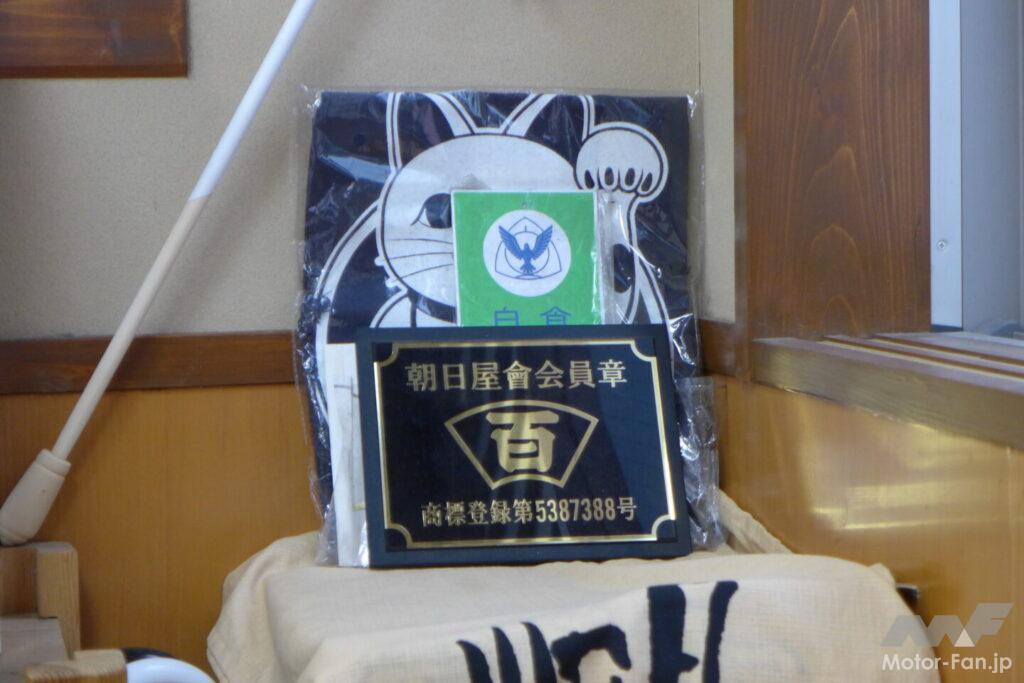
The Asahi-ya Association membership badge displayed inside the Asahi-ya Koenji store. The character “100” on the fan is a reference to the name of the company’s founder, Hyakujiro Naruse.
One day, an employee of Daiasahi was involved in a traffic accident while making a delivery. Fortunately, he was not seriously injured, but suffered serious injuries that required two months to heal. After reading in the newspaper that similar accidents were occurring frequently all over Tokyo, he decided to take on the challenge of developing a delivery machine (hereafter referred to as a delivery machine), despite being an amateur when it came to machinery.

Katsudon set (1,260 yen) at Asahiya Koenji store. You can enjoy delicious soba noodles at a reasonable price. The attentive service that you’d expect from a long-established restaurant is also a plus.
Asahiya Koenji store
Address: 3-2-10 Yamatocho, Nakano-ku, Tokyo
TEL: 03-3337-7792
Business hours: 11:30-15:30/17:00-20:30
Closed: Mondays
The requirements for a food delivery vehicle were:
1) The loading platform must remain level at all times, regardless of road conditions
; 2) It must be able to absorb any shocks from the road surface, assuming it will be driven on uneven roads
; and 3) It must be able to use existing fixtures and have the carrying capacity to carry at least three stacked food delivery trays
.
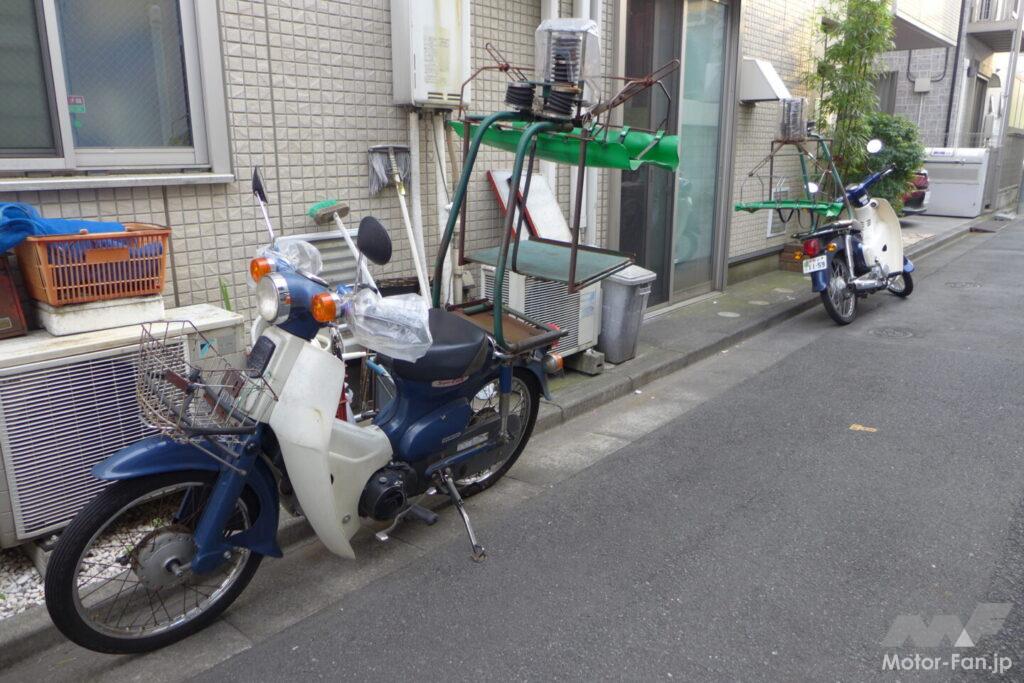
Asahi-ya Koenji store appears to also offer delivery services, and behind the store there were two Super Cubs equipped with delivery machines parked side by side.
After several days of coming up with the idea, Touma was inspired by a standing birdcage he happened to come across, so he drew up a full-scale blueprint and began the prototype stage. However, he did not have the large-scale specialized manufacturing techniques or machine tools. So he relied on a local factory for parts that required metal processing, such as the main frame, and purchased suitable springs and other parts from an auto parts store in Furukawabashi, Azabu. It was in February 1952 that he finally gathered all the necessary parts and built the first prototype.
Late at night after closing time, Tohma tries out the first prototype of the delivery machine. Restraining his excitement, he attaches the prototype to the carrier of his bicycle, places a delivery tray with a bowl of udon noodles on it, just like an actual delivery, and slowly starts pedaling. Soon, he hears a rattling noise from behind. He can’t confirm it because he’s driving. It seems the bowl is dancing. Then, as he approaches a gentle slope, the carrier begins to swing back and forth, and the delivery tray slides down onto the road, shattering not only the bowl but the tray itself, scattering the udon noodles and bringing his first experiment to a tragic end.
But Tohma was not one to be discouraged. The next night and the next, he made improvements and tried again, only to meet the same failure again and again. Pieces of the rice bowls that had not been removed even after cleaning began to become noticeable on the roadside around the restaurant, and he began to receive complaints from neighbors that they were causing problems by clogging the drains. Tohma’s wife would help out by cleaning again each time, but with each experiment the restaurant’s rice bowls were worn out, and it eventually got to the point where it was affecting business (they managed to avoid this by asking a porcelain wholesaler to sell them damaged or unsold items at a low price).
After repeated failures and trials, the technology is finally on the verge of being put into practical use…
About a week after the start of the experiment, Tohma came up with an idea to prevent the bowls from falling off due to the shaking of the loading platform. Because the loading platform is suspended at a single point, it gradually sways like a swing, eventually causing the load to tip over, but completely stopping this shaking would make it impossible to maintain a level surface. So, to control the shaking while keeping the loading platform level, Tohma could add mechanical resistance to the front, back, and sides. With this in mind, he created a flywheel using parts he had made himself to stop the lateral shaking, and for the vertical shaking, he adapted an insecticide sprayer to utilize the resistance created by air friction to suppress the shaking.
As expected, this attempt was a success. In June 1952, the first prototype was completed, which was capable of transporting a single tray of food on flat roads. Although it was not yet fully operational, this was the moment when the prospect of commercializing food delivery machines became clear.

The structure of the Marushin delivery machine, which is still manufactured and sold today, has its origins in Toma.
However, while the revised prototype No. 1 had no problems on flat roads, the load would easily shift if the road was even slightly inclined, and it was also vulnerable to uneven road surfaces. So Touma came up with the idea of using air springs to cushion the loading platform. He bought four bicycle pumps and inserted metal springs into them. He attached a four-pronged air spring to the connection between the main frame and the loading platform.
This significantly reduced the impact from above and below, and the second prototype was completed, which was practical for carrying a single layer of delivery food. However, if the delivery food was stacked more than twice, the food would slip and fall, so further improvements were needed to transport a large number of orders at once.
To put his future research and improvements into practice, Toma decided to take the plunge and buy a scooter (the model is unknown, but it’s likely a Rabbit or Silver Pigeon), attach the second prototype to the carrier, and use it for his daily off-duty work, gradually improving it as he aimed to develop a more practical delivery machine. Furthermore, having judged that he had a good idea of how practical the machine could be, he decided to start preparing a patent application for the delivery machine in parallel with the improvement work.

Marushin’s food delivery machine lineup. In the past, several companies manufactured food delivery machines, but now only Marushin continues to manufacture and sell them. I would like to introduce Marushin’s food delivery machines next time.