
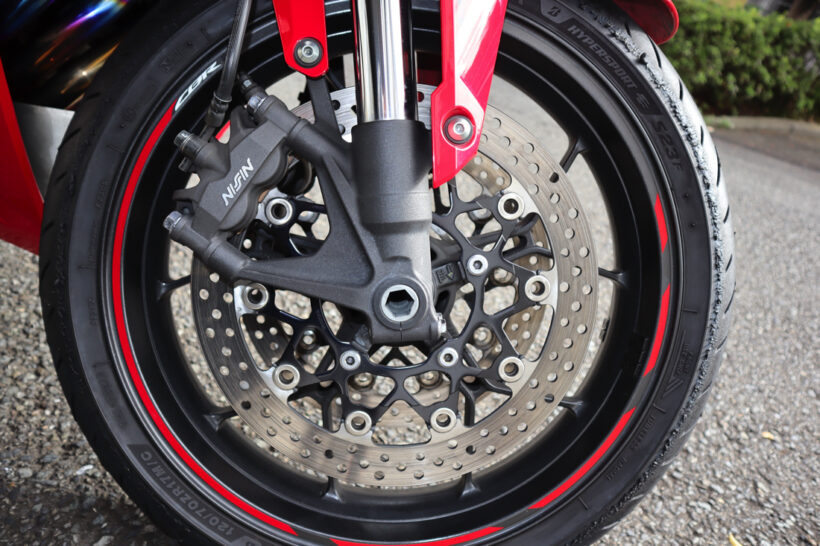
ABS is a device that prevents the wheels from locking up.
As many people may know, ABS is an abbreviation for “Anti-lock Brake System.” “Anti-lock” here means “to prevent the wheels from locking.” “Lock” refers to a state in which the wheels completely stop rotating due to braking.
One cause of this is applying the brakes hard while driving. This is especially likely to occur during sudden braking, such as panic braking when a car or person suddenly appears in front of you. If the wheels stop rotating at such a time, the tires that are in contact with the ground will naturally slip (losing control), which can often lead to accidents such as falls.
ABS is a device that prevents this from happening as much as possible. If the tires lock during braking, it detects this and quickly restores the tire rotation speed to maintain vehicle stability.
The mechanism varies slightly depending on the manufacturer and model, but in the case of Honda vehicles, for example, sensors mounted on the front and rear wheels detect the rotational speed of the front and rear tires, and if there is a difference between them, it determines that the slower tire is locked.The system then releases the brake on the locked tire to restore its rotational speed, and then brakes again.This is repeated every 1/1000 of a second to ensure braking force and maintain vehicle stability.
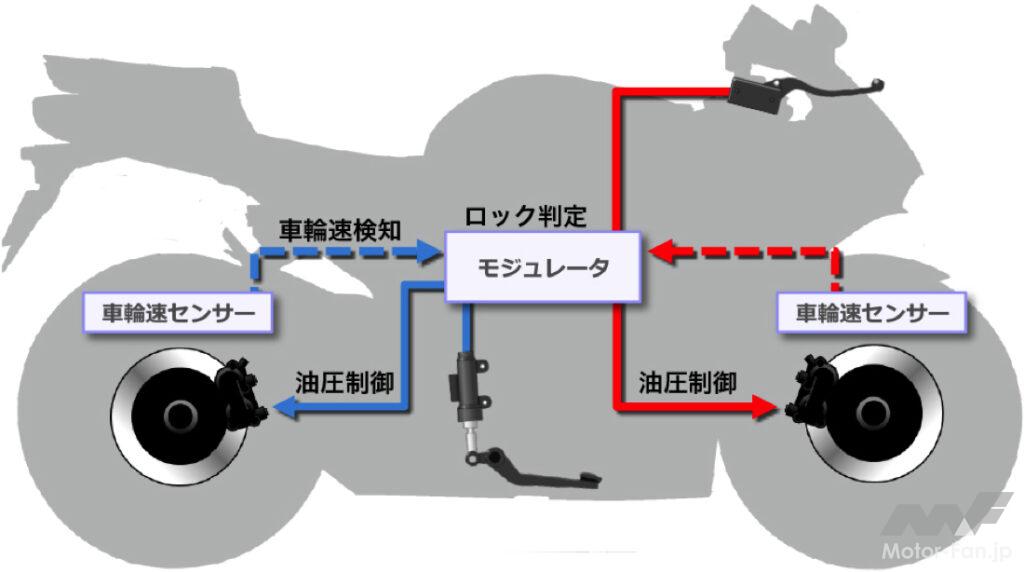
ABS system example (Honda vehicles)
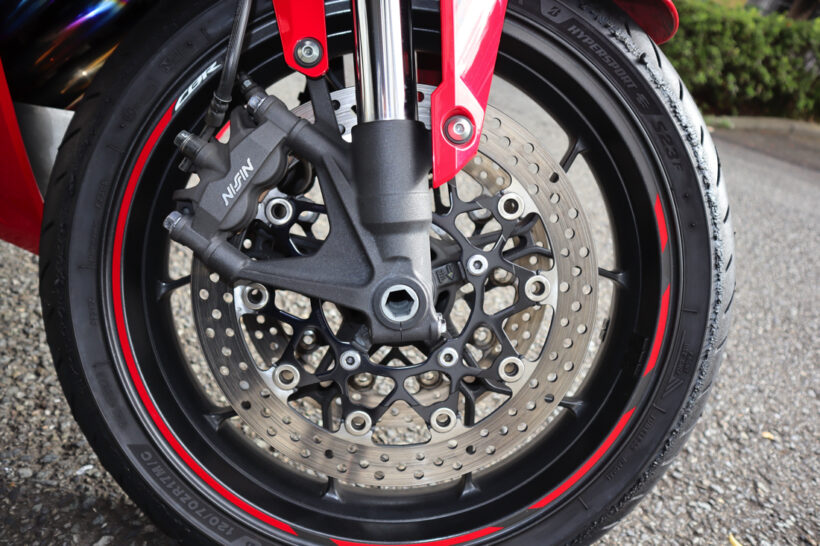
ABS uses a sensor to read wheel speed, and on a typical motorcycle, this is located near the center of the brake disc. There is often a disc-shaped part with slits, and a sensor that detects wheel speed is attached to this slit. By looking at these, you can tell whether a motorcycle has ABS or not.
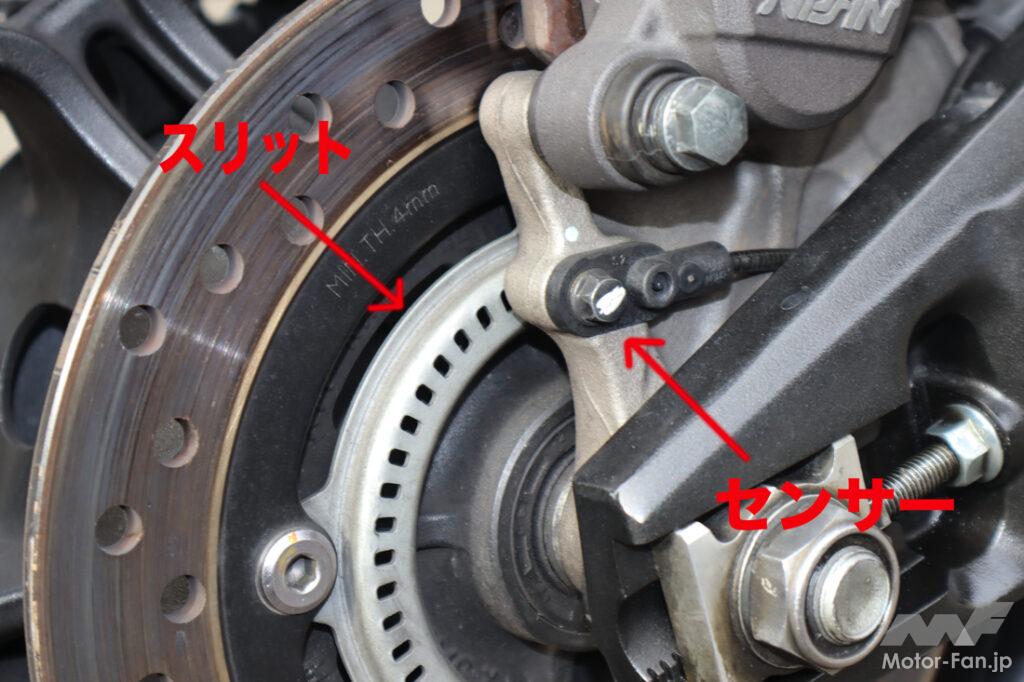
ABS sensors attached to the rear brake of the Honda CBR650R
ABS will be mandatory from 2018
The mandatory installation of ABS on motorcycles was made possible by the Ministry of Land, Infrastructure, Transport and Tourism’s revision of the “Road Transport Vehicle Safety Standards” and other related ministerial ordinances in January 2015. As a result, it became “mandatory” for motorcycles to be equipped with an advanced braking system.
More specifically, motorcycles with an engine displacement of over 125cc are now required to be equipped with an ABS that meets certain technical requirements. The law also applies to Class 2 mopeds (motorized bicycles) with engine displacements between 50cc and 125cc, which do not necessarily require an ABS; CBS is also acceptable.
CBS here stands for “Combined Braking System,” which refers to the front and rear brakes that are linked together. While the front and rear brakes on a typical motorcycle are operated separately, this system operates both the front and rear brakes by operating either the front or rear brake.
For example, the “combined brake” often used on Honda’s 110cc and 125cc scooters distributes braking force to the front wheel when the left lever (rear wheel brake) is pressed, supporting well-balanced braking.
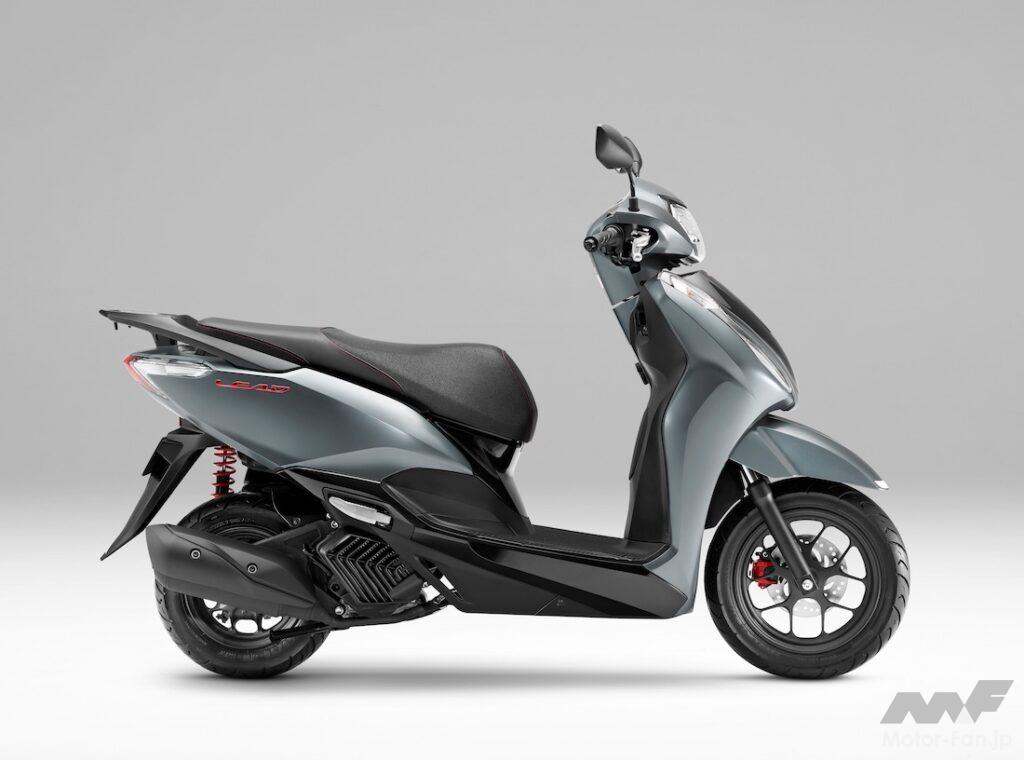
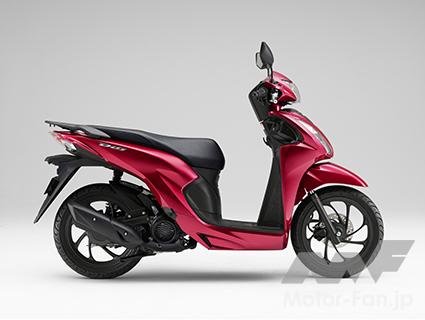
Combination brakes are often used on Honda’s 125cc and 110cc scooters (pictured is the Lead 125).
The advantage is that the system can be simplified and is cost-effective compared to ABS, which requires complex electronic controls and sensors. For this reason, it is often used on small scooters and small motorcycles with small engine displacements, which are small in size and relatively inexpensive.
The specific application period for ABS and CBS is from October 1, 2018 for new vehicles. Furthermore, for continued production vehicles, the installation of ABS and CBS will be mandatory for models sold after October 1, 2021.
There are various types of ABS and CBS
As such, ABS is a must-have for motorcycles, and there are mainly the following types depending on the characteristics and performance of the model being fitted.
[Single Type ABS]
This type only affects the front wheels, which are prone to locking up and causing a fall. It is often used on small-displacement models.
[Dual Type ABS]
A type that acts on both the front and rear wheels to improve stability at high speeds. Used on a wide range of engine displacement models.
[ABS for supersports]
This type is designed for harder driving, such as circuit driving. By detecting the vehicle’s behavior, it suppresses excessive nose dive and also supports braking while cornering.
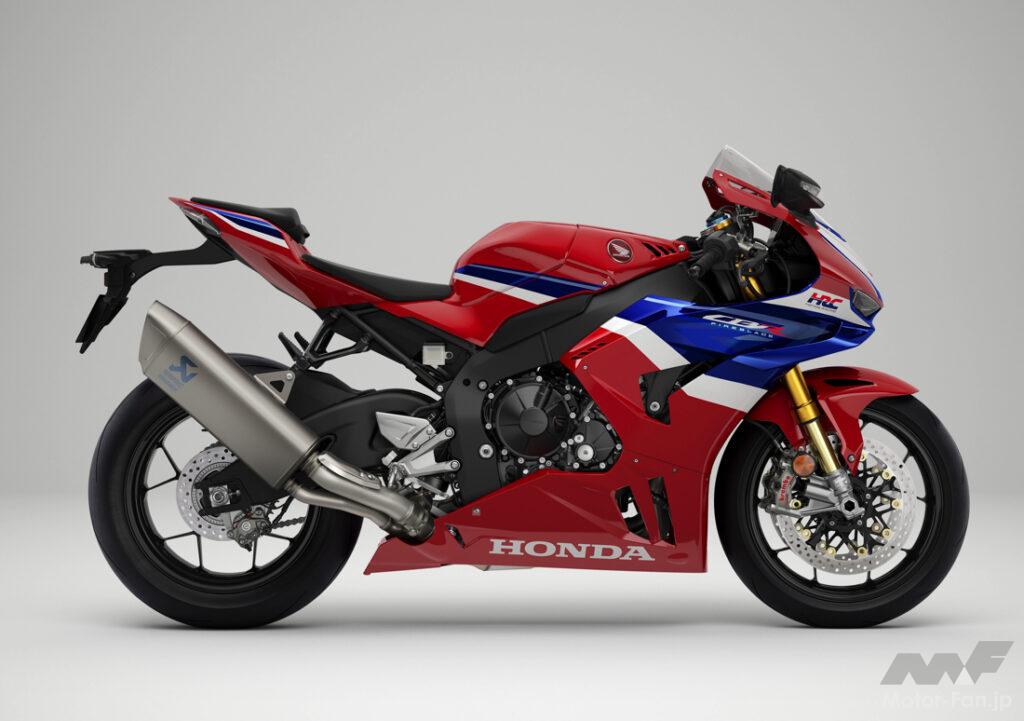
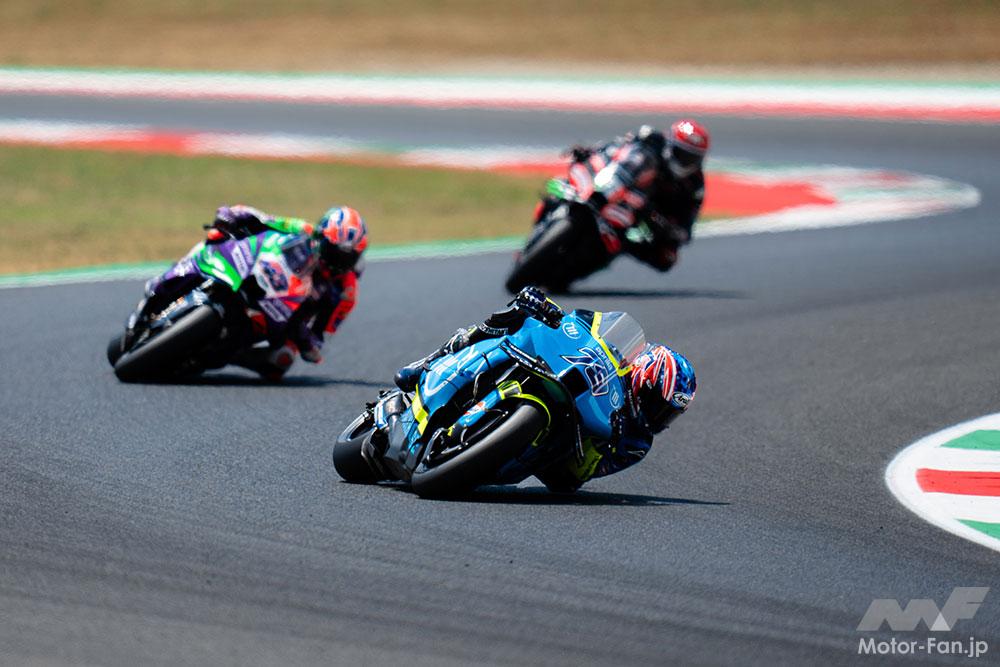
The ABS for supersport bikes is designed for more aggressive riding, such as circuit racing (pictured is the CBR1000RR-R Fireblade SP).
[ABS for off-road use]
This system allows the rider to deactivate the ABS on the rear brake only with the flip of a switch when the rider determines that it is necessary to use both the front and rear brakes in situations such as off-road riding.
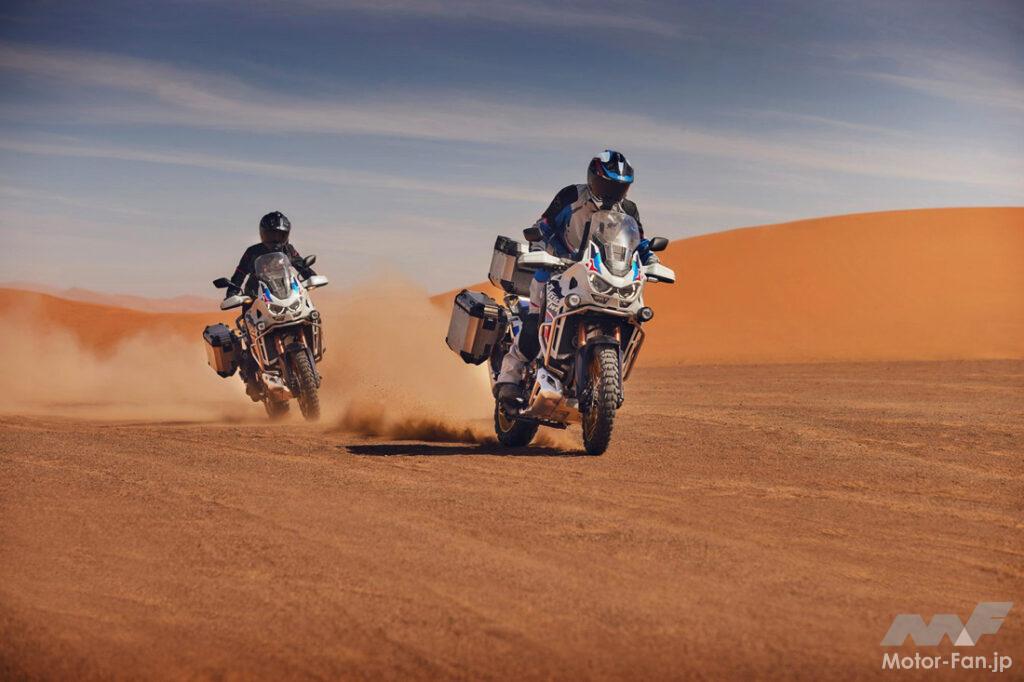
The off-road ABS can be deactivated for the rear brake only with the flip of a switch (photo shows a CRF1100L Africa Twin Adventure Sports ES).
[Combined ABS]
A system that combines CBS, which automatically distributes braking force appropriately between the front and rear wheels, with ABS, which prevents locking. It is often used in large tourers. For example, on Honda’s Gold Wing Tour, when the front brake is applied, braking force is distributed to the rear brake as well, and when the rear brake is applied, braking force is distributed to the front brake as well. By operating the front and rear brakes simultaneously in a balanced manner, excessive nose dive caused by braking is suppressed. In addition, dual-type ABS also prevents tires from locking.
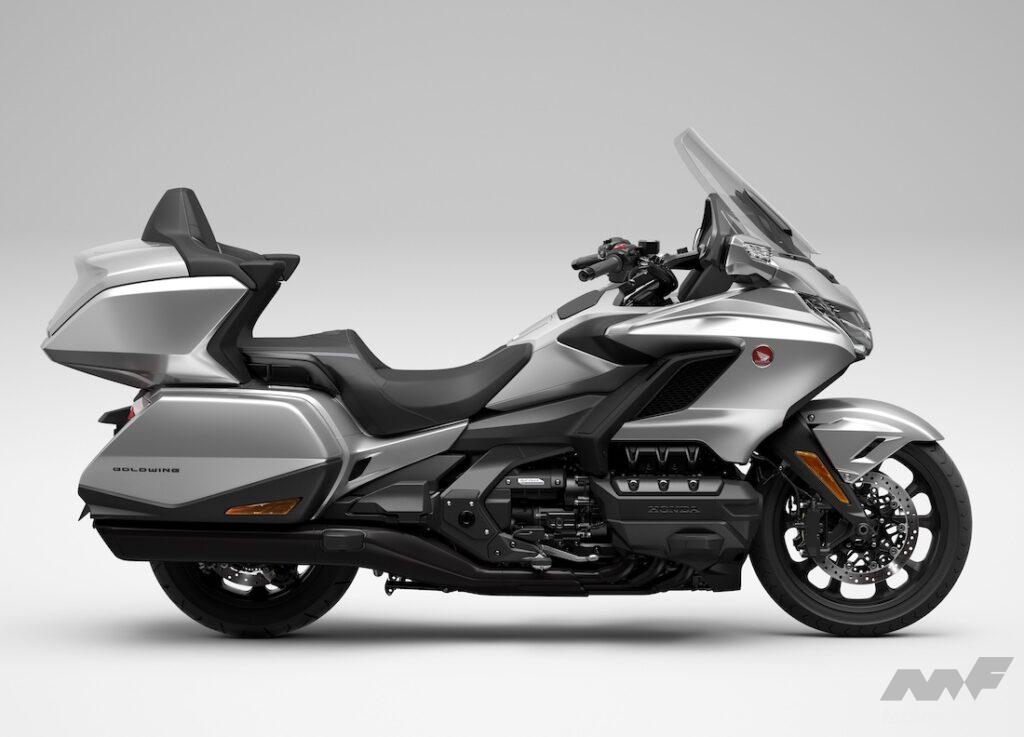
Gold Wing Tour equipped with electronically controlled combined ABS
Do new standard mopeds come with ABS and CBS?
The above is an overview of ABS and CBS, which are now mandatory for most motorcycles, but previously this did not apply to Class 1 mopeds (first-class motorized bicycles) of 50cc or less, and installation was not mandatory.
However, due to the new emission regulations that will be introduced from November 2025, production of 50cc bikes that cannot comply with the regulations has basically been discontinued, and new standard mopeds have been introduced in their place.
This refers to motorcycles with an engine displacement of 125cc or less that have a maximum output limit of 4.0kW (5.4PS) or less. Engine displacement of 125cc or less is the same as the conventional Class 2 moped, but the key point is that by reducing the power, the performance is equivalent to that of a 50cc motorcycle. Compatible models can be driven with a moped license, and are treated the same as Class 1 mopeds in terms of traffic rules and regulations.
So, what about the installation of ABS and CBS in the case of mopeds that meet the new standards? In this regard, the four types of mopeds that Honda has announced that meet the new standards basically use one of these systems.
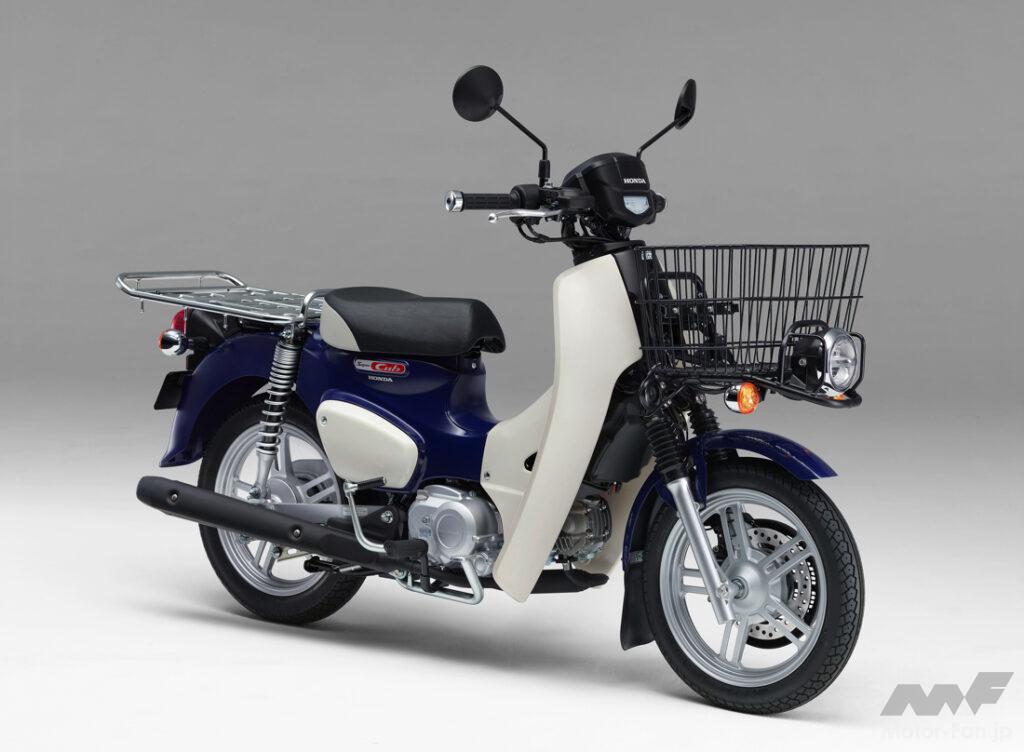
First up are the business bikes, the Super Cub 110 Light, Super Cub 110 Pro Light, and Cross Cub 110 Light. All of these models are based on the 110cc Super Cub 110, Super Cub 110 Pro, and Cross Cub 110, but the maximum output of their 109cc air-cooled single-cylinder engines has been reduced from 5.9kW (8.0PS) to 3.5kW (4.8PS), making them compliant with the new moped standards.
These models use front disc brakes and a single-channel ABS that only works on the front wheels, the same setup as the base model for Class 2 mopeds.
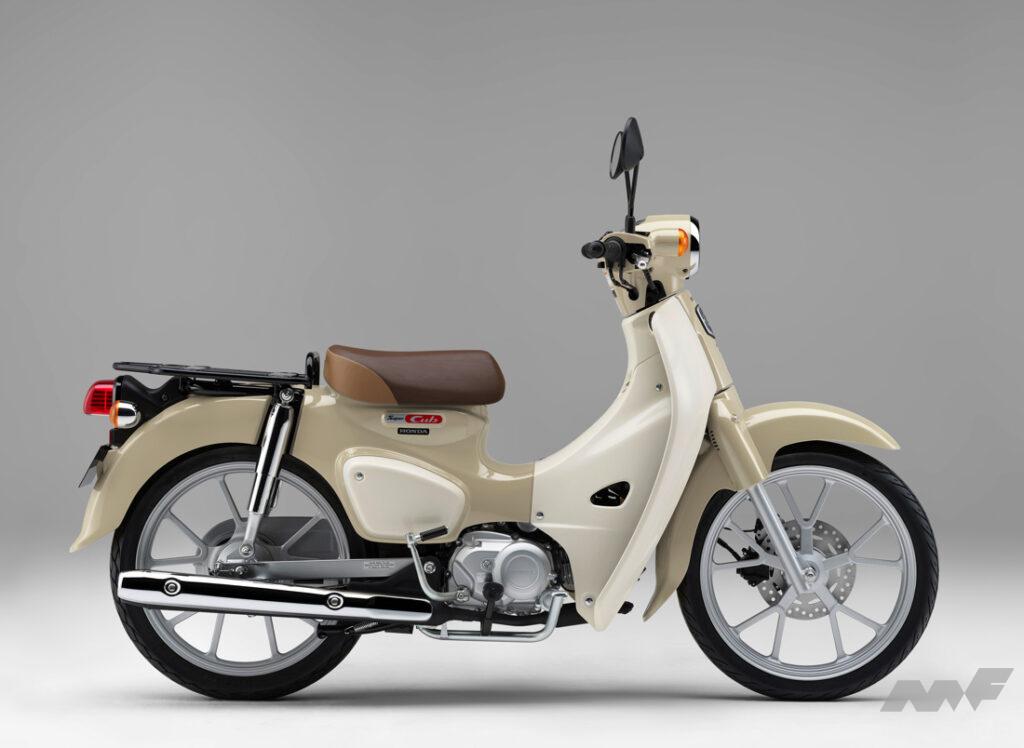
Super Cub 110 Light
ADVERTISEMENT
Super Cub 110 Pro Light
ADVERTISEMENT
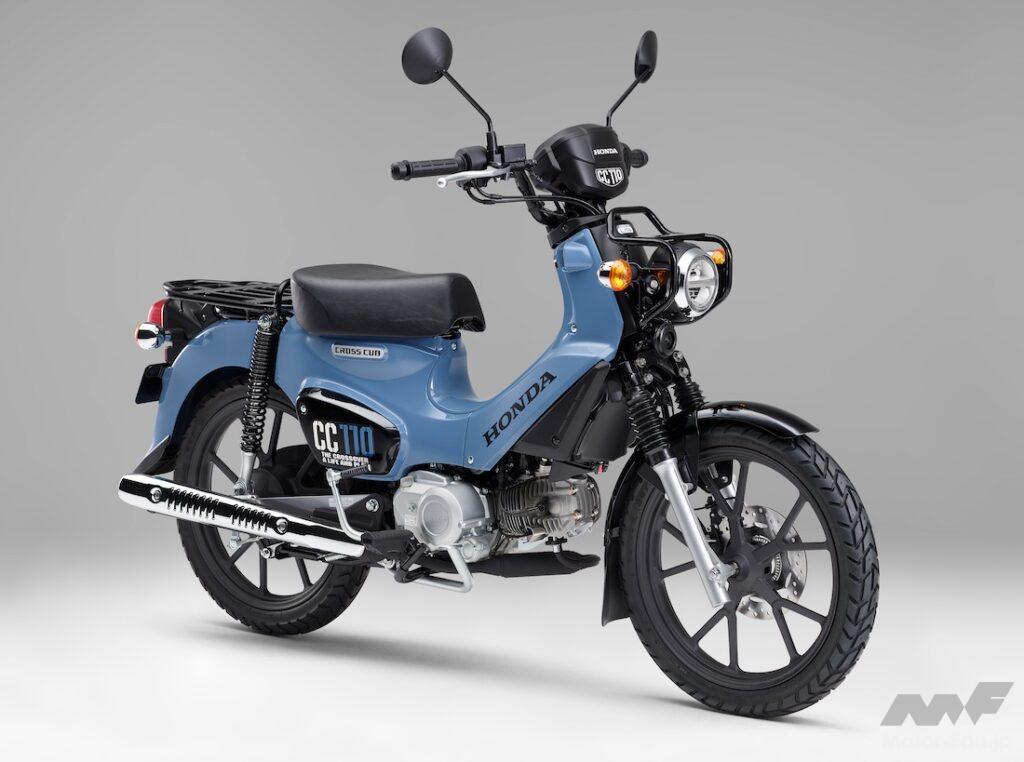
Cross Cub 110 Light
There is also the scooter model “Dio 110 Lite.” This is based on the “Dio 110,” but the maximum output of the 109cc air-cooled single-cylinder engine has been reduced from 6.4kW (8.7PS) to 3.7kW (5.0PS). This model also complies with the new moped standards.
This model is also equipped with a CBS combined brake, just like the Dio 110, a two-wheeled scooter. As mentioned above, when you squeeze the left lever (rear wheel brake), it distributes braking force to the front wheel as well, using Honda’s unique braking system to provide balanced braking support.
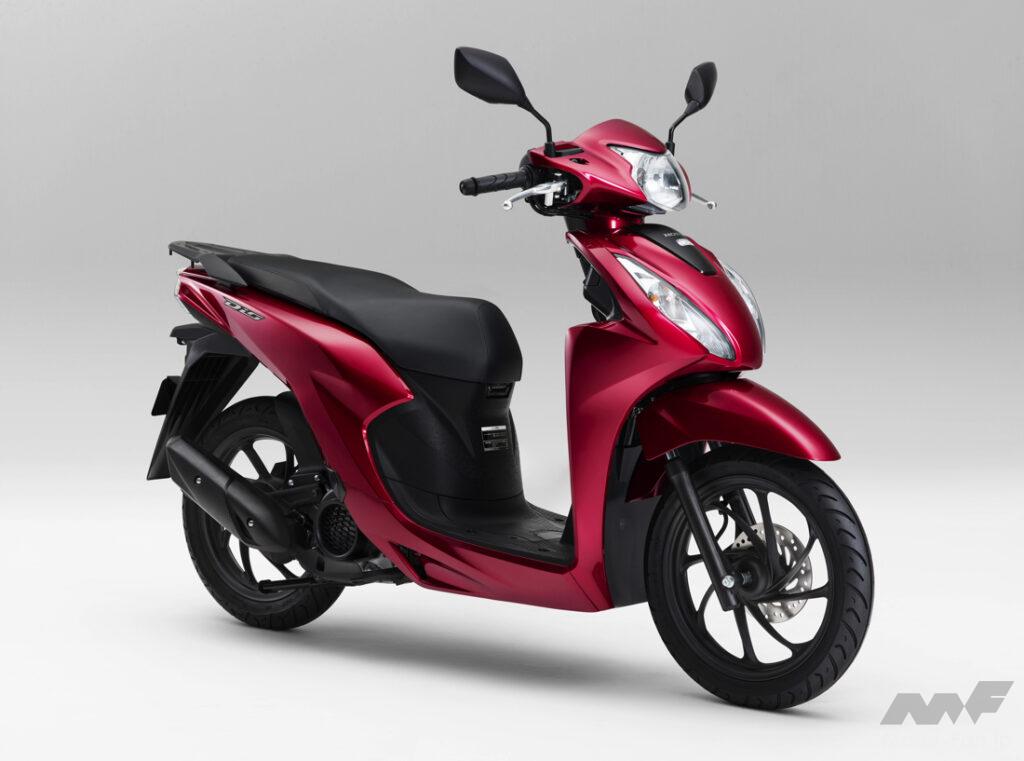
Dio 110 Light
As you can see, ABS and CBS are now standard equipment on most new motorcycles you can buy. These are useful systems that prevent tires from locking up and optimize the front-to-rear braking balance, but it’s important to remember that these devices aren’t necessarily foolproof. It’s important to ride carefully and in a way that allows you to stop safely in an emergency.