

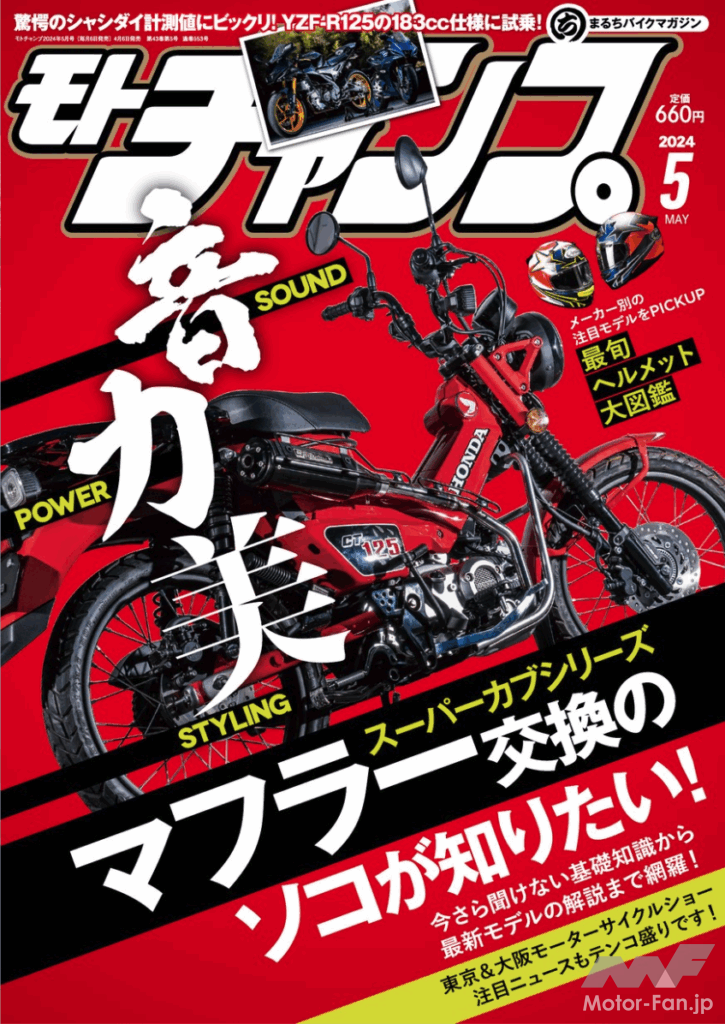
I want to know about replacing the muffler on the Super Cub series!
A satisfying 2000 killer filled with the spirit of a modder
It has the power and ride feel of a racing machine. The R125 made by KN Kikaku is a testament to the work of a true professional tuner, on a completely different level from a simple, plug-and-play custom. We’d like to explain this with some words from Mr. Sasaki of KN Kikaku, who built the machine.
This is the person I heard the story from!

Mr. Sasaki of KN-YOKOHAMA
is the manager of “KN-YOKOHAMA”, the Kanto branch of KN Planning, which supports the brand. He is well versed in tuning all kinds of mini bikes, from scooters to manual transmission bikes, and his knowledge and skills are among the best in the industry!
This person is the tester!

Kenny Sagawa:
In the past, he participated in races such as the NK Championship and the Suzuka 4 Hours, and despite his appearance, he has a deep knowledge of tuning, as he builds and sets up his own machines (laughs).
The first thing we want to know is the development concept. “It may seem extreme, but we’ve placed emphasis on ease of handling so that it can be enjoyed by a wide range of people, from young people to veterans,” says Mr. Yamamoto. He says he wanted to recreate the “feel” of the old days when people would modify and bore-up NSRs and TZRs and have fun. It’s true that in the Showa era, people didn’t just buy fast bikes, but rather modified their machines and improved their skills to become faster. This machine evokes the scent of that nostalgic era.
The reason for choosing the YZF-R125 as the base is simply because of its superior materials. “The Deltabox frame and inverted forks give it a good chassis. The engine is also based on the NMAX, so the parts we’ve developed are easy to use,” he says. The engine, bored out to 183cc, also happens to use racing parts from the previous R15, which was used in the Asian Championships. While it’s impressive that the bore-up alone adds nearly 60cc, the R125 was originally a bored-down version of the R15 (155cc), so it apparently has ample capacity. The throttle body was also enlarged to match the displacement. The stock φ30mm was replaced with a φ36mm developed by KN Kikaku for the Cygnus Griffus, leveraging the extensive experience and know-how cultivated over many years of tuning scooters and small-displacement engines. With all this, the ECU wasn’t just standard, but a full-control system was installed, allowing for flexible adjustments of fuel mixture and ignition timing. The exhaust was also upgraded to a KN Kikaku model from “HOTLAP.”
Point of tuning This is directly related to power!
The only change to the engine’s heart is a bore-up! If you do it all the way down to the lower part, it could go over 200cc!?

▲The cylinder and piston were changed with a KN Kikaku bore-up kit, increasing the displacement to 183cc. The head and lower parts remain stock, but by modifying the lower parts such as the connecting rods and crank, it is possible to exceed 200cc.
The muffler is a Hot Lap KN Planning model.

The muffler is a prototype model made by HOTLAP, specifically designed for bore-up engines, and is scheduled for release. It looks and sounds super racing.
Full combo control with “aRacer”!

The ECU, the brain of the bike that controls the output characteristics, has been replaced with a full aRacer RC SuperX controller. The fuel mixture and ignition timing map can be finely adjusted, and the VVA activation timing can also be changed.
Big Throbo increases intake

The FI throttle body, which directly leads to increased power and top speed, is a large-diameter φ36mm type made by KN Kikaku, which is 6% larger than the stock! The air cleaner is also made by STAGE6, which fully strengthens the intake.
The suspension has also been thoroughly upgraded. The front disc is made by KN Kikaku, with the same diameter as the stock disc (286mm), and an even more powerful 320mm disc is currently in the works. The rear shock, brake caliper and master cylinder, levers, and footpegs are all made by the popular Malaysian brand RCB. “Since the grip performance has increased since we changed to radial tires, we want to make the brakes more effective. We can also push the bike more aggressively,” says Sasaki. Incidentally, RCB is relatively inexpensive, has good performance, and is extremely popular in Asia. It also seems to work well with the R125’s single disc and four-pot caliper. However, the brake lever feels a bit spongy when you squeeze it, so the hoses are planned to be changed to mesh.
“I was impressed by the incredible torque and how easy it was to handle even with the engine downswing.” – Kenny Sagawa

My impressions from the test ride are that the engine is powerful and the acceleration easily exceeds that of the R15. It’s a complete transformation, with no trace of it having been a 125 bike left. The torque overflows from around 5000 rpm, allowing for rapid acceleration. At first, I shifted up at 7000 rpm (when the indicator lights up), just like the standard, but rather than pulling it up to high rpm, I found that chucking up the gears earlier and riding the wave of torque resulted in better acceleration. Looking at the meter, the straight-line speed was completely different. On the short straight at Akigase Circuit, the standard bike was in fourth gear, but this bike easily went all the way up to fifth. Shifting was a bit hectic, but the optional quickshifter on the full-component system sent the gears through with a click-click, just like a racer.
Detail check! There are other interesting parts too!

KOSO sequential LED turn signals (set of four clear lenses) are included. The slim design and flowing light are cool!

The RCB rearsets have a firm rigidity and just the right amount of up and back movement, making them ideal for sporty riding. I recommend using them in combination with the smooth-responding quick shifter (optional for full-controller).

The gold-colored calipers are RCB 4-pots that are linear and easy to control. The Dunlop α14s are one size larger (F 110/70-17, R 150/60-17) and radial.

The clutch lever is also made by RCB. It has a racing design and is a foldable type that is easy to operate and is strong even in the unlikely event of a fall. It is also perfect for dressing up the bike.

Both front and rear master cylinders are manufactured by RCB. The front is a radial pump type (piston diameter φ14mm) that provides a linear touch and powerful performance.
ADVERTISEMENT

This authentic RCB shock absorber features initial and damping adjustment. The shock length of 265mm (standard 262.5mm) provides a raised rear for sporty handling.
PowerCheck! Power check will reveal your true potential!
A glance at the power graph reveals a huge difference between the stock (red line) and the KN Kikaku (blue line), with the lines not even overlapping. The difference in power is nearly 1.4 times, and in torque it’s actually over 1.5 times. What’s noteworthy is the beauty of the waveform, which maintains maximum torque flatly over a wide range from 4000 rpm to 7000 rpm. This makes it fast and easy to handle.

The rigid, deeply knurled footpegs make it easy to lean into corners, and the lightweight forged MOS wheels allow the machine to be thrown into corners as light as air. The overwhelming sense of security when cornering is surely due to the radial tires. The Dunlop α14 tires have an excellent grip on the front of the car, making braking control when entering the corner easy, and the one-size thicker rear tire and the supple rigidity of the RCB rear shock absorb the torque firmly when accelerating.
“The standard model is more geared towards low and mid-range torque, but if the compression is high with a big bore, the theory is to use a high cam to offset it. If we add a high cam and increase the rotation speed, I think it will be even more impressive,” says Sasaki, narrowing his eyes. If that’s the case, it might not be a dream to have the R125 beat a 250cc sports car. It’s a bold and daring idea to have a 4-stroke beat a machine with twice the displacement, not a 2-stroke, but I’m sure I’m not the only one who finds it romantic. Kudos to the spirit of this modder, who seems to have traveled back in time to the Showa era. Let’s look forward to even more evolution in the future!
Power check at M Factory!

The power was checked using a Dynostar from M Factory (measurement fees start from 4,400 yen for mini bikes). Comparing the two bikes, the stock and KN Kikaku specifications, revealed a difference that surprised representative Mihoda.
M-Factory
1-2-17 Kawaryucho, Koshigaya City, Saitama Prefecture / ☎︎048-987-0940