
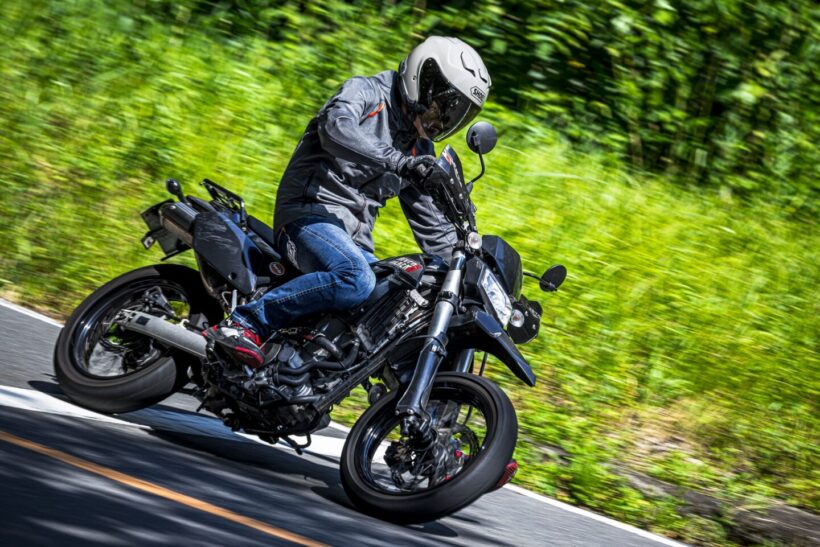

Before the test drive, I was half excited and half worried.
As mentioned in the first article, the D-Tracker X with its original box has a through-rod type pressurized piston in the front fork (mainly to prevent cavitation), and the damping force generating mechanism of the rear suspension has been changed from a disc valve to a poppet valve (to improve responsiveness and reduce temperature dependency).
Before the test ride, I was feeling half excited and half anxious about this vehicle. I was excited to experience a mechanism that had never been seen before on a two-wheeled vehicle, but I wondered if I would be able to tell the difference from a normal one.

Conceptual diagram of a through-rod type pressure piston. The volume and pressure of the upper and lower chambers do not change when the piston extends or retracts, so negative pressure, which can cause cavitation, does not occur. The lower end of the through-rod is equipped with a pressure piston that contributes to maintaining positive pressure. Illustration: Shigeru Chikada
That being said, the D-Tracker X, with its front and rear suspension internally modified by the shop, was a completely different beast from the stock one. In fact, having tried out a wide variety of front forks and rear suspensions in my work and personal life, I was impressed by the ride feel of this bike, which I felt was the ideal suspension system for a two-wheeled vehicle.

Poppet valves currently being produced for the stock rear suspension of the D-Tracker X. In this photo, all the valves are facing upwards, but in reality half of the valves face upwards and half face downwards.
Room for improvement in motorcycle suspension
The first thing that impressed me about the D-Tracker X with the original box was how well it absorbed the unevenness of the road surface. Of course, the stock version isn’t bad in that respect either, but the original box model absorbs shocks instantly, so even on mountain roads with uneven surfaces painted all over, you can brake and bank into corners with the same feeling as on a good road, and you can open the throttle boldly when exiting corners.

Next to the shock absorption, what impressed me was the stability of the bike. With a stock bike, the posture change is large and quick when the rider takes action, which can sometimes lead to negative aspects, but the pitching of the original box bike feels gentle (but not slow or hard), and it feels like it maintains its original posture as much as possible.
Perhaps that’s why the car feels smaller while driving, allowing for quick turns from left to right, and considering that your line of sight doesn’t move as much, fatigue on long runs will likely be reduced.

The D-Tracker X’s front forks are φ43mm inverted type. The standard damper adjustment mechanism is only on the compression side at the bottom, but this vehicle has an extension side adjuster added to the top.
Also, about an hour into the test ride, I was more than impressed; I was blown away by the bike’s incredibly wide range of suspension. The front and rear suspension of this bike, like the electronically adjustable and semi-active suspensions that have become increasingly popular on large-displacement bikes in recent years, provide a high-quality, gentle ride when riding at a leisurely pace, but when you get the hang of it, you get a clear sense of contact with the ground and a firm grip.

The D Tracker’s rear suspension is gas pressurized and equipped with a reserve tank, with a compression damper adjuster on the top and a rebound damper adjuster on the bottom.
On the other hand, this test ride has made me have some doubts about the recent trend towards high-tech front and rear suspensions. I don’t mean to reject the latest technology, but I feel like there is still room for improvement in the suspension of two-wheeled vehicles, even without the use of electricity.

Any rider can experience the beauty of it
That’s why I was so impressed with the qualities of the through-rod pressurized piston and poppet valve. After the test ride, I shared my thoughts with Kuma Kunimasa of Original Box, the manufacturer of this machine, and he gave me the following response:
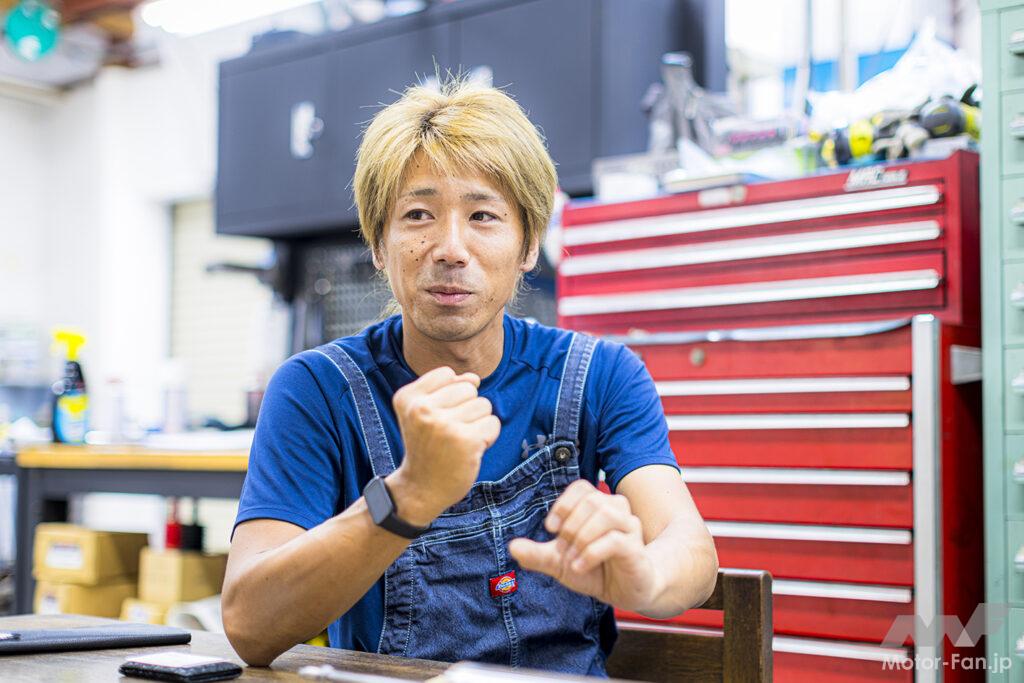
Kuma Kunimasa is not only a specialist in four-wheel vehicles, but is also well-versed in two-wheel vehicles. In his younger days, he was absorbed in tuning scooters, and in recent years has been competing in four-wheel dirt trials with vehicles that he has built himself.
“When you bring up words like cavitation and responsiveness, the average rider might be put off, but once they try out our D-Tracker X, I’m sure riders of all skill levels will be able to feel the difference from a stock suspension. As Nakamura says, there is still room for improvement in front and rear motorcycle suspension.”
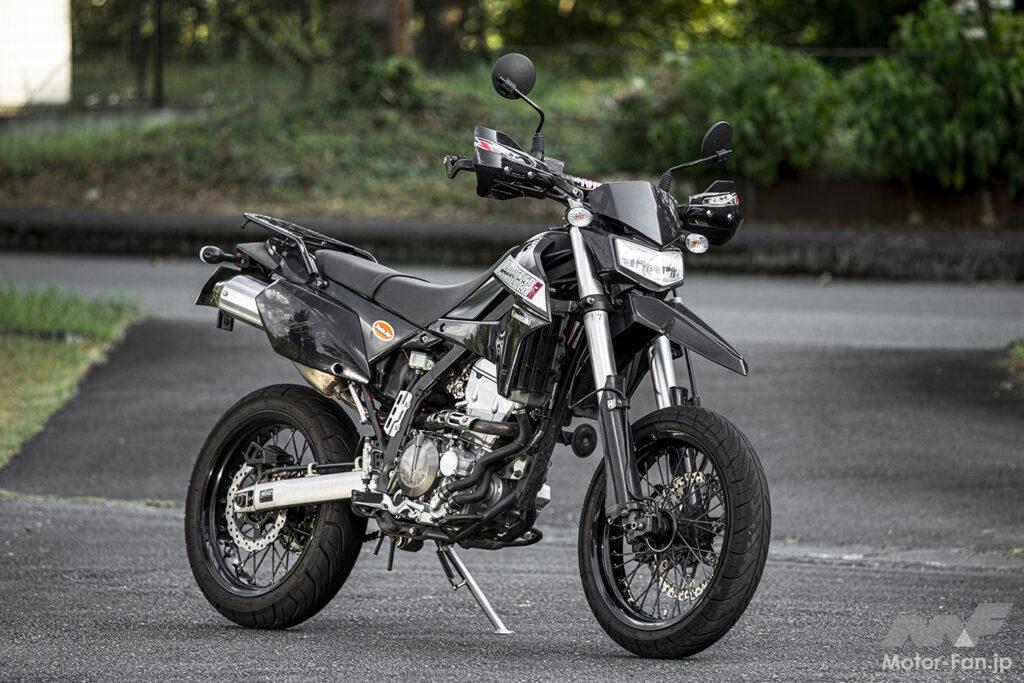
The D-Tracker/X, sold by Kawasaki from 1998 to 2007, was a supermotard based on the KLX250.
However, the store says that at present it has no plans to actively promote the two new front and rear suspension technologies.
“The main reason is that we’re busy with our main business of automobiles, but when we introduced these two technologies into the front and rear suspension of the D-Tracker X, we had to produce many of the parts as one-offs, which was very costly and time-consuming. That’s why we’re hoping to get suspension manufacturers interested. If a manufacturer produces them with mass production in mind, the through-rod pressure piston and poppet valves won’t cost that much.”

The front and rear suspension springs were originally standard, but as a result of pursuing a better match with the completely revamped dampers, the current rate is lower than standard.
That said, Original Box is not closed to the general public. Although the cost and time will need to be discussed, they will accept the work if you bring in the front and rear suspension separately.
Air Chuck One allows precise air pressure control
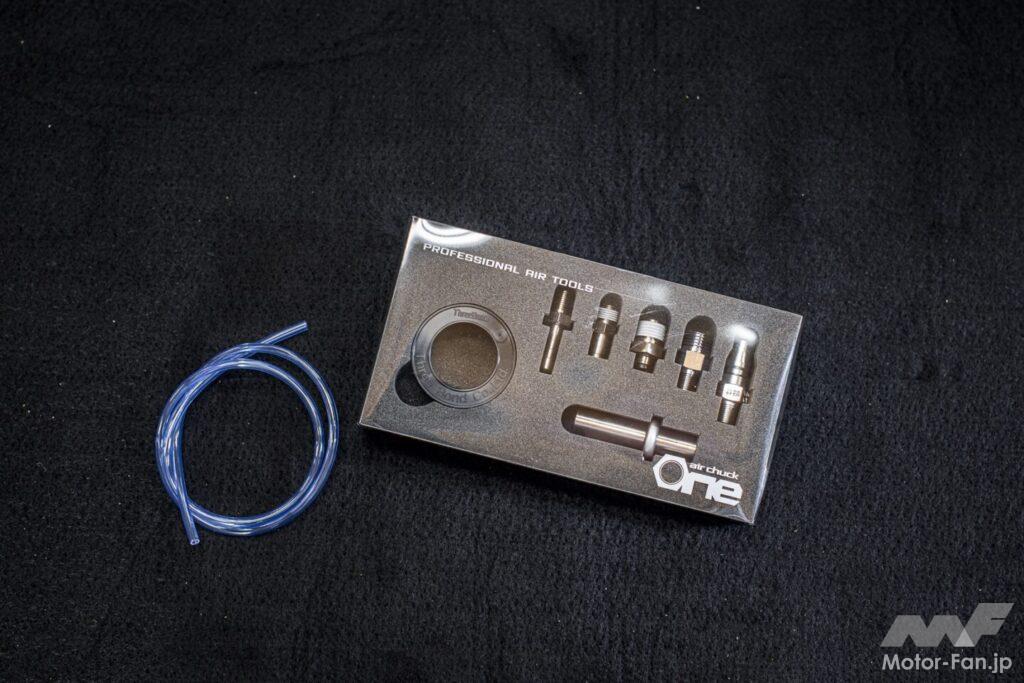
The Air Chuck One was originally developed for Asahi Sangyo’s Gauge Botaru, but the product comes with two types of fittings and joints, so it can be used with a variety of air gauges.
Although it is a bit off topic from the topic of this article, Original Box develops and sells a large number of original parts. Most of them are for cars, but the Air Chuck One, which has been used by all teams in the All Japan Super Formula Championship since 2018 to measure tire pressure, is sure to interest motorcycle users as well.

A cutaway model of the Air Chuck One made by the store to make its unique structure easier to understand.

The valve on the wheel side opens only after the zipper has created a complete seal, so there is absolutely no air leakage.
Originally created to fill shock absorbers with pressurized gas, this product’s unique feature is its closed structure with a built-in automotive valve core. When inserting or removing the chuck of a typical air gauge into or from the valve core, a small amount of air leaks out with a “pshhh” sound (the actual air pressure is lower than the number displayed on the gauge), but the Air Chuck One eliminates this leakage.


Of course, how you feel about a small amount of air leakage is up to you, but for riders looking to improve their times in road races, gymkhana, motocross/enduro, etc., the Air Chuck One, which allows for precise tire pressure management, will be an effective tool.
 An explanation of the unprecedented new technology in motorcycle suspension | Motor-Fan is a media platform that distributes automotive-related articles
Original Box, a company renowned in the four-wheel world, is introducing a new world of front and rear shock absorbers for two-wheel vehicles. I don’t mean to brag, but I think I have a fair amount of experience when it comes to customizing and setting front and rear suspension for two-wheel vehicles.