

The difference between a turbo and a supercharger
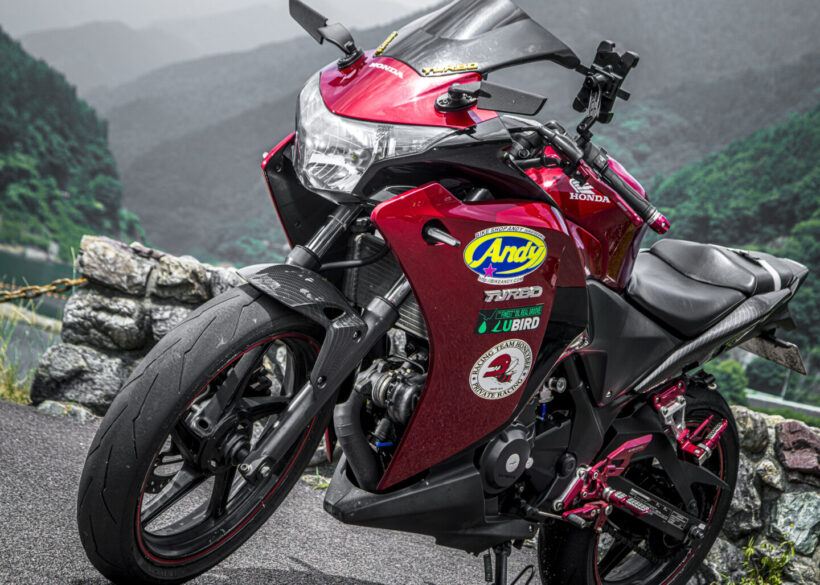
This article will introduce two 250cc single-cylinder + supercharged bikes built by Bike Shop Andy: a CBR250R + turbocharger and a Z250SL + supercharger. Incidentally, turbochargers and superchargers have their own advantages and disadvantages, so it is difficult to say which is superior.

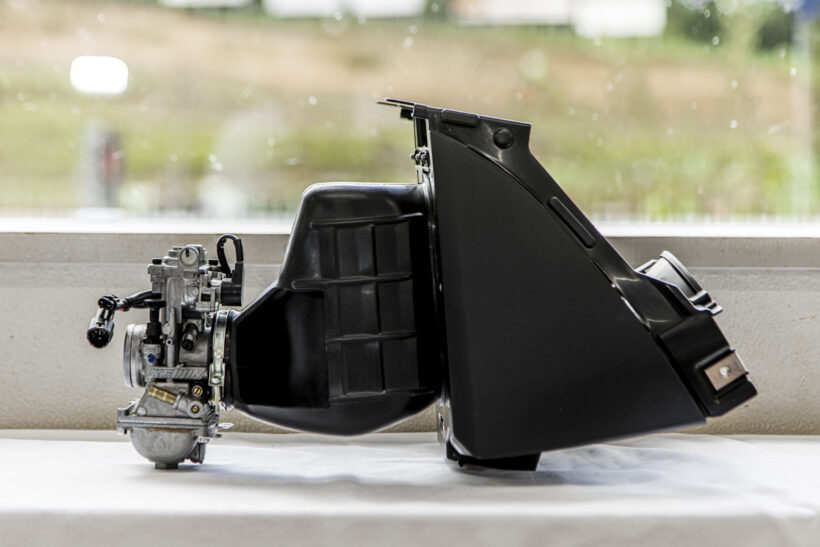
Conceptual diagram of a turbocharger. The rotation speed of the turbocharger itself is generally around 100,000 to 200,000 rpm for turbos and around 100,000 rpm for superchargers (130,000 rpm for the Kawasaki H2R), with turbos generating more heat. Superchargers are generally lubricated and cooled by oil within the unit, but turbos typically have dedicated lines added and are lubricated and cooled by engine oil.
To be more specific, turbochargers have the advantage of being able to recycle the energy of exhaust gases to turn a turbine and having a small number of parts, but when the turbine speed is low, they tend to suffer from a delayed response to throttle operation (turbo lag).On the other hand, superchargers have the disadvantage that, although they can achieve sufficient boosting from low speeds, they lose some power because they extract power from the crankshaft to run the supercharger, and structurally they cannot achieve the same level of boosting as a turbo at high speeds.

Superchargers come in a variety of forms, including the centrifugal compressor type, which has a structure similar to that of a turbo, the Roots type, which rotates two sets of two- to four-lobe twisted rotors, the Lysholm type, which has a similar structure to the Roots type but compresses internally, and the scroll type, which compresses inside a volute-shaped housing. Intercoolers and surge tanks, which contribute to stabilizing the intake air, are not mandatory equipment (the same goes for turbos).
However, the engine characteristics of the Z250SL + supercharger model that I posted about a while ago were excellent, and I didn’t feel any negative aspects at all.So, what was the ride like of the CBR250R + turbocharger model?
Maintaining the power band for sport riding
In addition to the turbo’s inherent nature making it difficult to obtain supercharging effects at low rpm, the maximum output is set at just under 40 hp (the stock version is 29 hp), so the engine characteristics of this bike are  not as powerful across the entire rpm range as the Z250SL with a supercharger (maximum output is 42.5 hp).However, I felt that it was impossible to say which of the two supercharged bikes was more attractive.

That’s because the CBR250R + turbocharged model has a clear power band. You can feel the torque exceeding that of the stock model from around 4000 rpm, but the acceleration becomes incredibly sharp above 7000 rpm. It’s a feeling reminiscent of the old 2-strokes, and as an owner of a 1986 TZR250, I felt like I had achieved what I wanted.

And just like the Z250SL + supercharger model, this bike is not difficult to handle at all, and it can be ridden at a leisurely pace using the low and mid-range RPMs (in that sense, it is similar to the two-strokes that were introduced after the mid-1980s when exhaust devices were introduced). However, riders who have a fondness for the two-stroke road sports of the past will be intoxicated by the fun of maintaining a power band between 7000 and 10,000 rpm on mountain roads.
Qualities of an Old Man Killer
This may sound a bit strange, but after test riding the two bikes made by Bike Shop Andy, I was left with the impression that the combination of a 250cc single-cylinder road sports engine and a turbocharger was just too much for some old guys…
Let me explain why: First of all, I’ve recently had quite a few complaints from sports bike enthusiasts in their 50s and 60s about how middle-class and larger bikes are becoming physically demanding, and how maintaining a bike with a vehicle inspection certificate is difficult when considering the family budget. It’s difficult to say whether the current state of 250cc road sports bikes can meet their demands. But I think there are plenty of middle-aged men who are tempted by a 250cc single-cylinder supercharged bike.

Mr. Ando (left) from Bike Shop Andy, and Mr. Kubo (right), a CBR250R+ Turbo owner who accompanied me on the test ride, are both veteran riders with ample racing experience. The author is in the center.
“That’s exactly what I was aiming for (laughs). With these two bikes, they’re compact, and maintenance costs after completion will be low (the only difference in maintenance from a standard bike is that you only need to change the oil and clean the air filter every 1000km or so), and they also have a special feeling to them. It may sound like I’m bragging, but for a sports bike enthusiast who’s no longer young, I think a 250cc single-cylinder road sports bike with a turbocharger has ideal characteristics.”

The Z250SL + supercharger model achieves a power increase of 13.5ps over the standard model.
The two supercharged cars that Ando worked on were designed with careful consideration for any potential problems that might occur. While they incorporate a custom-developed sub-computer and additional injectors, they still use the stock ECU and injectors, meaning that the cars can continue to run even if a problem occurs with the supercharger-related parts. The supercharger drive belt is also designed so that it can be replaced in just a few minutes.

Compared to a normal naturally aspirated engine, a turbocharged engine is subjected to significantly higher loads. Taking this into consideration, Bike Shop Andy has adopted the concept of “Protect to Attack” and has collaborated with LUBIRD, a company that specializes in protective oils, to develop an engine oil specifically for turbocharged motorcycles. The price is 4,500 yen per liter. It’s not a cheap product, but since the oil capacity for a 250cc single-cylinder engine is around 1 to 1.5 liters, it shouldn’t put a big strain on the engine.
“The main premise of my tuning is to avoid any negative aspects compared to the stock model, not only in terms of ride quality but also in terms of maintainability. Of course, the stock model is superior in terms of durability and fuel economy, but just because I installed a turbocharger doesn’t mean that those two aspects will drop drastically.”

The CBR250R, which was released in 2011, was discontinued in Japan in 2017, but the Rebel 250, CL250, and CRF250L series are still available as models with the same engine. Incidentally, the price of this CBR250R was apparently 100,000 yen on Yahoo! Auctions.
Although there are differences in equipment, both of the bikes introduced in this article are Stage 1 specs, with no modifications made to the engine internals except for reinforced clutch springs, and the cost including parts starts from 600,000 yen. How you feel about that figure will vary from person to person, but if you purchase the base bike for under 400,000 yen, the total cost will be around 1 million yen (the fastest modern 250cc road sports bike, the CBR250RR, starts at 902,000 yen).

The shop is currently working on refining a CB250R + turbo model with Stage 3 specifications. The boost pressure is 1.3 bar, and the maximum output
has increased by 52 hp, so the pistons and connecting rods have been changed to stronger types.In any case, it would be impossible to achieve the feeling we saw on these two bikes through mechanical tuning, which involves replacing pistons, camshafts, crankshafts, etc. With this in mind, I was impressed by Bike Shop Andy’s supercharger tuning, which I thought was reasonable…or rather, cheap?
Detail explanation

An air-fuel ratio gauge and boost meter have been added to the cockpit. The boost gauge needle starts pointing in the positive direction around 4000 rpm, reaching 0.7 bar at around 7000 rpm.
ADVERTISEMENT

The compressor/turbine is based on that for a light vehicle, and engine oil is used to cool and lubricate the unit. The radiator is standard, and since it was manufactured with cost reduction in mind, it is not equipped with an intercooler. The air filter is a stainless mesh type that does not require oil application.

After searching for a lightweight and small product suitable for a motorcycle, Ando chose a generic blow-off valve made in China. However, he made his own improvements to the internal bypass and packing (the same applies to the Z250SL + supercharged model).
 A man’s dream: a supercharger. We installed one on a 250cc single-cylinder Z250SL and rode it. | Motor-Fan is a media platform that distributes automotive-related articles.
Performance Unachievable with Naturally Aspirated Engines In this two-part series, we will introduce the Z250SL with a supercharger and the CBR250R with a turbocharger, both built by Bike Shop Andy. Even in the world of two-wheeled vehicles, […]










![The child seat is retro and cute. But the 124cc straight-line leader is the Honda Chari! [Portrait of a 4MINI Enthusiast]](https://motopeek.com/wp-content/uploads/2025/10/4598-1762340867209.jpg)
![Only the frame and tank are genuine! A modified Ape finished with used parts [Portrait of a 4MINI Enthusiast]](https://motopeek.com/wp-content/uploads/2025/10/4604-1762340994544.jpg)