
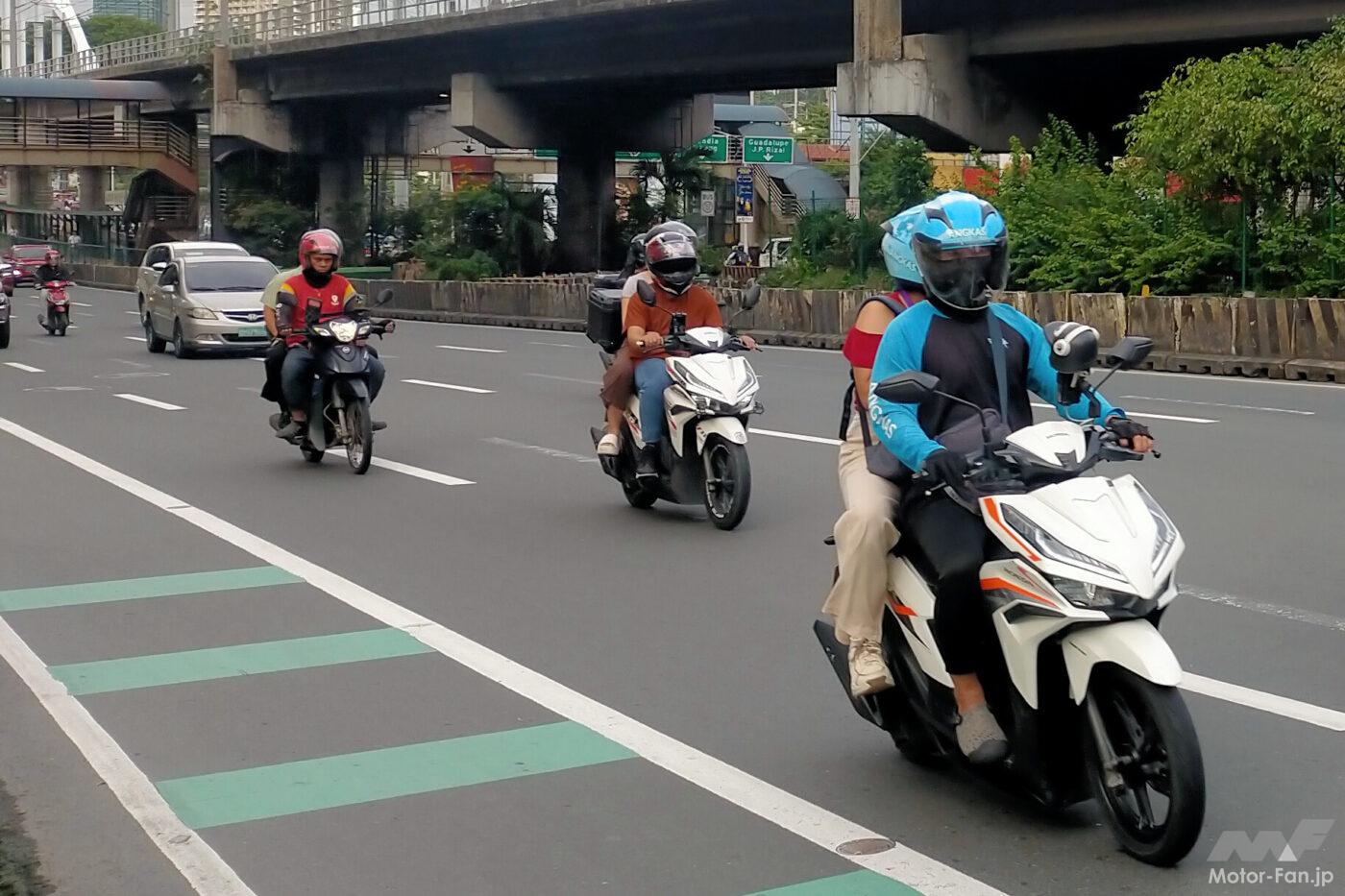

Most of the motorcycles running in Manila are “motorcycle taxis”
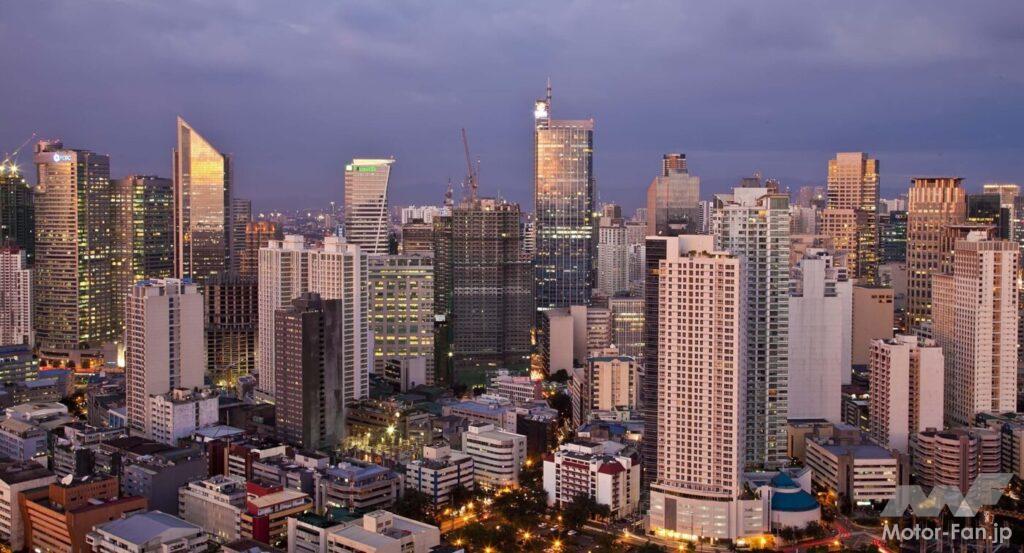
Manila is a huge city known as the capital of the Philippines.
The flight from Narita International Airport in Chiba Prefecture took about four and a half hours. We arrived at Ninoy Aquino Airport’s Terminal 3 (Naia 3) around 4:00 PM local time (one hour behind Japan). We boarded a Grab taxi (Note 1) that we had booked on our smartphone at the rotary on the first floor and headed first to our booked hotel in central Manila.
The first thing that surprised me about the traffic jam was the overwhelming number of Japanese cars. Japan drives on the left side of the road, while the Philippines drives on the right. While there were differences in whether or not there were light vehicles, the road was jammed with regular passenger cars from Toyota, Mitsubishi, and Honda, as well as Isuzu trucks, and the scene was almost the same as in Japanese cities like Tokyo and Osaka.
The next thing that surprised me was that most of the vehicles were newer models with clean bodies, and there were almost no older, worn-out cars. This is what you’d expect from Manila, the capital and megacity of the Philippines, which has achieved remarkable economic growth in recent years. I felt that in this respect, it was better than Japan.
The next thing that surprised me was the number of motorcycles on the roads. Cars and motorcycles coexist on the roads in almost equal proportions. Or rather, it seemed as if they were competing with each other. Like cars, the motorcycles were mostly older models, and there were almost no old, beat-up models to be seen.
Roughly speaking, Japanese manufacturers, Honda, Yamaha, and Suzuki, account for 60-70% of the market. The rest are Korean, Chinese, and European manufacturers. Very occasionally, you might come across a Kawasaki Ninja with a cowl, or even a large motorcycle like a Harley-Davidson.
The majority of motorcycles are in the 125cc class, with a ratio of 7:3 for scooters and manual transmissions (mostly underbone frame Thai Cub models or standard naked models). Although few in number, 250cc scooters and 250cc racer replicas (such as the Honda CBR250RR) are also on the road. Regardless of the model, there are many customized vehicles that have had their stock mufflers replaced with aftermarket sports mufflers.
There is a high probability that two people will be riding on a motorbike (about one in three to one in two). This is not because couples or friends are enjoying a tandem ride… Most of the motorcycles traveling around Manila are actually “motorcycle taxis.”
Kawasaki Ninjas, Harley Davidsons, and Honda CBR250RRs, which are extremely expensive even locally, are likely ridden by wealthy young locals as their daily transportation or as a hobby.
※注1:「Grab(グラブ)タクシー」とは東南アジア(シンガポール、マレーシア、インドネシア、タイ、ベトナム、フィリピン、カンボジア、ミャンマーの8ヶ国)で使用できるタクシーの配車アプリ。他の交通手段に比べて料金はやや割高だが、アプリ内で事前に決定した金額をクレジットカード決済できるため(チップもアプリ内で支払い可能)、海外のメータータクシーにありがちなボッタクリ等の被害や、面倒くさい料金交渉の気苦労から開放されるというメリットあり。ADVERTISEMENT
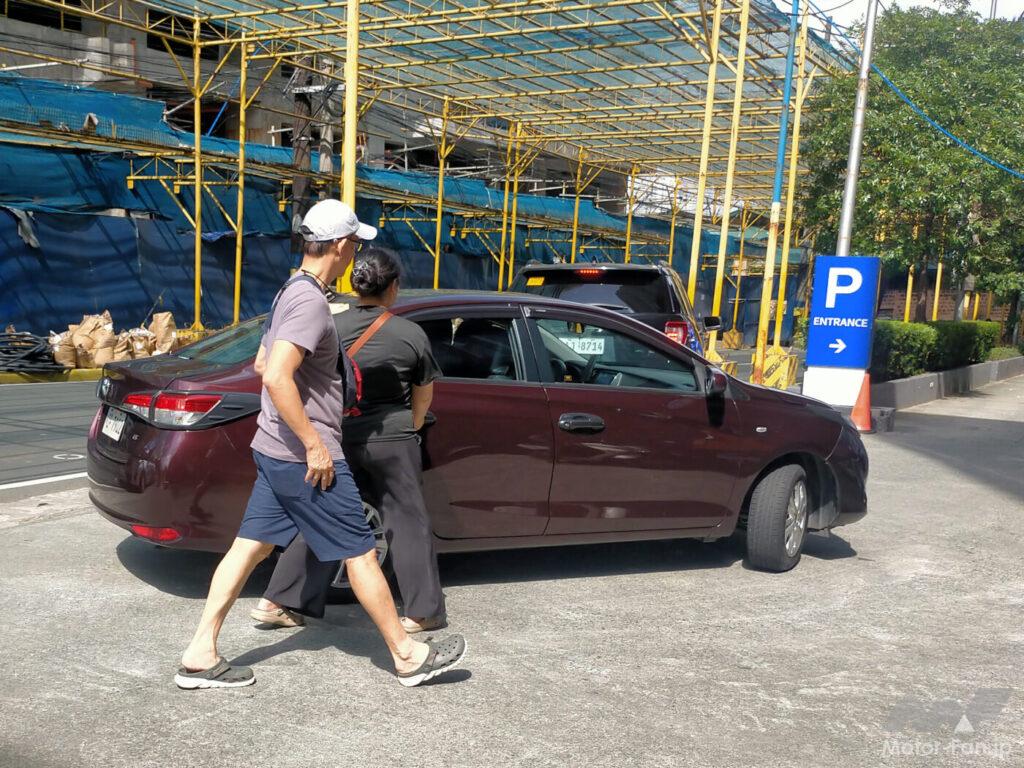
The “Grab taxis” (pictured) I used this time all had a “Grab” sticker or similar on the rear window, and basically looked like regular passenger cars. After booking on your smartphone, you search for the vehicle at the designated location using the license plate number, and once both parties confirm the match on the app screen, you can board. The fare is displayed before boarding, and the payment is made by credit card, making Grab taxis extremely convenient for me.

Manila’s motorbike taxi drivers wear special bibs that identify them on their upper body. The range of motorbike taxis varies depending on the driver. According to online information, there are some brave drivers who have used a motorbike taxi for three hours one way.
Motorbike taxis are very popular among the general public as they save money and time!
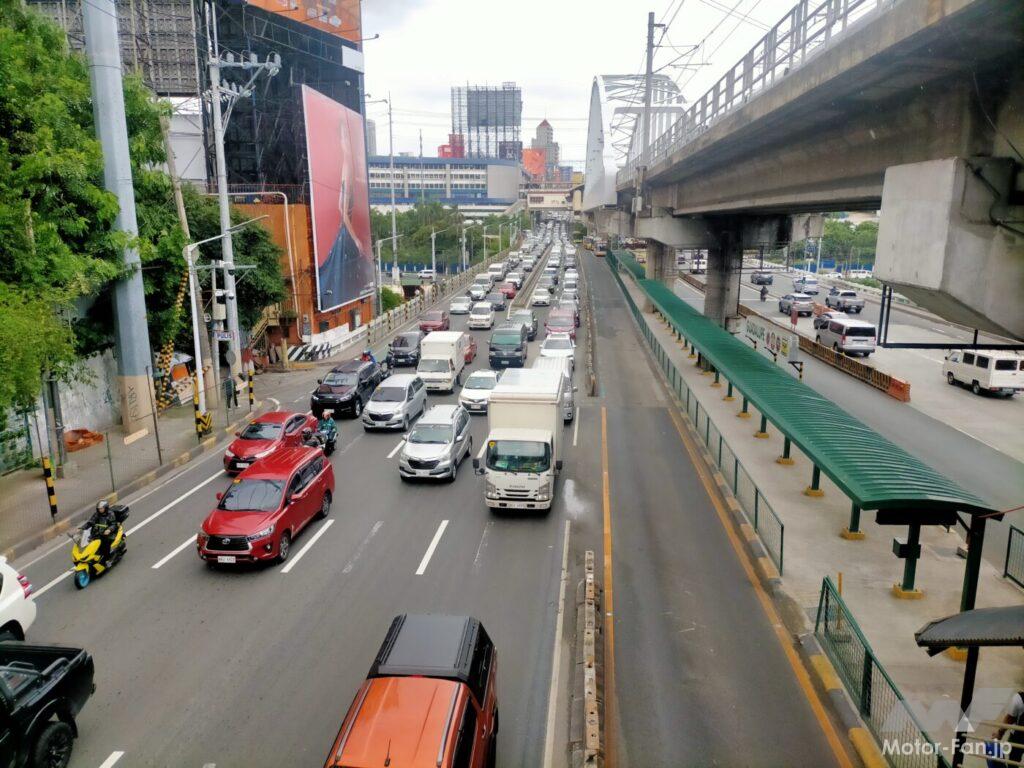
A congested main road in Manila in the morning. Photographed from a footbridge. There are very few pedestrian crossings in Manila, where cars have priority.
Manila has trains that run only in certain sections, but the subway and bus networks are not as well developed as those in Tokyo. Furthermore, the city’s roads are chronically congested everywhere (Note 2), making travel by four-wheeled taxi time-consuming. For this reason, motorbike taxis, which are cheaper than four-wheeled taxis and can significantly reduce time by “slipping through” traffic, have become extremely popular among the general public.
Manila’s motorbike taxi drivers wear special bibs to identify them on their upper bodies. They also all have special smartphone holders attached to the handlebars of their motorbikes, where they can place their smartphones. Most passenger helmets are jet-style, and are typically stored in a top case or under the seat, or secured in a helmet holder.
Customers can request a ride on a motorbike taxi using a dedicated smartphone app (payment by credit card or cash). Alternatively, they can go to a motorbike taxi stand in a shopping mall or similar, negotiate the destination and fare directly with the driver, and pay in cash. The driver then uses the navigation on their smartphone to get the customer to their destination.
※注2:増え続ける膨大な交通量ながら、現況マニラ市内には交差点での交通の流れを調整するための信号機が圧倒的に少ないのが特徴。増加の一途をたどるクルマの数に対し、インフラ整備が追いついていない。これが慢性的な渋滞を招いている大きな要因。なお基本的にクルマやバイク優先のマニラの道路には歩行者用の横断歩道が少なく、慣れない日本人(筆者)が道路を横断するには命懸けだった。ADVERTISEMENT
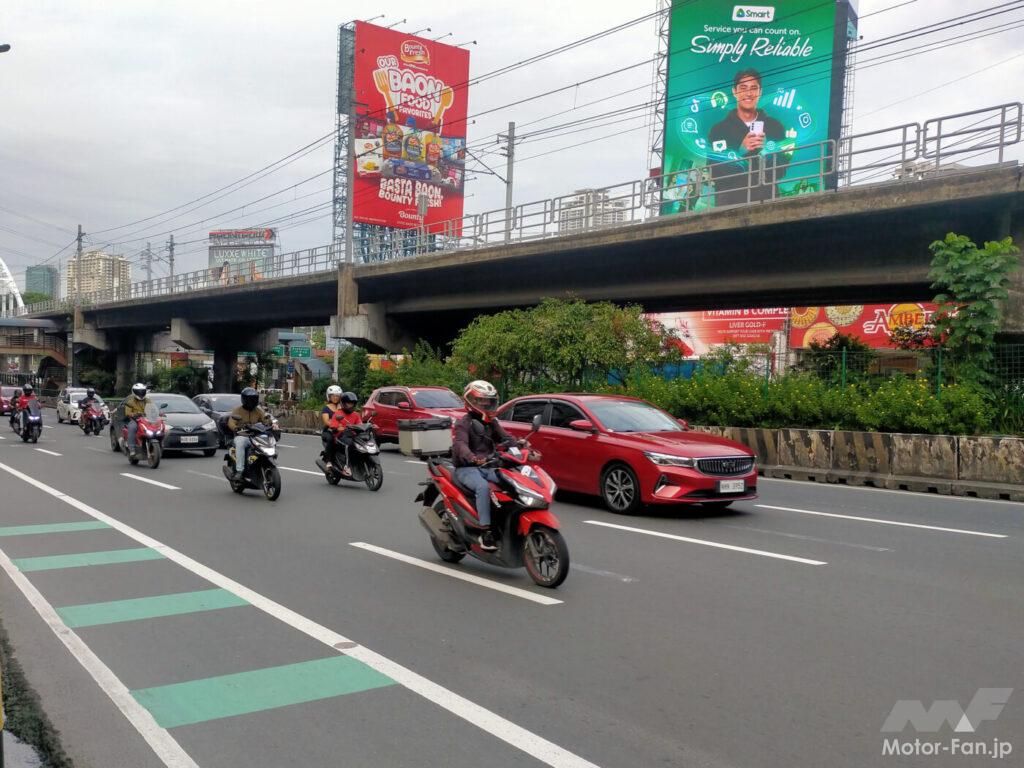
A major road in Manila.
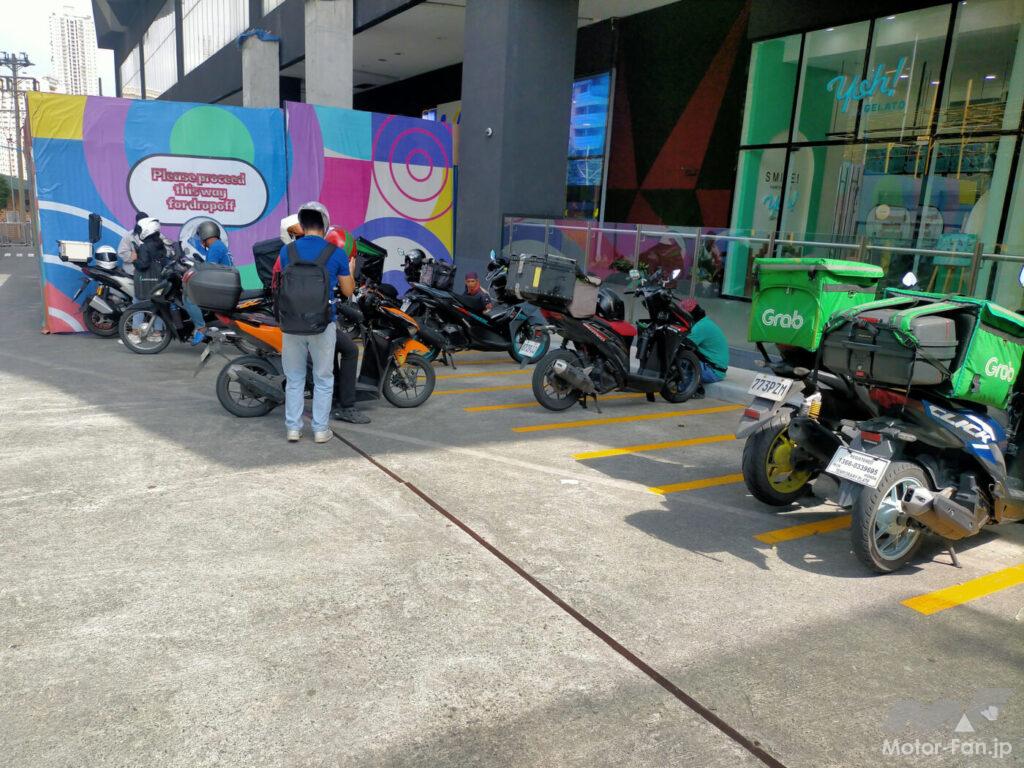
A motorbike taxi stand set up in a shopping mall.
It’s like an obstacle course with a huge prize! A fierce battle to “slip through” motorcycles

A scene in Manila.
I sat in the passenger seat of a Grab taxi and carefully observed the cars and motorbikes driving around Manila. I noticed that both the cars and motorbikes were honking their horns frequently and without regard for others. I don’t just “honk,” I mean, “honk hard.” They were using their horns to the fullest, to the point that I wanted to tell them to stop.
Anyone who has been there even once will know that this is a common occurrence in ASEAN countries. The loud honking of the horn, which acts as a greeting, warns the other driver of danger. Or perhaps it is intended to relieve the driver’s frustration. In other words, it has a strong implication of “Don’t get in the way of my driving!”, and it gives a glimpse of the clash between individuals.
From their behavior, you can hardly sense the “spirit of compromise” that Japanese drivers have. This simple and straightforward feeling is refreshing for me as a Japanese person (the author) who thinks that “humility = virtue.”
Most of the Grab taxi drivers I rode with were neurotically frequent lane changes, aggressively cutting in (otherwise they would never be able to change lanes), and skillfully dodging cars aggressively cutting in at the last moment, letting them in while they were still moving.
They also honk their horn mercilessly if there is an obstructive motorcycle in front or on either side, and whether it is a two-seater or something else, they overtake with such furious force and with such a tight gap that it makes me nervous in the passenger seat.
When stuck in traffic, cars become quiet and motorbikes show their true colors by weaving through traffic like devils. Each motorbike honks its horn as they desperately try to get between cars, as if they’re fighting for revenge or competing in an obstacle course with a huge prize (this is just my imagination).
In Manila, you can sense the incredible passion in both cars and motorbikes, eager to move even 10cm forward, even one second faster. If the vehicle in front of you moves forward and the vehicle in front doesn’t notice, you’re safe if you move forward within one second. However, if you miss 1.5 seconds, you’re out, and horns start blaring from behind. You can’t help but admire how carefully every vehicle is checking every little detail. It’s like a mother-in-law bullying her daughter-in-law in the kitchen.
Perhaps it’s because of this constant state of fierce battle? The drivers of the taxis I used (a total of nine) this time were not at all casual and leisurely, asking things like “Where are you coming from, sir?” like Japanese taxi drivers.
They are generally unfriendly and silent, eager to get even 10cm further, even one second faster. This is probably because if they arrive at their destination quickly, they can pick up the next customer, which means more money. That’s how fierce the competition for customers is. Despite the harsh conditions, the drivers are endlessly greedy.
None of the drivers showed the slightest interest in me, a foreigner, and only seemed to get irritated when there was a traffic jam, asking in Tagalog-accented English, “This road is crowded. Would you like to take another road?”
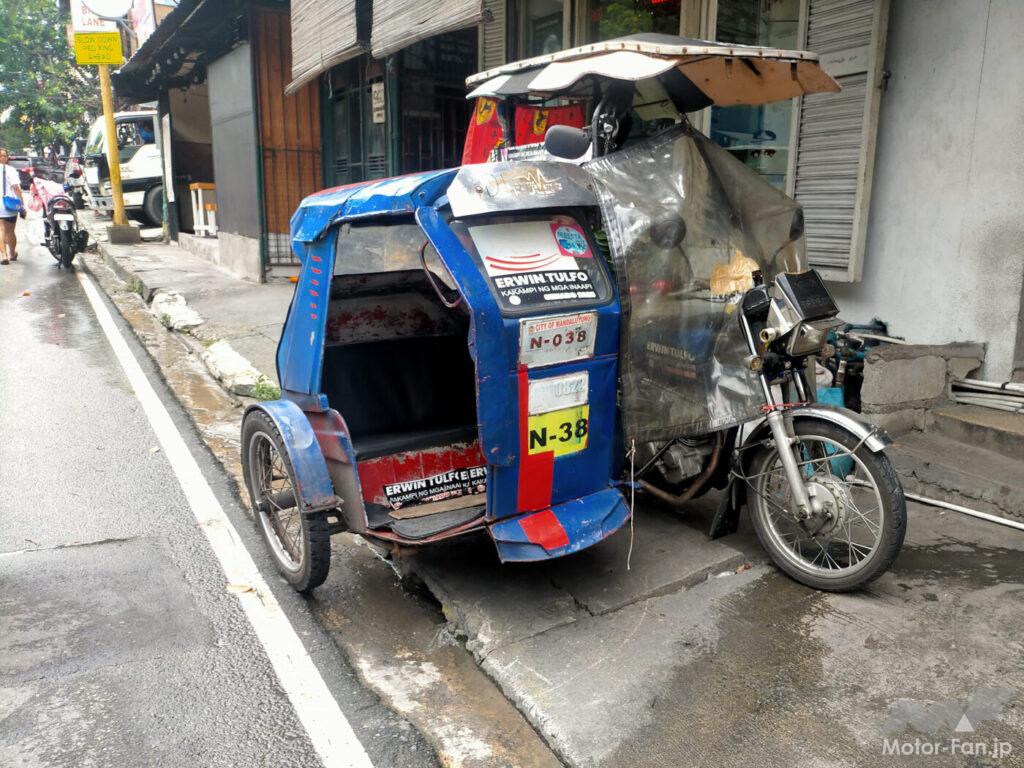
It’s an old-fashioned motorcycle taxi with a sidecar. It basically only operates in city streets and alleyways. Its range seems to be limited (perhaps there are restrictions on the roads it can operate on), so when I asked the driver to take me to a certain place about 15km away, he refused, looking angry and saying “No!”
Perhaps the fierce battles on public roads help hone each driver’s technique, but the drivers and riders in Manila are generally skilled drivers. Their techniques, such as narrowly avoiding other vehicles, dodging at the last moment, moving other vehicles into their lane without any wasted movement, stopping just a few centimeters in front of other vehicles, passing just before contact, and accelerating instantly, are simply amazing!
As a passenger in the passenger seat, I was extremely nervous and there were more than 10 moments when I was convinced we were going to collide (but they avoided every single one). I felt that many Japanese drivers and riders, including myself, would be too scared to drive in Manila during the day (due to the differences between driving on the left and right sides, and the difference between right-hand drive and left-hand drive cars).
After experiencing thrilling experiences on the level of Fuji-Q Highland’s scream-inducing rides while sitting in the passenger seat, you might think there must be a lot of traffic accidents. However, despite traveling a fair distance in a total of nine Grab taxis, I didn’t witness a single serious accident, such as a motorcycle falling over.
Speaking of accidents, I saw a motorbike taxi traveling slowly on a congested road, crashing lightly into a car in front of it, unable to brake in time. I also saw two cars collide on a congested road, with the drivers yelling at each other in a furious manner, almost to the point of a fight. In both cases, no police cars or officers showed up, and the affected vehicles quickly drove away.
The physical strength of motorbike taxi drivers who continue to drive under extremely harsh conditions is superhuman!
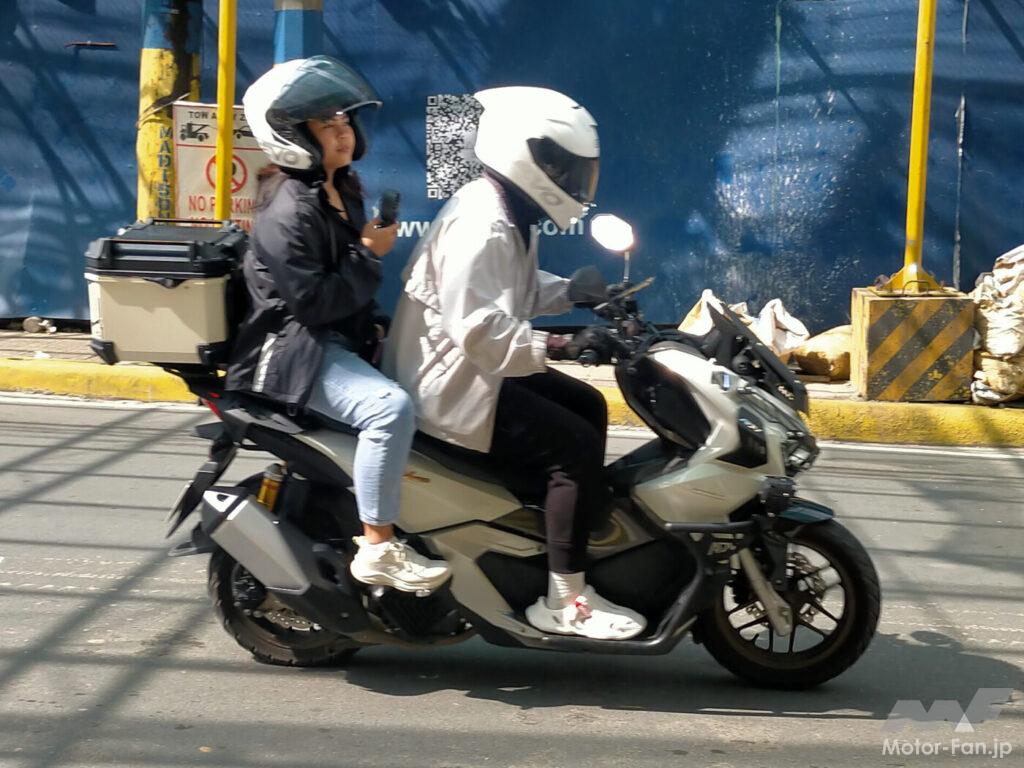
This bike is fitted with a top case that also functions as a backrest. The passenger in the tandem riding section is holding a small air blower in his right hand. This item is a staple among women in Manila.
Along the roads of Manila, a variety of stores are set up all over the place from early morning until late at night, including shops that double as residences, authentic street stalls with roofs, and small stalls with only balasols. When motorbike taxi riders get hungry or thirsty, they typically park their motorbikes in front of a store to eat or take a break.
Another oasis for riders is under road overpasses, where they can escape the rain and sun. Especially during the rainy season, when sudden downpours occur, it becomes a popular gathering spot for many riders to park their bikes and put on their raincoats.
The riders in Manila were adept at putting on and taking off their raincoats and the protective plastic bags that protect their smartphones from their special holders. They all worked calmly and with ease, without any sign of being bothered.
The road conditions in Manila, where traffic is extremely heavy, are not as good as those in Japan, and there are many rough spots. I think that 125cc class minibikes often lose control of their handlebars.
In addition, the traffic conditions are “constant battle,” and most of the time the driver is riding with someone in the pillion seat, staring at the smartphone screen fixed in a holder.
In addition, during the rainy season (June to November), the temperature and humidity are high and muggy, so you have to wear a sealed full-face helmet, a system helmet, a jet helmet, long sleeves, and long pants. On top of that, you sometimes encounter heavy downpours (squalls)…
I was honestly in awe of the mental, physical and emotional strength, as well as the endurance, of the motorbike taxi drivers who continue writing almost every day, for a whole day (possibly even 10-plus hours), in this extremely, extremely, extremely harsh environment. They are all seriously tough.
A woman in a tank top and shorts, like an acrobat, just grips the knee with both feet and releases her hands to play with her smartphone.
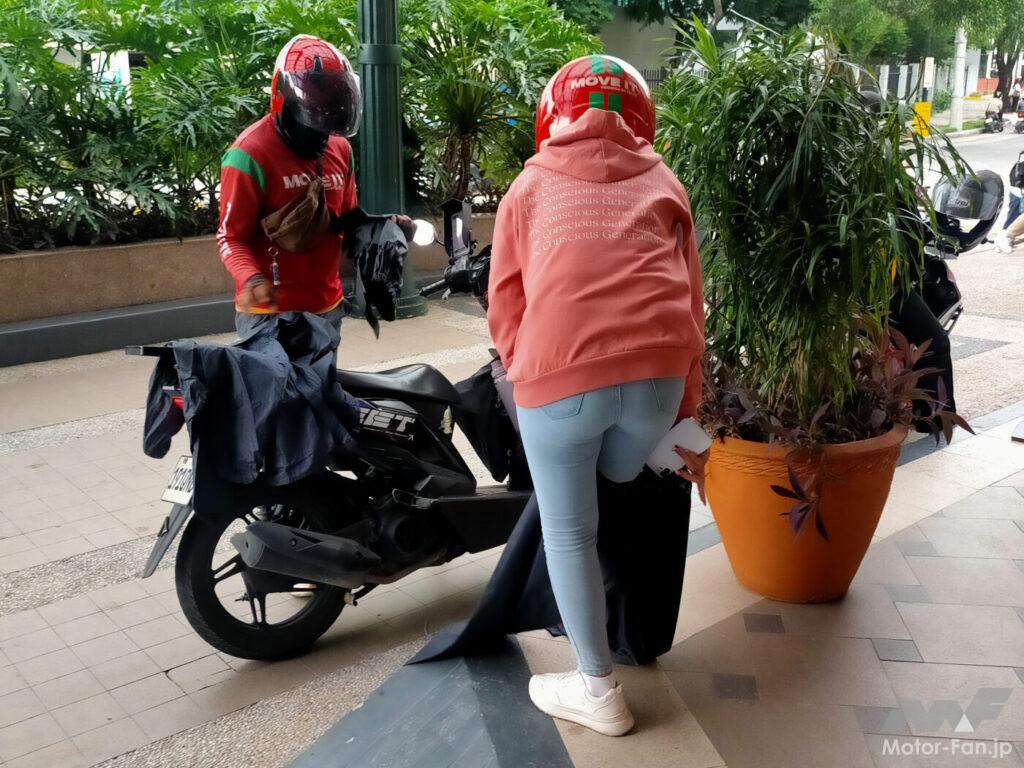
At the motorbike taxi stand. As it started to rain, passengers borrowed raincoats stored in the space under the seat and put them on. The photo shows a motorbike without a top case.
The superhuman physical strength and endurance of the motorbike taxi drivers is astounding, but the circus-like “tandem techniques” of the locals who use motorbike taxis are also impressive.
Most motorbike taxis are fitted with a top case that the passenger (passenger) can sit on (the top case can store the passenger’s helmet and raincoat for when it rains), but there are also many vehicles that do not have a top case.
In this case, the pillion rider needs to put their hands around the rider’s upper body and hold on tightly to both the pillion belt attached to the seat and the rear cowl to avoid being thrown off. This is common sense in Japan.
However, local Manila residents who are accustomed to riding motorbike taxis simply climb onto the back of the bike, even if there is no top case backrest, and simply stand a little distance away from the driver, with one hand on the rear cowl or pillion bar (probably because they don’t want to be in close contact with the sweaty driver).
The most shocking thing I witnessed was a woman with both legs in a knee grip (holding the bike between her legs) and no hands, carrying a large, heavy-looking bag diagonally across her shoulder. She was wearing a tank top, shorts, and beach sandals with bare feet.
Even in this state, it would be dangerous, painful, and difficult enough, but she took the smartphone in her left hand, brought it close to her face, and for some reason, with a half-smile, operated the screen with the index finger of her right hand.She looked just like a confident circus acrobat.
Furthermore, most motorcycle taxi passenger helmets are jet-style and are shared by all passengers (as far as I could see, there was only one motorcycle taxi that had introduced disposable cap covers, and it was on the airport grounds). Manila, Philippines, is hot all year round. During the humid, rainy, and muggy rainy season (June to November), the inside of the helmets “worn by strangers, even middle-aged men,” becomes like a natural sauna, and the atmosphere inside must be intense in many ways.
I have never actually worn this recycled helmet, which could be described as torture or hardship. However, having been born and raised in hot and humid Japan, I can roughly imagine what it’s like inside a helmet in the middle of summer.
However, the locals showed no sign of worrying about this, and put it on as if it were their own helmet, with a familiar hand, almost humming a tune. This point (and many others) is hard for a neat and tidy Japanese writer to understand (perhaps with the “when in Rome, do as the Romans do” mentality, one will eventually get used to it?), and I felt that this was a major difference.
If I get into an accident while riding a motorbike taxi, will my insurance cover it?
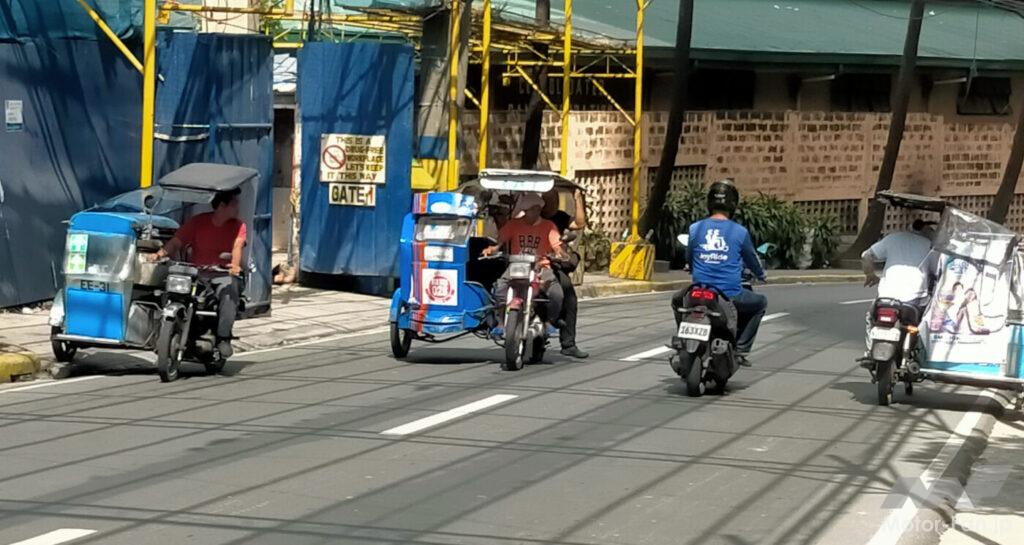
A group of old-fashioned motorcycle taxis with sidecars waiting and dropping off passengers in front of a shopping mall.
If you are involved in a traffic accident while riding on the back of a motorbike taxi, it is unclear whether motorbike taxi insurance will fully cover the accident. Therefore, I personally do not recommend using a motorbike taxi for people who are not used to riding tandem or have never ridden tandem before. For those who really want to try riding a motorbike taxi, it is a good idea to take out overseas travel insurance that also covers motorbike taxi accidents.
As an aside, I used nine Grab taxis to get around Manila this time, and all of them were late-model Toyota 2000cc sedans, so the ride was excellent. The air conditioning worked well, and the interior was clean and very comfortable. Some of the vehicles were luxurious, with all the seats replaced with genuine leather seats that seemed to be custom-made and provided 120% more comfort.
The average monthly salary in the Philippines is about 120,000 to 130,000 yen (as of 2025, compared to about 330,000 yen in Japan). Considering the purchase price of the vehicle, the monthly salary of a Grab taxi driver is expected to be significantly higher than the average monthly salary in the Philippines, although this will vary from person to person.
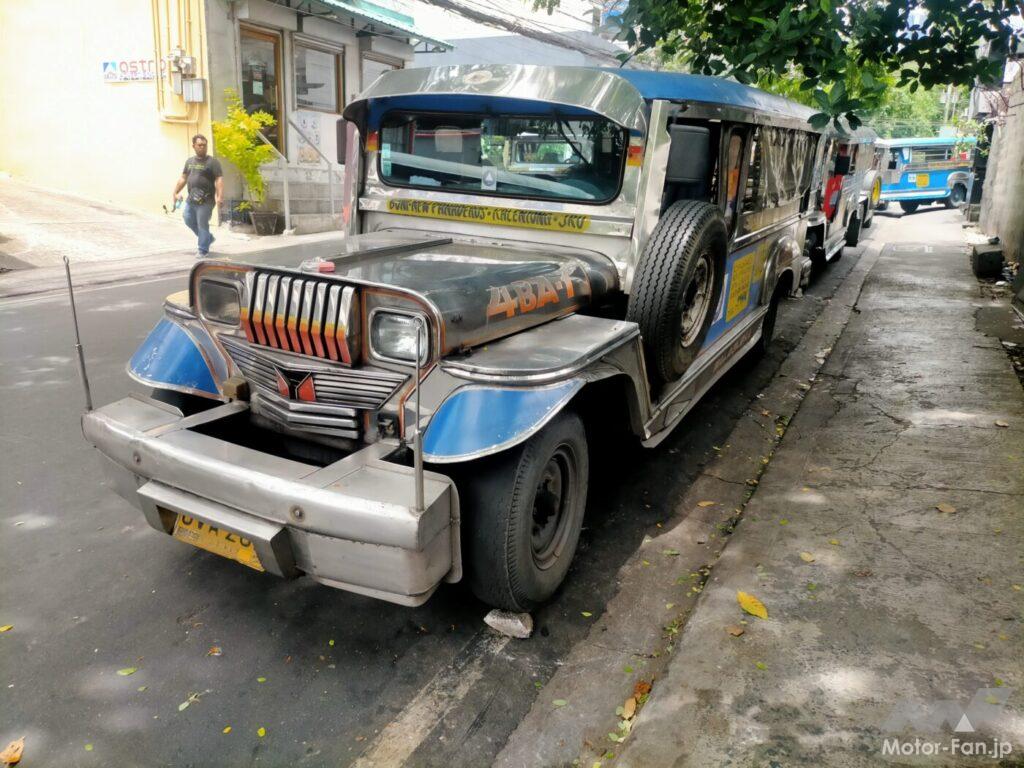
In Manila, for the same distance traveled, the fare order is generally Grab taxi > metered taxi > motorcycle taxi > motorcycle taxi with sidecar > shared bus ( jeepney *Note 3 ) > bicycle with sidecar (this order may vary depending on conditions, etc.).
Round-trip airfare from Narita Airport to Manila Airport + 3 nights in a comfortable hotel = 31,000 yen per person!
Many shopping malls in Manila (where security is tight, with gun-toting guards inspecting bags and conducting surveillance at the entrances) have also opened stores specializing in motorcycle helmets. While motorcycles are largely a hobby in Japan, in Manila they are firmly integrated into the lives of ordinary people.
Recently, there has been a lot of talk about electrifying cars and motorcycles, especially in Europe and China. However, is this actually a realistic option for ASEAN countries, including the Philippines? This thought crossed my mind as I glanced at the retro bus, or “jeepney,” mentioned above.
There are also great deals on cheap airfares between Japan and Manila. This time, I used the travel site Expedia to get a cheap round-trip ticket with AirAsia (Narita Airport to Ninoy Aquino Airport) plus a package that included three nights in a comfortable hotel comparable to a domestic business hotel (excluding meals and transportation) for just under 31,000 yen per person, and enjoyed my trip to the fullest.
With the exception of some areas pointed out by the Japanese government and tourists, Manila is generally safe during the day (not sure about the situation at night) and I didn’t feel any fear. Personally, I would like to visit again; it’s a powerful, energetic, and wonderful city. Although omitted from this report, visiting historical tourist sites, including Fort San Pedro, which has deep ties to Japan, was also very meaningful.
I hope you all will enjoy an exciting and fun trip to Manila, Philippines. Thank you so much to everyone in Manila who took care of me. Thank you!
 [Part 1] Basic knowledge for traveling around Ishigaki Island, an Okinawan island closer to foreign shores than the mainland / Touring spots you’ll want to ride your motorcycle around | Motor-Fan is a media platform that distributes articles related to automobiles.
Ishigaki Island has a total area of approximately 222 km2, roughly the same as Osaka City. The circumference of the island is approximately 140 km. Ishigaki Island is part of the Yaeyama Islands, the closest island to Taiwan in Okinawa Prefecture. Ishigaki Island is the main island of Okinawa […]
ADVERTISEMENT
 Travel Practice! The only option for touring Ishigaki Island is a rental bike! [Part 2] / Touring spots you’ll want to ride a bike to | Motor-Fan [Motor Fan] A media platform that distributes articles related to automobiles
[Part 1] Basic knowledge for traveling around Ishigaki Island, an Okinawan remote island closer to foreign lands than the mainland / Touring spots perfect for motorcycles. Can you ride your own car around Ishigaki Island? Passenger ship routes were discontinued in 2008. Currently, the only way to get there from the mainland or Okinawa’s main island is by plane.
 A one-way trip for a moped costs 3,450 yen. Head to Amami Oshima, a remote island in Kagoshima Prefecture, a World Heritage Site you’ll want to visit at least once in your lifetime! “Practical Guide” / Motorcycle Touring Spots | Motor-Fan [Motor Fan] A media platform that distributes articles related to automobiles
Amami Oshima is a rainy place. How can you enjoy a trip on a beautiful day? In the “Basic Knowledge” section, we reported on the characteristics and charms of Amami Oshima in a digest. Here, we will introduce specific travel tips, such as how to tour Amami Oshima and the costs involved. The subtropical […]
 A complete guide to Amami Oshima, a remote island in Kagoshima Prefecture, a World Natural Heritage site that Japan is proud of! “Basic Knowledge Edition” / Motorcycle Touring Spots | Motor-Fan [Motor Fan] A media platform that distributes mainly automobile-related articles
Amami Oshima, a remote island in Kagoshima Prefecture, located about 380km from Kagoshima City, is a hidden place where the sea and mountains are inseparable, with expanses of blue sea and deep green. It is the second largest island in Japan after Sado Island in Niigata Prefecture, and is characterized by its mountainous terrain and limited flat land. The island is bordered by Amami City, Setouchi Town, and […]