
![Pay attention! JMS2025: Hydrogen powers everyday life | Yamaha H2 Buddy Porter Concept [Japan Mobility Show 2025]](https://motopeek.com/wp-content/uploads/2025/10/4616-1761685279379.jpg)

Jointly developed by Yamaha and Toyota

With hydrogen engines being seen as one of the many options for achieving carbon neutrality, Yamaha Motor has collaborated with Toyota to develop a small, certified high-pressure hydrogen tank suitable for mounting on motorcycles, resulting in the “H2 Buddy Porter Concept.”
This model also incorporates the technical requirements for driving on public roads and complies with Euro 5 exhaust gas regulations, including NOx, so it goes beyond being a mere exhibition model and is designed with practicality in mind for the next generation of society.
In this way, Yamaha’s concept model presents a vision of future mobility that differs from existing EVs and hybrids, with a clear intention to implement a hydrogen engine in a motorcycle.
Technical Overview and Features
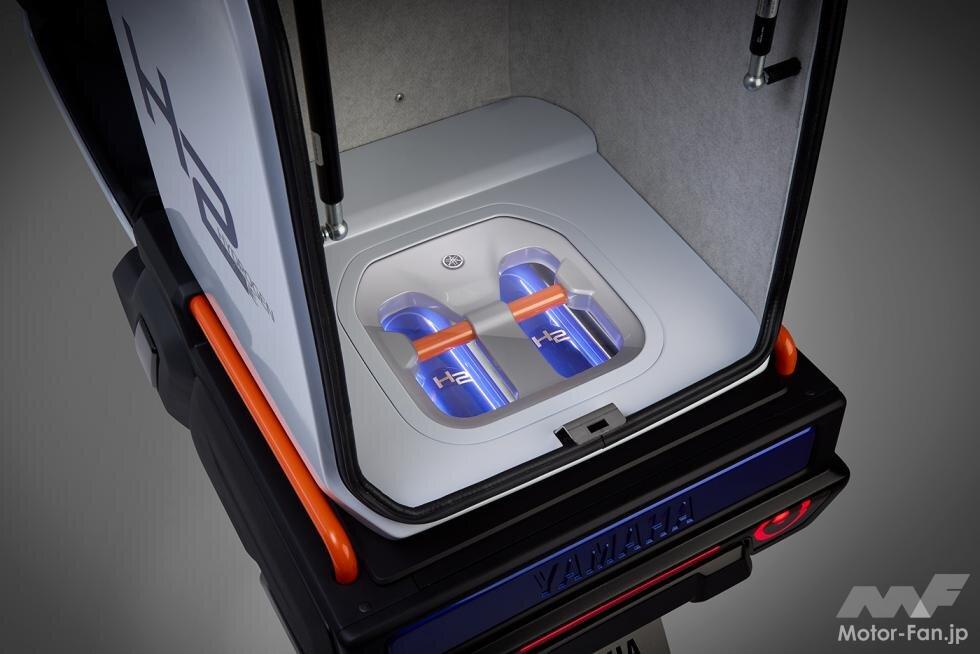
The first feature of the H2 Buddy Porter Concept is its high-pressure hydrogen tank, which is newly developed by Toyota and is suitable for motorcycles and scooters, and is designed to fit into the narrow space inside a motorcycle.
With the tank full, the vehicle has a measured range of over 100 km, demonstrating its practicality for urban or short-distance use.
Furthermore, the engine and chassis structure have been specially developed, with Yamaha primarily handling the “hydrogen engine and chassis, etc.” In terms of environmental performance, it complies with the Euro 5 exhaust gas regulations (including NOx), and efforts are being made to incorporate the value of hydrogen combustion into actual systems and regulations, even for motorcycles.
From a design perspective, the vehicle also hints at the mobility of a scooter and a porter for transport purposes, and its proportions and configuration are designed for everyday use in the city.
Significance and intended use of the concept
The significance of this model is that it demonstrates the potential for hydrogen use that is possible only with motorcycles. By deliberately examining the option of hydrogen storage and combustion in motorcycles, where it is relatively easy to make the body smaller and simpler than in cars, it highlights the company’s approach to pursuing environmental friendliness in mobility from multiple angles.
Furthermore, for urban delivery, transportation, and short-distance use, the vehicle’s specifications of being able to travel over 100 km in a single trip and being able to be equipped with a high-pressure hydrogen tank make it a significant infrastructure step in compensating for the challenges of developing an EV charging environment and the weight and cost of batteries.
It is also noteworthy that this is a joint development between Yamaha and Toyota, two companies that have focused on motorcycles and automobiles, respectively. Yamaha, which handles motorcycles, is aiming to “hydrogenate a practical motorcycle,” while incorporating Toyota’s technology, which has strengths in the automotive field, suggests that the development phase is closer to practical implementation.
Future developments and challenges
This concept model is positioned as an “exhibition reference vehicle,” but it can be seen as a stepping stone to the roadmap for technological verification and social implementation for practical use. As it incorporates compliance with laws and exhaust gas regulations with an eye toward driving on public roads, test operations or demonstration projects in limited areas are expected in the near future.
On the other hand, the challenges are clear. These include the development of hydrogen filling stations, the cost structure of motorcycles, competition with battery EVs, ensuring vehicle weight and safety, and clarifying demand forecasts. Furthermore, there are still technical hurdles to overcome, such as “increasing the pressure of hydrogen tanks” and “ensuring vibration, weight reduction, and power transmission specific to motorcycles.”
Nevertheless, the fact that Yamaha has chosen this path shows the “diversification of options” in the motorcycle market, and can also be seen as a message that the future of motorcycles will not be limited simply to EVs. Going forward, attention will be focused on trends toward demonstrations and mass production in various regions.
In this way, the H2 Buddy Porter Concept is a future-oriented model that combines environmental friendliness, practicality, and the joy of mobility, and it begins to paint a concrete picture of an era in which motorcycles run on hydrogen. We’ll be keeping a close eye on what it will look like in future announcements, specification releases, and project progress.