
![[Part 1] Basic knowledge for traveling around Ishigaki Island, an Okinawan island closer to foreign countries than the mainla](https://motopeek.com/wp-content/uploads/2025/05/2628-1760842227517.jpg)

The total area of Ishigaki Island is about 222 km2, roughly the same as Osaka City. The circumference of the island is about 140 km.
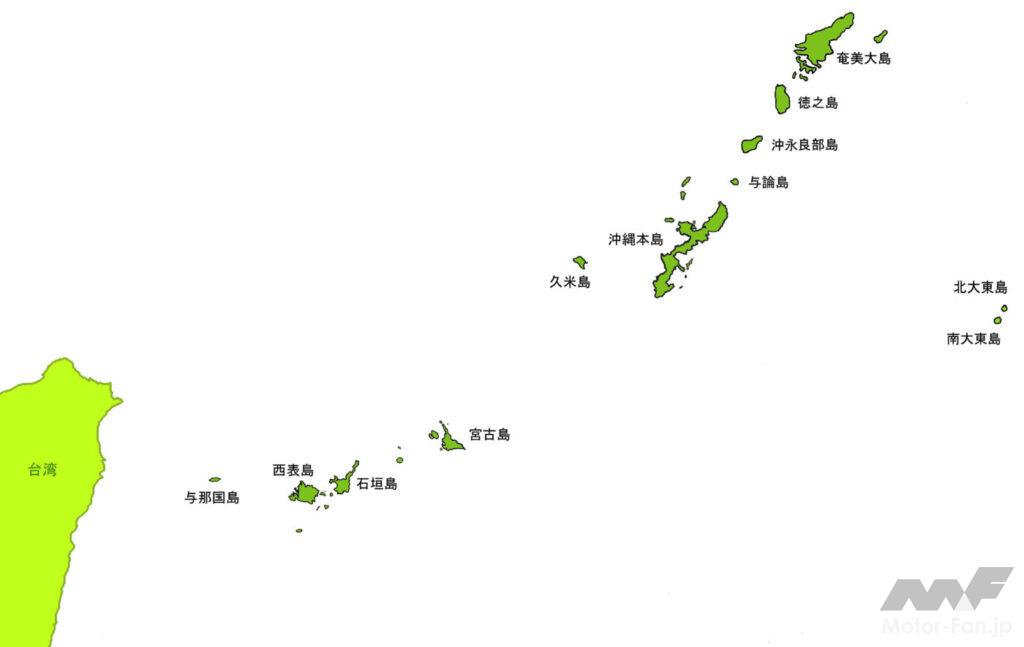
Miyako Island, Ishigaki Island, Iriomote Island, Yonaguni Island, and other islands located southwest of the main island of Okinawa are collectively called the “Yaeyama Islands,” “Yaeyama Islands,” or “Yaesu Region.”

On a clear day, you can enjoy the emerald green sea at any beach on Ishigaki Island.
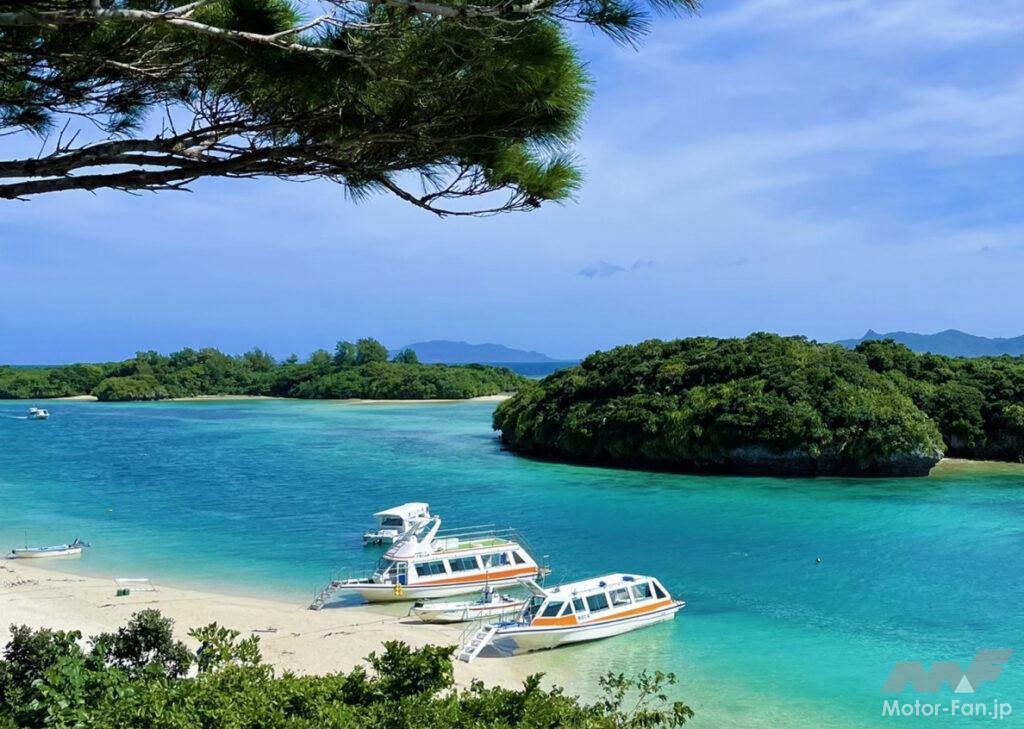
Kabira Bay is a famous spot on Ishigaki Island where you can enjoy spectacular ocean views except when it rains.
Ishigaki Island is the island closest to Taiwan in Okinawa Prefecture, belonging to the Yaeyama Islands. Ishigaki Island is the third largest island in Okinawa Prefecture after Okinawa Island and Iriomote Island, and the 21st largest in total area in Japan (including the four islands of Hokkaido, Honshu, Shikoku, and Kyushu, as well as Okinawa Island).
Ishigaki Island has a total area of approximately 222 km2 (square kilometers), which is close to Osaka City (223 km2) and Amakusa Kamishima Island in Kumamoto Prefecture (approximately 225 km2), one-third the area of Tokyo’s 23 wards (approximately 620 km2), and about half the area of Yokohama City in Kanagawa Prefecture (438 km2). It is slightly larger than Shodoshima Island in Kagawa Prefecture (153 km2) in the Seto Inland Sea.
Ishigaki Island is a remote island located approximately 410 km southwest of Naha City (Okinawa main island), the prefectural capital of Okinawa Prefecture. It is only approximately 270 km from Taiwan to the west, making it closer to Taiwan than most areas in Japan. The entire island is “Ishigaki City,” with a total population of 49,651 (as of September 2022).
The distance around Ishigaki Island is around 140km. This distance is equivalent to the distance from central Tokyo to Numazu in Shizuoka Prefecture, or from Osaka City to Maibara City in Shiga Prefecture. There are only regular roads, no expressways.
If you use the 2 nights and 3 days itinerary wisely, you can fully enjoy touring, sightseeing around the island, visiting outlying islands, and leisure trips to the sea and mountains.
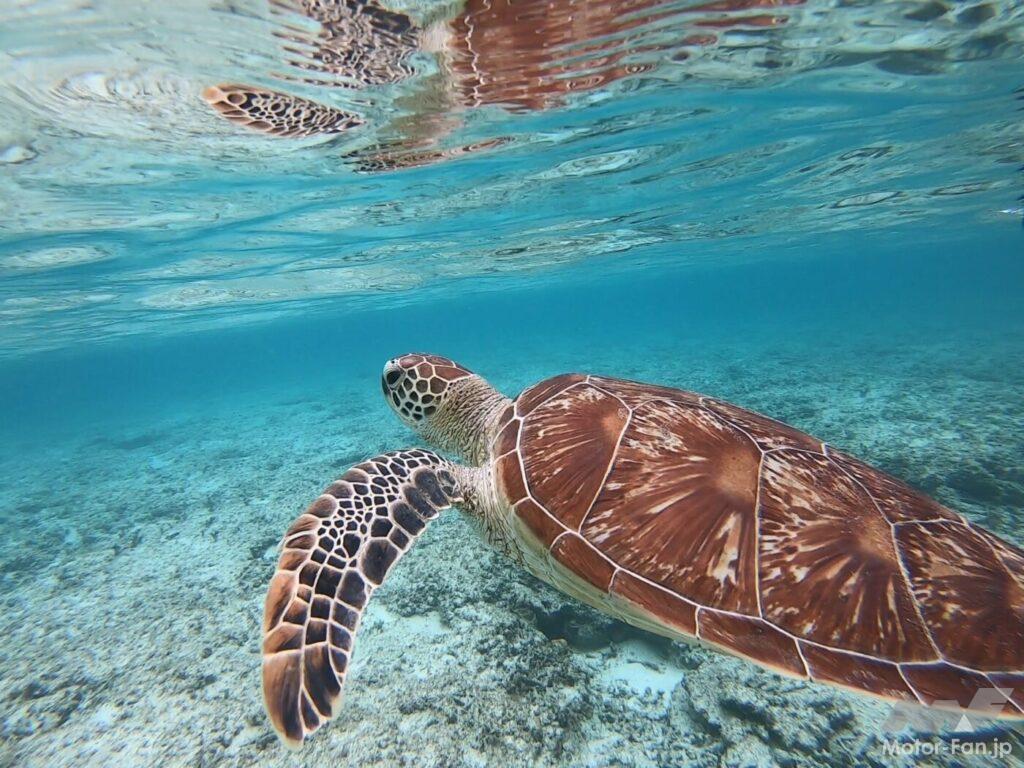
Enjoy the emerald green ocean! Scuba diving, snorkeling, and glass-bottom boating (a sightseeing boat with a partially transparent bottom) will give you the chance to see beautiful coral reefs and maybe even sea turtles! *Photos are for illustrative purposes only.
To go around the island by motorcycle (excluding 50cc mopeds) or car, if you go at 40km/h, it takes about 3 to 4 hours by simple calculation. With few traffic lights on major roads except in the city and suburbs, and almost no long-distance traffic jams, it is surprisingly easy to drive around the island. In particular, the roads overlooking the sea offer spectacular views, so the distance of about 140km around the island doesn’t feel like a big deal.
Let’s say you want to see all the famous tourist spots. If you use a 3-day, 2-night trip wisely, you should be able to enjoy touring, sightseeing around the island, visiting outlying islands, and leisure activities in the sea and mountains. However, a 2-day, 1-night trip might be too hectic.
From a tourism perspective, Ishigaki Island can be roughly divided into three areas: the north, central, and south. The north is dotted with tourist attractions such as beautiful beaches, limestone caves, and observation decks, the central area is home to New Ishigaki Airport, the air gateway, and the south is home to one of the island’s most popular shopping districts and the main port connecting the island to the outlying islands.
Ishigaki Island is a place where the sea and the mountains are two sides of the same coin, with an emerald green ocean and a rich natural landscape of mangroves and other deep greenery. The image is of the sea on the outside of the island and the mountains on the inside. In this respect, it may be similar to Amami Oshima.
However, Amami Oshima has a total area of about 712 km2. By comparison, Okinawa’s main island is about 1,208 km2. Compared to these two islands, Ishigaki Island, at about 222 km2, feels very compact, both numerically and in terms of feel. With the sea in front of you and the mountains behind, it’s a unique geography that allows you to instantly enjoy both the sea and the mountains, like “getting two for one island!” To me, Ishigaki Island feels like a more compact version of Amami Oshima.
History and Culture of Ishigaki Island
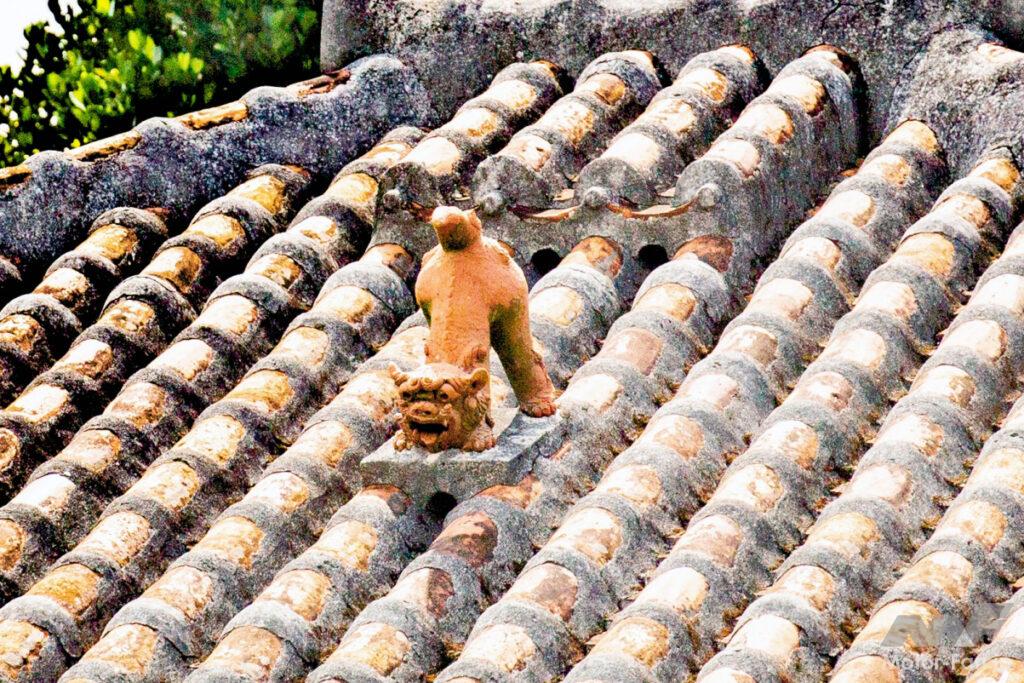
Shisa were a symbol of authority during the Ryukyu Dynasty. After the Ryukyu Kingdom was abolished and Okinawa Prefecture was established, they became popular and plaster and ceramic shisa began to be placed on roofs and walls.
People have lived on Ishigaki Island for a very long time, with human bones dating back approximately 20,000 years having been discovered. In 1500, the Yaeyama Islands, including Ishigaki Island, came under the control of the Ryukyu Kingdom on the main island of Okinawa.
In 1872, when the Edo period under the Tokugawa Shogunate came to an end, the Meiji government forcibly abolished the feudal domains and established prefectures in the Ryukyu Kingdom. As a result, the Ryukyu Kingdom, which had been under the jurisdiction of the Satsuma Domain, came under the direct control of the Meiji government and became Okinawa Prefecture.
After Japan lost the Pacific War, Okinawa Prefecture, which was under occupation, came under the rule of the United States. On May 15, 1972, Okinawa Prefecture was returned to Japan by the United States, where it remains to this day.
The Ryukyu Kingdom had a history of approximately 450 years , from 1429 to 1879. Okinawa Prefecture, which had active diplomacy and trade with China, has a unique culture that has been heavily influenced by Chinese culture and is clearly different from that of the mainland.
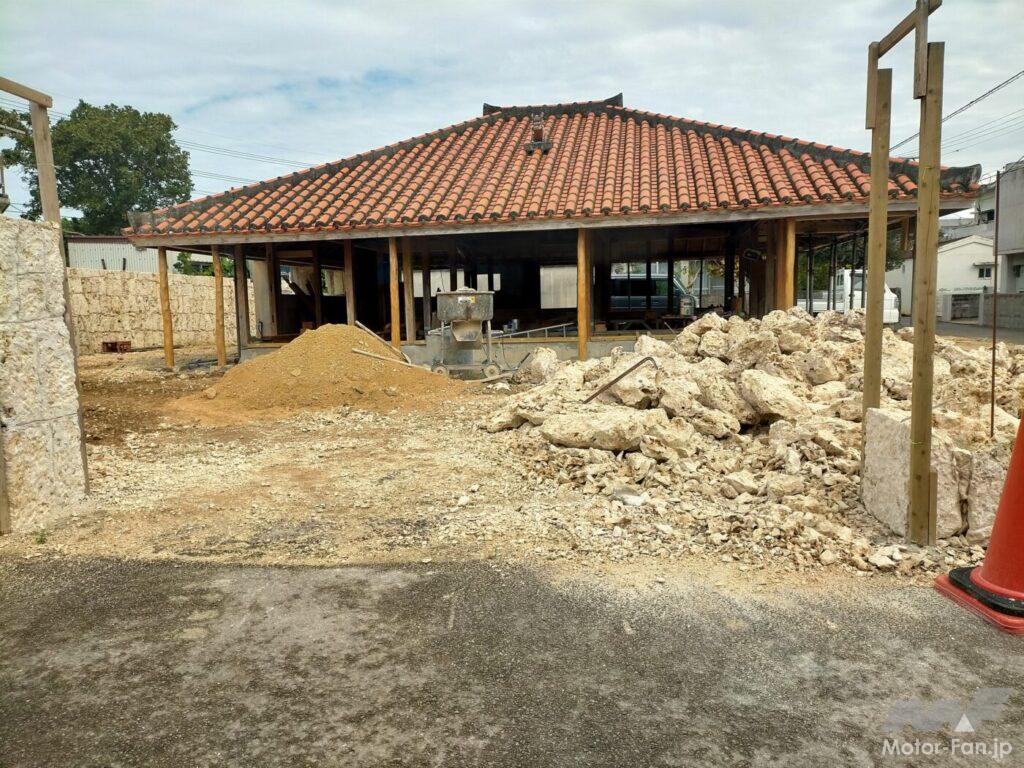
A scene from the village. It is unclear whether the building is undergoing renovation or reconstruction, but the roof tiles and wall designs are a continuation of Ryukyu culture. A shisa, Okinawa’s guardian deity, is placed on the roof.
The suburban streets of Ishigaki Island are particularly striking. They feature red roof tiles, high stone walls made with carefully stacked stones from the island that provide excellent wind and rain protection, and Okinawa’s guardian deities, the “shisa,” installed on top of the roofs and stone walls. The culture and lifestyle of the common people from the Ryukyu Kingdom era still remains, and you can see the unique scenery of Ishigaki Island, which is prone to typhoons.
This is something I heard from someone from Miyakojima (a man in his 50s who lived in Miyakojima from birth until he graduated from high school at age 18, and has lived in Tokyo ever since). He said that although the Yaeyama Islands may seem similar, the temperament (island character) of the islanders varies slightly from island to island.
For example, Miyako Island, located northeast of Ishigaki Island, has a strong pioneering spirit (there is no mountains or rivers, so people have a history of working hard to secure water). The people are also cheerful and can easily get along with anyone.
On the other hand, the people of Ishigaki Island, which is surrounded by mountains and rivers, tend to be conservative and protect their traditions and culture. According to him, people from Miyako Island don’t like Ishigaki Island very much (because of a sense of rivalry), but they admire the “big city” of Okinawa Island. He also said that people from Okinawa Island often look down on people from outlying islands (this is just his story, and the veracity of this is unknown).
This is similar to the Kanto region’s Tokyo > Kanagawa > Chiba = Saitama diagram, where cities are ranked higher than rural areas. It’s a show of pride that’s often referred to as “local pride.”
The island character of Okinawa Prefecture is probably a stereotypical view (widely held fixed ideas, preconceptions, and preconceptions), but keeping this in mind, one of the joys of traveling is experiencing the differences of Okinawa’s remote islands for yourself.
Ishigaki Island’s climate, weather, and sea color
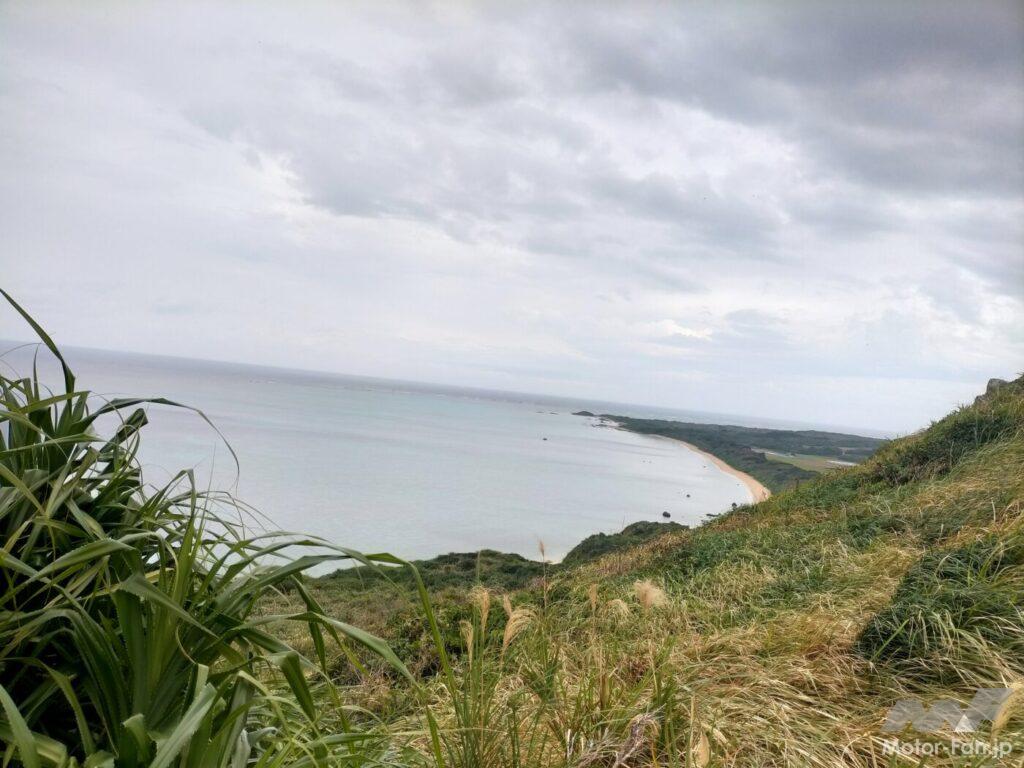
The sea seen from Hirakubozaki Lighthouse, the northernmost point of Ishigaki Island. At the time of the photo, it was cloudy with occasional light rain. You can see the faint emerald green of the sea, but the sea around Ishigaki Island generally tends to turn a dull black color when it rains.
Ishigaki Island is blessed with a beautiful landscape where, if you go up a little higher, you can see the emerald green ocean on a clear day. There are also beautiful beaches in many places, giving the impression that the sea and mountains are on one side and the other.
However, when it rains, the emerald green sea tends to turn a dull black color. This writer feels that this tendency is particularly strong in the sea of Kabira Bay, a famous spot on Ishigaki Island that is famous for its spectacular views.
When the rain stops and the clouds clear, much of Ishigaki Island’s ocean regains its beautiful blue color. This is different from Amami Oshima, a remote island in Kagoshima Prefecture, where you can enjoy the emerald green ocean even when it rains (although this varies by area).
Ishigaki Island has a subtropical climate, with hot and humid summers, more rainfall than the mainland, and changeable weather. Throughout the year, temperatures range from 17°C to 32°C, but rarely drop below 13°C and exceed 33°C.
The rainy season begins around late May and ends around mid- to late June. There is a very high chance of prolonged rain during this time, so it may be best to avoid traveling. The humidity is also higher than on the mainland, so be careful not to get heatstroke. In addition, don’t forget that there are many typhoons in the summer, and flight cancellations can occur.
Ishigaki Island is characterised by extremely changeable weather throughout the year, with sudden changes from heavy rain to sunny skies (especially along the mountains) .
On the first day I visited Ishigaki Island, it rained heavily in the morning. However, the afternoon turned out to be a dream come true. The hotel staff at the hotel where I stayed advised me to use the weather forecast as a guide only. Just to be safe, I recommend bringing a folding umbrella and raincoat with you when you go out.
Ishigaki Island receives more rainfall annually than the mainland, but if you’re a student or someone with more freedom in choosing your travel dates, you can research the weather for the next three years using the “Ishigaki Island Past Weather” website, which is available online. By narrowing your search to dates that have a clear weather forecast for the past three years, you can statistically increase your chances of enjoying good weather.
In the second part, we will introduce the practical guide for touring Ishigaki Island.
Ishigaki Island’s yearly and monthly temperatures
ADVERTISEMENT
| month | Ishigaki Island (lowest) | Ishigaki Island (the best) | Ishigaki Island (average) | Tokyo (average) |
| January | 16.5℃ | 21.2℃ | 18.6℃ | 5.4℃ |
| February | 16.9℃ | 21.6℃ | 19.1℃ | 6.1℃ |
| March | 18.5℃ | 23.5℃ | 2.01℃ | 9.4℃ |
| April | 21.2℃ | 25.8℃ | 23.3℃ | 14.3℃ |
| May | 23.6℃ | 28.3℃ | 25.7℃ | 18.8℃ |
| June | 26.1℃ | 30.4℃ | 28.0℃ | 21.9℃ |
| July | 27.6℃ | 32.0℃ | 29.5℃ | 25.7℃ |
| August | 27.1℃ | 31.8℃ | 29.2℃ | 26.9℃ |
| september | 25.8℃ | 30.7℃ | 27.9℃ | 23.3℃ |
| October | 23.7℃ | 28.7℃ | 25.9℃ | 18.0℃ |
| november | 21.1℃ | 25.8℃ | 23.2℃ | 12.5℃ |
| december | 18.0℃ | 22.7℃ | 20.1℃ | 7.7℃ |
“Temperature and Rainfall Statistics” from https://weather.time-j.net/
Rainfall on Ishigaki Island (mm/monthly total/yearly total)
| January | February | March | April | May | June | July | August | september | October | november | december | Annual total | |
| Naha | 73.2 | 145.0 | 82.3 | 147.2 | 353.0 | 282.0 | 173.8 | 283.7 | 95.8 | 312.0 | 217.8 | 128.2 | 2294.0 |
| Miyakojima | 151.0 | 91.8 | 73.7 | 182.5 | 238.8 | 180.2 | 173.2 | 230.0 | 96.8 | 334.0 | 199.0 | 103.2 | 2054.2 |
| Ishigaki Island | 120.2 | 133.8 | 41.2 | 137.7 | 277.5 | 125.8 | 113.2 | 213.0 | 122.3 | 571.2 | 167.7 | 91.5 | 2115.1 |
| Tokyo | 51.5 | 104.2 | 105.3 | 157.5 | 189.8 | 150.2 | 67.7 | 171.0 | 238.7 | 202.3 | 119.5 | 95.8 | 1653.5 |
| Minamitorishima | 75.5 | 75.3 | 68.2 | 26.8 | 107.2 | 83.8 | 111.5 | 290.5 | 161.2 | 84.7 | 25.5 | 114.5 | 1224.7 |
*Statistics for the three years of 2009, 2010, and 2011. Calculated from data from the Japan Meteorological Agency.
 A complete guide to Amami Oshima, a remote island in Kagoshima Prefecture, a World Natural Heritage site that Japan is proud of! “Basic knowledge” / Touring spots you’ll want to visit by motorcycle
Amami Oshima, a natural treasure trove, was registered as a World Natural Heritage Site in 2021. Located about 380km from Kagoshima City, this remote island in Kagoshima Prefecture is a hidden gem that can be called a “treasure of the world,” with its blue sea and deep greenery two sides of the same coin. With its warm climate, Amami Oshima is a place where you can enjoy touring all year round. This report will introduce the features and points of Amami Oshima, a place you’ll want to visit at least once in your life, in two parts: “Travel Preliminary Knowledge” and “Travel Practice”! PHOTO/REPORT●KITA Hideaki Interview date: Mid-April 2025 (3 days) *Note: Some of the content in the article is from the day of the interview and may vary depending on the season, time, weather, etc.
 A one-way trip for a moped costs 3,450 yen. Let’s go to Amami Oshima, a remote island in Kagoshima Prefecture, a World Natural Heritage site that you should visit at least once in your life! “Practical Edition” / Touring spots you want to visit by motorcycle
Amami Oshima, a natural treasure trove, was registered as a World Natural Heritage Site in 2021. Located about 380km from Kagoshima City, this remote island in Kagoshima Prefecture is a hidden gem that can be called a “treasure of the world,” with its blue sea and deep greenery two sides of the same coin. Amami Oshima’s warm climate makes touring enjoyable all year round. This report covers the features and points of Amami Oshima, a place you’ll want to visit at least once in your life. Following on from the “Basic Travel Knowledge” section, we will introduce the “Practical Travel” section♪ PHOTO/REPORT●KITA Hideaki Interview date: Mid-April 2025 (3 days) *Note: Some of the content in the article is from the day of the interview and may vary depending on the season, time, weather, etc.