
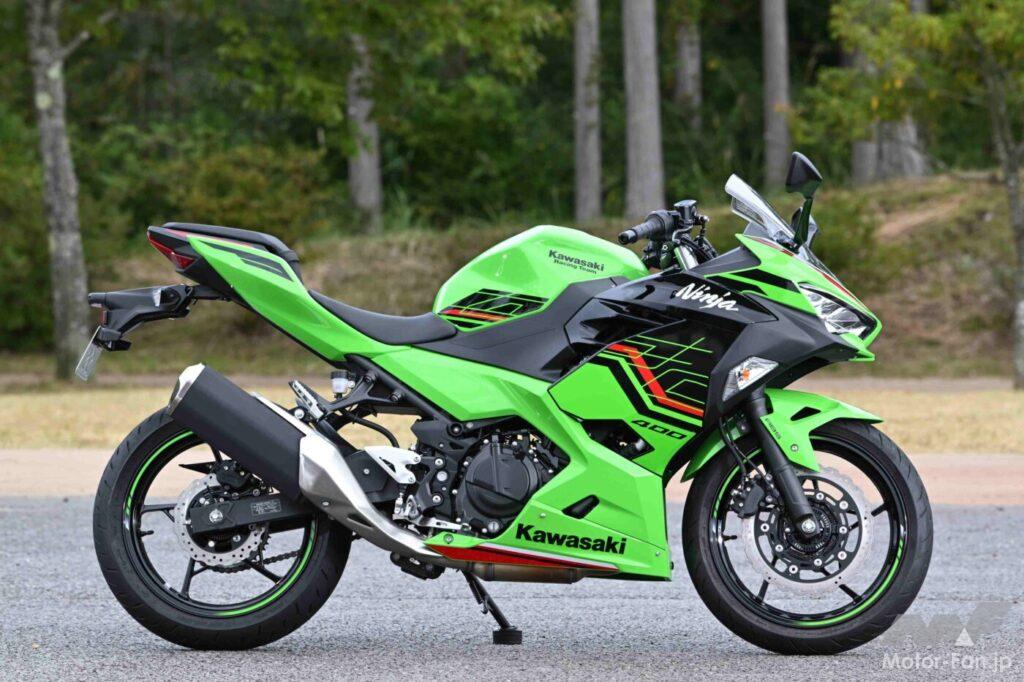
Kawasaki Ninja 400…770,000 yen
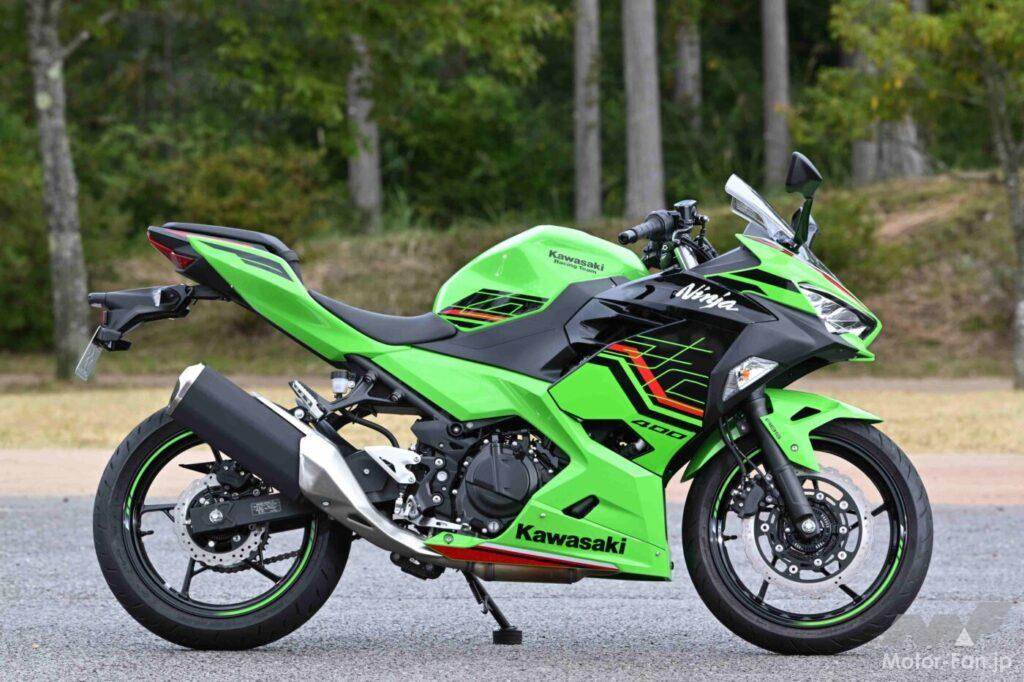
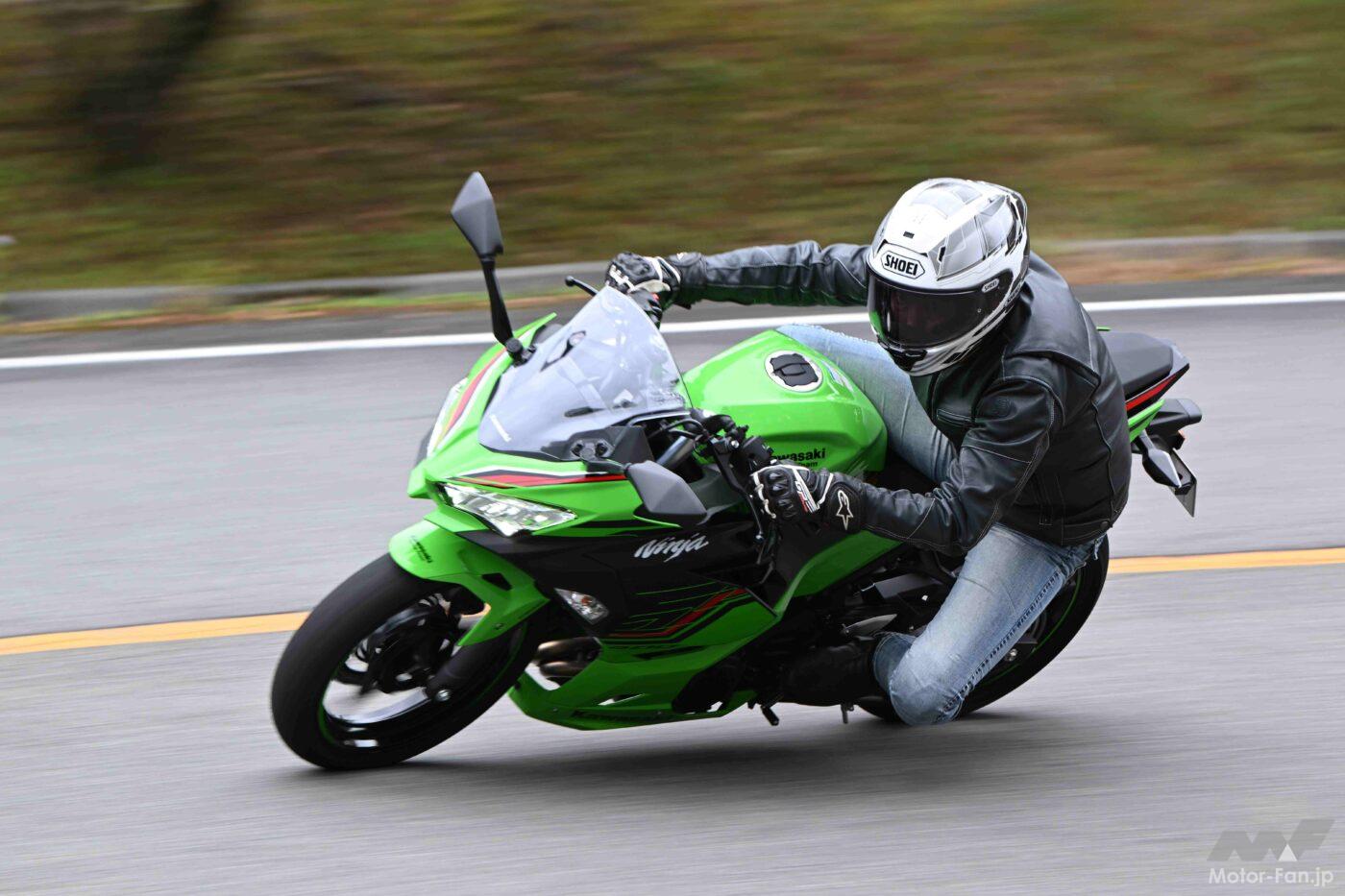
Kawasaki has been selling 400cc sports models equipped with water-cooled parallel twin engines for a long time since the release of the GPZ400S in 1986. The current Ninja 400 debuted in 2018.
What I felt while going to Tsukuba Circuit
I apologize for starting off with a personal story, but 14 years ago, when I turned 40, I suddenly decided that “at least once in my life, I want to try racing on a circuit seriously,  ” and so I bought a 2010 Triumph Daytona 675. At the time, there was a wide variety of super sports bikes to choose from and they were reasonably priced, so I chose the British-made three-cylinder bike because I felt a sense of familiarity with it during my test drive work, but unfortunately, my skills were not up to the task of realizing the Daytona 675’s full potential.
At the time, I was avidly visiting Tsukuba Circuit in Ibaraki Prefecture, and my goal was to achieve a time in the 1 minute 5 second range. Incidentally, a 1 minute 5 second range at Tsukuba is easily achievable by expert riders on mid-range or larger supersport bikes, and has become quite commonplace among the top riders in the JP250 class of the All Japan and Regional Championships in recent years, but from the perspective of an average rider, I think it’s fair to say that this time is on the fast side.

The reverse slant nose front mask is a feature of Kawasaki’s full-cowl sports bikes in recent years, and its origins lie in the Ninja H2, which was released in 2015.
Even after years of riding, my best time was still 1 minute 7 seconds flat. However, when I later switched to a 1985 TZR250 and continued riding, I finally managed to break the 1 minute 5 second mark after 10 years of going to the circuit. Through this experience, I came to the conclusion that the maximum potential for the average rider on the circuit can only be fully realized with a 250cc bike with a maximum output of around 50ps and a weight of around 150-160kg. (The 2010 Daytona 675 has a maximum output of 128ps and an equipped weight of 185kg.)
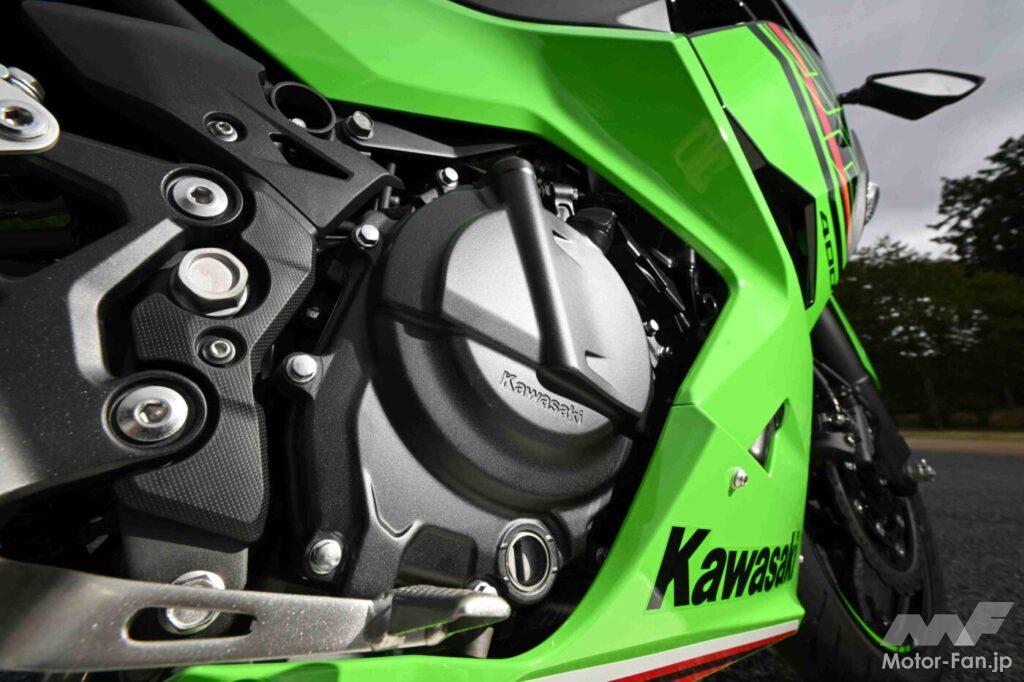
The basic design is the same as its younger brother, the Ninja 250, but the main parts of the parallel twin-cylinder engine with a 180-degree phase crank are designed specifically for each model. The bore and stroke are 400: 70 x 51.8 mm, 250: 62 x 41.2 mm.
But that doesn’t necessarily mean that the recent 250cc full-cowl sports bikes are ideal for me. After all, the TZR250’s maximum output and curb weight were 45ps and 142kg, giving it a power-to-weight ratio of 3.15ps/kg, while the Honda CBR250RR, which boasts the best maneuverability in the modern 250cc class, has 42ps, 168kg, and 4ps/kg. So, I was looking for a current bike that offered a little more power and a little more lightness, and when I first test rode it a few years ago, I felt that the current Ninja 400, with its 48ps, 167kg, and 3.48ps/kg, was the one for me.
What makes us different from our rivals?
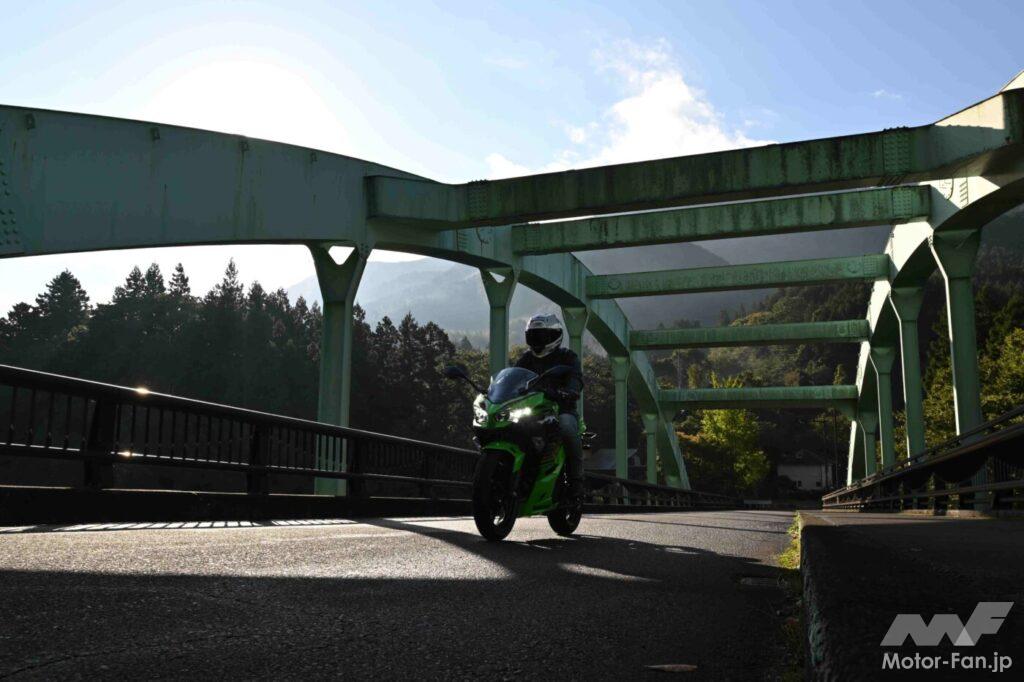
Although it has achieved a 4ps power increase over its predecessor, the most notable feature of the current Ninja 400, which went on sale in 2018, is that instead of the previous approach of making it a smaller-displacement version of the Ninja 650, it has taken the route of making it a larger-displacement version of the Ninja 250, which has made it 44kg lighter than its predecessor. However, even with this amazing weight loss, the current Ninja 400 is still over 20kg heavier than the TZR250, but as someone who struggles to maintain an old bike from about 40 years ago, I thought that a certain degree of weight was within an acceptable range.
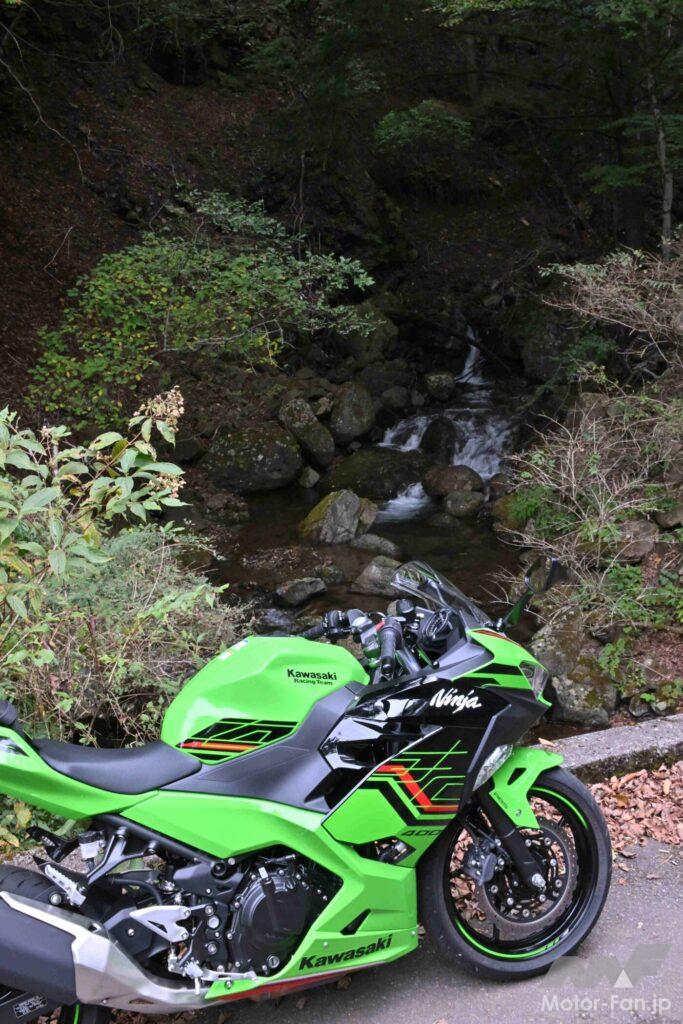
However, in the modern 400cc class, there are other fully-cowled sports bikes that can be enjoyed on the circuit besides the Ninja 400. If you look at the maximum power output, curb weight, wheelbase, caster angle, and trail listed below, you will be able to understand the characteristics of each bike (roughly speaking, the figures excluding maximum power output are smaller if they are more sport-oriented, and larger if they are more touring-oriented).
Kawasaki Ninja 400…48hp, 167kg, 1370mm, 24.7°, 92mm
Honda CBR400R: 46 hp, 191 kg, 1410 mm, 25.3°, 102 mm
Yamaha YZF-R3 ………………42hp, 169kg, 1380mm, 25° angle, 95mm
●KTM RC390………………44ps・164kg・1343mm・23.5°・84mm
Hmm? Looking at the numbers again, it seems like the differences are negligible except for the weight and wheelbase of the CBR400R, and the RC390’s numbers convey that it has the most drive in its class, but I’m still drawn to the Ninja 400. In addition to wanting to clarify the reason, I also wanted to understand what kind of impression I would have on a long run, which I have never experienced before, so I decided to focus on the Ninja 400 for this serious 1000km ride.
Engine characteristics and riding position
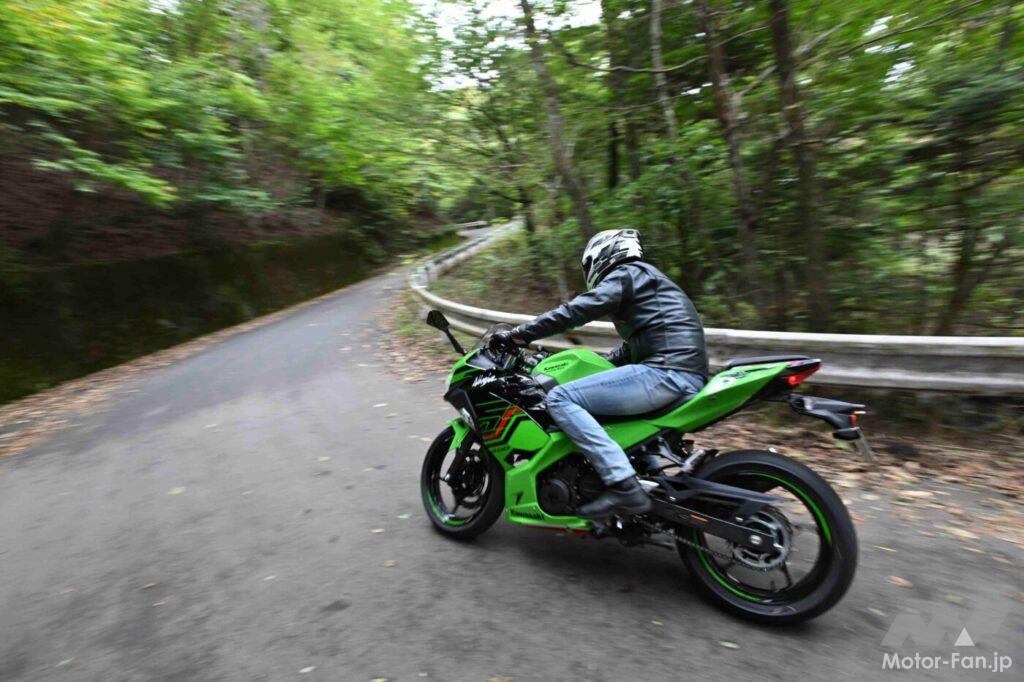
I rode the Ninja 400 for the first time in a while while shooting and touring for this article, and I immediately realized that one of the reasons I liked this bike was its engine. When it comes to 4-stroke 400cc parallel twin engines, many people seem to have the impression that they are torquey and straightforward from the low to mid-range (in fact, the CBR400R and YZF-R3 have those characteristics, and I think the 4-stroke single-cylinder RC390 also lacks flavor), but the Ninja 400’s engine is rich in modulation, with a moderate thumping feeling in the low-range and an exhilarating feeling as if the left and right cylinders are working together to surge up in the mid to high-range.
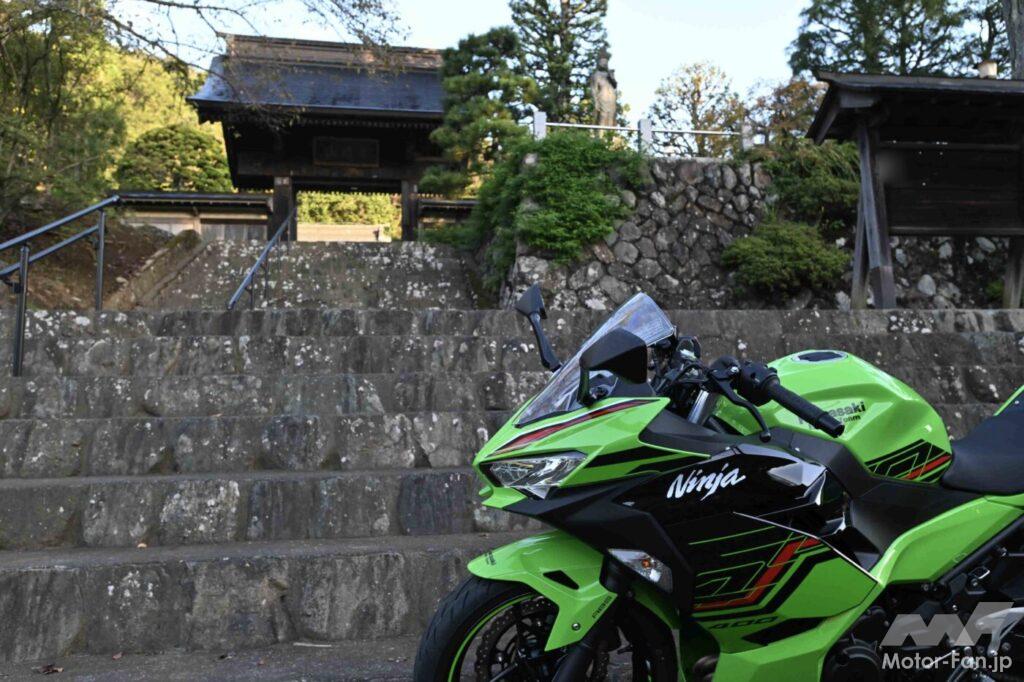
Incidentally, when motorcycle media covers the Ninja 400 and its sister model, the Ninja 250, they usually say that the 250 is the fun of revving up to high rpm, while the 400 is fast enough without having to rev up to high rpm. The rpm at which each bike generates its maximum power and torque is 250: 12,500/10,500 rpm, and 400: 10,000/8,000 rpm, so anyone would agree if they were to compare the two bikes under the same conditions.
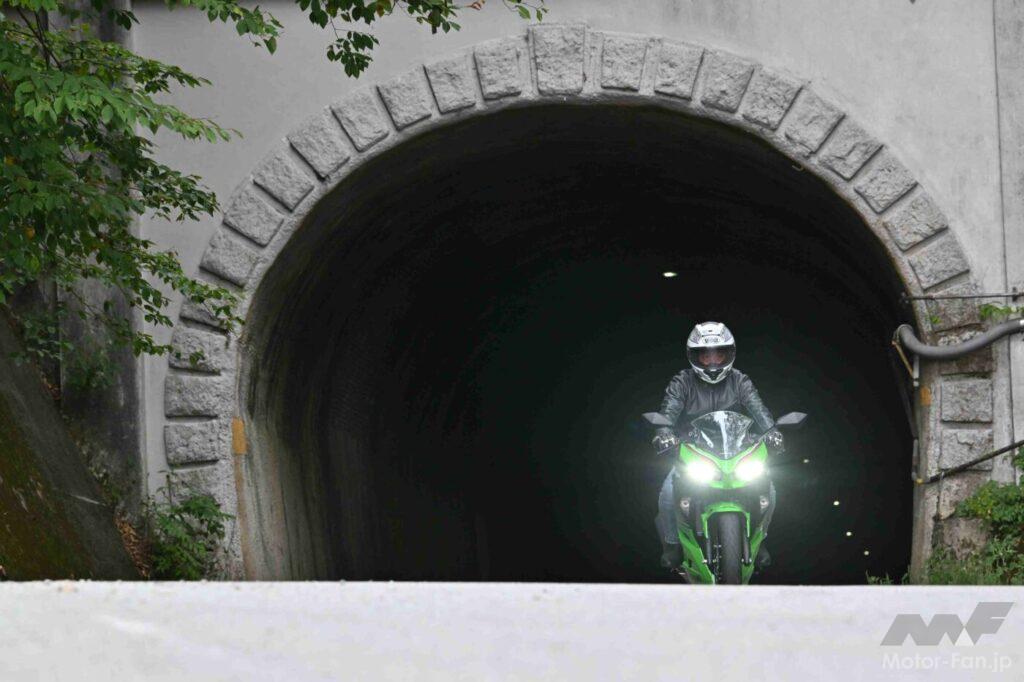
However, during this test ride, I felt that the Ninja 400 is fast enough without having to rev it up to high RPMs, and that you can still fully enjoy the fun of revving it up to high RPMs. And it is precisely because it has such an engine that I have come to like this bike.
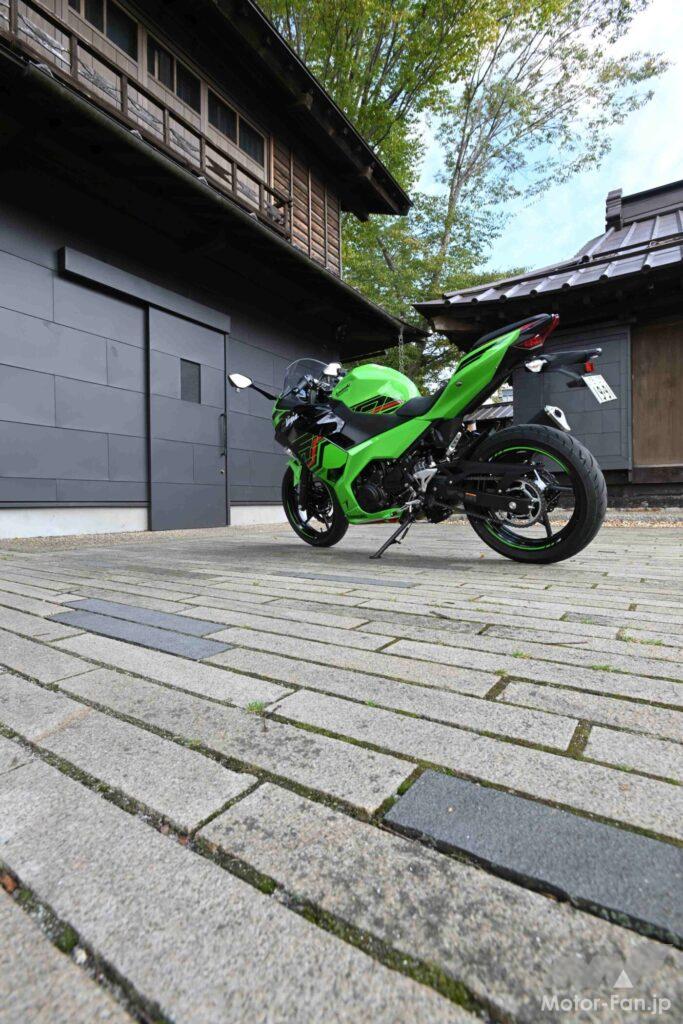
Next to the engine characteristics, what caught my interest was the riding position. That being said, among modern 400cc full-cowl sports bikes, only the RC390 has an aggressive riding position that is designed for circuits and mountain roads, and contrary to its racing looks, the riding position of the Ninja 400 is that of a sports tourer (the same goes for the CBR400R. The YZF-R3 has low handlebars, but is not aggressive).
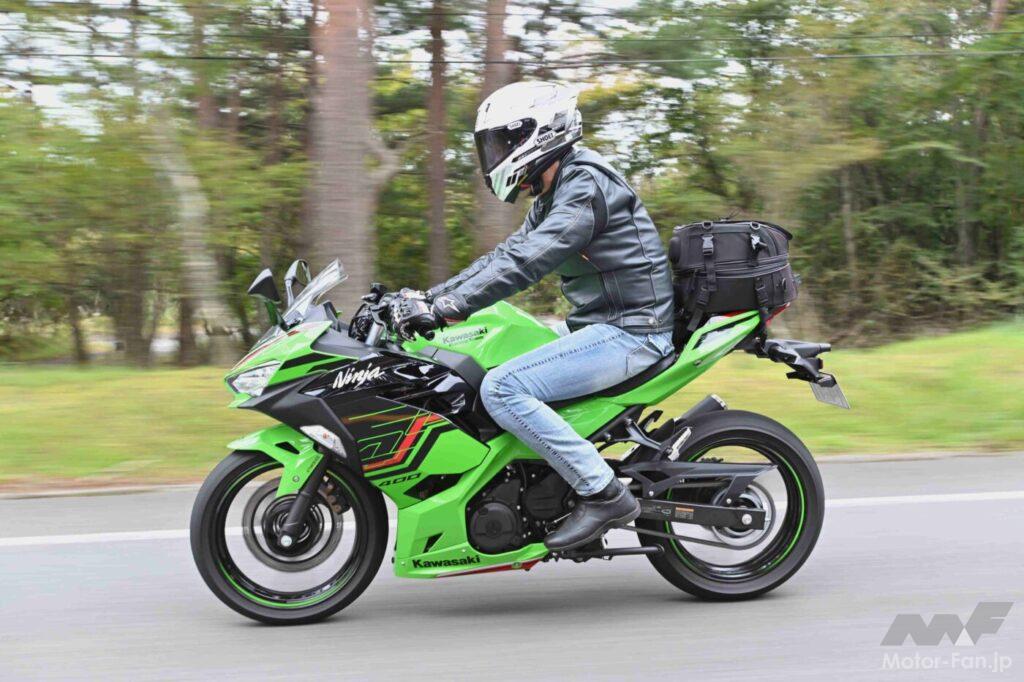
So when I first test rode the Ninja 400 a few years ago, I felt there was something missing, but this time, my focus was on city riding and long distances, so I was actually grateful for the riding position that was more like a sports touring bike. So, although it’s hard to say whether this is a good or bad thing, if I were to become a Ninja 400 owner, I would at least change the seat to the genuine accessory high seat, which increases the seat height by 30mm (from 785mm to 815mm) compared to the standard. Of course, if I were mainly using it on the circuit, I would consider adding lower handlebars and rearsets.
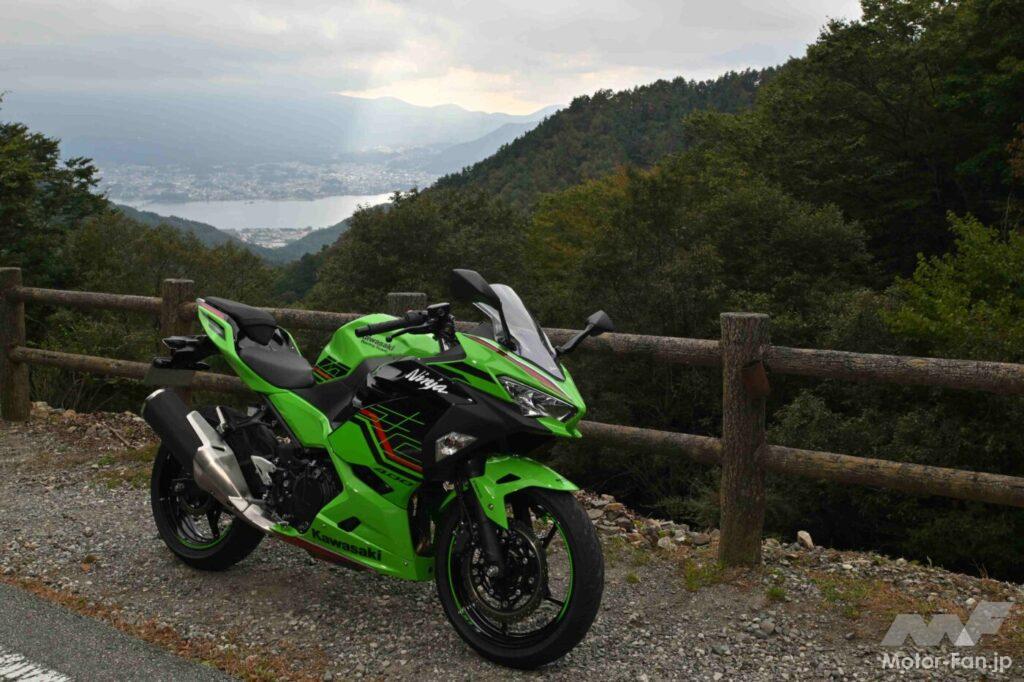
Well, since I used up quite a lot of characters in the introduction, I was only able to write a partial review this time, so in the second part, which will be published soon, I would like to share my impressions from a long run of about 700km, which took place over two days and one night, mainly on public roads, from western Tokyo to Joetsu City, Niigata Prefecture.
Although it is difficult to tell from the exterior, the current Ninja 400/250 frame has a special structure in which the swingarm mounting block is separate. As with the front mask, the model that pioneered this structure was the Ninja H2, which debuted in 2015.
Main specifications
Model: Ninja 400
Model: 8BL-EX400L
Length x Width x Height: 1990mm x 710mm x 1120mm
Wheelbase: 1370mm
Ground Clearance: 140mm
Seat Height: 785mm
Caster/Trail: 24.7°/92mm
Engine Type: Water-cooled 4-stroke parallel twin
Valve Type: DOHC 4-valve
Total Displacement: 398cc
Bore x Stroke: 70.0mm x 51.8mm
Compression Ratio: 11.5
Maximum Power: 35kW (48ps) / 10,000rpm
Maximum Torque: 37N・m (3.8kgf・m) / 8,000rpm
Starting Method: Self-starter
Ignition Method: Full Transistor
Lubrication Method: Wet Sump
Fuel Supply Method: Fuel Injection
Transmission Type: Constant Mesh 6-Speed
Return Clutch Type: Wet Multi-Disc Coil Spring
Gear Ratio
1st Gear: 2.830
2nd Gear: 1.930
3rd gear: 1.420
4th gear: 1.140
5th gear: 0.960
6th gear: 0.840
1st and 2nd reduction ratios: 2.218 and 2.928
Frame type: Trellis (diamond type)
Front suspension: Telescopic upright type φ41mm
Rear suspension: Bottom link mono shock
Front tire size: 100/70R17
Rear tire size: 150/60R17
Front brake type: Hydraulic single disc
Rear brake type: Hydraulic single disc
Vehicle weight: 167kg
Fuel used: Unleaded regular gasoline
Fuel tank capacity: 14L
Passenger capacity: 2 people
Fuel consumption rate (Ministry of Land, Infrastructure, Transport and Tourism notification value): 31.1km/L (2 people)
Fuel consumption rate (WMTC mode value, class 3-2): 25.7km/L (1 person)