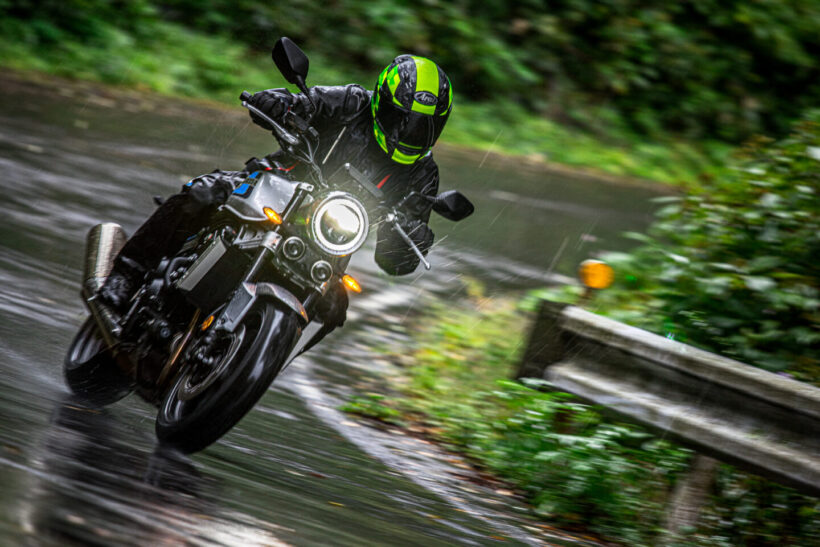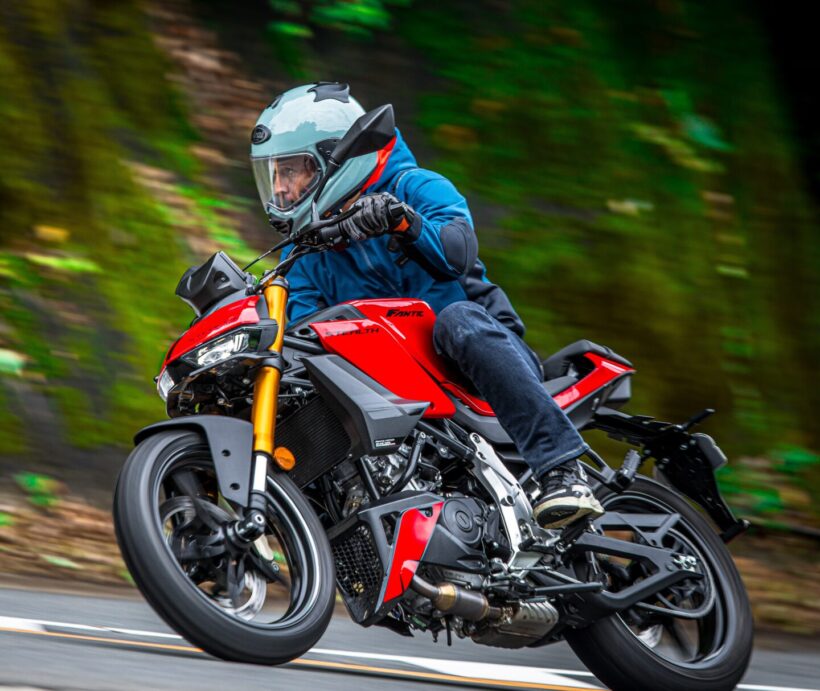

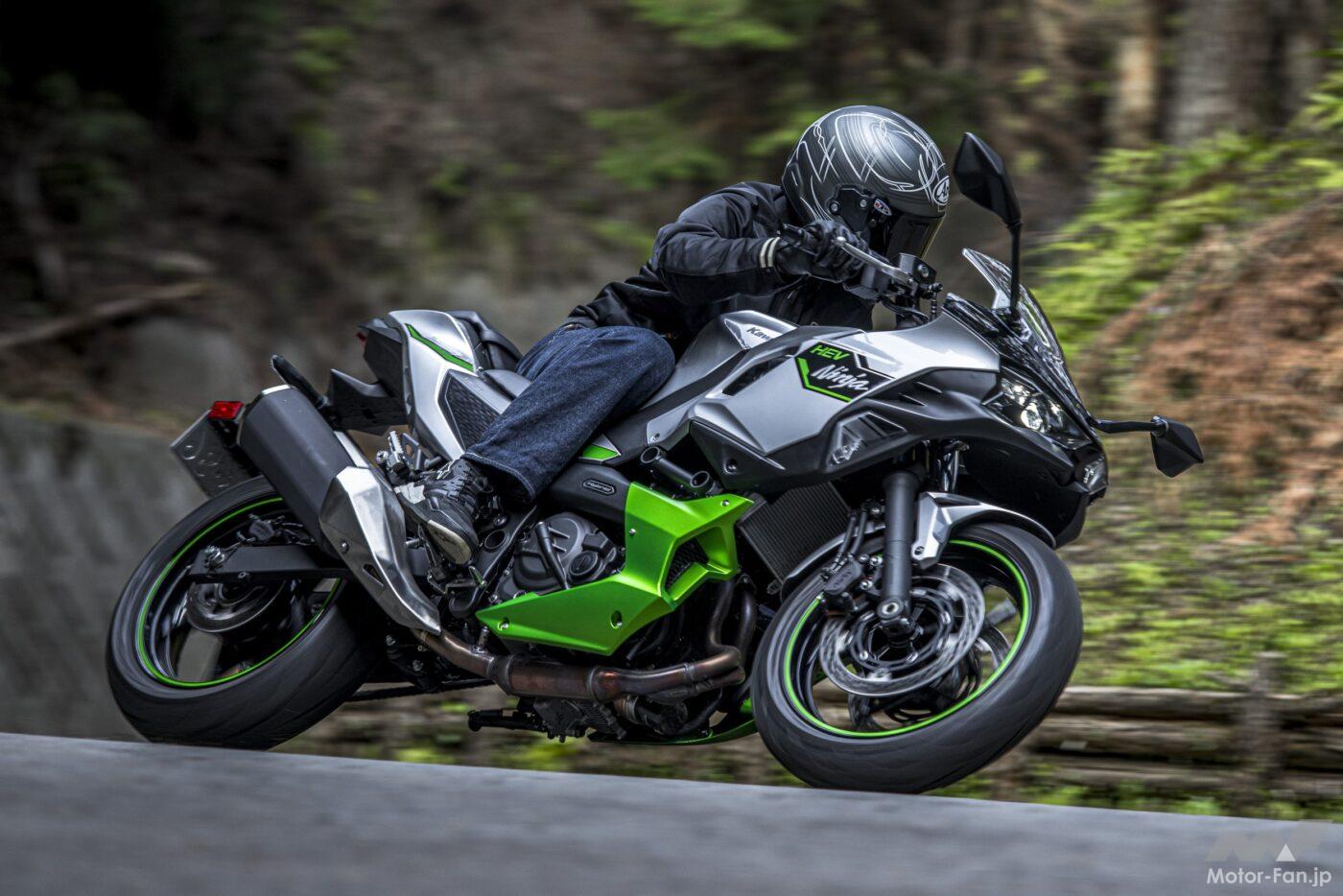

Kawasaki Ninja 7 Hybrid… ¥1,848,000 (released February 15, 2025)
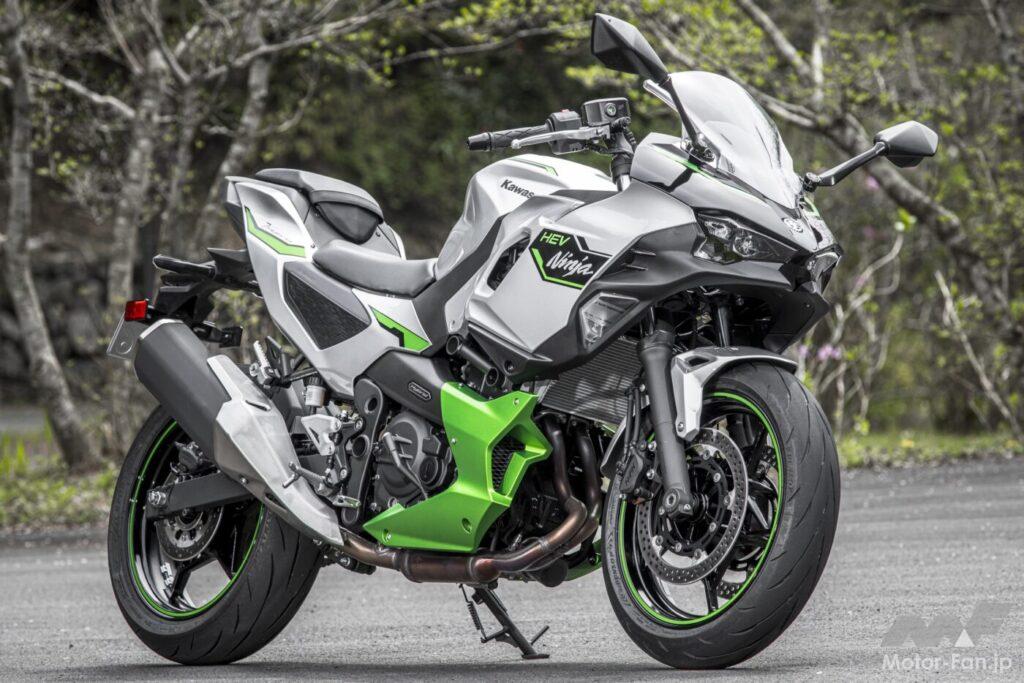
The original release date for both the Ninja 7 Hybrid and the Z7 Hybrid was June 15, 2024, but due to various circumstances, this has been postponed to February 15, 2025. Both models are priced at 1,848,000 yen and are “Kawasaki Care Models” that include three years of after-sales care.
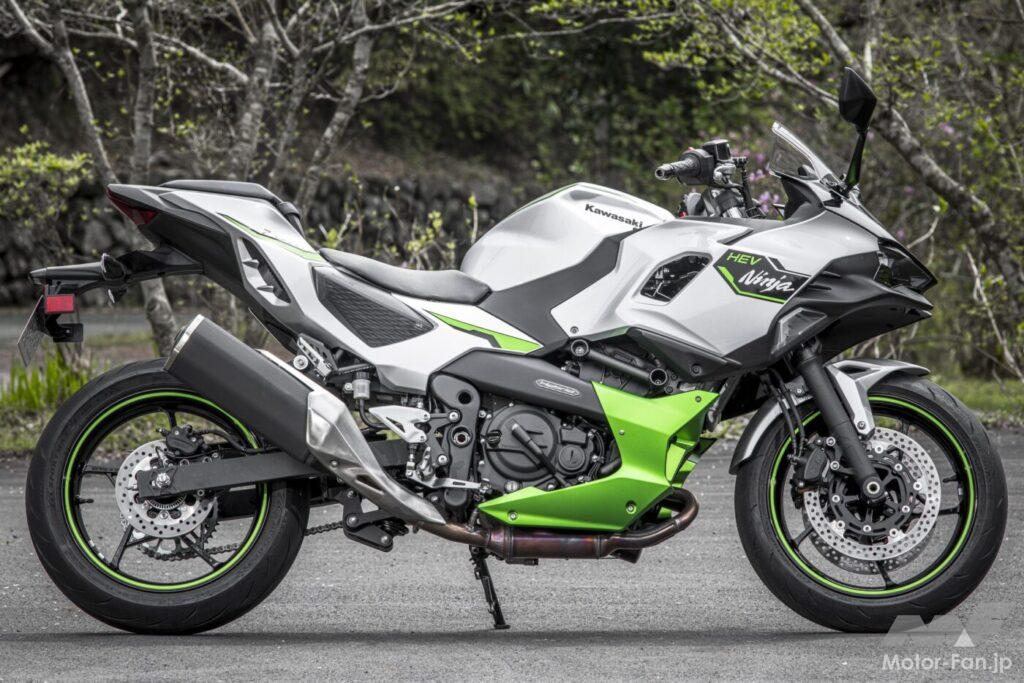
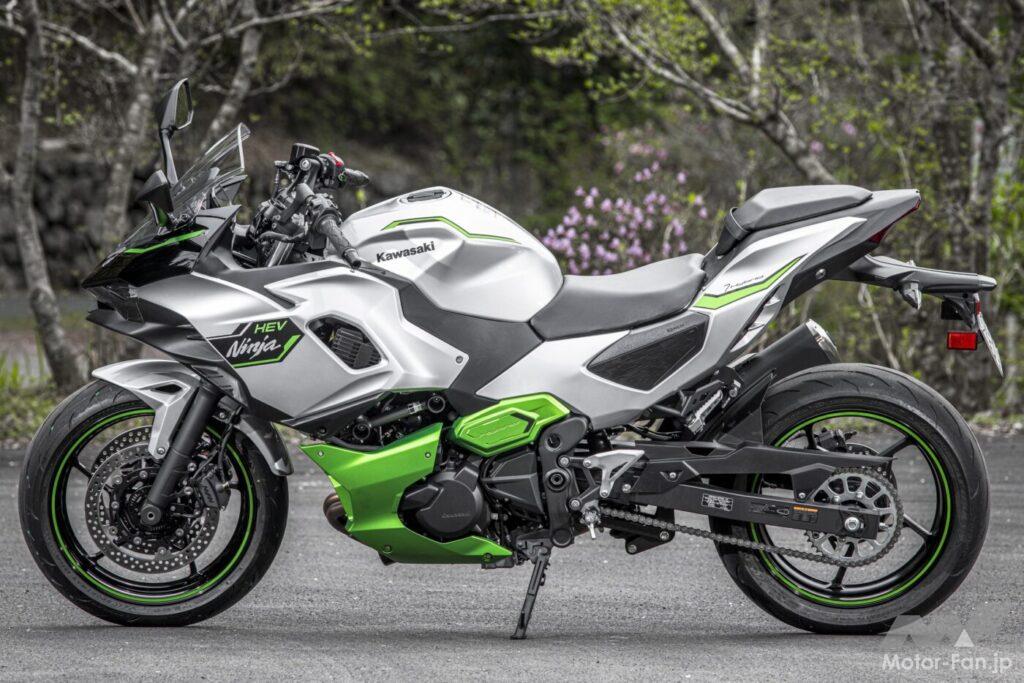


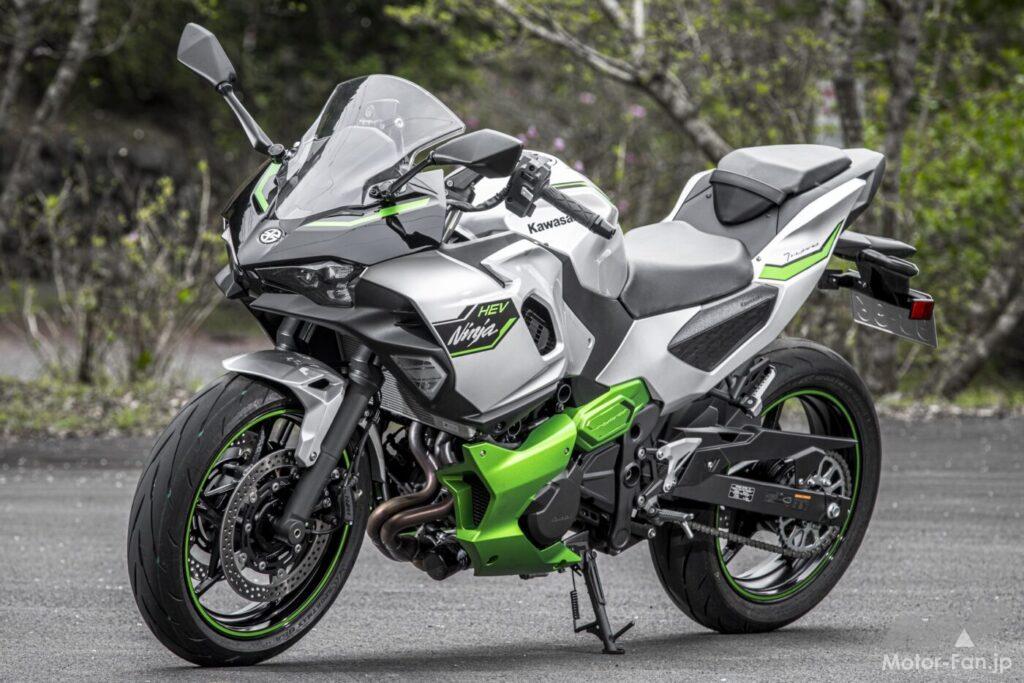
The official wheelbase is 1535mm, which is 15mm longer than the cruiser Eliminator, and the weight is 228kg, approaching that of the Ninja 1100SX, so when maneuvering it, you’ll want to actively use the walk mode (forward speed approx. 3km/h, reverse approx. 2km/h).
The system specs are comparable to those of a 650cc class, and the e-boost acceleration is intense!
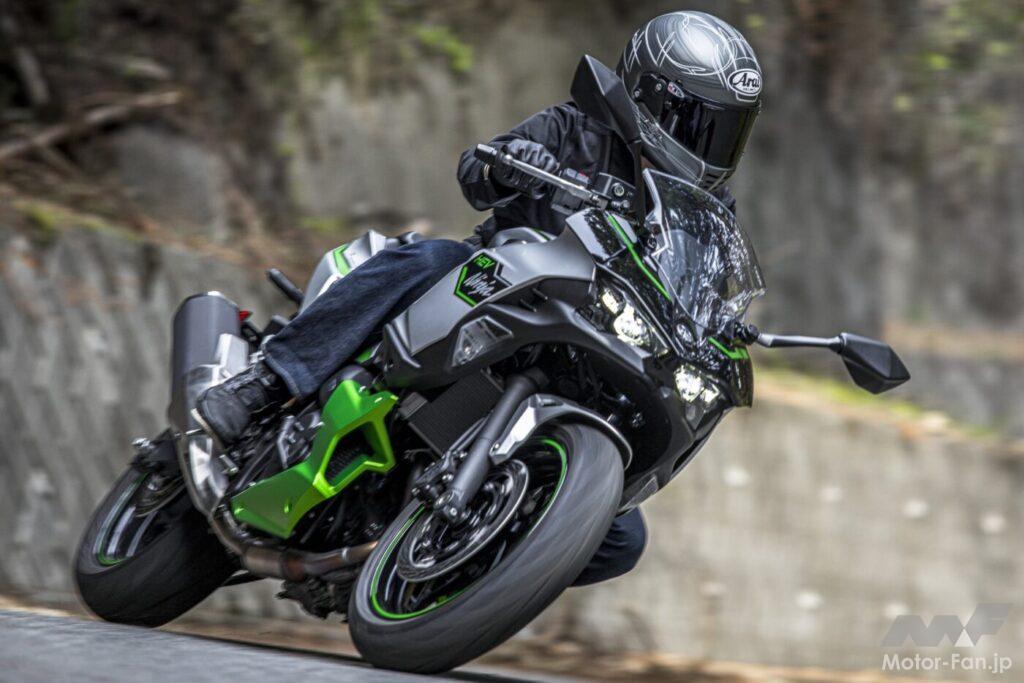
The first time I saw the actual vehicle was at the Japan Mobility Show 2023 held in October 2023. A year and a half has passed since then, and I finally had the opportunity to test drive the Ninja 7 Hybrid. This new vehicle is the world’s first mass-produced strong hybrid motorcycle, and the power unit and transmission it is equipped with are a bit complicated, so please take a look at the images and captions first.
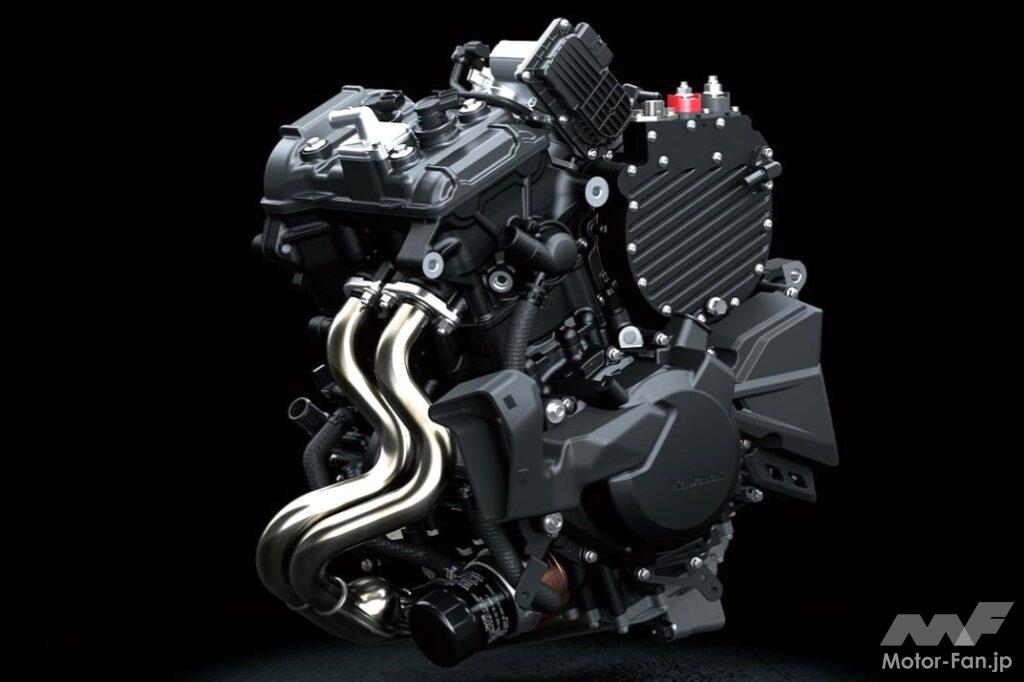
The engine is based on the 451cc water-cooled, four-stroke, DOHC, four-valve, two-cylinder engine that is installed in the Ninja/Z/Eliminator 500 for overseas markets, with changes made to the compression ratio (11.3 to 11.7:1), throttle bore diameter (φ32 to 36mm), primary reduction ratio, and six-speed transmission ratios. The maximum output of the engine alone has been increased from 45.4 PS (Ninja 500, EU spec) to 58 PS. The ISG (Integrated Starter Generator) is located on the left side of the crankcase, and the idle stop function works when in Eco HV mode.
ADVERTISEMENT
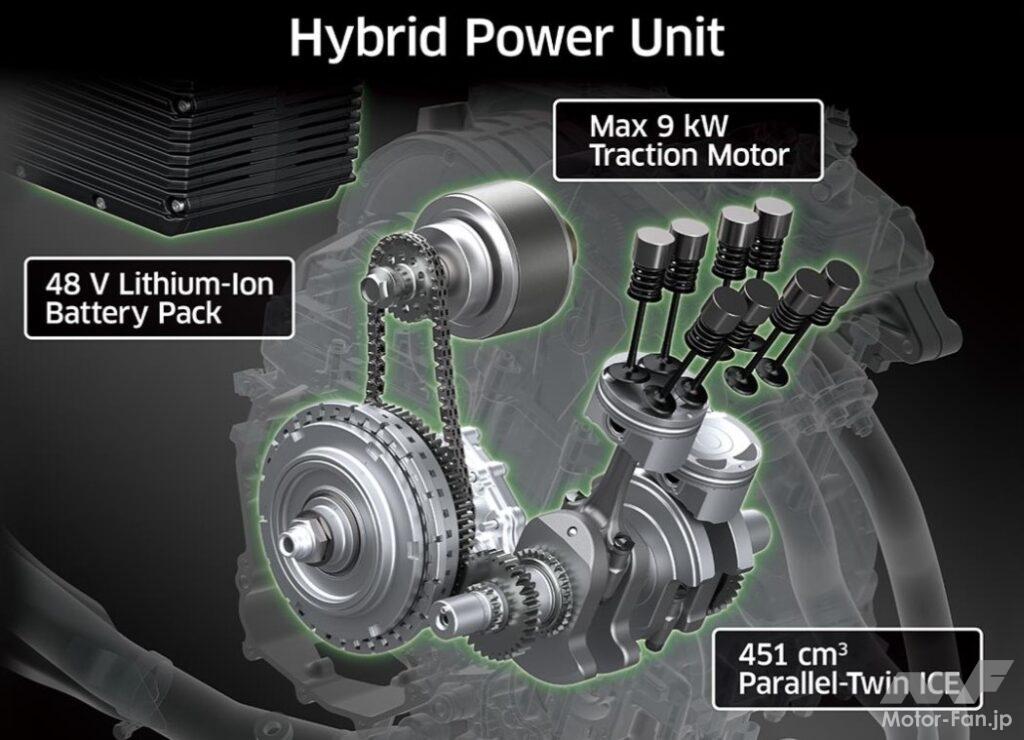
The drive motor, which generates 9kW (12.2PS), is located behind the cylinder, and a 48V lithium-ion battery is placed under the seat. The system has a maximum output of 69PS and a maximum torque of 60Nm, which is the same spec as the Ninja 650 (68PS, 63Nm).

It uses Kawasaki’s unique electronically controlled transmission, which has two modes: fully automatic (AT) and manual operation (MT). The hydraulic clutch is controlled by a dedicated oil pump and solenoid valve, so there is no clutch lever. Also, when operating manually, gear changes are performed using two shift selectors on the left switch box, so there is no shift pedal. ALPF (Automatic Launch Position Finder), which automatically returns the gear to first gear when the vehicle comes to a stop, can be selected as desired.
In recent years, Yamaha and BMW have made big announcements about their automatic transmissions, known as the Y-AMT and ASA, respectively. Kawasaki has also adopted a similar system in the Ninja 7 and Z7 Hybrids. There are three riding modes: Sport HV mode, in which the drive motor assists the engine; Eco HV mode, in which the engine and motor work together while driving after starting off on the drive motor alone; and EV mode, in which the engine and motor work together while driving on the drive motor alone. Sport HV mode is manual transmission only, Eco HV mode is available with either manual or automatic transmission, and EV mode is automatic transmission only (maximum speed 60 km/h, up to fourth gear). Shifting with the manual transmission is performed using the shift selectors located in front of and behind the left switch box, with upshifts only possible when the throttle is open and downshifts only when it is closed. This means that unlike Honda’s E-Clutch, shifting is not possible regardless of the throttle opening or closing direction.
The “e-Boost” system, which is also used in the fully electric Ninja/Z e-1, can only be used in Sports Hybrid mode. It is a system that uses the drive motor to increase power output across the entire range to that of a 650cc engine for approximately five seconds, and is activated when the vehicle speed is over 10km/h and the throttle opening is 20% or more. There is also a “Launch e-Boost” function that can be used when starting, but this can only be set when the vehicle is stopped; if the vehicle speed exceeds 100km/h or the gear is shifted into third gear or higher, the function will be forcibly stopped.
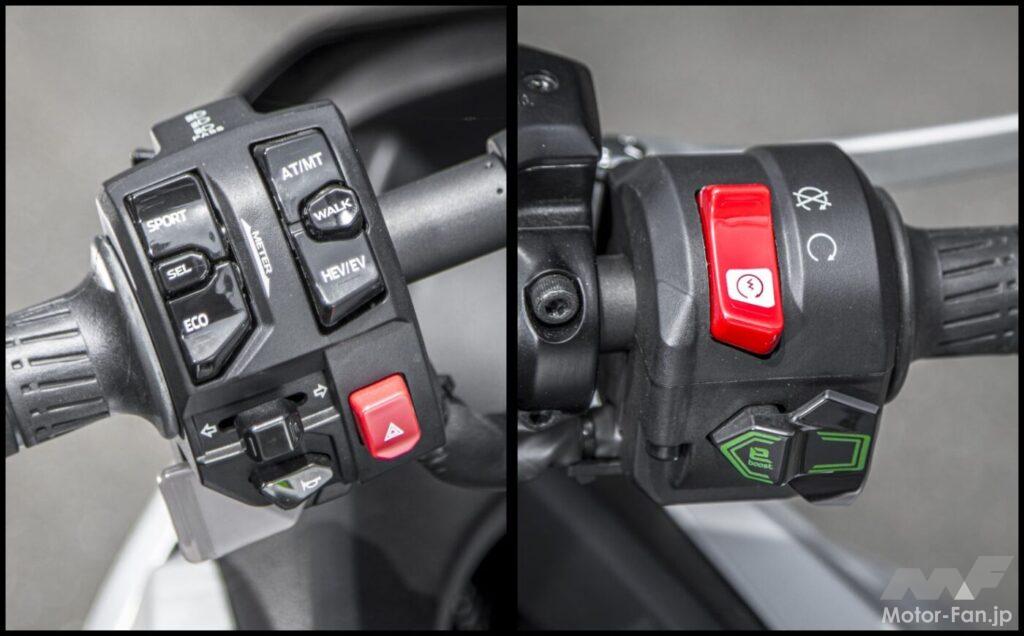
The e-Boost button is located on the right-hand switch box. It is surprisingly difficult to press it when the throttle is open above 20%. Riding modes and MT/AT mode switches are all located on the left-hand side.
Those of you who have patiently read this far may have noticed that the operation and prerequisites are complicated, and we have spent 1500W just explaining them. And this is not all, as even after a full day of test riding you may still be wondering, “Um, why doesn’t it switch to walk mode?” Please be prepared that it will take a considerable amount of time to get your body used to it.
Now, let’s explain our impressions of each riding mode. We’ll start with the most lively Sport HV mode. In this mode, the engine is always running. The 180-degree phase-shift crank gives off a pulsating feeling equivalent to a 451cc displacement, but the acceleration clearly exceeds that, creating a truly mysterious sensation. What’s more, the assist and regeneration system provided by the drive motor is exquisite, resulting in no sense of discomfort in the throttle response. Gear changes using the shift selector are extremely smooth and quick, with very little shift shock regardless of the RPM range at which you shift up or down. The ALPF system, which automatically returns to first gear before coming to a stop, also works well, and it seems that you’ll only need to shift up when driving stop-and-go in town.
The acceleration power of the e-Boost is so sudden that it can be described as intense and powerful in a straight line. It certainly feels like the same power as a 650cc, or even more so, but since the vehicle weighs 34kg more than the Ninja 650, you should be concerned about whether you can slow down sufficiently when using the e-Boost. Also, despite being packed with cutting-edge technology, it does not have traction control, so you should be extremely careful when using the e-Boost in slippery conditions.
Next is Eco HV mode, which is suitable for everyday use. Here, the automatic transmission can be selected, making riding even easier. When waiting at a traffic light, the engine stops idling, and when the throttle is opened, the vehicle starts quietly using only the drive motor. The engine starts once the vehicle passes 20 km/h, and the vehicle sequentially shifts up to third gear at 30 km/h and fourth gear at 40 km/h. In normal city situations where acceleration and deceleration are required, such as when a throttle opening of 25% or less is sufficient, the automatic transmission shifts gears extremely smoothly, and downshifts are also performed appropriately. However, if you frequently use the throttle opening above 50% and try to ride vigorously, the hydraulic clutch remains disengaged for long periods of time, causing an impact strong enough to pitch the vehicle with each gear change.
Additionally, on a mountain pass with a steep uphill gradient, there were many instances where the rider was unable to communicate with the system, such as trying to exit a corner in third gear even though the speed had dropped to 20km/h during a turn. However, the impression is that the hardware is almost complete, so with the software refined, this electronically controlled transmission will likely see significant changes.
The last mode is EV mode, which runs on the drive motor alone. When you open the throttle and start moving, the bike automatically shifts up to fourth gear, with a top speed limited to 60km/h. Considering that the motor’s maximum torque is generated in the low rotation range of 0-2400rpm, it makes sense to combine it with a stepped transmission, and I liked how, unlike typical electric motorcycles, the torque feels uninterrupted up to 60km/h. The driving range is very short at around 10km, so it can only be used in limited situations, such as when driving through quiet residential areas, but it is still a very practical mode.
Unique handling that complements the long wheelbase

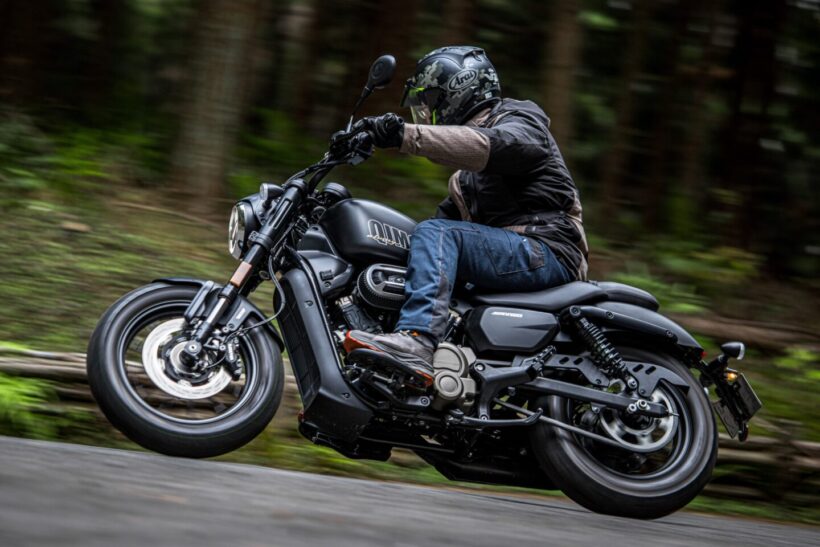
In terms of handling, perhaps to compensate for the low turning ability due to the long wheelbase of 1535mm, the front wheels turn in quickly or tend to turn inwards, resulting in a somewhat unique maneuverability. However, it’s not so bad that it can be described as cutting in, so as long as you make sure not to interfere with the steering movement, you can turn corners smoothly.
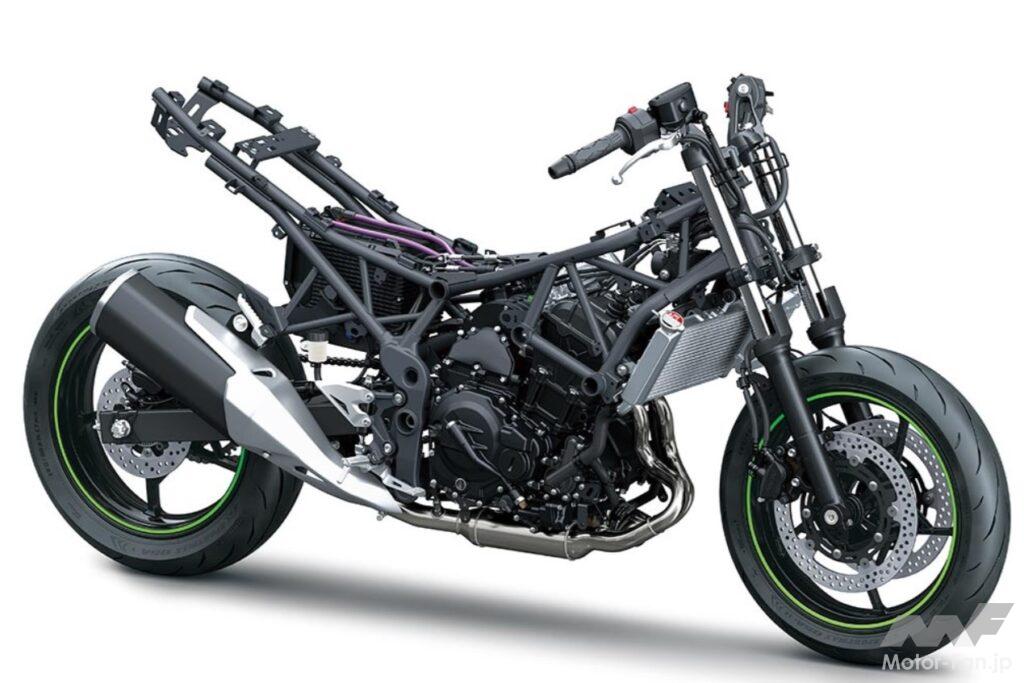
The frame is a diamond (trellis) type. Because the 50.4V lithium-ion battery (weighing 13kg) for motor drive is located under the seat, we suspect that the wheelbase had to be extended to gain rear wheel travel and distribute the load on the front wheels.
The front suspension is a non-adjustable 41mm upright fork, and the rear is a link-type monoshock, with only preload adjustment possible. The square-section steel pipe swingarm on a bike that costs over 1.8 million yen is a bit disappointing, and the front and rear suspensions don’t work as well as they should, but the ride was comfortable, likely thanks in part to the standard tires (Dunlop Sportmax Q5A).

The standard tires are Dunlop Sportmax Q5A. The front forks are 41mm upright and have no adjustment mechanism. The front calipers are Nissin pin-slide, single-side, two-piston calipers.
ADVERTISEMENT
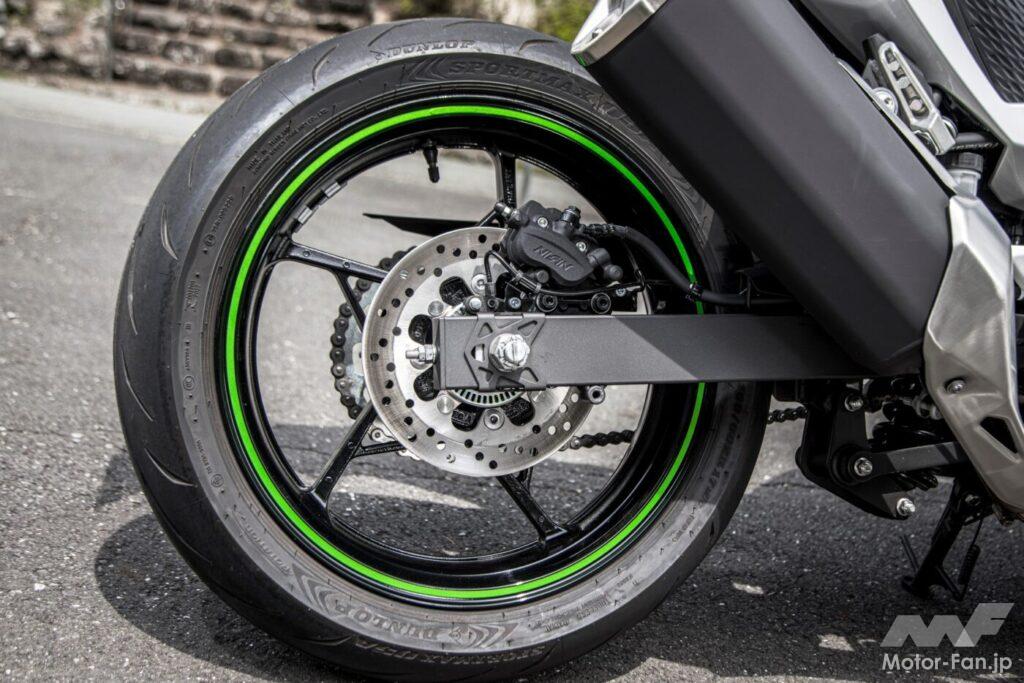
The swingarm is made of square-section steel pipe. The rear suspension is a link-type monoshock with seven adjustable preload positions. The standard position is the fourth position from the weakest.
The brake set has more than enough stopping power to slow down the 228 kg body, and it is easy to control. The ABS is a simple type that does not take into account banking angle, but I felt that the intervention level was appropriate.
Looking back at Kawasaki’s long history, there are many models that have attempted new power units but were never released, such as the water-cooled, two-stroke, four-cylinder Square-Four 750 and the rotary engine X-99. The Ninja 7 Hybrid was released despite its release date being postponed, and we would like to express our respect for that. The ride of a strong hybrid is one of a kind, and for those who want to support Kawasaki’s futuristic technology, this new model is sure to strike a chord with you.
Riding position and foot reach (175cm/68kg)

The handlebars are separate, but the grip position is high, so you only have to lean your upper body forward a little. The riding position is compact, equivalent to that of a 400cc class bike.
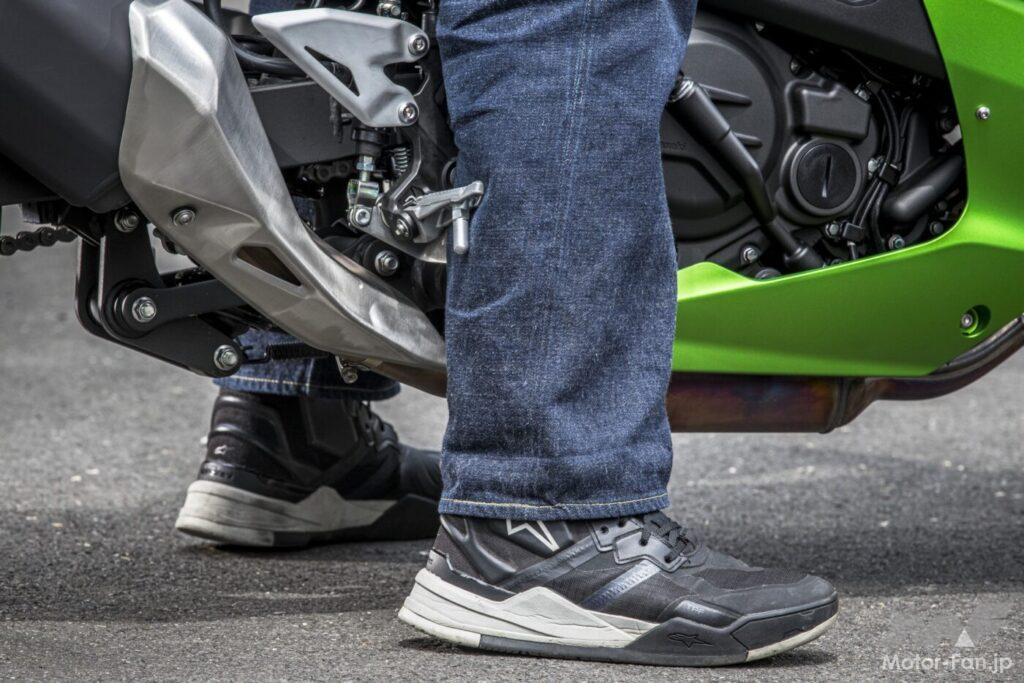
The seat height is 795mm, which is 5mm higher than the Ninja 650, but as you can see, the foot reach is good. Although it is equipped with a drive motor and a large-capacity battery, the width of the part that you straddle is slim.