
Kushitani’s racing service at the MotoGP site
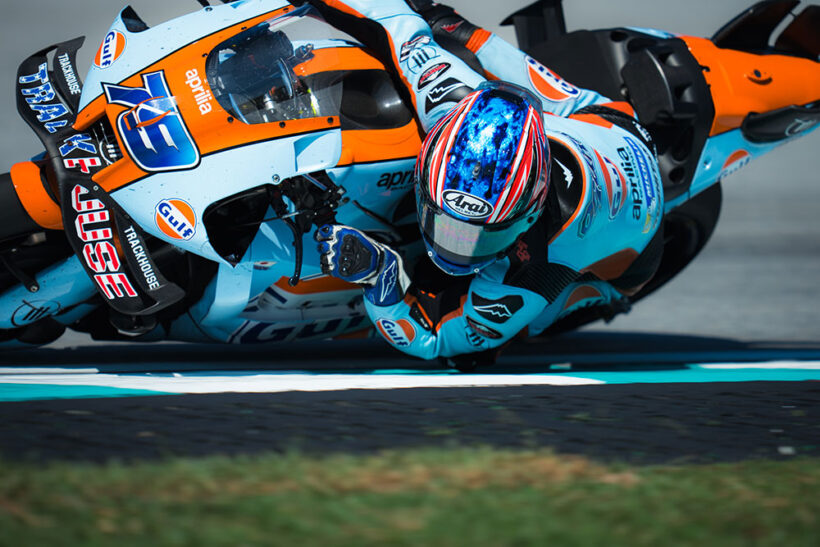
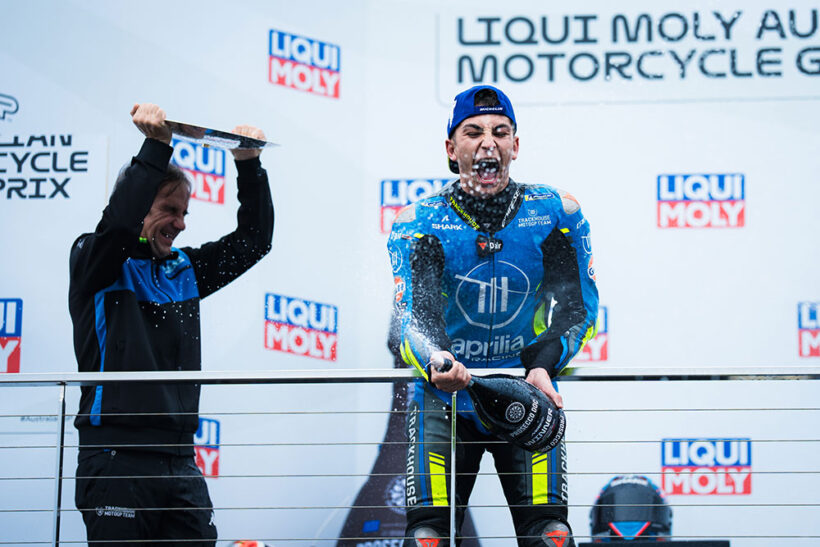
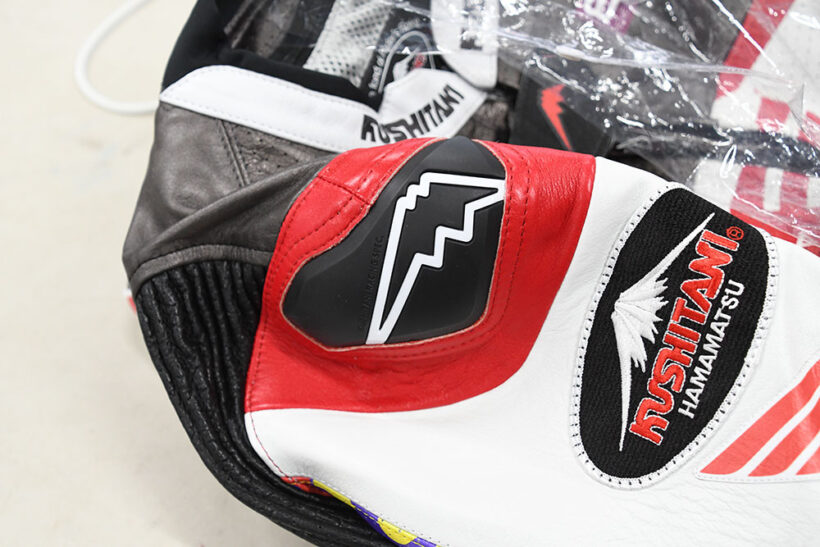
One of the manufacturers supplying racing suits to the MotoGP paddock is the Japanese manufacturer Kushitani. In the 2025 season, Kushitani will be moving into the top class with MotoGP riders Ai Ogura (Trackhouse MotoGP Team) and Somkiat Chantra (IDEMITSU Honda LCR). This season, Kushitani is supporting riders in the MotoGP class, as well as riders from IDEMITSU Honda Team Asia in the Moto2 class and Honda Team Asia in the Moto3 class.
We spoke to Kushitani’s Racing Service Manager, Maki Mutsuura, at the Japanese Grand Prix about the MotoGP scene. This article focuses mainly on racing suits, but we also have a separate article focusing on gloves, so please take a look. (Article: “Protecting the hands of MotoGP riders. Kushitani takes on the front lines of glove development” )
First, the Racing Service routine begins. They arrive at the circuit on Wednesday to set up the workshop, and work begins on Thursday. Thursday is a day when no races take place, but preparations are made for the races that begin on Friday.
“We start by repairing any racing suits that were involved in a crash in the previous race, and maintaining and charging the airbags. For European Grands Prix, we sometimes bring repaired or new racing suits from Japan. Of course, we fix anything that can be fixed on site, but in the MotoGP class, it can be difficult to fully repair a suit that has been involved in a crash on site, so in those cases we bring the suit back to Japan, repair it there or in Thailand, and then take it to the next round.”
“When we take the racing suits to Europe, we remove all the padding from the shoulders and elbows to make them as light as possible, so we have to reassemble them once we arrive. We then install the airbags and prepare them for handing over to the athlete. We also make small repairs to the racing suits, even if they haven’t crashed, and repaint them.”
Meeting with the riders and listening to their requests is also an important part of the job. There are no races on Thursdays in particular, so the riders still have relatively free time. Of course, there are many media appearances and event attendances, but when the races start on Fridays, the riders’ mood changes considerably.
“There’s not much we can do on-site, but there are things we can do. Ogura sometimes drops by (the Racing Services office), and some riders even come to talk to us.”
On Friday, the practice session begins. In the case of riders like Ogura and Chantra in the MotoGP class, their assistants usually bring the racing suits they used to the racing service. For riders in the Moto2 and Moto3 classes, Kushitani’s racing service staff go to the pit to pick up the racing suits and take care of them. Kushitani supports riders in all three classes, so just imagining it is a busy time. If a crash occurs, there is even more work to be done.
“If a rider falls, we check the actual racing suit and clean it. We also have to decide whether it can be used for the next race, and if it can’t be used, we have to bring out the racing suit we have prepared.”
“That said, it’s not often that the suit can be used immediately after a crash. We provide another racing suit, and in the meantime we wipe the one we crashed on, paint over any areas that have come off, or even sew it up if necessary. That’s why we always have a few spares on hand.”
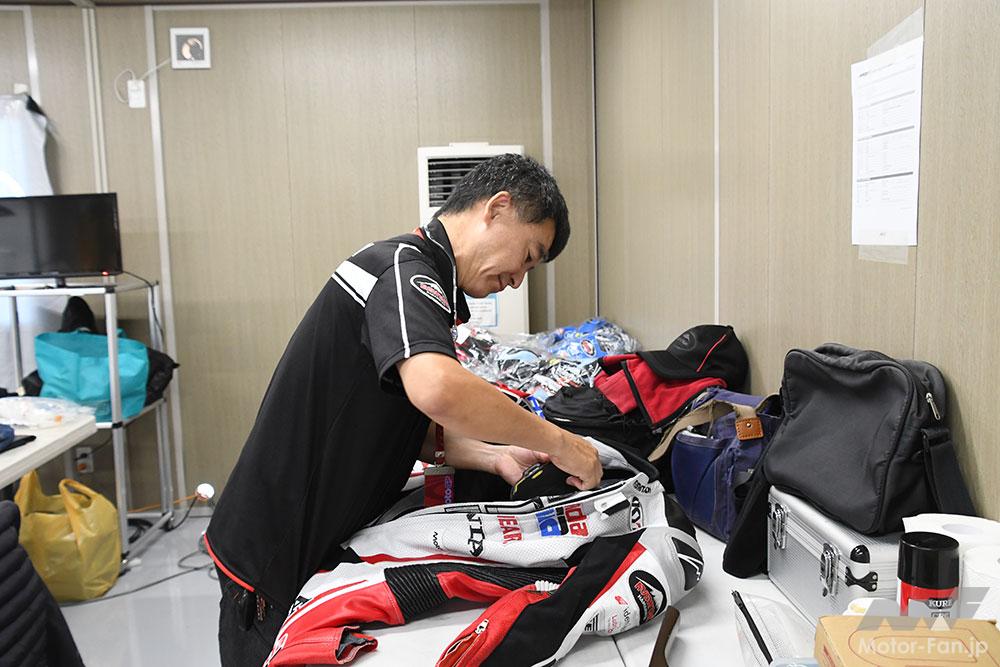
If any pads have been removed, they will need to be installed before the start of the race on Friday. ©Eri Ito
ADVERTISEMENT
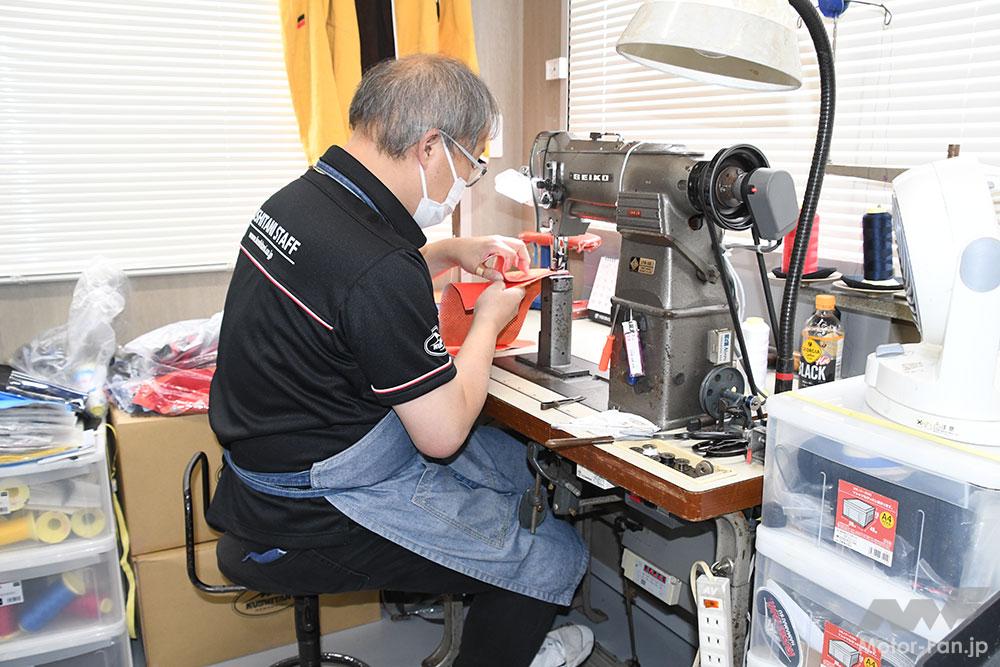
Repairing racing suits with a sewing machine in the paddock ©Eri Ito
ADVERTISEMENT

The parts that come into contact with the tank get scratched. These parts are also repainted. ©Eri Ito
ADVERTISEMENT

The leather on the knee grip area will discolor as shown here. This will also need to be painted. ©Eri Ito
The difficulties of being a Japanese manufacturer
As the only Japanese manufacturer supporting racing suits in the MotoGP paddock, they are faced with the “barriers of distance and time between Japan and Europe.”
The home of motorsports is Europe. For example, in the 2025 season, more than half of the 22 races will be held in Europe. Racing services in Europe are carried out using mobile service trucks, so not all of the facilities are exactly the same as in Japan. If repairs are difficult to make on-site, the parts will have to be transported back from Europe to Japan. If spare parts need to be replenished, they will have to be transported from Japan to Europe. Roughly speaking, it takes two days by plane and rental car to get from Japan to each European circuit.
“In the case of Japan, we have to consider logistics. There is a limit to the amount we can bring in from Japan. If we were to send it, it would take at least an extra week, and in some cases two weeks. European manufacturers, for example, Italian manufacturers, can bring it in immediately. In that respect, we are at a disadvantage compared to European manufacturers. But we have to be aware of that and do it. To compensate, we may have to provide more in some cases, or we need to operate more sewing machines on-site than other manufacturers.”
In this situation, Kushitani has been providing racing services at all races since this season.
“This is true in every category, but there is a difference between being there and not being there. Naturally, there are some things you can do less overseas. I think that having Kushitani Racing Service on-site at every race gives the drivers peace of mind.”
The size of the racing suit may change depending on the class…
One of his important duties is to listen to the riders’ requests, and Chantra, who became a MotoGP rider this season, says he often has requests regarding size.
“Chantla’s arms have gotten thicker through training, and his demands have changed. Especially since he moved up to MotoGP this year. I guess it’s because he’s been training, but he’s starting to wonder, ‘Were his arms really this thick?’ So we’ve been working on gradually adjusting the size.”
“In some cases, we will measure only the parts that have changed in size, but if we look at the whole suit and the balance is too off, we will of course re-measure the whole thing. Depending on the situation, we may decide to lengthen just the arms of the racing suit, or the bust, or, no, this is no longer possible so we will have to remake it, and this decision will be made on a case-by-case basis.”
On the other hand, Ogura, who also became a MotoGP rider this season, doesn’t seem to have many demands when it comes to racing suits, not just size.
“Even when we provide the options and give them to customers, they often say, ‘There’s no need to change anything,'” Mutsuura says with a wry smile.
“We’ve been working with him since the CEV (now the FIM Junior GP World Championship, an important championship that serves as a stepping stone to MotoGP), so I think he trusts us. We’re the ones who are constantly making improvements, and I get the impression that he’s a rider who doesn’t say much about it.”
“Even when it comes to size requirements, Ogura hasn’t made many changes, like building up and getting bigger arms. He mainly trains by riding a bike.”
The reason there aren’t many requests is typical of Ogura Ai, who focuses all her attention on what she can do.
“In Ogura’s case, I get the impression that he is more focused on achieving success through his own running than on those small details.”
“Someone once said to me, ‘You should only talk about racing suits after you’ve done everything you can and the car has done everything you can,’ and I replied, ‘That’s not the point. There’s still a lot of work to do.'”
However, the most important thing is that Kushitani racing suits are so comfortable that you don’t need to pay any attention to them while driving.
In the midst of all this, Kushitani continues to make detailed suggestions to Ogura and Chantra for further improvements. For example, sometimes the size is changed as an improvement proposal from Kushitani, rather than as a request from Ogura himself.
The bike used by MotoGP riders is based on the Nexus 2 K-0080XX ARISE SUIT.
“Of course, there were some changes in size when she was still growing, but now her body size hasn’t changed much. However, we do make adjustments to the size by saying, ‘We want to get rid of this wrinkle.'”
“By ‘wrinkles’ I don’t just mean the shirring, but also the excess leather that remains when worn. If we can remove even a small amount of wrinkles (by using less leather), the garment will be lighter. Mr. Minagawa (Tomohiko), who is in charge of this, is very concerned about such things.”
“We’ve made progress by making these small adjustments, while also considering whether it would be easier or harder to move with the suit on. So, compared to when Ogura was first with Team Asia, I think the photos of him wearing the racing suit look a lot slimmer (there are no wrinkles).”
Aerodynamics is an important element in racing suits
The technology developed in the MotoGP field will be fed back into new commercial products. Kushitani’s current high-end racing suit is the Nexus 2, but Mutsuura reveals that the next model is in the works.
“In fact, Nexus 3 is already on standby.”
“(The Nexus 3) incorporates many of the details and modifications made in MotoGP. Therefore, it will be a racing suit that is much closer to the MotoGP suit than the Nexus 2.”
One of the improvements is the hump, or the bump on the back.
Just as with motorcycles, aerodynamics is a very important factor when it comes to racing gear such as racing suits and helmets. The Nexus 3 will eliminate the hump that affects aerodynamics. This is technology that was developed precisely in the MotoGP world, where the world’s best riders race at speeds of over 300 km/h.
“In fact, the previous model of the Nexus 2 used the same back hump that Kushitani had used for generations. However, Hirokazu Aoyama (currently Honda Team Asia manager and 2009 250cc champion) returned to be one of our support riders and was to test ride the RC213V in 2015, so we supplied him with a racing suit.”
“He said that doing so would cause the head to shake. So we investigated the shape of the hump on the back and finally had them give it a shape that took aerodynamics into consideration. First of all, the shaking was reduced and the bike was able to achieve top speed. At that test, Aoyama-san was the one who achieved top speed.”
“That was designed to prevent the car from shaking when turning into a corner. I don’t know for sure, but I think it was because the car didn’t lose its shape when exiting a corner that it was possible to open the throttle. The Nexus 2 is the car that has achieved this hump in its back for sale.”
However, the installation of airbags in racing suits became mandatory in 2018. Kushitani uses airbags from another company (currently Alpinestars Tech-Air®), and since the ECU and gas cylinder need to be stored in the hump, the design prioritizes that.
However, since we have made something good with Nexus 2, we want to reflect that, so the bumps in Nexus 3 may change a little.
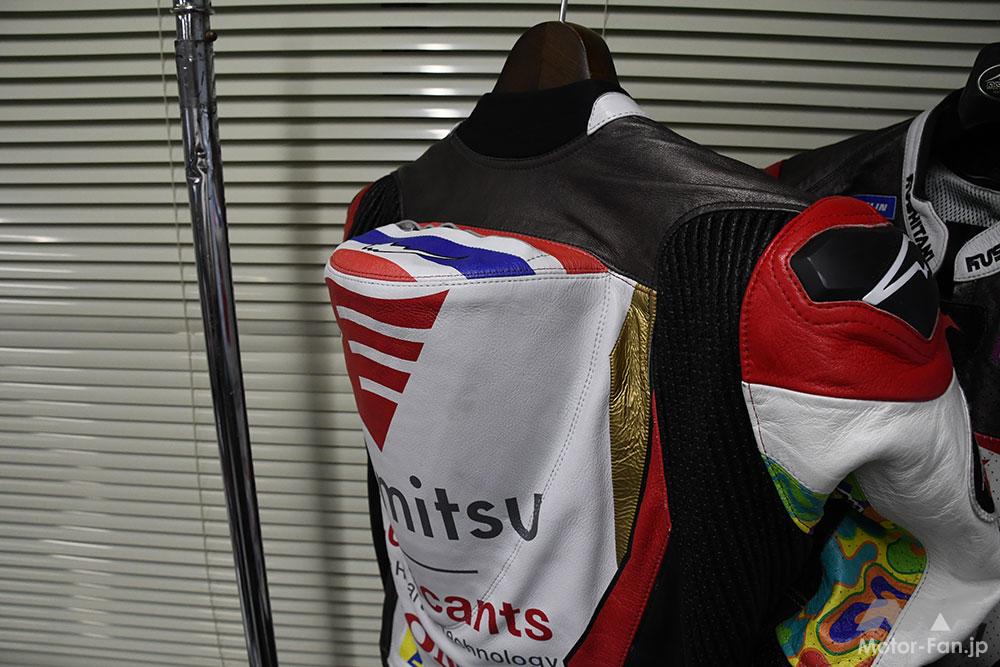
The hump of the racing suit currently used by MotoGP riders ©Eri Ito
Speaking of aerodynamics in equipment, helmets are also very aerodynamic. I wonder if any consideration was given to the interaction between the helmet and the equipment.
“If the helmet is completely integrated with the body, top speed is good, but when you stand up after your body is on the inside of a corner, the aerodynamics act as a force that pushes you back, preventing you from moving out,” explains Mutsuura.
If the helmet and racing suit were completely integrated aerodynamically, the driver’s head would be forced to drop.
“That’s why I intentionally made it a separate design. Up until now, we’d been trying to completely integrate it. In other words, the shape was designed to fit the helmet. But when Aoyama pointed this out to me, I decided to go in the direction of making the racing suit itself aerodynamic.”
“A lot of thought has gone into the aerodynamics of the helmet. If the helmet is separate from the racing suit and can exert its own aerodynamic force, it won’t behave strangely. That was the idea. It worked, and it’s made so that even when your head leaves the motorcycle, it doesn’t shake or get pulled back.”
“We are currently developing a design that can accommodate Alpinestars gas bottles without compromising aerodynamics. We plan to incorporate this design into a commercially available model.”
It’s truly the world’s best feedback that can only be obtained at the MotoGP site, and this technology is reflected in the commercial products that we use today.
Kushitani
Racing Service Manager
Maki Mutsuura
Joined Kushitani in 1989. After working in product management, production management, and sales management from 1990, he was put in charge of racing services from 2003. Since then, he has been involved in service activities mainly in the All Japan region.

©Eri Ito