
![It does not have a gyro or adjustable balance weight. Yamaha “MOTOROiD:Λ (Lambda)” [Japan Mobility Show 2025]](https://motopeek.com/wp-content/uploads/2025/11/4684-1762340107420.jpg)
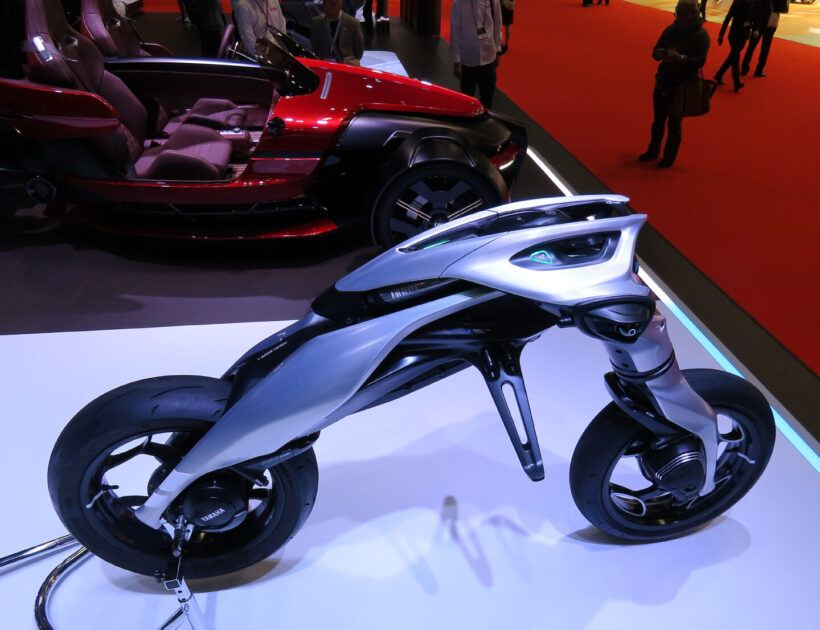
The next evolution is “MOTOROiD:Λ (Lambda)”.

This is merely a concept model currently in experimental development. It’s important to note that it’s not designed for human use. In keeping with the show’s overall theme, this study model was proposed by Yamaha to inspire excitement about what the future might hold 10 years from now. As you can see, what sets it apart from previous Motoroids is its simple, sleek design. What’s even more surprising is that this isn’t just a display piece; it’s a fully functional model capable of autonomous driving. We
spoke with Keisuke Terada, group leader of the Technology Development Division, who oversaw its development.
The key features of the vehicle are motorized on all four axes, including the front and rear wheels, and automatically controlled by AI (artificial intelligence). While it can be operated with a wireless remote controller, the vehicle’s movement and performance (automatic control by AI) are further enhanced by learning (providing a variety of information) about the vehicle’s condition and how it should move in a virtual environment (utilizing simulation technology). Yamaha is currently conducting intensive research to determine which models are suitable for practical use and to use this information to develop new products.
Basic research began with the small “functional verification model” shown in the photo below, which evolved into the well-designed model “Λ (Lambda)” that we have now. Its greatest feature is that the body of the vehicle bends in a “L” shape at the steering head, which is what you would find on a conventional motorcycle. The wheelbase is adjustable, and the steering can be turned up to nearly 90 degrees. It is amazing that it does not have a gyro or adjustable balance weight, but instead relies solely on four-axis control to achieve autonomous driving without human assistance.

A small “initial function verification model” created to check the functionality of the 4-motor, 4-axis structure.
After activation, the development towards independence happened in an instant.

The bars on the left and right that look like steps are outriggers that act as support rods when the vehicle tilts. In the photo, the vehicle is not touching the ground because it is balanced.

As soon as the vehicle starts, the wheel base shrinks, and the vehicle remains upright through integrated control of the front and rear wheel drive and steering.

It has become a standard style while maintaining upright stability.
ADVERTISEMENT

When the vehicle came to an autonomous stop, it felt like a trial standing still. The steering movement was jerky and oscillating at regular intervals.
ADVERTISEMENT

Apparently, it can currently run at a running speed, and demonstrated beautiful turns at a walking speed on the stage.
If this technology is deployed in future motorcycles, it will be possible for the bike to move automatically from the garage to the front door, and even provide a comfortable auto-cruise. Of course, we can also expect it to be packed with comprehensive safety devices to prevent falls.
The ever-evolving Motoroid has its origins in the Twister.

The vehicle is easier to lift, and the steering is less responsive even when cornering at low speeds.

By twisting the neck, a subtle steering effect is created on the rear wheel located at the rear.

This is the Twister prototype, which was given to a select group of media representatives for a test drive in 2012. The name “TWISTER” comes from “Two Wheels Intelligent STEeRing.” It features a unique mechanism that provides two-wheel steering. By using a mechanism that slightly swings the head immediately after the steering head, it was proposed to make steering heavy-duty motorcycles and raising the body more nimble.
This mechanism itself is not reflected in the current Λ (Lambda), but it is no exaggeration to say that it was the first step towards starting development of the Motoroid.
Close-up photos of details

This vehicle itself cannot be ridden by a person.

Although it is offset from the axle, it uses an in-wheel electric motor.

The front is driven by an electric motor using the same method as the rear.

Although details are unclear, the rudder can be turned nearly 90 degrees, or it may be able to rotate 360 degrees.

The horizontal axis that folds the body is set just above the electric steering.

Although it is a simple experimental vehicle, its slim body design is impressive.

It is powered by a lithium-ion battery, and the movement of all four axes is automatically controlled by AI.

Once you add the seat, steps, and handlebars, you’ll be ready to ride.
There are two LiDAR sensors on the underside of the bike, pointing towards the ground. While this is a future concept, it could be used to grasp the condition of the ground and inform the rider, or even provide guidance and advice on riding techniques to help improve motocross riding skills. This is a truly exciting and dream-fueled innovation packed into the bike. Its potential is immeasurable.