
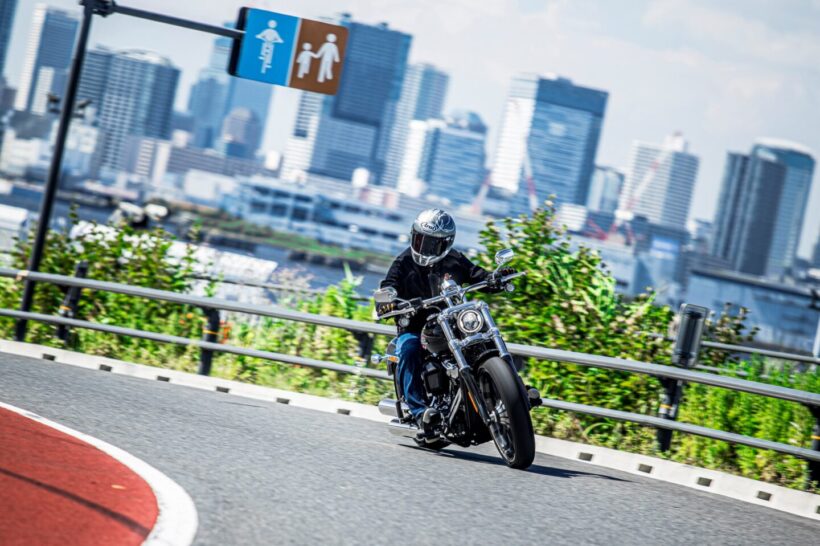

Harley-Davidson Breakout…Starting from 3,451,800 yen (released July 3, 2025)

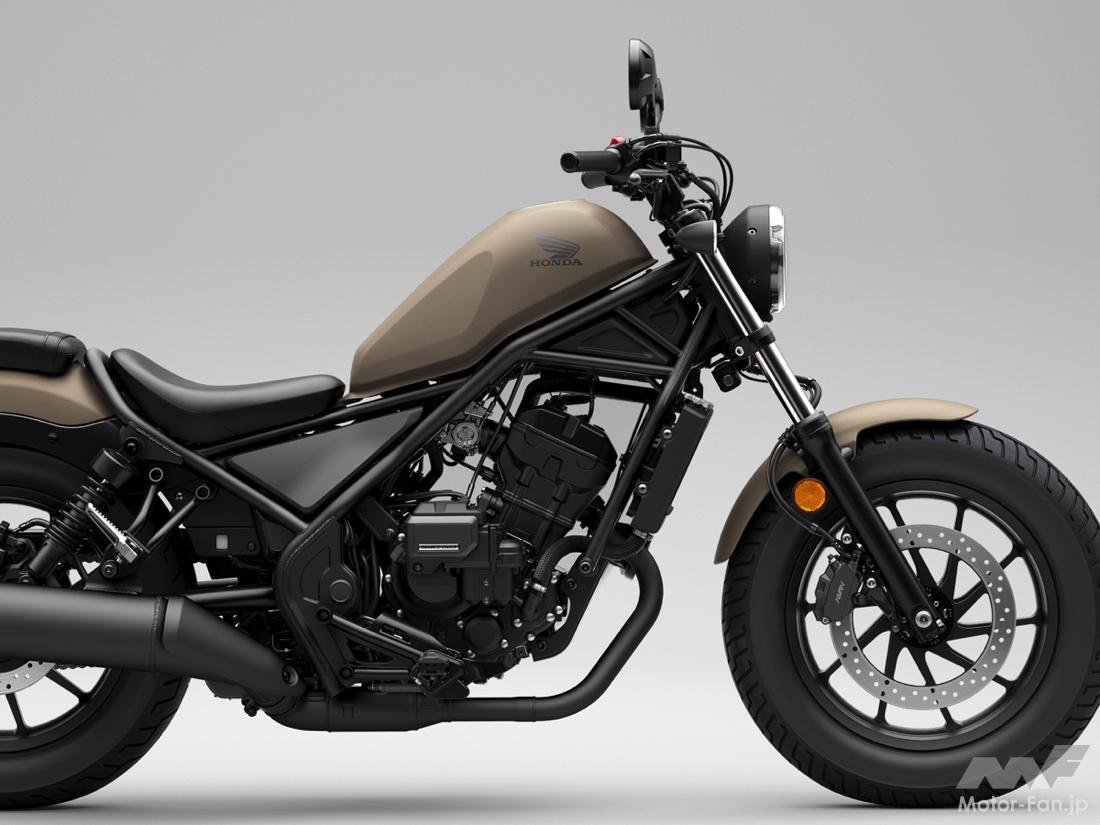
The regular model first appeared in 2014 as the “FXSB Breakout” (starting at 2.34 million yen). The Twin Cam 96B (1584cc) engine that was installed was expanded to the 103B (1689cc) in 2016. The latest model has a seat height of 665mm, which is 25mm lower than the Honda Rebel 250.


ADVERTISEMENT

The wide tire sizes of 130/60B21 in the front and 240/40R18 in the rear have been the same from the first generation to the latest model. The standard tires are Michelin Scorcher 11.
ADVERTISEMENT

Even after the Softail and Dyna families were merged in 2018, the Breakout continued with a combination of a new frame and a Milwaukee-Eight 107 (1745cc) engine. The engine displacement was gradually increased to 114ci (1868cc) in 2020 and 117ci (1923cc) in 2023. The 2025 model will be available in five body colors, with the Midnight Firestorm shown in the photo costing an additional 286,000 yen. All colors will be available with chrome trim only.
The sense of furious acceleration has a purpose, and there is a sense of quality to it.

The Breakout is the only model in the Harley-Davidson lineup that has gained popularity for its old-school chopper style. Its steeply sloping front forks are topped by large 21-inch wheels, and its rear tire is a 240mm wide tire that would put a Toyota Alphard to shame. Its seat height is lower than that of the Honda Rebel 250, and its handlebars are straight drag bars.
All models in the Cruiser family to which this Breakout belongs are equipped with a Milwaukee-Eight 117 (1,923cc) engine. There are three specifications: Classic with a maximum output of 92.3 PS, Custom with 104.4 PS, and High Output with 115.6 PS, with the Breakout being equipped with the “Custom” model, which is in the middle. The Lowrider ST that I test drove on the same day was the “High Output” model, so I’m curious to see how it compares to that.

The engine is a Milwaukee-Eight 117 Custom (1923cc, air-oil-cooled, 4-stroke OHV, 4-valve, 45° V-twin engine) that produces a maximum output of 104.4 PS. The 2025 model features a new riding mode selector, with Sport, Road, and Rain modes changing the engine characteristics as well as the intervention level of the ABS and traction control. The air cleaner has been changed from the heavy breather intake with the same shape as the Low Rider ST to a new touring intake.
First, start the engine. The sound of the approximately 2L, air-oil-cooled, 45° V-twin is full of energy even at idle, naturally raising the rider’s spirits. However, contrary to the crisp V-twin exhaust note, there is almost no vibration that shakes the body. I am impressed and think that this must be the effect of the dual counterbalancer.
I grab the clutch lever and shift into low with my left foot. I can feel the gears meshing together through the soles of my shoes, and I can imagine the precision of the machined transmission. The gear shifting itself feels heavy compared to Japanese motorcycles, but I personally think this is part of the charm of Harley.
I set the riding mode to the intermediate level “Road” and finally set off. Even with the clutch half engaged at almost idle speed, there was no jerky feeling whatsoever. This was proof that the fuel mixture was extremely excellent. And the acceleration from there up to around 3000 rpm was slightly better than that of the Lowrider ST. Of course, since the Breakout does not have a cowling, it is subject to direct wind pressure, which can make it easier to misjudge the speed. However, the kick-off feeling with each combustion burst is clear, and it feels like the stride of the gallop is wider than that of the Lowrider ST.
After making sure it was safe all around, I repeatedly opened and closed the throttle. The thick, ‘zudadadada’ exhaust note reverberated through my insides, and the incredible thrust. It was accompanied by a certain pleasure, and before I knew it, my mind was empty. Over the course of roughly 12 years, the Breakout’s displacement had been gradually increased (1584cc → 1689cc → 1745cc → 1868cc → 1923cc), and this was likely due to the cries of users who had become numb to the pleasure of acceleration and wanted more power.
And what will further satisfy those horsepower-obsessed enthusiasts is the newly added riding mode. When you set it to the most powerful “Sport” mode and open the throttle wide for a moment, you’ll experience acceleration that will make you barely hang on to the handlebars. It’s so powerful it could be described as a warp, and it’s no wonder that so many people are hooked.
Even the Lowrider ST felt incredibly powerful, but the Milwaukee-Eight 117 Custom on the Breakout seems to be all about power in the lower to mid-range. Even with the same engine, I can only take my hat off to Harley’s skill in creating different characters to suit the concept of the machine.
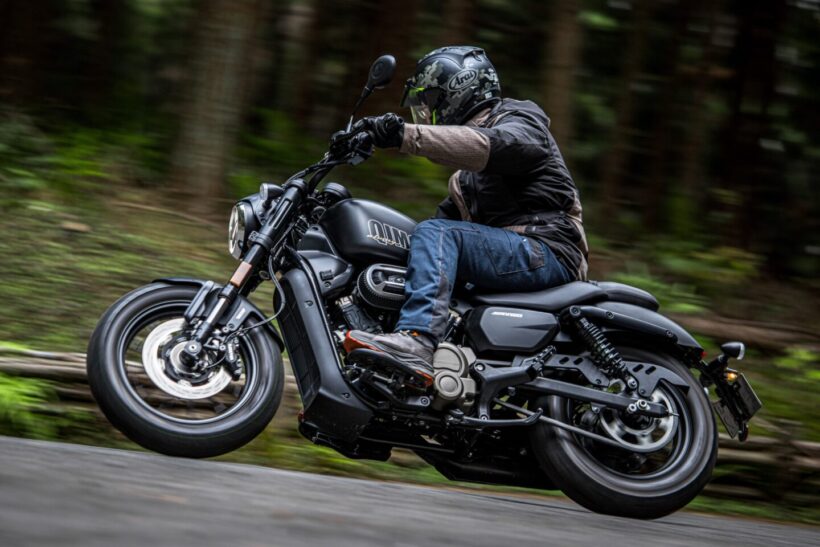
It dispels the image of a straight-line boss, and despite its chopper style, it turns well.

I was a little apprehensive about the handling based on past experiences. This is because I didn’t have a good impression of Harley’s rear 240 tire. My first experience was probably with the VRSCDX Night Rod Special, which came out in 2007. At low speeds, the front cuts in strongly, but as the speed increases, the bike becomes too stable in a straight line and becomes difficult to turn. It was so depressing that I wondered if my riding had gotten worse, and my negative impression of Harleys became somewhat stronger.
However, the latest Breakout’s handling is so easy that the moment you turn at the first intersection, you’ll think, “Wow, this thing is easy to ride.” The response and feel up to full banking is much smoother and more consistent than you’d expect, and the steering weight of the 21-inch front wheels is offset nicely by the handlebars’ easy-to-push and pull design. During secondary turns, the bike works to maintain a firm banking angle, and the suspension’s road-holding ability is excellent. Because of its long wheelbase and relatively small banking angle, it’s not very good at making tight U-turns. However, there’s no trace of its former self, which was once mocked as a “straight-line boss,” so even if you’re switching from a Japanese cruiser, you shouldn’t be confused.

The rear shock absorber unit with hydraulic preload adjustment is located under the seat. The shock itself has a stroke of 43mm, which is shorter than the Lowrider ST’s 56mm.
The traditional Harley style is to mainly use the rear brakes, and riding the Breakout in this way presents no problems. The front is a single disc, but if you squeeze the lever firmly it provides considerable stopping power and is highly controllable. The latest model is equipped with cornering ABS, traction control that takes bank angle into account, and engine brake management, giving you a very high sense of security.

The caster angle is a fairly slack 34°, which is the source of the chopper style. By the way, the caster angle for the 2013 CVO and the 2014 regular model was 37°, and for 2015 to 2017 it was 35°. The wheel has 13 spokes on each side, for a total of 26 spokes. The front brake is a single disc with a diameter of 300mm.
For riders who suddenly feel like taking a trip on the empty Shuto Expressway for an hour or two late at night to change their mood, the Breakout will be the perfect companion. Everything from the styling to the ride feel is straightforward, so if you fall in love with the look, you won’t regret buying it.
Riding position and foot reach (175cm/68kg)

The footpegs are positioned forward for control, and the risers are higher for the 2023 model, making the handlebars at a height that makes them easier to control.

The seat height is 665mm. Naturally, it is easy to reach the ground with your feet, and with the seat so low, you feel like you are very close to the asphalt, especially when cornering.
Detailed explanation

The muffler is a 2-into-2 offset shotgun type, and there are no design changes from the 2024 model.
ADVERTISEMENT

The harness is routed inside the drag bar, giving the cockpit a very clean look. The fuel tank has been enlarged from 13.2L to the current 18.9L for the 2023 model.
ADVERTISEMENT

The LCD meter, which was previously embedded in the handlebar clamp, will be replaced with a 4-inch analog type, the same as the Roadster ST, in the 2025 model. The internal LCD display is extremely multifunctional, and also has a numeric tachometer display function.
ADVERTISEMENT

The switch box has been completely redesigned for the 2025 model. Cruise control has been available since 2023.
ADVERTISEMENT

The seat has a metal emblem in the center. The seat is wide and the urethane is firm, so your buttocks won’t hurt even on long trips.
ADVERTISEMENT

The rear turn signals are integrated into the tail and brake lights. The rear tire is 240mm wide, so the bobtail rear fender is also very wide.
ADVERTISEMENT

There is a USB-C port on the lower left side of the steering head.
Harley-Davidson Breakout Main Specifications
Dimensions:
Length 2,375 mm ,
Width 940 mm
, Seat height (unladen) 665 mm,
Ground clearance 115 mm,
Rake 34,
Trail 145 mm,
Wheelbase 1,695 mm
, Tires, Type Michelin™ Scorcher 11, front and
rear , Tires, Front 130/60B21 63H BW
, Tires, Rear 240/40R18 79V BW,
Fuel capacity 18.9 l,
Oil capacity (with filter) 4.7 l,
Kerb weight 309 kg,
Luggage capacity (volume) 0.056 m3
[Engine]
Milwaukee-Eight™ 117 Custom Engine,
Bore 103.5 mm,
Stroke 114.3 mm,
Displacement 1,923 cc,
Compression Ratio 10.3:1,
Fuel System Electronic Sequential Port Fuel Injection (ESPFI)
, Exhaust 2-2 arrangement, Catalyzer (muffler)
Performance:
Engine torque test method EC 134/2014
Engine torque 168 Nm
Engine torque (rpm) 3000
Horsepower 103 HP / 77 kW @ 5020 rpm
Lean angle, right (degrees) 26.8
Lean angle, left (degrees) 26.8
Fuel economy test method EU 134/2014
Fuel economy 5.6 l/100 km
Drivetrain:
Primary drive chain, gear ratio: 34/46;
1st gear ratio (overall): 9.311
; 2nd gear ratio (overall): 6.454;
3rd gear ratio (overall): 4.793
; 4th gear ratio (overall): 3.882
; 5th gear ratio (overall): 3.307;
6th gear ratio (overall): 2.79
[Chassis]
Front fork: Dual vent valve, 49mm telescopic type, aluminum fork triple clamp, dual rate spring
rear shock: Hidden free piston type, coilover mono shock, 43mm stroke, hydraulic preload adjustment
wheel, front type: Gloss black, 26-spoke aluminum cast
wheel, rear type: Gloss black, 26-spoke aluminum cast
brake, caliper type: Front: 4-piston fixed, rear: Floating 2-piston
brake, rotor type: Black, split 7-spoke floating rotor (front and rear)
Electrical:
Lights (per country regulations), headlamps, tail/stop/front signal lights. Headlamps: All LED, low beam, high beam and signature position lamps. Tail/stop: Bullet style, LED stop/tail/turn signals. Front signal lights: LED bullet turn signals
. Gauges: 102mm (4 inch) analog speedometer. Digital displays for gear, odometer, fuel gauge, ride mode, heat gear, traction control, ABS, TPMS, cruise control, clock, mileage, range and tachometer.