
![[Husqvarna] Vitpilen’s first twin-cylinder and largest-displacement “801” is the strongest handling machine](https://motopeek.com/wp-content/uploads/2025/06/2556-1760841067436.jpg)

Husqvarna Vitpilen 801… ¥1,459,000 (released in August 2025)

The Vitpilen 801 was announced in October 2024, two months after the variation model Svartpilen 801. It will be produced in Austria.


The lineup includes the yellow shown in the photo as well as silver body colors. Based on the KTM 790 Duke, the front and rear wheels have been changed to a five-spoke design similar to the 701.
The true essence of this model is the immersive feeling of sports riding.
In 2013, Swedish motorcycle brand Husqvarna Motorcycles became a subsidiary of the Austrian KTM Group. The following year, at the Milan Show in 2014, the brand unveiled two concept models that indicated a new direction for the brand: the cafe racer-style Vitpilen 401 and the scrambler-type Svartpilen 401.
The basis for both models is KTM’s naked model, the 390 Duke. It wasn’t actually released to the market until 2018, but its styling has been a hot topic since its launch. It was designed by Kiska, an Austrian design studio with close ties to KTM. With its unique form that strips away all unnecessary elements, this bike leaves a strong impression that Husqvarna, which has a strong off-road presence, is serious about taking on the street scene.

I test rode the Vitpilen 401 in 2019. My upper body leaned forward as much as on a supersport bike, and I couldn’t say that I could reach the ground with my feet. This unusual riding position had a big impact on the handling, but I think that even this aspect embodied the worldview of a cafe racer.
Subsequently, the Vitpilen 701, based on the KTM 690 Duke, was announced in 2017, and the Svartpilen 701 in 2018. Both models were equipped with a 692.7cc water-cooled single-cylinder engine, and combined with a lightweight body comparable to a 250cc bike, they offered a sharp acceleration feel like a rabbit when the throttle was opened wide.

The Vitpilen 701. It had a maximum output of 75 PS and weighed just 157 kg excluding fuel, making it extremely light. The price at the time was 1,355,000 yen.
These two big single-cylinder bikes were rare these days, but were quickly discontinued. Just when it seemed the large-displacement models in the Pilen series would disappear, the Svartpilen 801 and Vitpilen 801 were suddenly announced in 2024. The base model was the KTM 790 Duke, equipped with a 799cc water-cooled in-line twin-cylinder engine, making them the first twin bikes in the Pilen series, which also includes 125cc and 250cc models, and also the largest in displacement.

The Svartpilen 801 and Vitpilen 801 are based on the KTM 790 Duke. Its maximum output is 77kW (105PS), and its official weight without fuel is 174kg. The standard tires are Maxxis Supermaxx ST. As of the time of writing, in early June 2025, the price is 1.19 million yen.
This introduction has gotten a little long, but that’s the origin of the Vitpilen 801 that I’ll be introducing today. As for styling, it inherits the clean minimalism of the original 401, but has evolved to be more modern, and the skill of Kiska, who designed it, is truly amazing. In particular, the change from separate handlebars to a bar type was a major change, and this marked a change from Vitpilen’s cafe racer to a roadster.
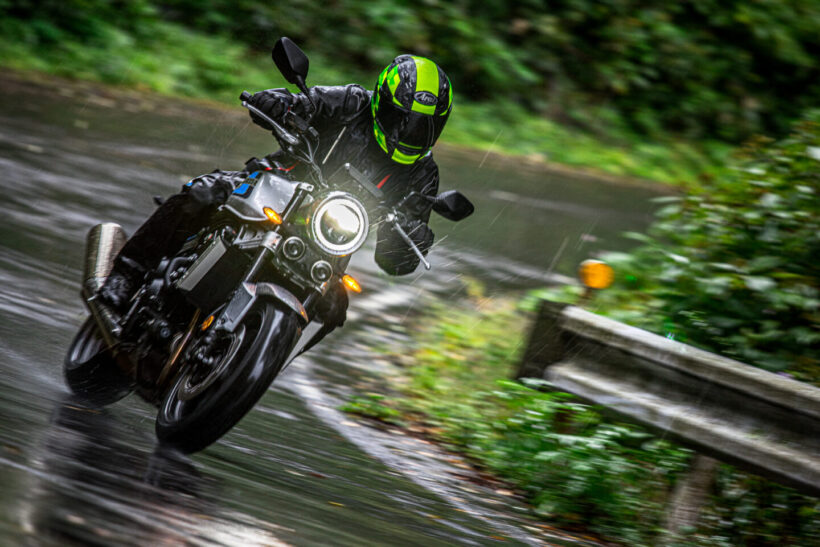
Well, what impressed me most about this test ride was the handling. It’s not just the cornering ability that’s impressive, but also the constant sense of security from entering and exiting corners, allowing you to naturally immerse yourself in sporty riding. The Yamaha MT-07 immediately comes to mind when thinking of the commonality between the two bikes: “ability to control at will,” but the SVARTPILEN 801 has a higher-grade suspension, which makes a big difference in the quality of its ride.

The aluminum cast wheels are 17 inches front and rear, with a black anodized finish. The standard tires are Michelin Road 6, with a recommended air pressure of 2.3 bar in the front and 2.6 bar in the rear, regardless of whether a passenger is present. The brake set is made by J.JUAN, a Spanish company under the Brembo umbrella, and the front disc has a diameter of 300 mm.
ADVERTISEMENT

The φ43mm inverted front forks are WP APEX 3343 open cartridge type. The wheel travel is 140mm and the top cap is equipped with both extension and compression damping force adjusters. The standard position is three clicks back from the fully closed position on both the extension and compression sides.

The rear brake has a 240mm disc diameter and the Bosch Cornering ABS system is equipped with a Supermoto ABS mode that disables the rear ABS. The open lattice swingarm is made from die-cast aluminum.

The rear suspension is a linkless monoshock, and the shock unit is a WP APEX 3146. Wheel travel is 150mm. There are 10 preload settings, with the standard position being the third setting from the weakest. The standard position for rebound damping force is three clicks back from the fully closed position.
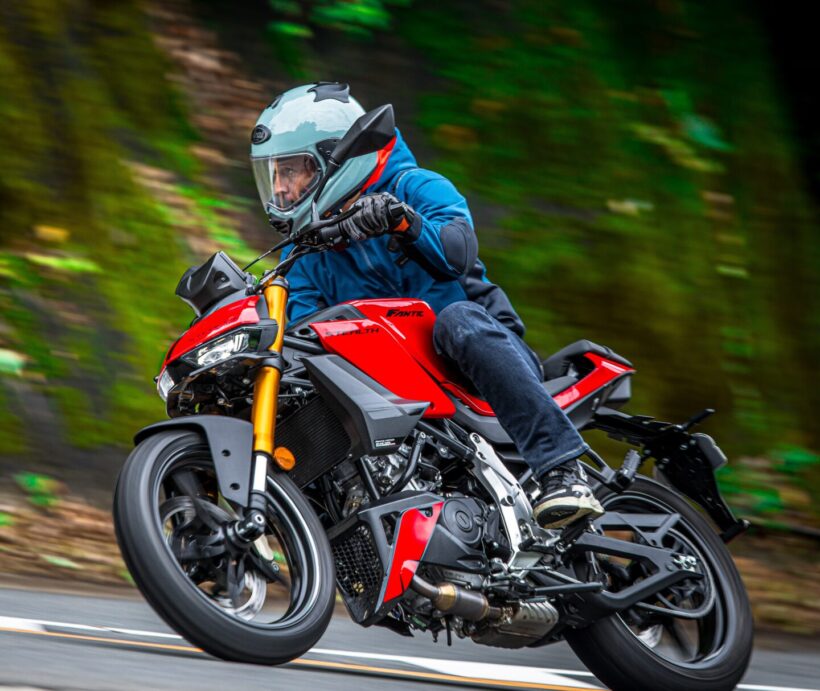
When you give a slight nudge with the handlebars or footwork, the machine smoothly and deeply banks, and at the same time the front tires grip the asphalt and turn with force. You can change lines freely while cornering, which is likely due in large part to the characteristics of the Michelin Road 6. On rough asphalt, the car may not be able to fully absorb shocks, but this can be alleviated somewhat depending on the suspension settings. Another plus is that the body is light, so it’s not so scary that it feels scary.
It is true that the first generation 401 and 701 Vitpilen bikes had low clip-on handlebars and a high, distant seat position that affected the riding position, spoiling the free-flowing maneuverability of the base models, the 390 Duke and 690 Duke. However, even if you ignore those negative impressions from the past, there is no doubt that the handling of the 801 is excellent and so enjoyable that it is exhilarating.

Stripped Vitpilen 801. The chrome-molybdenum steel tubular frame, which uses the engine as a stress member, is powder coated.
The brake set has been changed from Brembo on the 701 to one made by Hota Huang, which is a subsidiary of Brembo, but there were no complaints about controllability or absolute braking power, and the change from a single disc to a double disc at the front is a big plus. The rear ABS intervened several times while riding on mountain roads, but it seemed to activate a little early depending on the situation, perhaps due to the characteristics of the Bosch cornering ABS. However, it did not cause the rider any anxiety, and the vehicle’s behavior was always stable.
An engine that accelerates smoothly with a kick-off feeling
The 801’s engine was a water-cooled twin, replacing the water-cooled single of the 701. The displacement increased by approximately 100cc, from 692.7cc to 799cc, and maximum output increased by 30PS to 105PS. If you only heard about these changes in specs, it might seem like the engine had become more unruly, but in fact the impression was the exact opposite, as it had evolved into an engine with a deep capacity.

The engine is a 799cc water-cooled, four-stroke, parallel twin-cylinder with a 75-degree phase crank, producing 77kW (105PS). Balancers are placed in front of the crankshaft and in the cylinder head to eliminate unpleasant vibrations. It also features forged pistons, DLC-coated piston pins, a semi-dry sump, and a PASC clutch. The bike weighs an extremely light 52kg. There are three riding modes: Street, Sport, and Rain, and a “Dynamic Mode” can be set by adding the optional Dynamic Pack. Cornering traction control is also included.
The water-cooled parallel twin engine with a 75-degree phase crank is basically the same as the 790 Duke, with only the exhaust system design being different. In the most versatile Street mode, there is ample torque in the low and mid-range, so that under 5000 rpm is sufficient in most situations, and the twin-turbulence that is transmitted while cruising is actually quite pleasant. When you open the throttle wide, it accelerates sharply with a kick-off feeling, but the increase in rotation is extremely smooth, and there is almost no unpleasant vibration even when revving it up to 9000 rpm, where the redline begins.
In Sport mode, the throttle response is obviously sharper, but it’s not as aggressive, so it’s just as easy to handle as Street mode. On the other hand, Rain mode makes the ride much gentler, so being able to select it will be a great relief when driving in the rain.
Now, the test vehicle was fitted with a genuine accessory bidirectional quickshifter, so I’d like to talk about that as well. This engine is so particular about its transmission that gears 4-6 are glass bead blasted, and the shift feel itself is extremely light and smooth. Adding the quickshifter to this makes it so that you hardly need to touch the clutch lever while driving. Personally, I think it could do with being a little more restrained, but considering its convenience, it’s one of the genuine accessories that I would definitely like to have installed.

A bidirectional quick shifter called EasyShift (62,942 yen) is available as an option, and the test vehicle was pre-installed.
With the 801, design-conscious Vitpilen has evolved into a deep-pocketed roadster. While the headlights give it an extraordinary aura, its excellent handling stands out among naked bikes in this class, making it a model that truly exudes “fun to ride.” These days, we hope that more people will know about this fact.
Riding position and foot reach (175cm/68kg)

By changing from the clip-on handlebars of the 701 to bar handlebars, the forward lean of the upper body is much less and the seating position feels a little more forward, making for a comfortable riding position for city riding.

The official seat height is 820mm, which is 5mm lower than the 790 Duke and 10mm lower than the Vitpilen 701, and thanks to the slim body, the feet can be easily placed on the ground, as you can see.