


Why change “one month ago” to “two months ago”?
This new system is due to the revised “Road Transport Vehicle Act Enforcement Regulations,” which were issued in June 2024 (Reiwa 6), coming into effect on April 1, 2025.
As mentioned above, the main content is that vehicle inspections can now be taken two months before the expiration date of the vehicle inspection certificate (previously, the two-month period was required for vehicles whose main base of use is on a remote island, but this revision will make this the same nationwide).
According to the Ministry of Land, Infrastructure, Transport and Tourism, the reason for this is that “demand for vehicle inspections is concentrated at the end of the fiscal year.” As you know, the business fiscal year generally begins in April, meaning the end of the fiscal year is March. This is the time of year when many people buy or replace their cars and motorcycles, due to the transition to a new lifestyle and the timing of new car sales. And because there are so many purchases, vehicle inspections also tend to be concentrated around this time.
In fact, according to the “Monthly Vehicle Inspection Numbers (average for the five years from 2019 to 2023)” published by the Ministry of Land, Infrastructure, Transport and Tourism, March had the highest number of vehicle inspections at approximately 3.89 million vehicles. Compared to August, which had the lowest number of inspections at approximately 2.81 million vehicles, there was a difference of approximately 1 million vehicles.
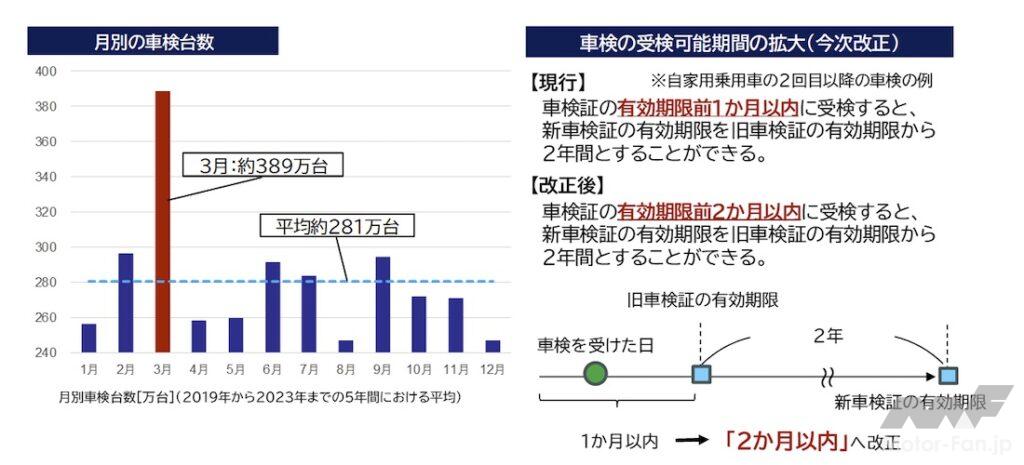
The Ministry of Land, Infrastructure, Transport and Tourism announced the monthly number of vehicles undergoing inspection (average for the five years from 2019 to 2023) (left) and the details of the revisions (right).
According to the Ministry of Land, Infrastructure, Transport and Tourism, this has led to problems such as users finding it difficult to make appointments for maintenance and vehicle inspections at the end of the fiscal year when vehicle inspections are concentrated, and auto mechanics being forced to work overtime and on holidays. The latest revision aims to resolve these issues.
Incidentally, the validity period of compulsory automobile liability insurance will also be changed in line with this revision. By amending the “Automobile Liability Insurance Law Enforcement Regulations,” the obligation to conclude a contract that previously added one month (two months on remote islands) to the validity period of the vehicle inspection will also be changed to two months (nationwide) from April 1, 2025.
Actually, you can get your car inspected at any time.
That’s the outline of the new vehicle inspection system. Originally, vehicle inspections could be taken “at any time” as long as they were before the expiration date, and there was no problem with taking the vehicle inspection two months or even earlier before the expiration date. However, if you take the vehicle inspection too early, the next expiration date may be brought forward, which can be a loss.
For example, if you have a private motorcycle over 251cc, and the vehicle inspection certificate expires on December 10, 2025, and the vehicle passes inspection on October 10, 2025, the next inspection expiration date will be October 10, 2027. If you had paid the costs up to December 10, 2025, for the previous inspection (renewal inspection fees, compulsory automobile liability insurance premiums, etc.), you would have lost two months’ worth of insurance under the previous law.
On the other hand, previously, if you had your vehicle inspected one month before the expiration date of your vehicle inspection certificate and before the expiration date, the next expiration date would not be brought forward. As in the example above, if your vehicle’s expiration date is December 10, 2025, even if you had your vehicle inspected one month earlier on November 10, 2025, your next vehicle inspection would still expire on December 10, 2027, so you would not have lost out.
The latest revision extends this system to two months before the expiration date of the vehicle inspection certificate. As in the example above, if the expiration date is December 10, 2025, even if the vehicle inspection is taken on November 10, 2025, the next vehicle inspection expiration date will be December 10, 2027.

Previously, there was no problem with having a vehicle inspection two months before the expiration date.
When will the new vehicle inspection system come into effect?
However, it is important to note that this new system will only be implemented if you undergo a renewal inspection after April 1, 2025, so it will not apply if you undergo the inspection in February or March.
For example, if your motorcycle inspection certificate is valid until May 1, 2025, and you have it inspected on March 1, 2025, two months before the expiration date, the renewal validity period will be February 28, 2027. As mentioned above, if you paid the fees up to May 1, 2025 for the previous inspection, you will lose two months of the inspection fee.
On the other hand, if your vehicle inspection certificate is valid until June 1, 2025, the two months before the expiration date is April 1, 2025, which is after the new system is implemented. If you have your vehicle inspected on that day, the renewal validity period will be June 1, 2027, meaning the expiration date can be the same date two years later.
In other words, the current system will remain in place until the end of March 2025, and the new system will not be implemented until April 1st. With this in mind, we can expect that vehicle inspection sites, such as local land transport bureaus, will remain as crowded as before, at least until March 2025. It is still unclear whether the new system will have the intended effect. Even if it is expected to ease congestion, the effect will likely not be seen until about a year later, after the end of fiscal year 2025 (March 2026).
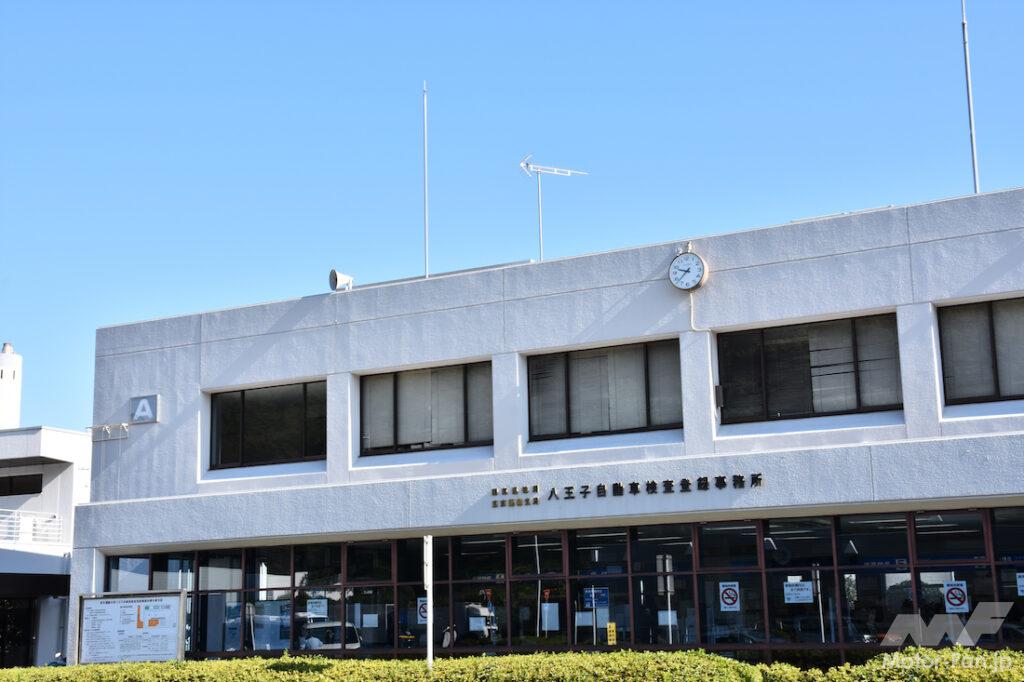
Congestion at land transport bureaus and other facilities may not be alleviated until the end of fiscal year 2025 (March 2026) or later.