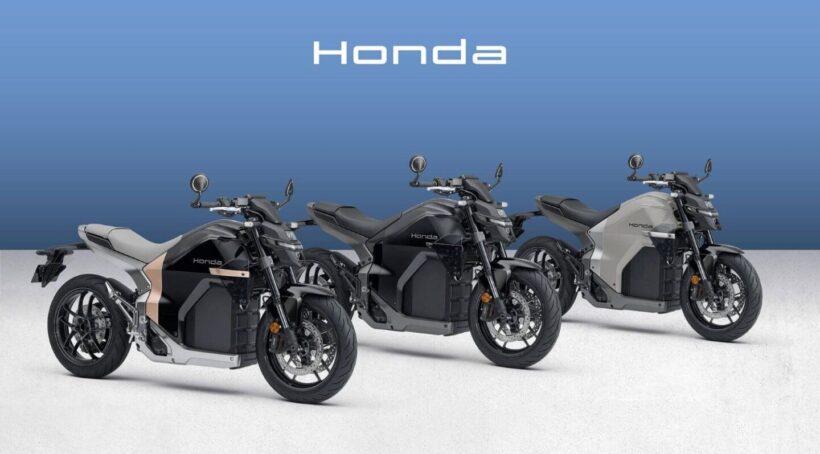

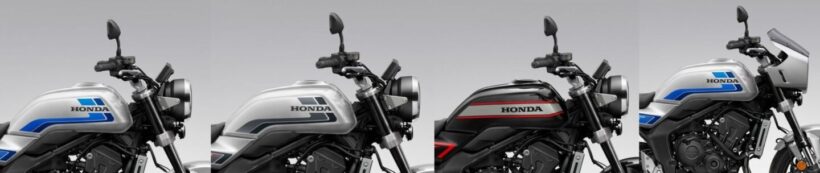


From left) Honda CB1000F /
Silver Metallic (Blue Stripe), Silver Metallic (Gray Stripe), Graphite Black
Honda CB1000F SE / Silver Metallic (Blue Stripe)
Honda CB1000F: ¥1,397,000 (including 10% consumption tax)
Honda CB1000F SE: ¥1,595,000 (including 10% consumption tax)
Honda CB1000F
ADVERTISEMENT

Honda CB1000F / Silver Metallic (Blue Stripe)
ADVERTISEMENT

Honda CB1000F / Silver Metallic (Gray Stripe)
ADVERTISEMENT

Honda CB1000F/Graphite Black
Honda CB1000F SE
ADVERTISEMENT

Honda CB1000F SE / Silver Metallic (Blue Stripe)
ADVERTISEMENT

Honda CB1000F SE / Silver Metallic (Blue Stripe)
Features of the two CB1000F models
The CB1000F is a large road sports model based on the engine of a super sports model, which combines ease of handling in urban areas with comfort at high speeds. The planned annual sales volume for the series as a whole is 5,000 units.
The high-end CB1000F SE is equipped with a headlight cowl, radiator grille, heated grips, a quick shifter, and a special color-stitched seat in addition to the base model. With enhanced appearance and functionality, it is a specification that further improves the sense of ownership.
The price for the CB1000F is 1,397,000 yen (1,270,000 yen excluding tax), and the CB1000F SE is 1,595,000 yen (1,450,000 yen excluding tax). Both prices include recycling fees, but insurance, taxes, and registration fees are required separately.
In-line 4-cylinder engine power performance
The power unit was developed based on the engine of a super sports model, and combines torqueful characteristics that are easy to handle in urban areas with a calm riding feel when cruising at high speeds.
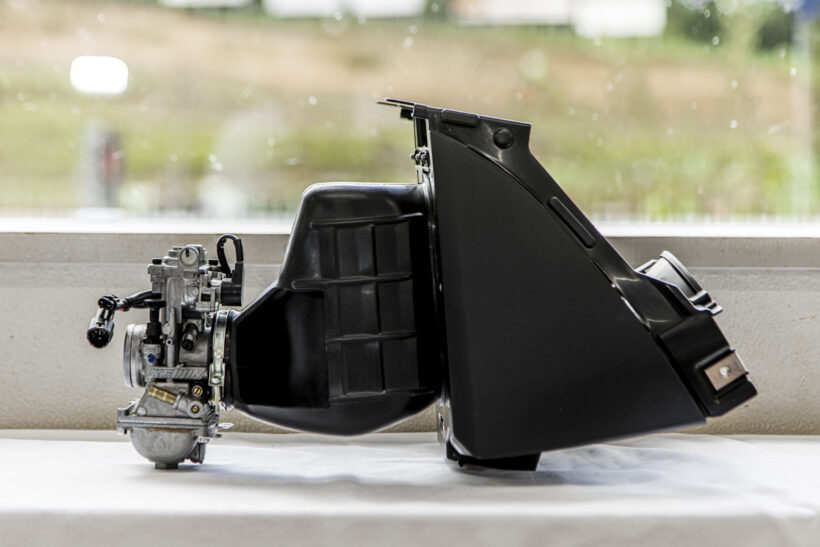
A newly designed camshaft has been adopted, optimizing valve timing and lift. This has resulted in smooth output characteristics without any dips from low to high revolutions. In addition to different valve timing for each of the two cylinders (left and right), a newly designed air funnel has been adopted. The aim is to achieve a torqueful setting in the low to mid-rev range and a deep, pulsating exhaust sound.
The transmission has lower ratios for first and second gears to increase driving force. The gear ratios are designed to be easy to use, taking into consideration ease of handling at low speeds and reducing engine rotation during high-speed cruising.
Design based on the successive CB750F models
The body design is based on the CB750F, a model released in 1979. It features a flowing line that runs from the fuel tank through the side covers to the rear cowl, creating a seamless, unified design. The power of the large-displacement in-line four-cylinder engine, equipped with the latest performance, is expressed through the widthwise inflection.
The frame is designed for a wide range of uses, and the seat rails are specially designed to provide comfort and load capacity when riding pillion.
Complete suspension and braking system
The front suspension uses an inverted SHOWA SFF-BP. It is equipped with rebound and compression damping force and preload adjustment mechanisms, allowing it to be set to suit the rider’s preferences and the situation. The rear uses a separate pressurized single-tube type cushion unit and a special link ratio. This contributes to straightforward handling, lightness, and a comfortable ride.
The front brakes are equipped with Φ310mm floating double discs and NISSIN opposed 4-pot radial mount calipers, while the rear uses a Φ240mm single disc and NISSIN 1-pot caliper.
The adoption of a 6-axis IMU enables more accurate detection of vehicle posture in terms of pitching, roll, and yaw, improving the precision of control technologies such as the throttle-by-wire system and cornering ABS.
5-inch TFT LCD meter and Honda RoadSync standard equipment
In terms of equipment, it features a 5-inch full-color TFT LCD meter that displays a wealth of information in an easy-to-read format. Honda RoadSync is standard equipment, and by linking the vehicle with a smartphone, voice input is possible using the select switch on the handlebars or a separately sold headset. It is a highly convenient system that allows you to operate apps such as music playback and navigation.
It is equipped with a riding mode that allows you to select your preferred output characteristics according to a wide range of situations and road conditions, from urban areas to winding roads.The Honda SMART Key system is adopted, and by carrying the smart key and approaching the vehicle, you can unlock the main switch knob without taking out the smart key itself.
Uses sustainable materials
Honda aims to achieve a 100% sustainable material ratio by 2050 in order to realize a society with zero environmental impact. For the CB1000F, excess resin generated during the manufacturing and molding processes of automobiles and home appliances is recycled and used for the rear fender and seat bottom plate, contributing to resource conservation.
Coloring is set to 3 colors + 1 color
The coloring is based on the coloring of the CB750F, which was active in the North American racing scene in the 1980s, and the stripes of the first-generation CB750F.
The CB1000F is available in three colors: Wolf Silver Metallic (Blue Stripe), Wolf Silver Metallic (Gray Stripe), and Graphite Black. The CB1000F SE is available in one color: Wolf Silver Metallic (Blue Stripe).
The CB1000F series combines traditional proportions with the latest technology, making it an attractive choice for riders looking for a powerful, nimble and fun ride in a wide range of situations.
Main specifications
| Nickname | CB1000F | CB1000F SE | |
| Car name and model | Honda 8BL-SC94 | ||
| Total length x width x height | (mm) | 2,135×835×1,125 | 2,135×835×1,170 |
| Wheelbase | (mm) | 1,455 | |
| ground clearance | (mm)★ | 135 | |
| Seat height | (mm)★ | 795 | |
| Vehicle weight | (kg) | 214 | 217 |
| Passenger capacity | (people) | 2 | |
| Fuel consumption rate *3 (km/L) | Ministry of Land, Infrastructure, Transport and Tourism reported fuel consumption value *4 (km/h) | 26.0 (60) <When two people are riding> | |
| WMTC mode value★(Class) *5 | 17.9 (Class 3-2) <1 passenger> | ||
| Minimum turning radius | (m) | 2.8 | |
| Engine model and type | SC94E water-cooled 4-stroke DOHC 4-valve inline 4-cylinder | ||
| Total displacement | (cm) | 999 | |
| Inner diameter x stroke | (mm) | 76.0×55.1 | |
| Compression ratio | ★ | 11.7 | |
| Maximum power | (kW [PS]/rpm) | 91[124]/9,000 | |
| Maximum torque | (N・m [kgf・m]/rpm) | 103[10.5]/8,000 | |
| Fuel supply device type | Electronic type <Electronically controlled fuel injection system (PGM-FI)> | ||
| Type of fuel used | unleaded premium gasoline | ||
| Starting method | ★ | Self-service | |
| Ignition system type | ★ | Fully transistorized battery ignition | |
| Lubrication method | ★ | Combined pressure-fed droplet type | |
| Fuel tank capacity | (L) | 16 | |
| Clutch type | ★ | Wet multi-plate coil spring type | |
| Transmission type | Constant mesh 6-speed return | ||
| gear ratio | 1st gear | 2.642 | |
| 2nd speed | 1.941 | ||
| 3rd speed | 1.583 | ||
| 4-speed | 1.333 | ||
| 5-speed | 1.137 | ||
| 6-speed | 0.967 | ||
| Reduction ratio | (1st★/2nd) | 1.717/2.812 | |
| Caster angle (degrees)★/Trail (mm)★ | 25°00´/98 | ||
| tire | before | 120/70ZR17M/C (58W) | |
| rear | 180/55ZR17M/C (73W) | ||
| Brake type | before | Hydraulic double disc | |
| rear | Hydraulic disc | ||
| Suspension method | before | Telescopic type (inverted suspension/big piston front fork) | |
| rear | Swing arm type (Prolink) | ||
| Frame Format | diamond | ||
■Type designation application figures according to the Road Transport Vehicle Act (★ indicates Honda published specifications)
■Manufacturer: Honda Motor Co., Ltd.
(※3) Fuel consumption rate is the value under specified test conditions. It will vary depending on various conditions such as the customer’s usage environment (weather, traffic congestion, etc.), driving method, vehicle condition (equipment, specifications), and maintenance status.
(※4) The steady-state fuel consumption value is the fuel consumption rate based on actual measurements taken while driving at a constant vehicle speed.
(※5) The WMTC mode value is a calculated value based on the exhaust gas test results measured in a driving mode that is an international standard, including starting, accelerating, stopping, etc. Driving mode classes are classified according to engine displacement and maximum speed.