
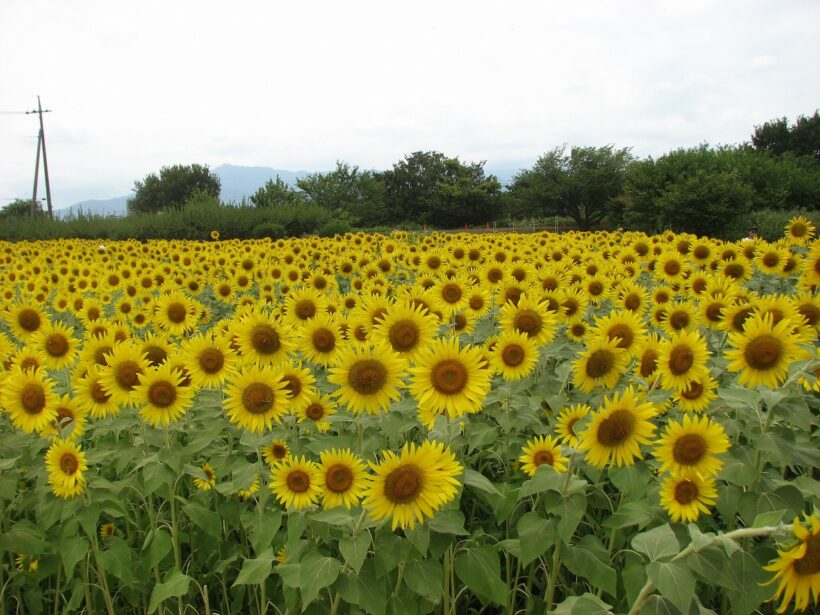

This summer has been a scorching heat wave. With temperatures approaching 40°C, I have no desire to ride my motorcycle. However, when the temperature drops a little, the urge to go out on my motorcycle pops up, but it's such a hassle. So I decided to take a short tour on my Super Cub to the sunflower fields in Zama, where the Sunflower Festival is being held. As usual, I took a detour and headed for the sunflower fields in full bloom.

Following the Sagami Line, a local line in the Tokyo metropolitan area
 The nearest stations to the Zama Sunflower Fields are Sobudai-shita and Iriya Stations on the JR Sagami Line. Both are a 20-minute walk away. Of course, this doesn't matter to me since I'm traveling on a Super Cub, but looking at the map, I could reach the fields by following the Sagami Line. The Sagami River flows further west, so I decided to take a route along the Sagami Line on the way there and the Sagami River on the way back.
 This year's 2025 Zama Sunflower Festival will be held for three days, from August 9th to 11th. The weather forecast predicted sunny skies only on the first day, the 9th. So I decided to go on the 9th.
 The JR Sagami Line runs 33.3 km between Hashimoto Station in Sagamihara City and Chigasaki Station in Chigasaki City, with a total of 18 stations. Running north-south along the east bank of the Sagami River, the line once had branch lines, such as the Kawasamugawa Line and Nishisamugawa Line, from Samukawa Station, which were used to transport gravel from the Sagami River. It was a rare non-electrified line in the Tokyo metropolitan area, but in 1991 the entire line was electrified and the new 205 series 500 trains, which were new at the time, were introduced. Electrification increased speed and convenience, but because it is a single track, there are waits at interchange stations, and the entire journey takes 64 minutes. There are also no express or rapid trains. In 2021, the latest E131 series 500 trains began operating, and all trains have now been replaced by these. However, it still retains the feel of a local line, so I headed to the sunflower fields while taking some train photos.
ADVERTISEMENT

The single-track Sagami Line has several stations for train interchanges. Sobudai-shita Station, the nearest station to the sunflower fields, is one of them.
ADVERTISEMENT

The new E131 series 500 series trains are all long seats, so the downside is that they lack the feel of a local line.
ADVERTISEMENT

The Super Cub can easily go to places that cars cannot. It is the perfect means of transportation for train photographers.
I probably should have headed south from Hashimoto Station along the tracks, but I don't have any particular preference, so I chose a road from Kamimizo that was as close to the tracks as possible. It was a rather tedious journey, getting lost in residential areas, coming to dead ends, and riding along paddy field paths, but I was glad that I was able to fully utilize the maneuverability of the Super Cub. There are three trains running in the morning and evening during the day. Simply put, that means I can photograph one train every 10 minutes, so I braved the summer heat to take photos at three different locations.
Sunflower fields crowded with tourists
 So, with all the train-loving elements, we arrived at the Sunflower Festival site just before 11am. The main road was already congested, and even my Super Cub couldn't move smoothly. So I drove like a cockroach on the back roads through the countryside, and safely arrived at the free bicycle parking area inside the festival site. Amidst the throngs of holidaymakers, we were enveloped in the 550,000 sunflowers in full bloom, the largest in the Tokyo metropolitan area. The
 Zama Sunflower Festival runs until the 11th, but you can still visit the sunflower fields after that, and enjoy the sunflowers until mid-August, so it might even be a good destination for couples on a tandem tour.
ADVERTISEMENT

ADVERTISEMENT

Zama Sunflower Field, with 550,000 sunflowers in bloom, is the largest in the Kanto region.
ADVERTISEMENT

ADVERTISEMENT

The Zama and Yotsuya venues are adjacent to each other, and both have observation decks and photo spots.
ADVERTISEMENT

During the Zama Sunflower Festival, there will be rest areas, restaurants, souvenir shops, and more.
On the way back, I rode upstream along the Sagami River, staying as close to the bank as possible. It felt refreshing to ride while enjoying the wide-open scenery. If only the temperature had been just five degrees lower, I would have been happy. The Hatagawa River, which flows into the Sagami River, has a sight to see, the Sandan Falls, and I was able to enjoy a bit of coolness. It was a short ride, but it was a mini-tour that really gave me a taste of summer.
ADVERTISEMENT

The Sagami River flows from the foot of Mount Fuji through Lake Sagami and Lake Tsukui, passing through two dams, and into Sagami Bay.
ADVERTISEMENT


The Sandan-no-Taki waterfall, which flows into the Sagami River, was created by taking advantage of the natural features of the river terrace. There is also a park called Sandan-no-Taki Observation Plaza. The nearest station is Shimomizo Station on the Sagami Line.
The distance traveled was about 57 km. The gasoline used was 1.07L. The cost of the trip was about 180 yen.











![[Izu City, Shizuoka Prefecture] A great touring spot to visit by motorcycle | Passing the Amagi Pass through central Izu.](https://motopeek.com/wp-content/uploads/2025/11/4734-1762339049801.jpg)