
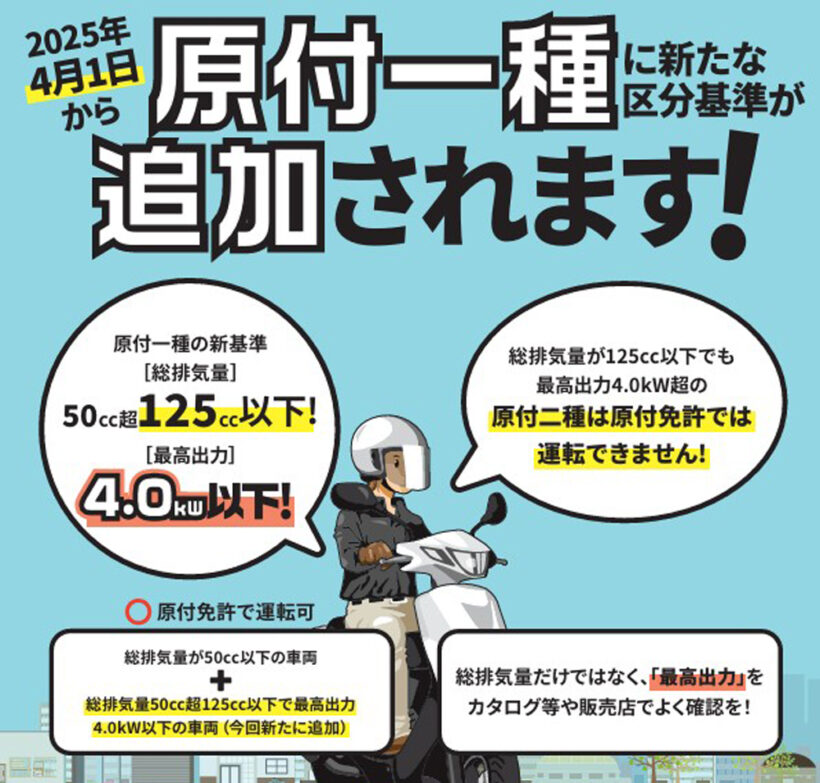
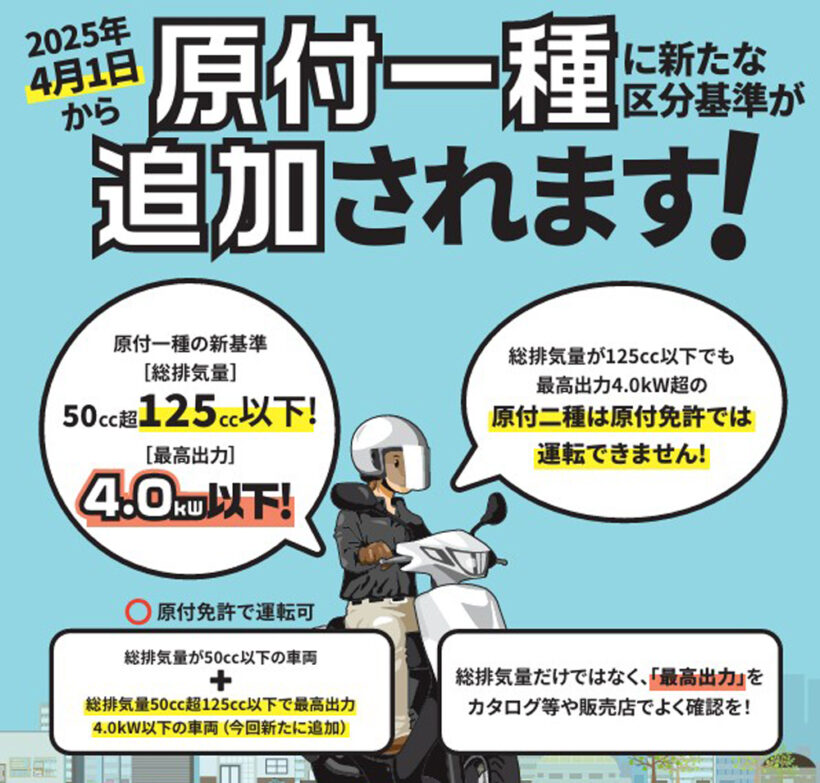
A new category, “New Standard Moped,” has been added to the Class 1 Moped category.

An educational leaflet published by JAMA (Japan Automobile Manufacturers Association), the National Police Agency, the Ministry of Land, Infrastructure, Transport and Tourism, and the Ministry of Internal Affairs and Communications. https://www.jama.or.jp/operation/motorcycle/cat1_scooter/
New exhaust gas regulations will apply to motorized bicycles (class 1 mopeds) with an engine displacement of 50cc or less from November 2025. As a result, production of current vehicles with an engine displacement of 50cc or less that cannot meet the exhaust gas regulations will effectively end at the end of October 2025.
Some people may be thinking, “What?! So the 50cc Class 1 moped, which is convenient for short distance travel, will disappear?” But don’t worry. The “replacement vehicle” that will appear is…
Vehicles with an engine displacement of over 50cc and up to 125cc (110cc and 125cc classes) and a maximum output of 4.0kW (5.4ps) or less will be classified as “new mopeds, Class 1,” and can now be driven with a moped license. This marks the birth of the “new standard moped.” This law will come into effect on April 1, 2025.
The reason for reviewing the displacement of mopeds is that “clearing exhaust gas regulations at 50cc is not profitable”

Since its debut in August 1958, the Honda Super Cub 50 has been loved by people not only in Japan but all over the world. It is equipped with Honda’s traditional horizontal, air-cooled, four-stroke, single-cylinder SOHC two-valve 49cc engine. The photo shows the current standard model.
Exhaust gas regulations are getting stricter every year. The new exhaust gas regulations (Tier 4) that will come into effect in November 2025 are the strictest to date. To meet these regulations while maintaining an engine displacement of 50cc, significant improvements will be required to the complex fuel injection system and catalytic converters made from expensive rare metals.
Furthermore, stricter exhaust gas regulations are generally in place for 50cc engines than for 125cc engines. The smaller the engine displacement, the more expensive the purification equipment required to meet the regulations becomes relative to the vehicle price, making it more difficult to meet them profitably. Meeting stricter exhaust gas regulations requires even more advanced technology and expensive materials, which requires a great deal of time and resources for research and development.
These rising costs are reflected in the selling price of motorcycles. For example, if the price of a 50cc model were to jump to 500,000 yen, no one would be able to afford a 50cc bike, which is supposed to be “the common man’s means of transportation,” meaning that motorcycle manufacturers would not be able to make a profit even if they produced them. In order to break this vicious cycle, which is bound by existing laws…
Reviewing engine displacement classification = Realizing realistic prices
Currently, the 50cc class is only available in Japan. Maintaining power while meeting strict exhaust gas regulations requires even more cost (money) than before the regulations.
Meanwhile, the 125cc class is a “standard” category serving the vast Asian motorcycle market as a means of transportation for the masses. Compared to the 50cc class, which is only available in Japan, the 125cc class, with its global market reach, offers an easier balance between meeting exhaust gas regulations and cost.
Meeting exhaust gas regulations requires less cost (money) than the 50cc class, making it easier to achieve a more realistic sales price than the 50cc class after the regulations were introduced.
This is the fundamental reason and the biggest point behind the recent revision of moped engine displacement. It also offers a major benefit: a win-win situation for both users and manufacturers.
Characteristics of motorcycles that fall under the “new standard moped”

The “Super Cub Lite Concept” is based on the Super Cub 110. Aside from the removal of the passenger step, the appearance is almost identical. The engine is the same as the Super Cub 110, an air-cooled, four-stroke, 109cc, single-cylinder OHC, but the maximum output has been detuned to 4kW (5.4ps) or less.
As of October 7, 2025, the official websites of domestic manufacturers have yet to list any “new standard moped” models. However, it appears that the baton will be passed on to new standard mopeds at any time depending on the manufacturer’s inventory of the current 50cc models.
Many of the new standard mopeds are based on the current 110cc and 125cc class mopeds.
– Reducing maximum power output –
Eliminating two-seater features such as tandem steps
– Changing double seats to single seats
– Changing the speedometer to display 60km/h
– Introducing a 60km/h speed limiter
– Introducing measures to prevent illegal modifications (increasing maximum power output, cutting the speed limiter, etc.)
It is expected that differentiation will be achieved by implementing measures such as the following.
At the Honda booth at the 41st Osaka Motorcycle Show held in March 2025, the “Super Cub Lite Concept,” which complies with the new moped standards, was unveiled.
The birth of new standard moped models based on the existing 110cc and 125cc models has led to some concerns such as “Won’t the body be too big to drive?” and “Will the seat height be too high?” However, in the case of the Super Cub, the body of both the 50cc and 110cc versions is basically the same size, so there is no problem.
New standard mopeds → The existing “30km/h speed limit,” “two-stage right turn obligation,” and “two-seater ban” rules will remain unchanged. No changes to traffic rules.

The new standard for mopeds is based on the regulations for engine displacements of 50cc or less.
・30km/h speed limit
・2-stage right turn mandatory
・No two-seater riding
The license system, license plate colours (white for Class 1 mopeds, yellow for Class 2 mopeds over 50cc to 90cc, pink for Class 2 mopeds over 90cc to 125cc), compulsory automobile liability insurance premiums and tax amounts will remain the same as in the previous period for motor vehicles under 50cc.
“New standard 125cc moped” and “125cc moped type 2” are different things.
Some online comments include:
“If people ride 125cc models with a moped license, it will increase the number of accidents and become dangerous.”
“Since the engine displacement will be increased to 110cc or 125cc, we should stop including moped licenses on cars.”
There are various opinions, such as…
The idea that “you can drive a 125cc motorcycle with a moped license” is a misunderstanding and a big mistake.
A moped license does not allow you to drive 110cc or 125cc class 2 moped models that do not fall under the “new standard moped” category (a small-sized regular motorcycle license or higher is required). As before, it is not possible to ride the existing 110cc or 125cc models with a moped license.
If you drive a 125cc moped, which requires a Class 2 moped license or a small-sized regular motorcycle license, you will be subject to penalties for driving without a license, and if you cause an accident, it is highly likely that your insurance will not cover it, so be careful.
To reiterate, the new regulations simply change the engine displacement of Class 1 mopeds from 50cc or less to 125cc or less for the sake of convenience. A notable feature is that the maximum output of engine-powered vehicles is limited to 4kW (5.4ps) or less.
We would like to emphasize once again that the new standard 110cc and 125cc mopeds that will soon be released are different from the 110cc and 125cc moped Class 2 models, which require at least a small-sized regular motorcycle license .
 “Moped Licenses Up to 125cc” | National Police Agency Considers | Domestic Moped Reform Finally Begins | Motor-Fan [Motor Fan] Media Platform Delivering Automotive-Related Articles
The current limit for motorcycle engine displacement that can be ridden with a moped (motorized bicycle) license is 50cc or less. The National Police Agency has now announced that this limit will be raised to 125cc or less (drivers will need a standard small-sized motorcycle license or higher). However, the maximum power output will be limited to 4kW (5.4ps).
 [Update] Honda Ends Production of 50cc Class 1 Mopeds (Zero Handlebars). New “Class 1 Mopeds (with maximum power limit)” are born, with engine displacements increased from 50cc to 125cc. | Motor-Fan, a media platform focused on automotive-related articles.
Why the Class 1 Moped Class will be raised from 50cc or less to 125cc or less (New Class 1 Moped Class) “Raising the displacement of Class 1 Moped Class from 50cc or less to 125cc or less” This argument comes as stricter exhaust gas regulations have forced small-displacement motorcycle engines to be upgraded from 2-stroke to […]