


Scooter V-belts can suddenly break while riding, so we recommend checking the belt if your scooter has a lot of mileage!
With the exception of some models, scooters use a V-belt continuously variable transmission (CVT) in their drivetrains. This transmission combines two pulleys (drive and driven) with a rubber belt. Centrifugal force and spring force change the width of the pulleys, shifting the position of the rubber belt to achieve gear changes. This rubber belt uses a V-belt to maximize contact with the ground. Because the V-belt is constantly in contact with the pulleys to transmit driving force, it wears out over time and cracks due to heat and aging. Japanese manufacturers generally recommend replacing the engine every 20,000 km, depending on the model. While stock Japanese vehicles rarely break even after 20,000 km, caution is required with foreign scooters. A certain Italian manufacturer recommends replacing the engine every 10,000 km, but there have been reports of engines breaking within that time. The vehicle we repaired this time was a scooter equipped with an Italian engine.

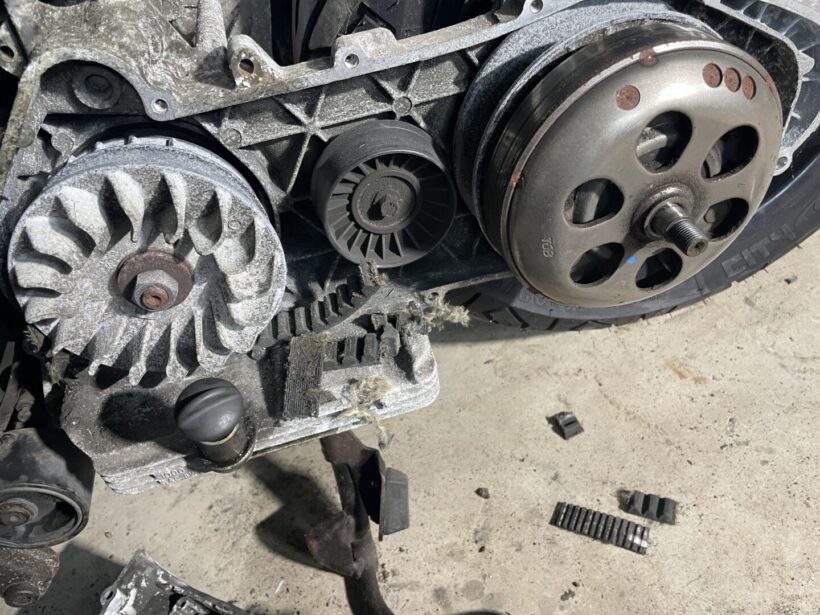
The broken V-belt was completely shattered and was stuck in the gap inside the case.


ADVERTISEMENT

The Kevlar fiber in the V-belt had frayed and was tangled in the gap of the driven pulley. I was relieved to find that there was no major damage.
I bought a scooter that hadn’t been ridden for a long time and was now immobile at an online auction. Since it was an abandoned vehicle, I thought I could revive it by cleaning the carburetor, so I made a bid. I quickly disassembled and cleaned the carburetor, and was able to start the engine. However, no matter how much I opened the throttle, the rear tire wouldn’t turn. I assumed the problem was with the drivetrain, so I opened the drivetrain case…and found pieces of rubber falling out. It seemed like the belt was broken. Pieces of the broken belt were stuck here and there, and the Kevlar fibers used in the belt had frayed and were packed tightly in the gaps between the crankshaft and pulleys.

I searched online to find new replacements for the broken belt, as well as the weight rollers and slide pieces, which were likely worn out. I discovered that the original V-belt was over ¥20,000! It’s more expensive than parts from Japanese manufacturers. It also has a shorter lifespan. Since the vehicle is over 15 years old and the dealer is from a manufacturer that no longer exists, I decided to replace it entirely at my own risk with a Honda V-belt that was the closest in length and width. I ordered the original weight rollers and slide pieces. After carefully removing the remains of the belt and cleaning up the worn belt shavings, I installed the new parts. This engine’s driven shaft passes through the belt case. Since the case uses a bearing, I replaced that bearing as well. All that was left to do was reassemble the case and it was complete. Although I used a non-original belt, there were no strange noises and acceleration seemed fine.

I used the original belt from Thai Honda for the early model PCX.

The weight rollers and slide pieces were also replaced with new ones.

There are traces of friction from the torn rubber belt. I polished them with metal compound.

It will be easier to install if you compress the driven spring, clamp the belt between it, and tie it with a cable tie to prevent the driven peeler from returning.

Once the pulley and belt are reassembled, it’s complete. I used a non-genuine belt, but there are no strange noises and there seem to be no problems with acceleration.
If you have a scooter made by a Japanese manufacturer and it’s left in its original condition, it’s unlikely that the belt will suddenly break within 20,000 km, but if you notice any unusual signs, such as a squeaking noise coming from the belt case or an uncomfortable feeling when accelerating rather than smooth, we recommend that you have it checked as soon as possible. In this case, the problem was fixed by simply replacing the belt, but a broken belt can get caught and damage the pulley or clutch, so it’s a good idea to regularly check the condition of the inside of the belt case.

The driven shaft is supported by a bearing on the case side.

I also replaced this bearing with a new one (using 6202ZZ).