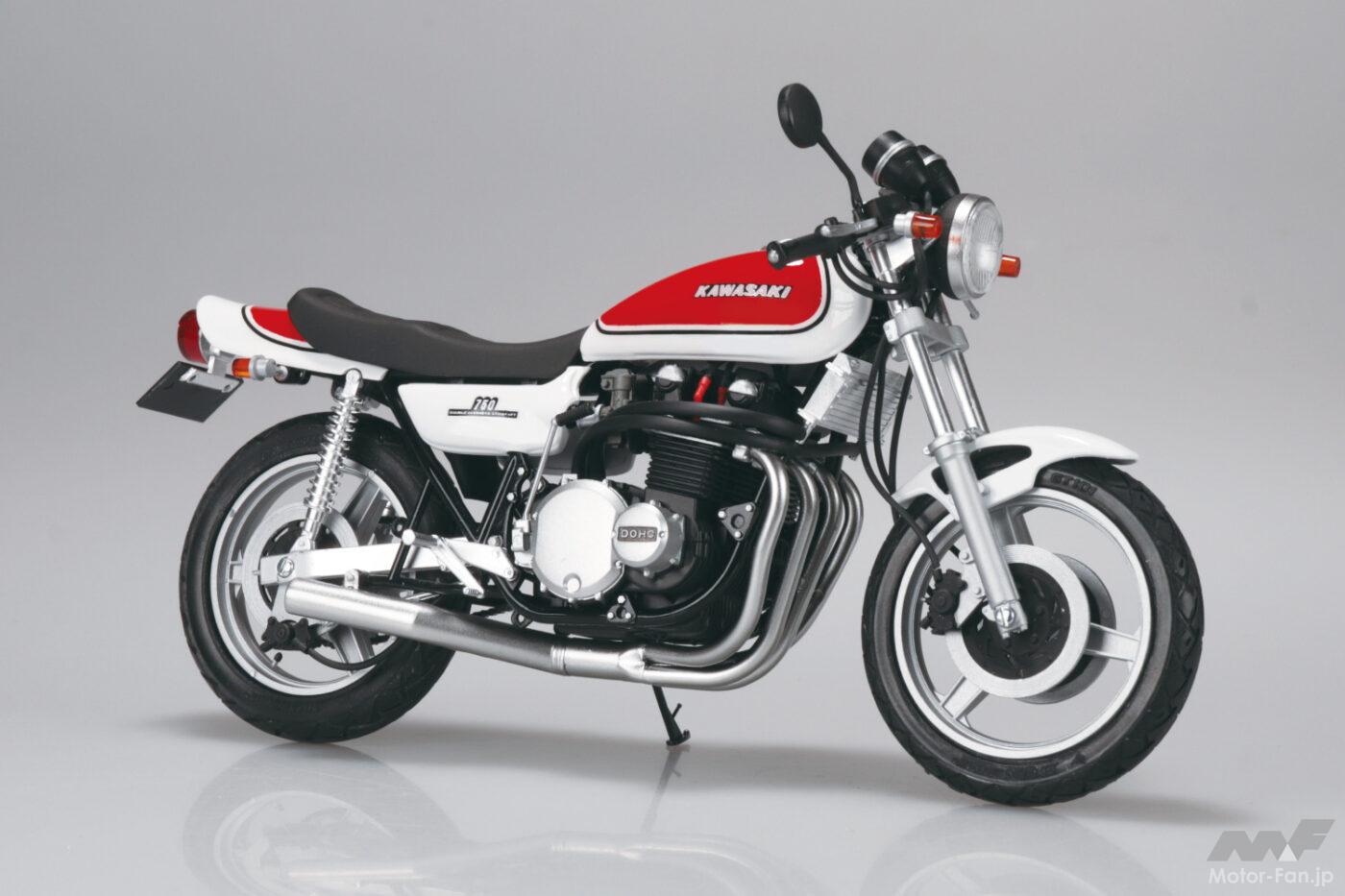

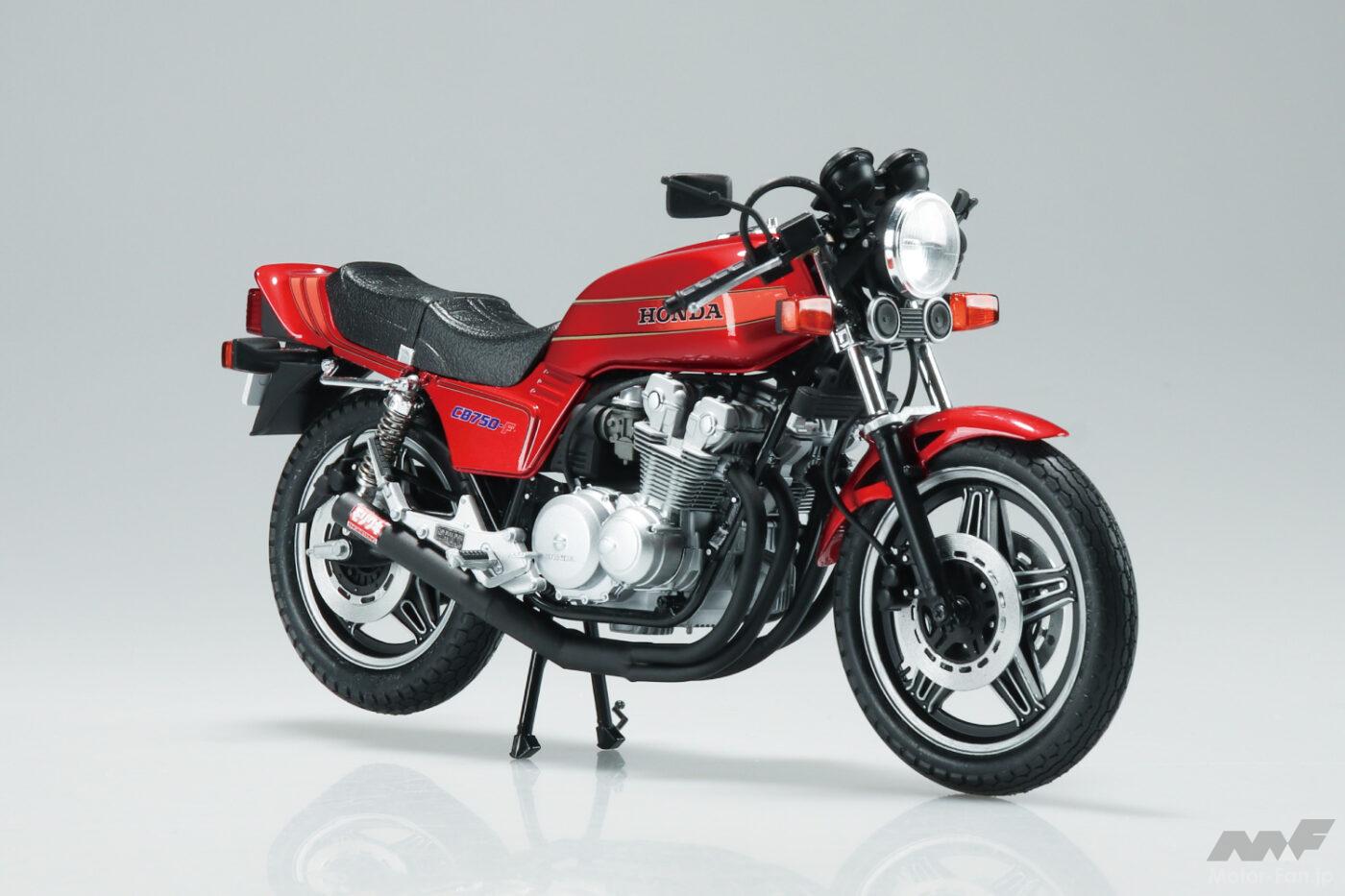
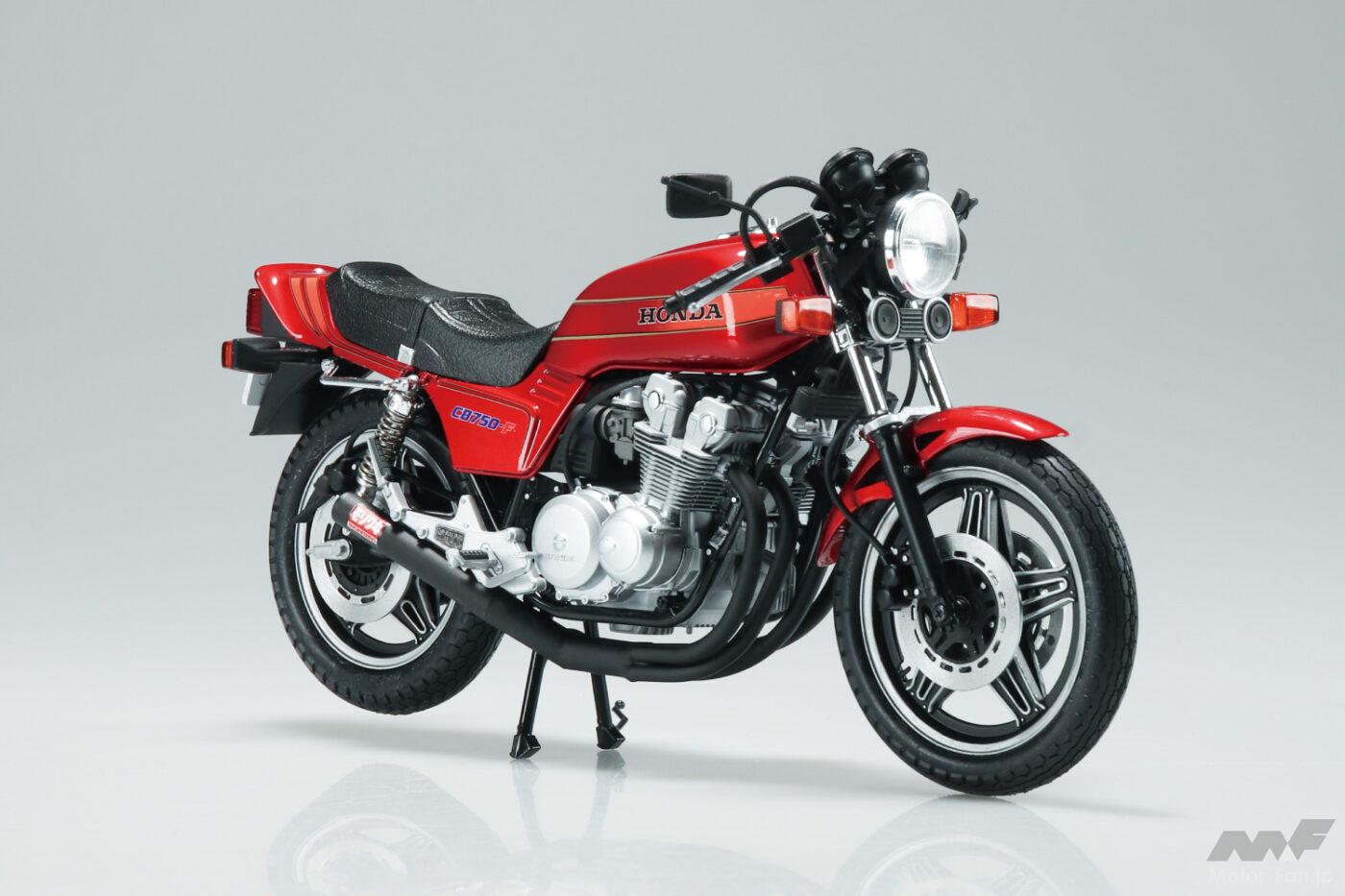
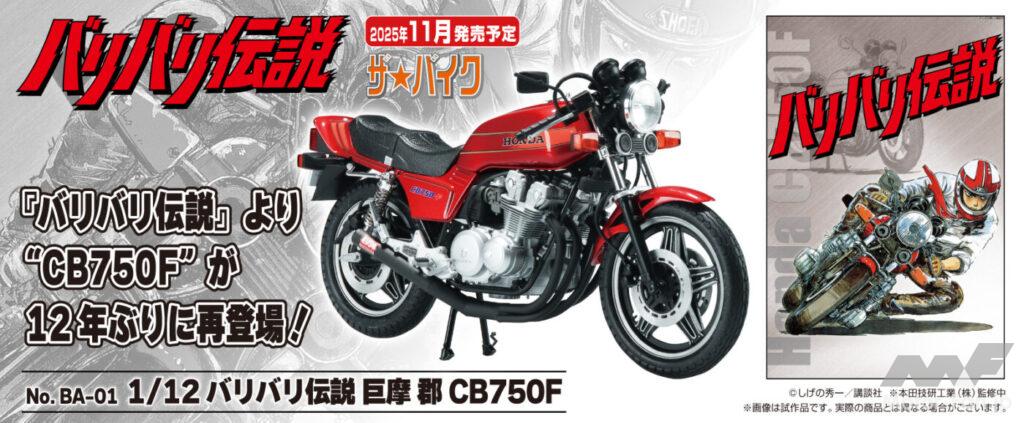
Aoshima The Bike No.BA-01 1/12 Scale Model: Baribari Legend Koma-gun CB750F… 4,260 yen (tax included) Scheduled for release in November 2025
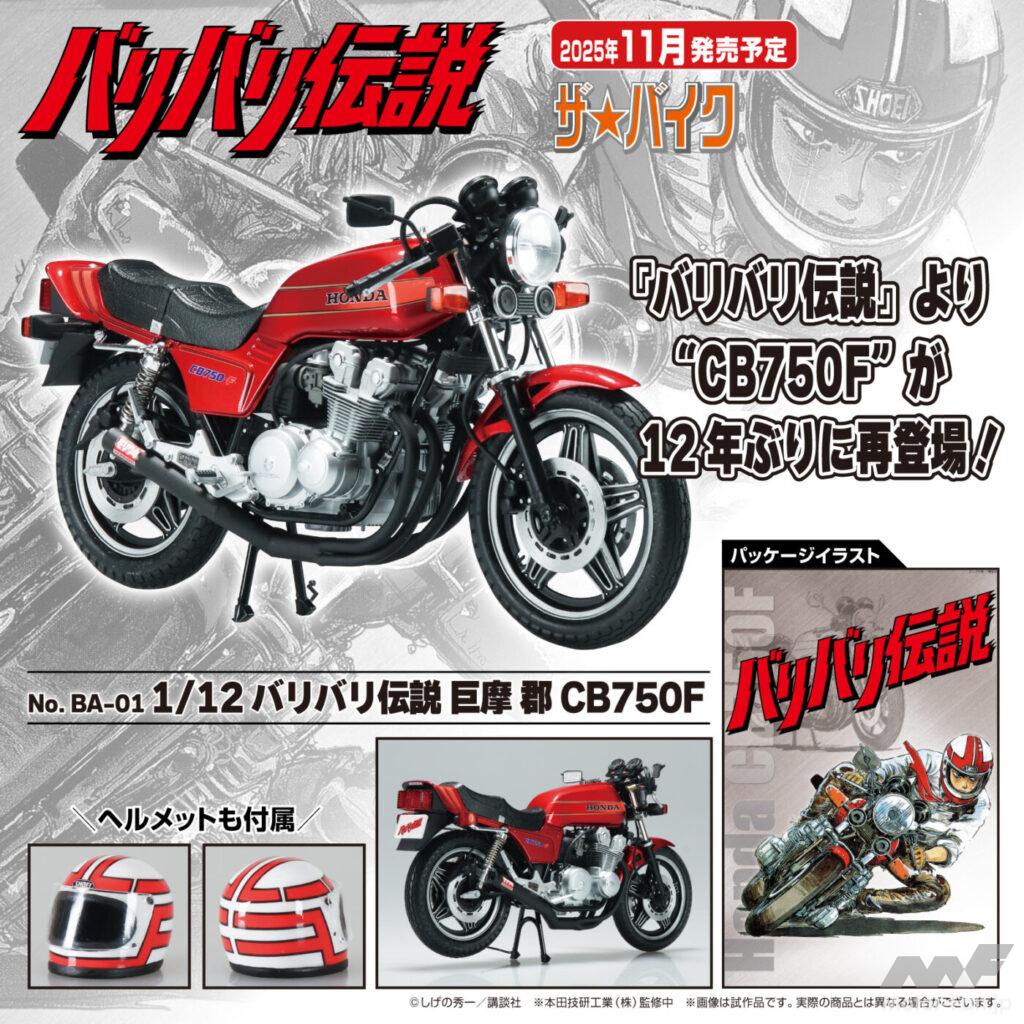
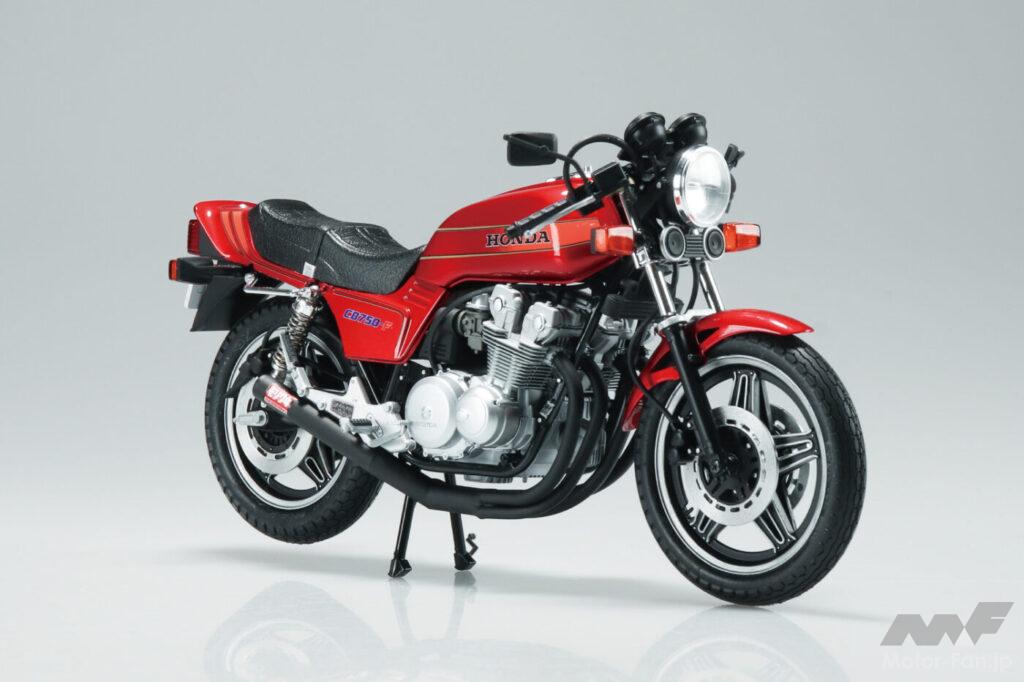
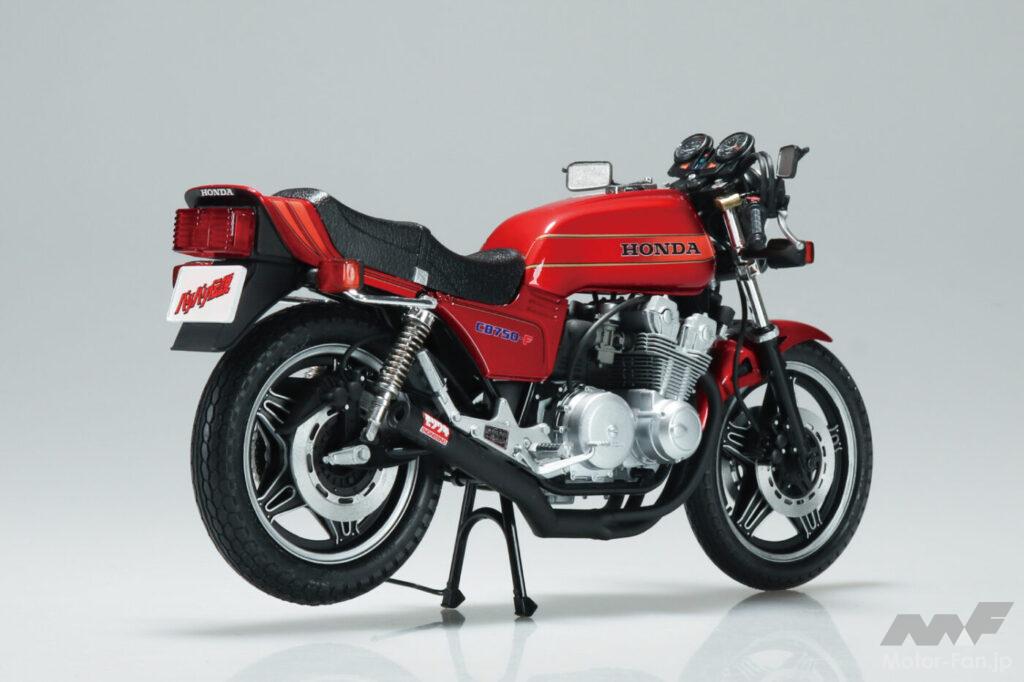
The Bali Den Gun spec CB 750 F is back for the first time in 12 years!
“BariBari Densetsu” is a popular motorcycle manga that was serialized in “Weekly Shonen Magazine” from 1983 to 1991. The Honda CB750F modified, the beloved bike that the main character, Koma Gun, rode in high school in the series, is now available as part of the Bike series. This 1/12 scale plastic model recreates the specifications seen in the series.
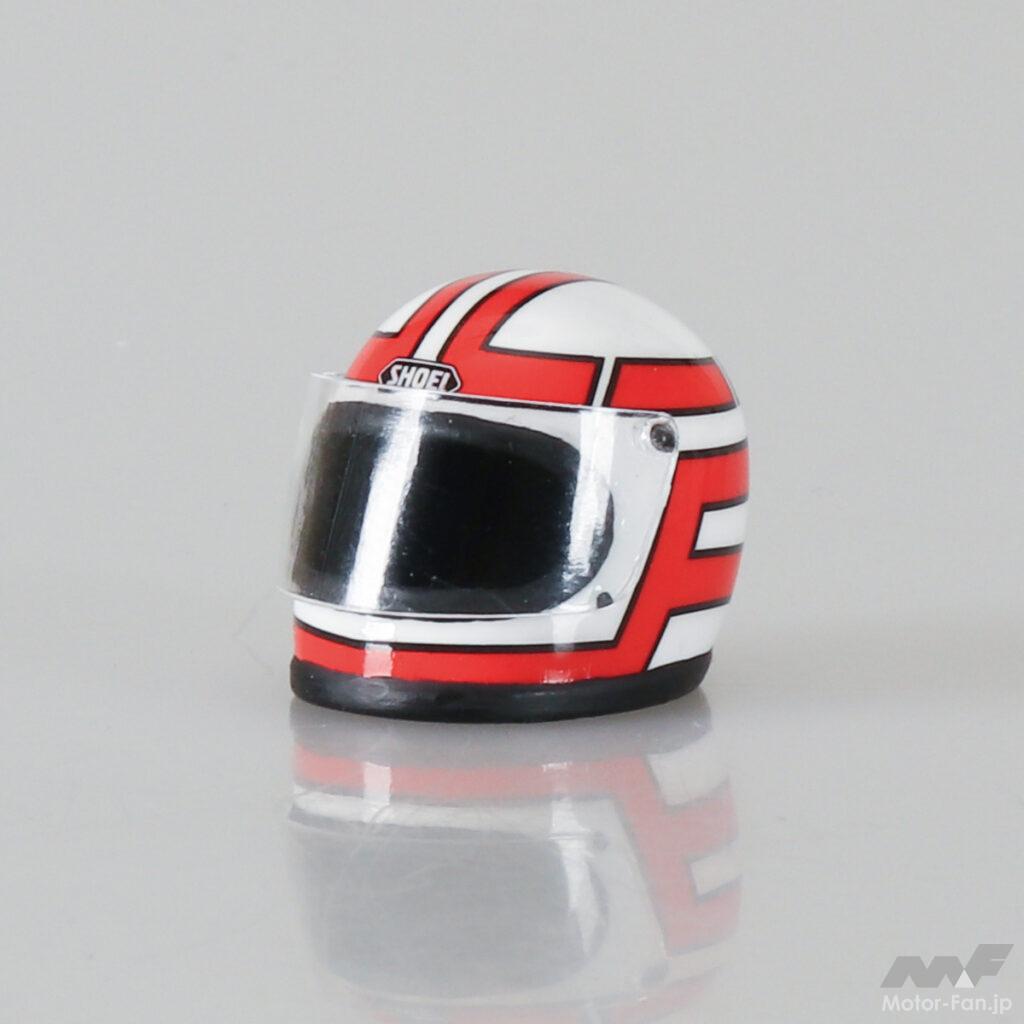
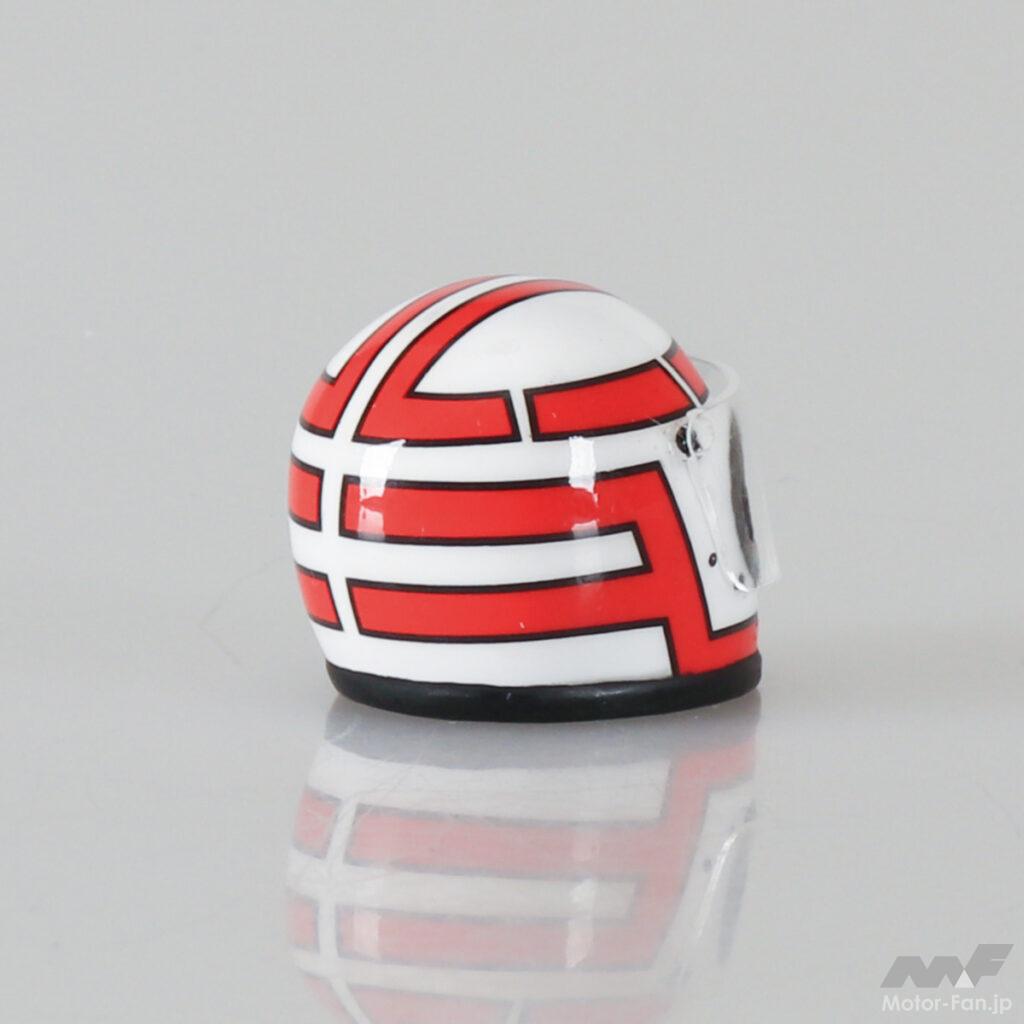
Just like the car in the movie, it also features custom parts such as a straight-pipe type collective muffler, separate handlebars, square mirrors, an oil cooler, and a front stabilizer. The axles and stems are made with metal screws, ensuring strength while being easy to assemble. The wires and hoses are made of vinyl pipes, which adds to the realistic form. A helmet designed specifically for Gun is also included.
[Product Specifications]
Price: 4,620 yen
Release Date: Scheduled for release in November 2025
Scale: 1/12
Size: Total length approximately 182mm
*Under supervision by Honda Motor Co., Ltd.
*The image is a prototype. It may differ from the actual product.
*This product is a plastic model kit. Separate tools are required for assembly.
©Shigeno Shuichi/Kodansha
Official manufacturer website: https://www.aoshima-bk.co.jp/product/4905083203392/
The King of 750cc Motorcycles that everyone admired! The Honda CB750F
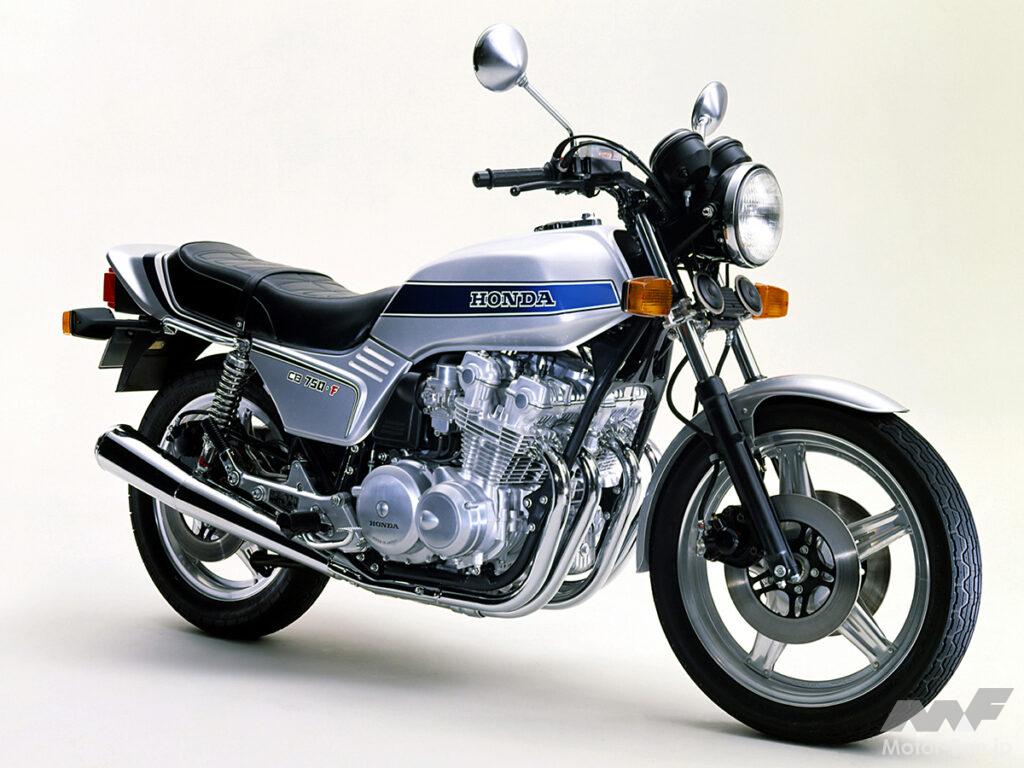
The first generation Honda CB750F (CB750FA) was released in 1979 (Showa 54).
ADVERTISEMENT
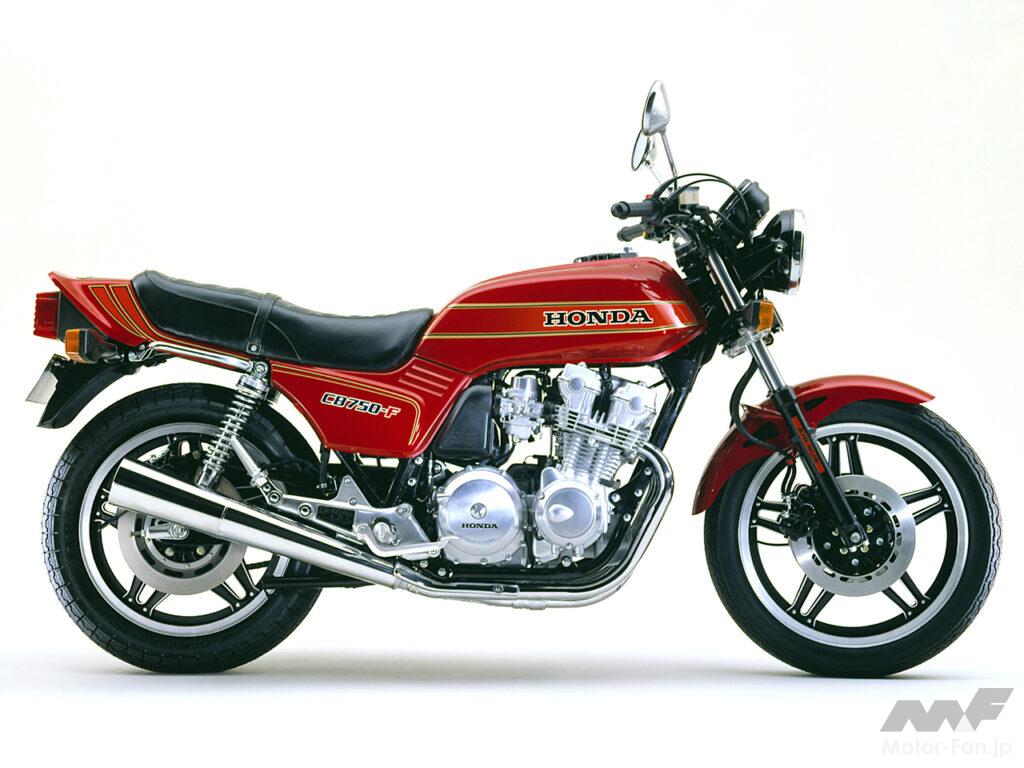
The second generation Honda CB750F (CB750FB) underwent a minor change in 1981. It became even more famous when it appeared as the favorite bike of Koma Gun, the protagonist of the TV drama “Bari Bari Densetsu.”
The Honda CB750F was released in 1979 (Showa 54). It was equipped with an air-cooled, 4-stroke, 4-cylinder, DOHC, 4-valve, 748cc engine that produced a maximum output of 68 horsepower. In 1981 (Showa 56), it underwent a minor change, adding the red color shown in the photo. The maximum output was also increased to 70 horsepower, and the suspension was strengthened.
At the time, the 750cc model, which was the top of the line in Japan, was called “Nanahan” and was the object of desire for riders. The CB750F was also known as “Nanahan F” and became an explosive hit. It is a famous story that many young people who were passionate about riding a Nanahan F attempted to remove the restrictions at a testing center, which was jokingly described as “more difficult than the bar exam” (Note 1) .
The protagonist of “Bari Bari Densetsu,” Koma Gun, is a 17-year-old high school student who has managed to break the restrictions and owns a CB750F (Gun’s father is a businessman who travels the world, and Gun lives alone with his pet cat in an apartment in Nerima, Tokyo, so he’s pretty wealthy). In the film, there is a scene where he battles a young delinquent on a public road (the boyfriend of a friend of Ito Ai, whom he later marries) who is riding a Yamaha RZ350 that keeps falling off the restrictions, and he easily beats him.
Currently, the CB750F is respected as a highly prized model, along with the Kawasaki ZI, ZII, and CB400FOUR, and well-maintained models are traded at high prices of several million yen.
*Note 1: In 1975 (Showa 50), the “large motorcycle (restrictions lifted)” entered a dark age…

In the 1960s, the “Kaminari-zoku” (thunder tribe) appeared, who would remove the mufflers from their motorcycles and roar as they sped through the streets. Later, the “Bosozoku” (bosozoku) became a social problem, riding in groups and dangerously on large motorcycles such as the 750cc “Nanahan” (750cc was the maximum engine displacement in Japan at the time due to manufacturer self-regulation).
As a result of these factors, the driver’s license system was revised in 1975. Motorcycle licenses were classified into “small motorcycle licenses” for motorcycles up to 125cc, “medium motorcycle licenses” for motorcycles up to 400cc, and “unrestricted motorcycle licenses” for motorcycles over 400cc (Note 2) .
*Note 2: Due to this change in the license system, young people who wanted to get a motorcycle license before the change flooded driving schools and driver’s license testing centers.
The most problematic aspect of this categorization was that while small and medium-sized motorcycle licenses could be obtained at driving schools, the system for obtaining a license for a motorcycle license over 400cc without a license restriction was not available at driving schools. The only way to obtain a license for a motorcycle license without a license restriction was through a one-shot test (which could not be obtained at a driving school).
Due to manufacturer self-imposed restrictions, the maximum engine displacement for domestic specifications at the time was 750cc. For this reason, the “removed restrictions” following the revision of the license system were commonly referred to as the “750cc license.”
The exam for the “Limit Removal” at the time was extremely strict, meaning that even the slightest mistake meant immediate failure. The pass rate was said to be only a few percent (only a few out of 100 people passed), and it was so difficult that it was mockingly described as “more difficult than the bar exam.”
In other words, it was an exam that was basically designed to fail people, with no intention of letting them pass (it could also be seen as implicit bullying and harassment by the government, telling people not to ride large motorcycles).
As a result, riders who passed the “removed restrictions” test and were riding 750cc motorcycles at the time were looked upon with envy, respect and admiration by intermediate license riders, who thought, “This guy passed that difficult test!” (One could also say that this was done to make those who rode large motorcycles role models for other riders).
At that time, in order to get through the “tests designed to fail (which, when you think about it now, are truly unreasonable and incomprehensible)”, some driving schools offered “specialized training to remove restrictions”. In addition to the school system, there were also efforts to efficiently remove restrictions in a short period of time, such as setting up a training camp system (Note 3) .
*Note 3: He is well known for his catchphrase, “I’ll teach you!” There was also a famous instructor, a former motorcycle police officer nicknamed “Demon Ogawa,” who would use a bamboo sword to give Spartan-style instruction, just like at Totsuka Yoto School (in the Showa era, there were actually instructors who would swing a bamboo sword around at driving schools).
The situation changed dramatically with a single word from the US! Since 1996, large motorcycles can now be obtained at certified driving schools.
This system was nothing more than a “bullying of large bikes,” and for a long time, “unrestricted” bikes remained out of reach. As a result, the domestic market for 400cc and 250cc bikes, which could be ridden with a medium-sized motorcycle license, became lively, and famous models such as the Kawasaki Z400FX and Honda CBX400F, equipped with voluminous four-cylinder engines, were born.
During the mid-to-late 1980s, when the motorcycle boom and racer replicas were at their peak, four-stroke models such as the Kawasaki GPZ400R, Yamaha FZ400, and Suzuki GSX400R, and two-stroke models such as the Honda NSR250R, Yamaha TZR250, and Suzuki RG250Γ, became extremely popular.
Things took a sudden turn in 1996 (Heisei 8), when the US government, which owns Harley-Davidson and had a significant trade deficit, came to blows.
“It’s hard to get a license to remove the restrictions in Japan, isn’t it? It’s unthinkable in the US. Isn’t this the main reason why Harleys aren’t selling well in the Japanese market?”
Due to pressure from the US government, the law was amended without much debate in the Diet, and from 1996 onwards, it became possible to obtain a large motorcycle license (with restrictions removed) at an accredited driving school.
When I think of this incident, I remember thinking with a wry smile, “What on earth was this strict, seemingly abnormal, licensing system that had pointlessly plagued riders who aspired to ride big bikes for decades?” It was a “strange incident” that symbolized “Japan, the country with the weakest, most vassal attitude toward America.”
Incidentally, ever since it became relatively easy to obtain a large motorcycle license at an accredited driving school, sales of big bikes, including Harley-Davidson, have grown significantly, just as the US government had intended.
It was a win-win for both Japanese riders and the American government. At that moment, I think many riders and potential riders felt, “Thank you, America, for abolishing this stupid system.”
There is more to this story.
Nine years later, in 2005, the ban on two-seater riding on highways was lifted. The United States had raised the following issues with Japan as a prelude to deregulating the acquisition of large motorcycle licenses.
1. Lift the ban on two-seater riding on expressways.
2. Abolish the 80km/h speed limit for motorcycles on expressways.
Japan is the only developed country that prohibits two-seater riding on expressways. It is a contradiction that two-seater riding is permitted on ordinary roads with many intersections, complicated traffic flows, and many pedestrians, but is prohibited on expressways with no intersections, obstacles, or pedestrians.
Regarding the maximum speed limit on highways, it is more dangerous for a passenger car to have a speed difference of 100 km/h compared to a motorcycle, with a speed difference of 20 km/h. No other developed country besides Japan has such speed restrictions. That was the argument of the US government.
If these systems were to be abolished, America’s Harley-Davidson would sell in large numbers in Japan. This is America’s plan.
These two laws were also amended in a flash. As a result, Harley-Davidson sold well in Japan. It was a win-win situation for both Japanese riders and the American government.
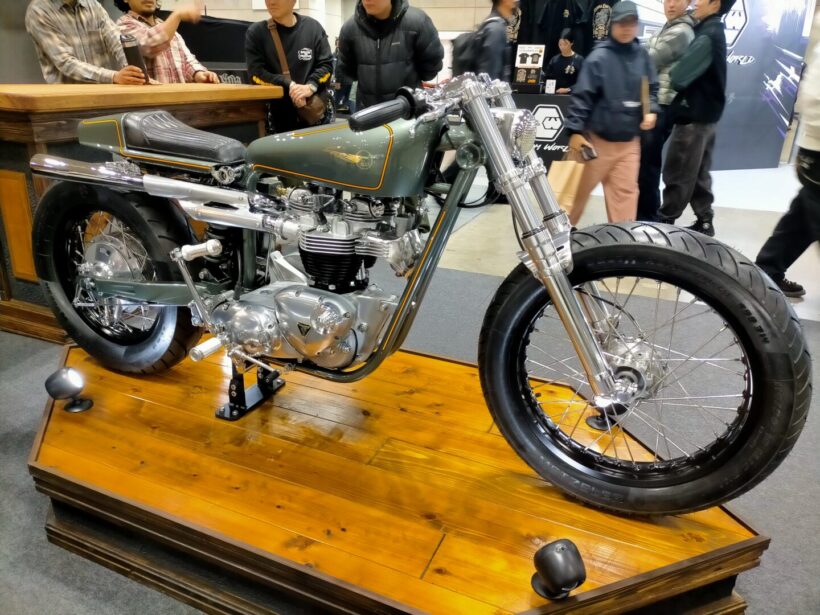
 A modern take on the legendary CB750F Koma-gun spec! Discover it at the Up Garage booth [Tokyo Auto Salon 2023] | Motor-Fan [Motor Fan] A media platform that delivers automotive-related articles
Up Garage is one of Japan’s largest buyers and sellers of used car and motorcycle parts. The Honda CB750F shown in the photo was on display at the store’s booth. It was owned by one of Up Garage’s Instagram followers. The Honda CB750F was priced at 197 […]
ADVERTISEMENT
 [¥22,000] Incredible Reproduction! “The Legendary” Koma-gun Spec CB750F Modified | 1/12 Scale Full-Scale Diecast Model | Motor-Fan [Motor Fan] Media Platform Delivering Automotive-Related Articles
Product Name: 1/12 Honda CB750F “Bari Bari Legend” *Includes Koma Gun helmet Price: 22,000 yen (including 10% consumption tax) Sold by: AUTOart *Pre-orders now being accepted / Scheduled to be shipped sequentially in late April 2022 The author was born in 1969 (Showa era) […]
 A 200,000 yen broken CB750F was revived using a full complement of used parts! Is it true that the total cost was only 480,000 yen? | Up Garage [Tokyo Auto Salon 2020] | Motor-Fan Bikes
I discovered the famous Honda CB750F at “Up Garage,” a well-known shop that buys and sells used car and motorcycle parts. This CB750F was actually restored from a non-working vehicle (with many missing parts) worth 200,000 yen, for a total cost of 483,600 yen, including vehicle expenses. A low-cost restoration… a man’s dream. PHOTO/REPORT: KITA Hideaki
 Good news for owners of discontinued Honda bikes! 23 genuine CB750F parts now available for resale!! | Motor-Fan Bikes
Honda has begun to gradually resell genuine parts for older bikes. Last summer, they started selling some parts for the CB750FOUR and NSR250R, and now they have also started resupplying 23 parts for the CB750F. The aim is to “build a motorcycle culture,” and this is good news for owners who have cherished their old bikes. REPORT & PHOTO ● AOKI Takao