

Performance that cannot be achieved with naturally aspirated engines
In this article, which will be divided into two parts, we will introduce a Z250SL equipped with a supercharger and a CBR250R equipped with a turbocharger, both built by Bike Shop Andy. However, turbos and superchargers are hardly common mechanisms in the world of motorcycles, so before we get into the main topic, we will provide an overview of superchargers.

To send large amounts of air into an engine. Put simply, that is the role of a turbocharger. While the purpose and application vary over time, such as power-up, downsizing, fuel economy, and air-fuel ratio correction, the common mission of all turbochargers is to rotate the parts inside the unit to send air compressed to above atmospheric pressure into the engine, achieving performance that cannot be achieved with naturally aspirated engines.

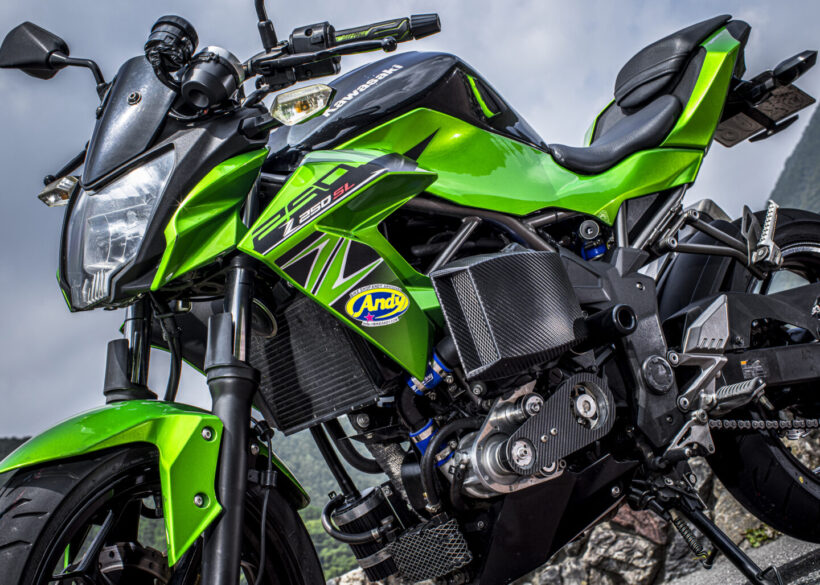
The centrifugal compressor supercharger mounted on the front left of the Z250SL crankcase is made by Rotrex of Denmark. The drivetrain, which extracts power from the crankshaft and uses a toothed belt, is a one-off creation by Ando. The sub-computer used in conjunction with the genuine ECU was also developed from scratch by Ando. The additional injector mounted on the intake duct is an aftermarket scooter part.
Broadly speaking, there are two types of turbochargers: turbos, which use energy from exhaust gases to spin a turbine, and superchargers, which use power from the engine to run the turbocharger (however, both are now available in electric versions. In other countries, turbos are also considered a type of supercharger), so it’s difficult to say which is superior. In fact, the two types of turbochargers coexist in the four-wheeled world, and some vehicles even use both turbos and superchargers.
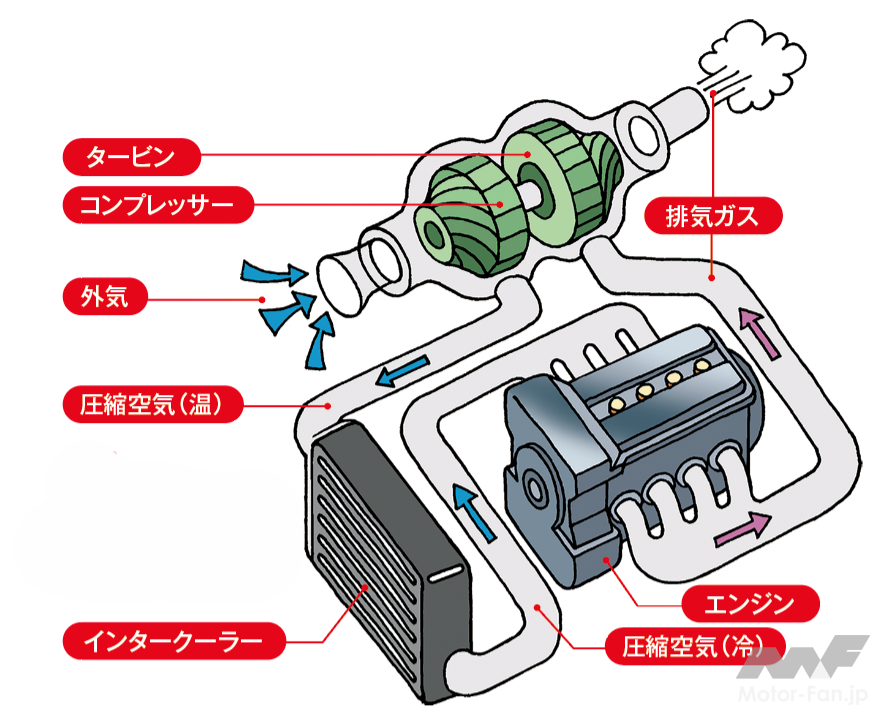
Turbocharger: The greatest advantage of a turbo is that it reuses the energy of exhaust gases, which would normally be wasted, to rotate a turbine that generates compressed air. Another advantage compared to a supercharger is that it has fewer parts. However, when the exhaust gas flow rate and turbine rotation speed are low, it is prone to experiencing a delayed response to throttle operation, known as turbo lag.
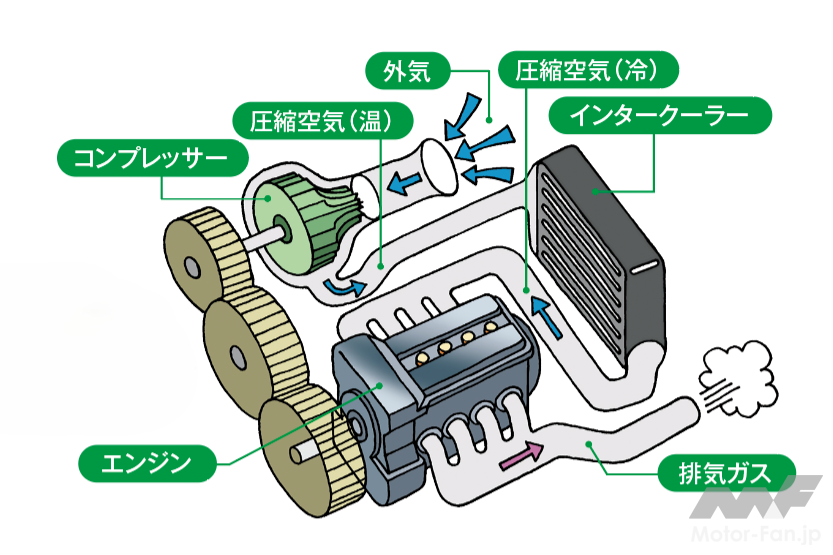
Supercharger (Centrifugal Compressor Type): The advantages of a supercharger are that it provides sufficient supercharging even at low rpm, with almost no delay in response to throttle operation. Conversely, its disadvantages are that it loses some power because it extracts power from the crankshaft to run the supercharger, and that structurally it does not provide as much supercharging as a turbo at high rpm.

Supercharger (Roots type): In addition to the centrifugal compressor type, which has a structure similar to that of a turbo, there are various types of superchargers, such as the Roots type, which rotates two sets of rotors, the Lysholm type, which has a similar structure to the Roots type but compresses with an internal twisted rotor, and the scroll type, which compresses inside a volute-shaped housing. Furthermore, power is generally transmitted from the crankshaft to the supercharger using either a gear, belt, or chain, or a combination of both.
Emphasis on fun on mountain roads and ease of handling in everyday use
Now, finally, to the main topic. When it comes to superchargers in the world of motorcycles, most people will focus on maximum power output and top speed. However, Ando-san of Bike Shop Andy says he isn’t particularly interested in absolute speed.
“In the past, I’ve recorded a speed of 137 km/h on a supercharged Address V125, but the supercharged cars I build generally prioritize fun on mountain roads and ease of handling in everyday use. It would be a shame to add interesting parts only to be able to enjoy their performance on long straights.”
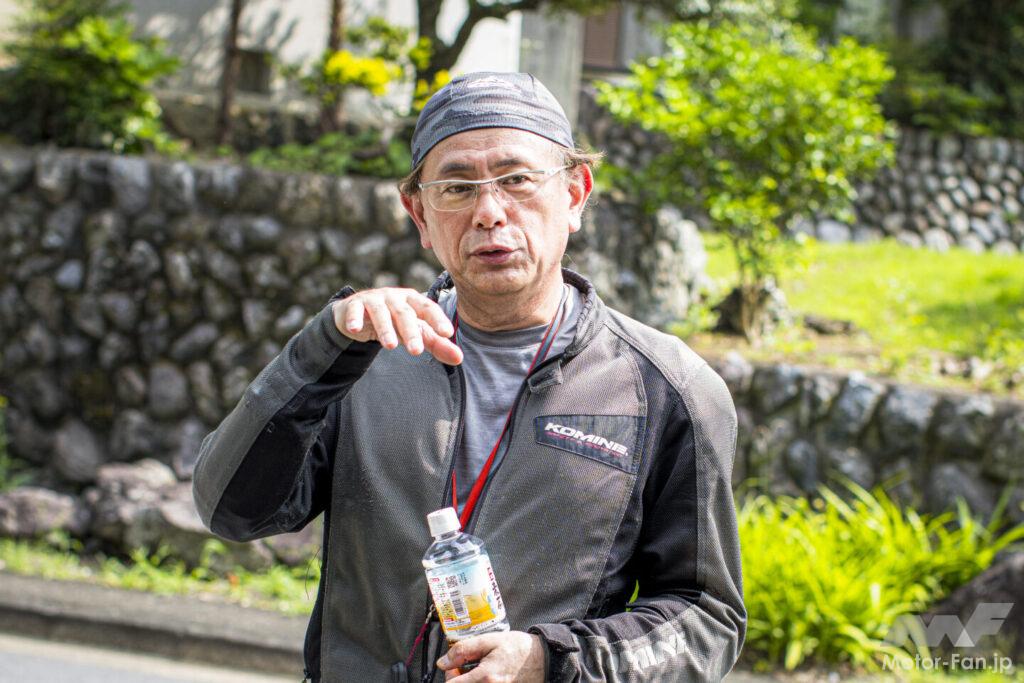
Satoshi Ando, the owner of Bike Shop Andy, competed in the All Japan GP125 Championship from 1986 to 1993, and at one point was involved in fierce battles with Kazuto Sakata and Akira Saito. Back then, and even now, the most important thing when tinkering with a bike is ease of handling.
Ando-san previously focused on 125cc scooters, but has now shifted his focus to 250cc single-cylinder road sports. In addition to the two bikes introduced in this article, he also produces supercharged versions of the Rebel 250, CB250R, and YZF-R15.
“The origin of my turbochargers goes back to the CB250RS turbo I built for myself about 20 years ago. So rather than changing the main focus, I think it was right to go back to my roots. I think the appeal of a 250cc single-cylinder road sports bike is that it gives you a feeling of agility that’s different from a 2/4-cylinder bike with the same displacement or one over 400cc, and that maintenance costs are low. However, there are many times when I feel the engine is lacking in power on mountain roads, so I installed a turbocharger to compensate for that.”

Ando has been riding the CB250RS since he was 16 years old. He converted the carburetor to an injection system around 2000 for his own study purposes, and after that work was completed he installed a turbo.
When I heard that, I thought it made sense, but I actually had some doubts about the necessity of a turbocharger. That’s because in the case of the Z250SL and CBR250R, you can increase the displacement by using parts for the export-spec KLX300 and CBR300R, and even before that, if you choose a 400cc single-cylinder bike from KTM or Triumph, you can solve the lack of power in the engine (of course, maintenance costs increase if the displacement exceeds 251cc). Also, I couldn’t help but wonder whether a turbocharger would be able to run properly on a 250cc class bike.

Our impressions of the CBR250R + turbo equipped model will be presented in the second installment, which will be released soon.
For this reason, I went into this test drive with mixed feelings… But after thoroughly experiencing the two supercharged vehicles in city streets and on winding roads, I was completely enlightened. In the following article, I will introduce the ride quality of the Z250SL + supercharged vehicle.
Z400SL…isn’t it?

The power curve of the Z250SL was measured on the chassis dynamometer at Wako 2rinkan. While the stock model produces 29ps as per the catalog data, the supercharged model produces 42.5ps.
 The Stage 1 boost pressure set by Bike Shop Andy is typically 0.7bar, but the Z250SL supercharged model is set to 0.9bar around 10,000rpm. In the more than three years of test runs, they have apparently not encountered any fatal engine trouble.
I was surprised at how powerful and torquey it was. I had seen the actual measurement data before the test ride, and knew that maximum output had increased from 29 to 42.5ps and maximum torque from 2.4 to 3.1kg-m, but the Z250SL + supercharged model was supercharged in every range, from the low rpm range just above idle to the high rpm range, and I could feel the powerful acceleration that exceeded the standard in every range. The difference with the standard model that Ando-san had prepared for comparison was clear, and at first I had the impression that it was a Z400SL?

However, that description is not accurate. The faithful response to the rider’s inputs and the sharp acceleration felt across the entire range are unique to a 250cc engine, where the moving parts inside the engine, such as the pistons and crankshaft, are light. If the engine displacement were increased by using the φ78mm pistons used in the KLX300 (φ72mm for the Z250SL), you would not be able to experience this light and nimble feeling.

The Z250SL, which was sold in Japan from 2016 to 2017, is a sports single with a trellis frame and a KLX250-based engine. The SL stands for Super Light, and the vehicle weighs 148 kg. It was also sold alongside the full-cowled Ninja 250SL, its sister model.
And speaking of lightness, this test ride made me realize once again the light handling that is unique to the 250cc class. This may contradict what I said earlier, but I don’t think you can get this same sense of nimbleness and freedom with the 400cc single-cylinder bikes sold by KTM and Triumph, which weigh just 170kg (the Z250SL is 148kg).

In any case, I was very impressed with the ride quality of the Z250SL + supercharger. What’s even more surprising is that the two bikes built by Bike Shop Andy had absolutely no negative aspects compared to the stock bikes. There was not even a trace of the harshness that many people associate with the word “supercharger.” I was able to open the throttle boldly when exiting corners on mountain roads, and I was able to ride easily through congested roads in the scorching sun with temperatures around 35 degrees Celsius with the same feeling as the stock bike.
Detail explanation
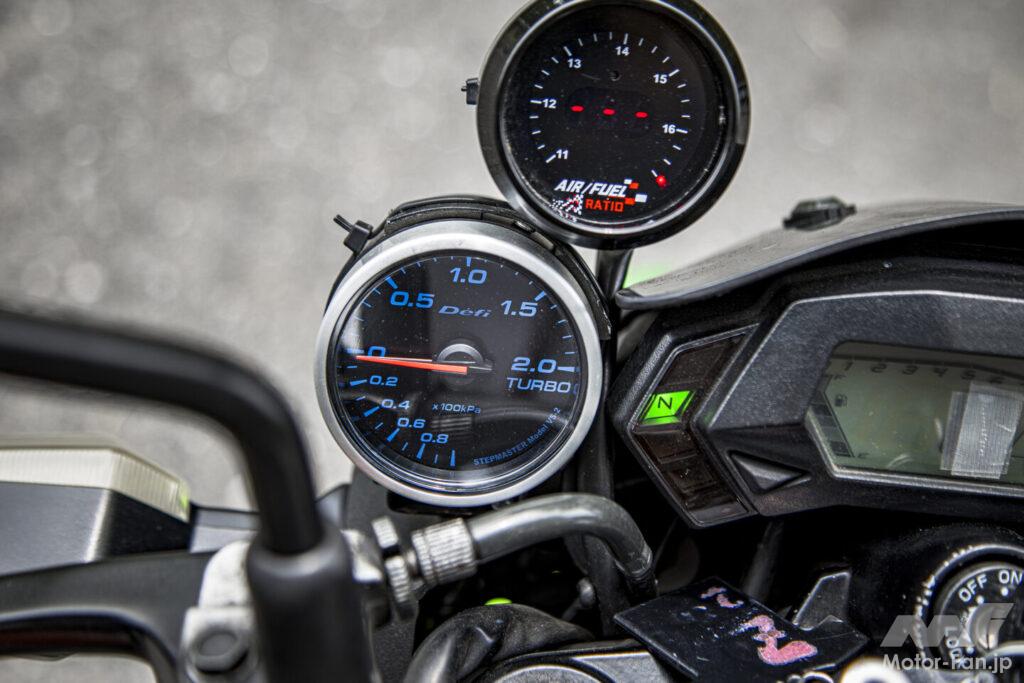
An air-fuel ratio meter and boost meter have been added to the cockpit. The Z250SL’s supercharging starts just above idle, the moment you engage the clutch and start moving, and even without forcing the throttle open, it reaches 0.7kpa just by driving normally.
ADVERTISEMENT
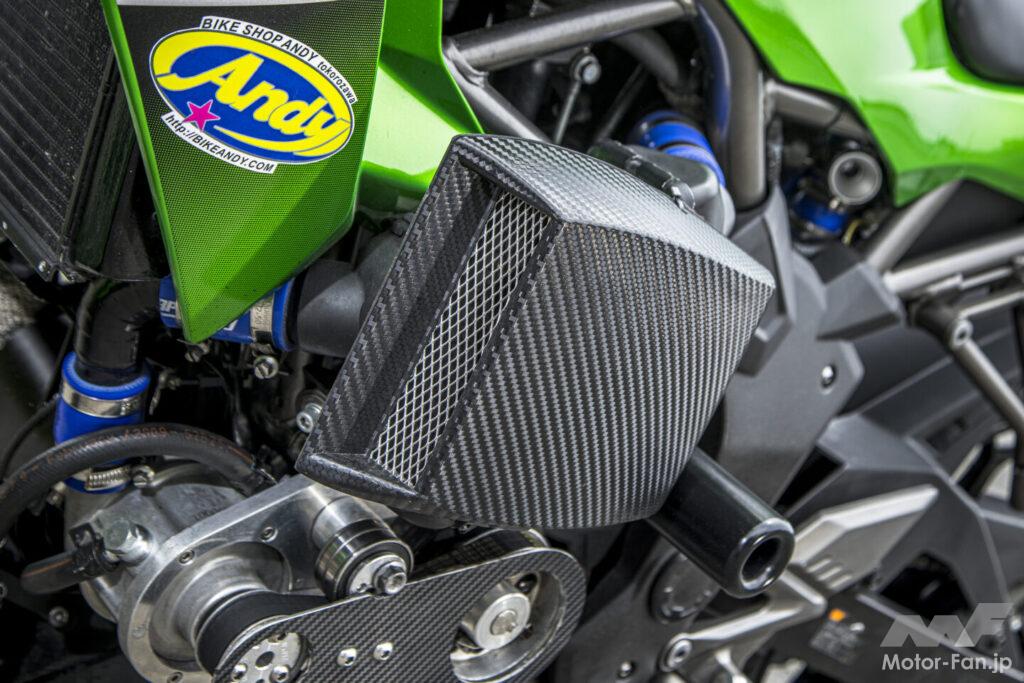
The intercooler on the left side of the engine is based on a light vehicle, and the carbon fiber cover is a one-off custom-made product by the shop. The intercooler is a part that lowers the intake air temperature, but it is not a must-have for Stage 1 specifications with a boost pressure of 0.7 bar.
ADVERTISEMENT
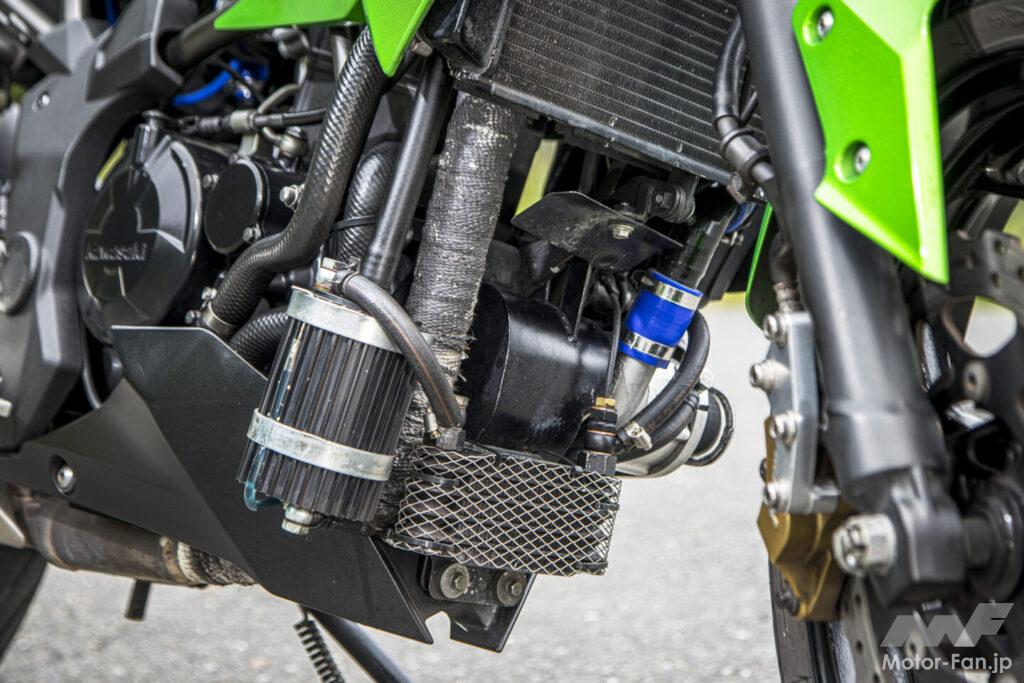
The air-cooled oil cooler located at the bottom front of the crankcase and the finned oil tank visible next to it are used to cool the supercharger. The radiator that cools the engine is the standard one.

A blow-off valve installed in the intake duct releases excess pressure when the throttle is released. The “whoosh!” sound heard when decelerating and the pressure on the left shin contribute greatly to the rider’s excitement during sports riding.
 This 250cc single-cylinder engine explodes with turbo power at high RPMs , giving it a two-stroke feel. Andy’s supercharged bike | Motor-Fan is a media platform focused on automotive-related articles.
The Difference Between Turbo and Supercharger This article introduces two 250cc single-cylinder + supercharged motorcycles built by Bike Shop Andy: a CBR250R + turbocharger and a Z250SL + supercharger. By the way, the turbo […]










![The child seat is retro and cute. But the 124cc straight-line leader is the Honda Chari! [Portrait of a 4MINI Enthusiast]](https://motopeek.com/wp-content/uploads/2025/10/4598-1762340867209.jpg)
![Only the frame and tank are genuine! A modified Ape finished with used parts [Portrait of a 4MINI Enthusiast]](https://motopeek.com/wp-content/uploads/2025/10/4604-1762340994544.jpg)