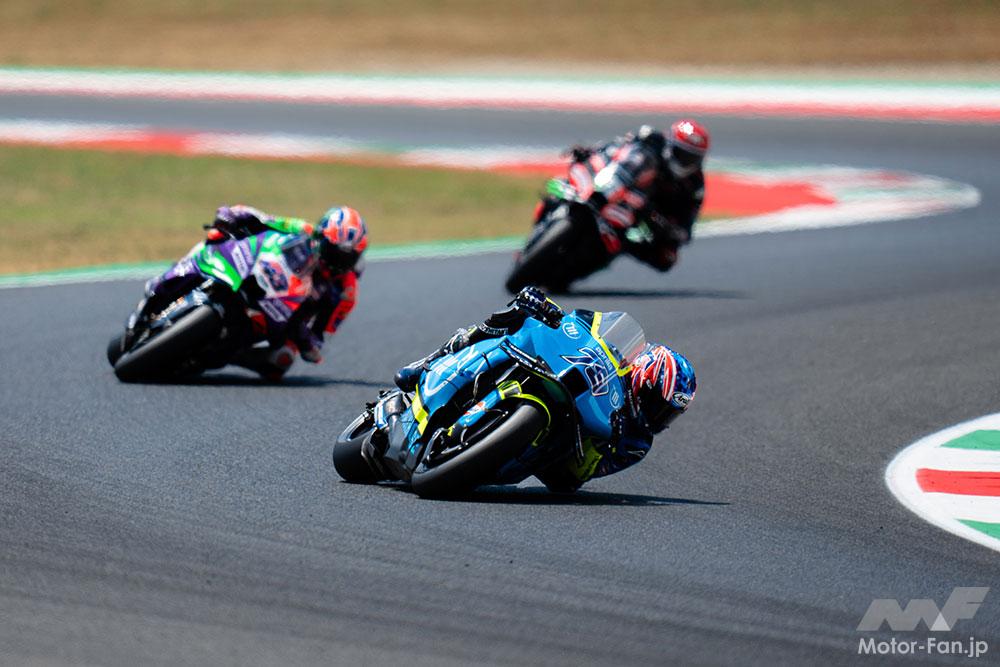

![A detailed explanation of the thoroughly driven Suzuki Katana. 1000km test drive [3/3]](https://motopeek.com/wp-content/uploads/2025/05/2770-1760844534644.jpg)

Suzuki Katana…1,661,000 yen
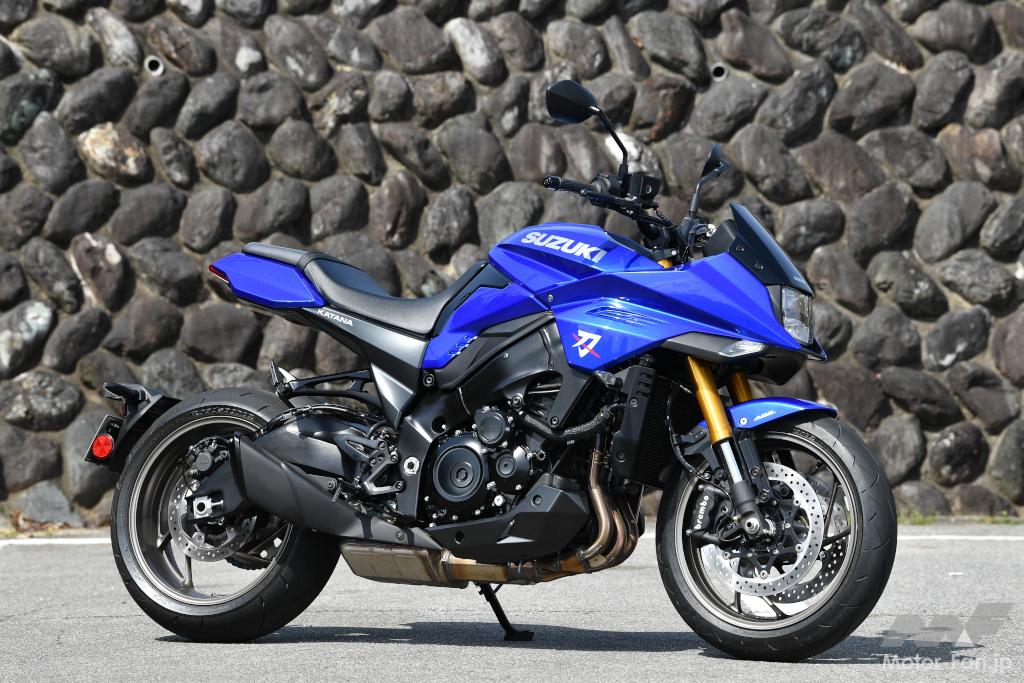
Whereas the GSX1100S Katana produced from 1981 to 2000 had a long and low body configuration (wheelbase 1520/1515mm, seat height 775mm), the modern Katana is short and tall (1460mm, 810mm). If you look at these two figures, it seems that the current Suzuki model that is closest to the old GSX1100S Katana is the Hayabusa (1480mm, 800mm).
Riding position (height 182cm, weight 74kg) ★★★★☆

By the standards of modern sports naked bikes, including the GSX-S1000, which shares the same basic design, the Katana has a forward seating position and a higher handlebar grip position. That’s why, on this test ride, which was my first in a while, I initially felt a little uncomfortable, but as the distance went on I was impressed with the handling, which I thought was only possible because of this riding position. On my first long run, I felt a lingering pain in my arms and legs, but this wasn’t due to the riding position, but rather the settings of the front and rear shocks. On my second long run, which I did with the preload/damper adjusters significantly loosened, I didn’t feel any obvious pain anywhere in my body.
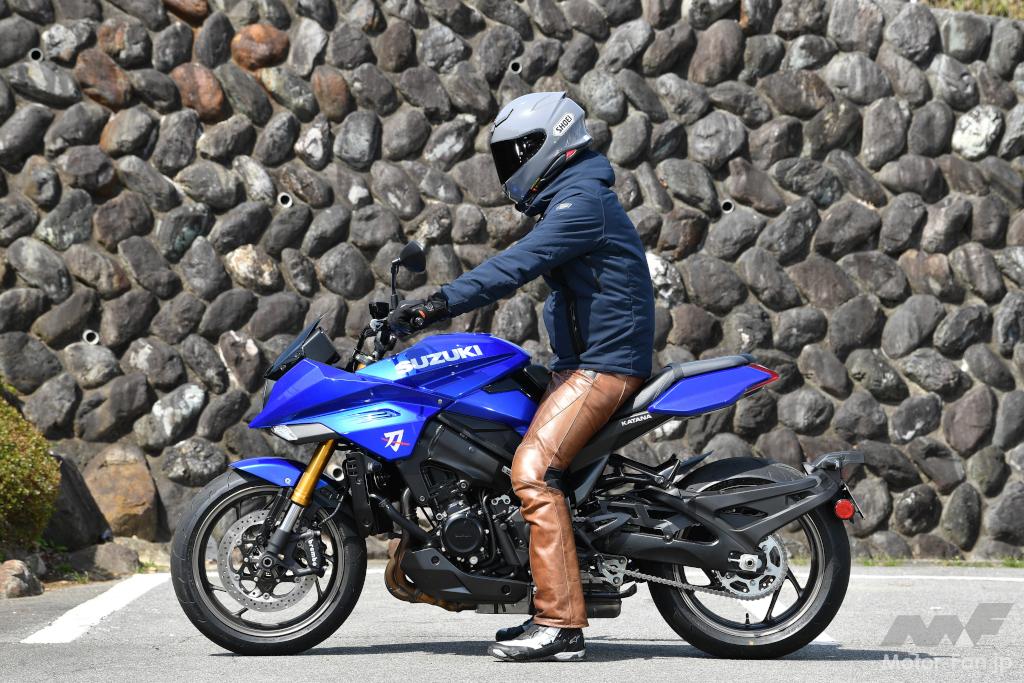
The seat height is 825mm, 15mm higher than that of the GSX-S1000, and in order for both feet to touch the ground, you need to be around 165cm tall. This may sound like a high hurdle to some, but 825mm is actually an average figure for recent sports naked bikes that have been created by reusing the basic design of supersport bikes. That said, it seems that there are quite a few riders in Japan who are dissatisfied with the Katana’s seat height, and there are many lowering kits available in the aftermarket.
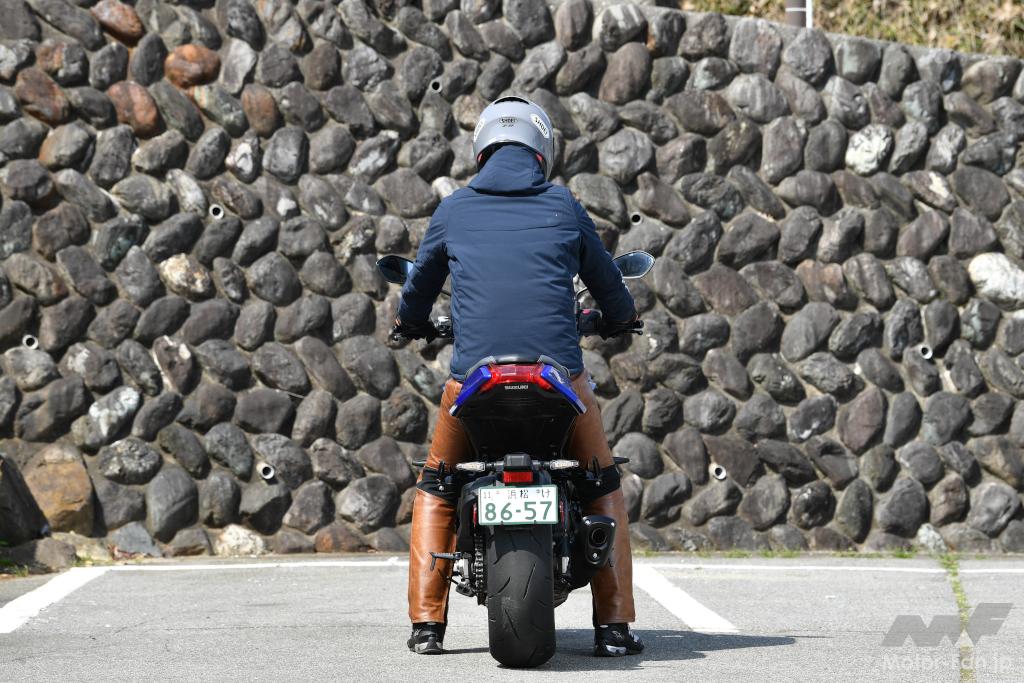
Tandem riding ★★☆☆☆
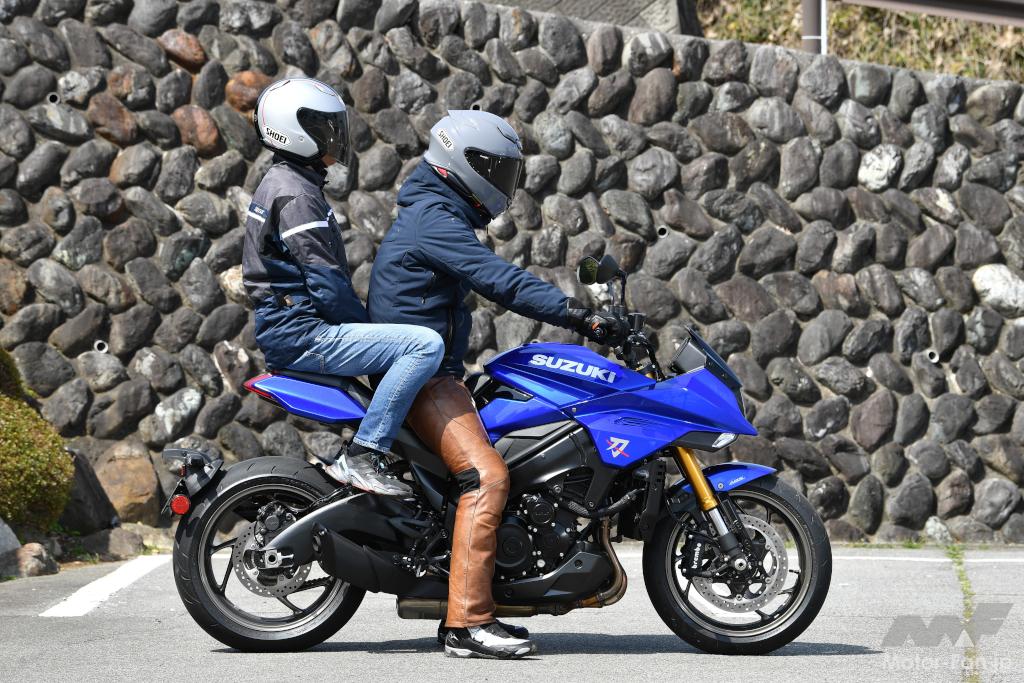
Previously featured in this article were Suzuki models such as the Gixxer SF250, V-Strom 250/SX, SV650 and GSX-8R, all of which had outstanding tandem riding capabilities, but perhaps because they were built with an emphasis on design, the Katana was a bit lacking. Below are the words of photographer Togashi, who was the tandem rider and is 172cm tall and weighs 52kg: “Even though it looks compact, the seat is surprisingly comfortable. However, the tandem belt is oddly long and the footpegs are positioned high, so my body was shaken around when accelerating and decelerating, making it uncomfortable. The problem could probably be solved by sitting closer to the main rider, but I don’t think this bike is really suited to tandem riding.”
Handling ★★★☆☆

At 215kg, it’s a little heavy for a modern liter-class sports naked bike (the lightest models, such as the Ducati Streetfighter V4 and BMW S1000R, are around 200kg), but the high handlebar grip position makes it easy to handle. That said, to avoid interference between the cowl and the front fork, the handlebar turning angle is set to 29 degrees (the GSX-S1000’s is 31 degrees), so pushing and pulling in tight spaces requires a bit of care.
Steering wheel/meter area ★★★★☆

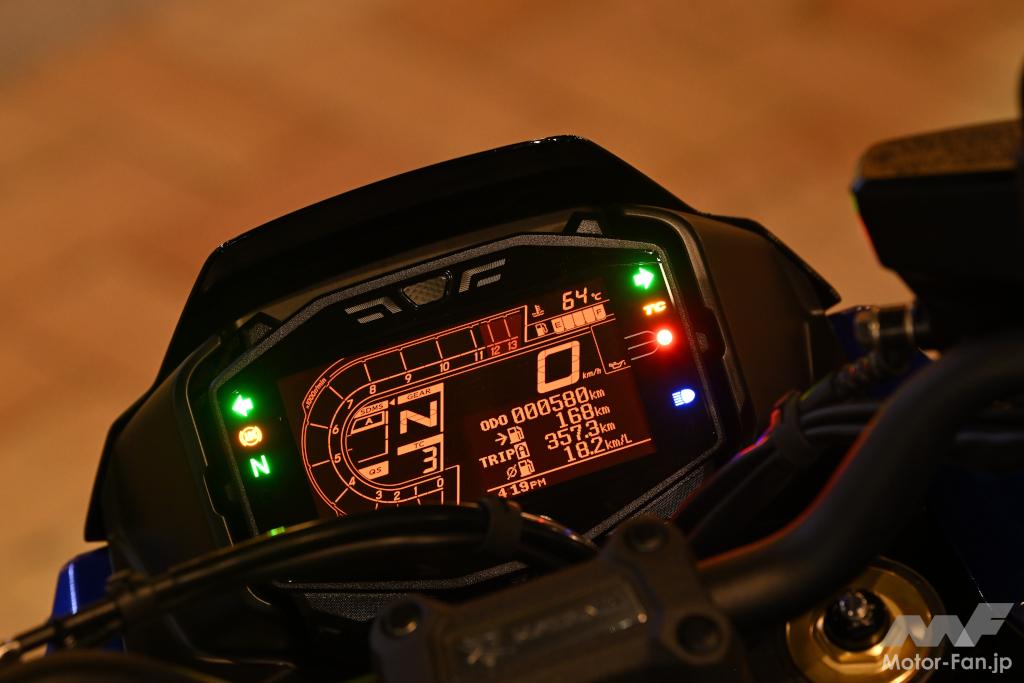
The tapered aluminum handlebars are wide and have a high grip position. Visibility in the rearview mirror is quite good, but considering the overall atmosphere of the vehicle, it seems like a lower, narrower setting would suit it better. The multi-function digital meter is based on the GSX-R1000 from L7 onwards, but the dial design is specially designed, and from the 2022 model onwards, a night mode with an orange display has been added. Considering the recent rapid spread of full-color TFT displays, perhaps this meter is actually fresh?
Left and right switch/lever ★★★☆☆
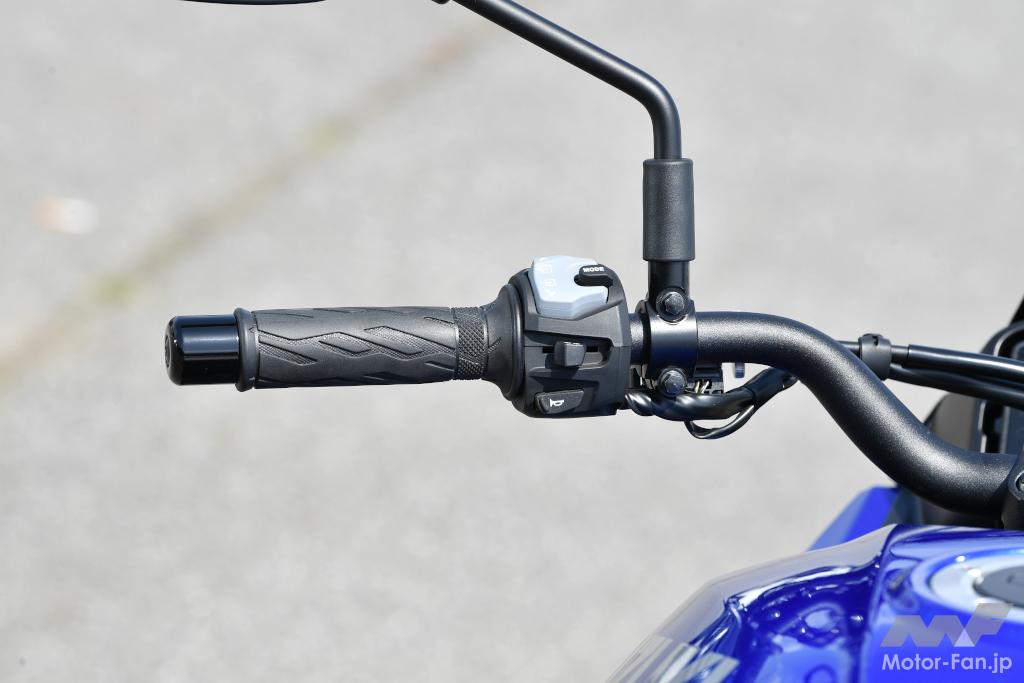
The left-side switch box is the same as that of the GSX-S1000, GSX-8R/S, V-Strom 800/DE, etc. The information in the meter, including the riding mode and traction control settings, is controlled with the select and mode switch on the upper left side.
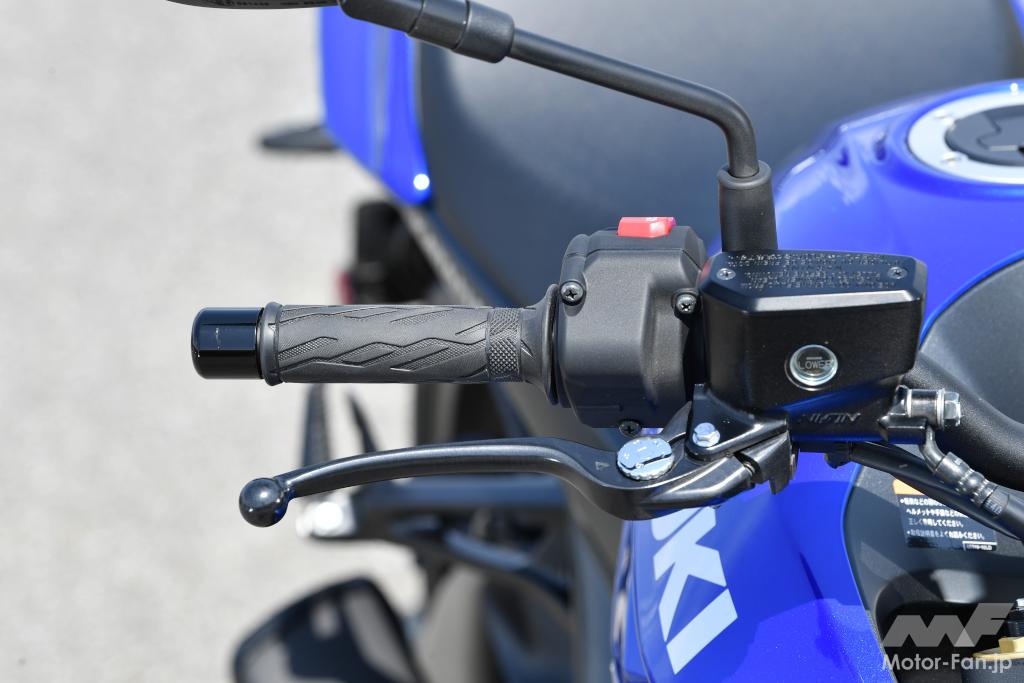
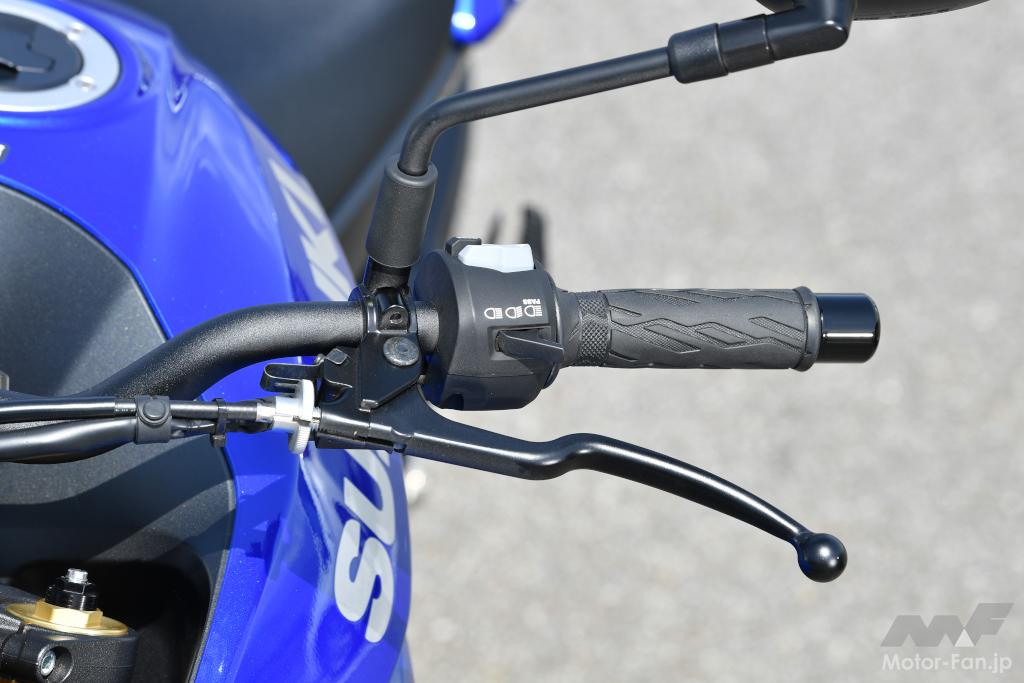
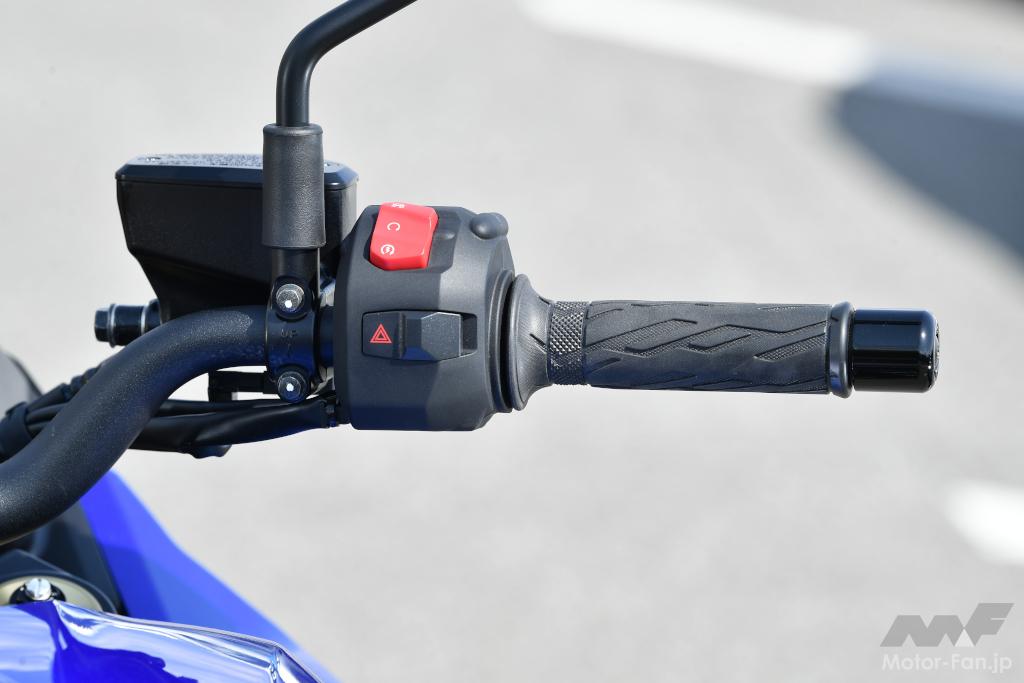
The front brake master cylinder is a conventional horizontally mounted piston type, and the base of the lever is equipped with a 5-stage adjuster dial. The grip rubber is a standard part of Suzuki’s road sports bikes in recent years.
Fuel tank/seat/step area ★★★★☆

The unique configuration of the gas tank cover, side covers, and seat evokes the atmosphere of the classic GSX1100S Katana. The side covers and the front end of the seat are what you grip with your knees while riding, and the fit is quite good. The seat was not bad at all, but while touring, I wished for a little more freedom in the front and a flatter surface. However, I feel that the reason I was able to naturally adapt to the intense acceleration and deceleration in A mode is because the seat surface has a moderate incline (upward and downward in the front).

Aside from the longer bank sensor, the footpeg area has a supersport-like design. The heel plate, which is integrated with the footpeg bracket, is designed with attention to detail in its narrow width, providing an excellent grip. The base of the shift rod is equipped with a quick shifter sensor.


Load capacity ★★★☆☆
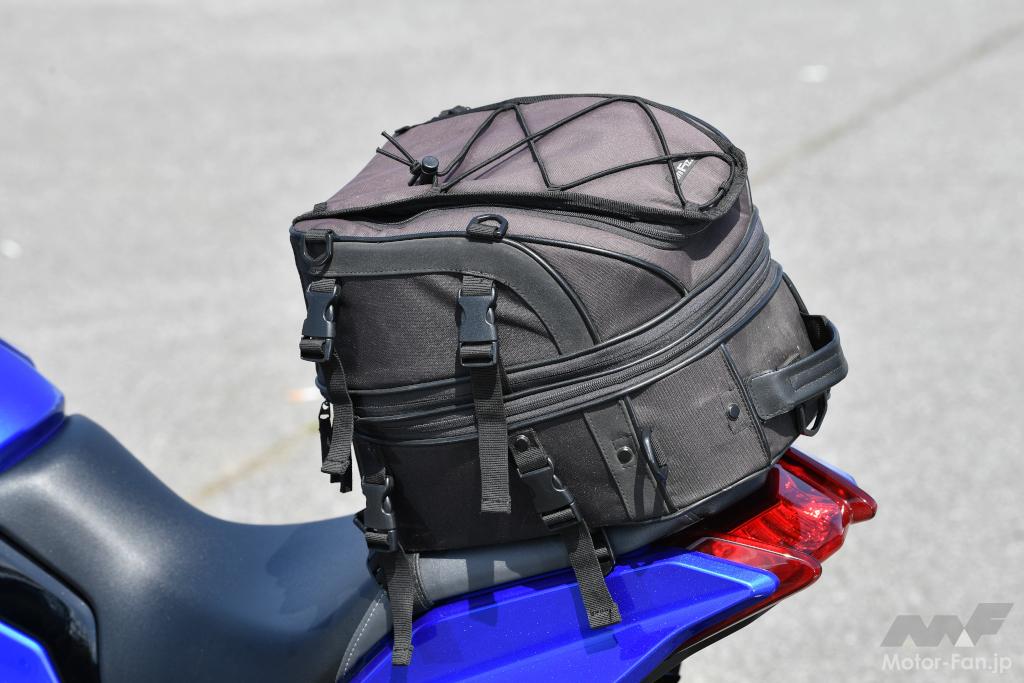
There is a retractable loop on the underside of the seat and a hook on the pillion step bracket, but it doesn’t seem like they’re necessarily effective when loading luggage… That said, when I tried loading my personal Tanax W-Deck Seat Bag using the belt that wraps around the pillion seat, it felt reasonably stable. The space under the seat is packed with electrical components, so riders who want to store an ETC unit neatly seem to use the bulge on the side of the tail cowl or under the gas tank.

Brakes ★★★★☆
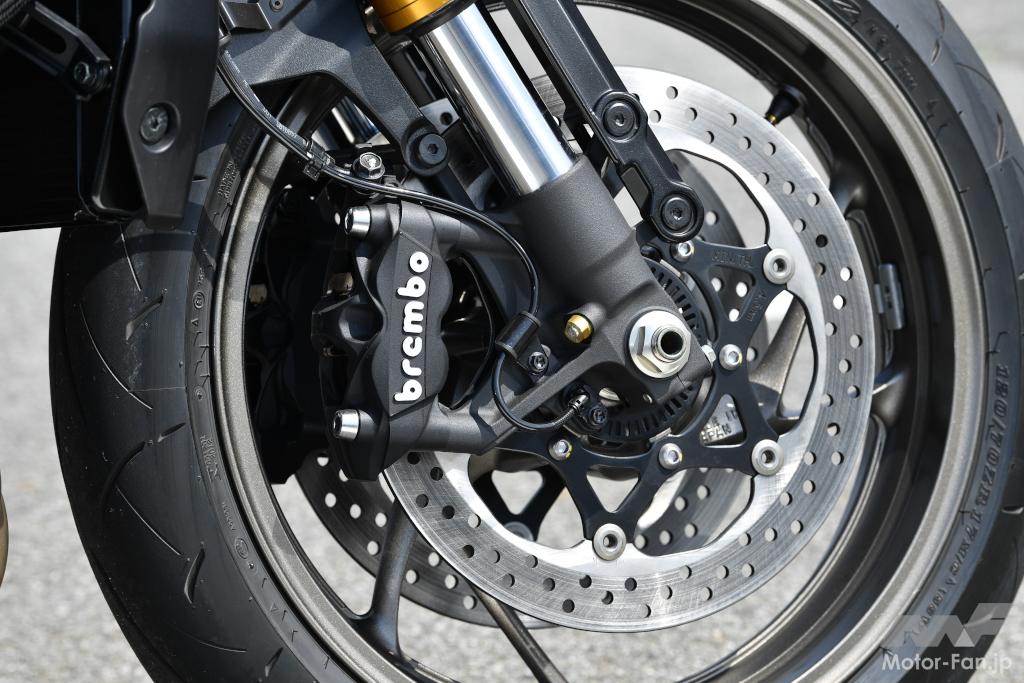
The brakes, a 310mm diameter disc + Brembo radially mounted 4-piston caliper in the front and a 250mm diameter disc + Nissin single-piston caliper in the rear, give the impression of being sturdy and robust, and are easy to control in any range. The ABS intervention is relatively slow, and although I confirmed the naturalness of its action by intentionally braking suddenly, it hardly engaged during the touring test ride.

Suspension ★★★★☆
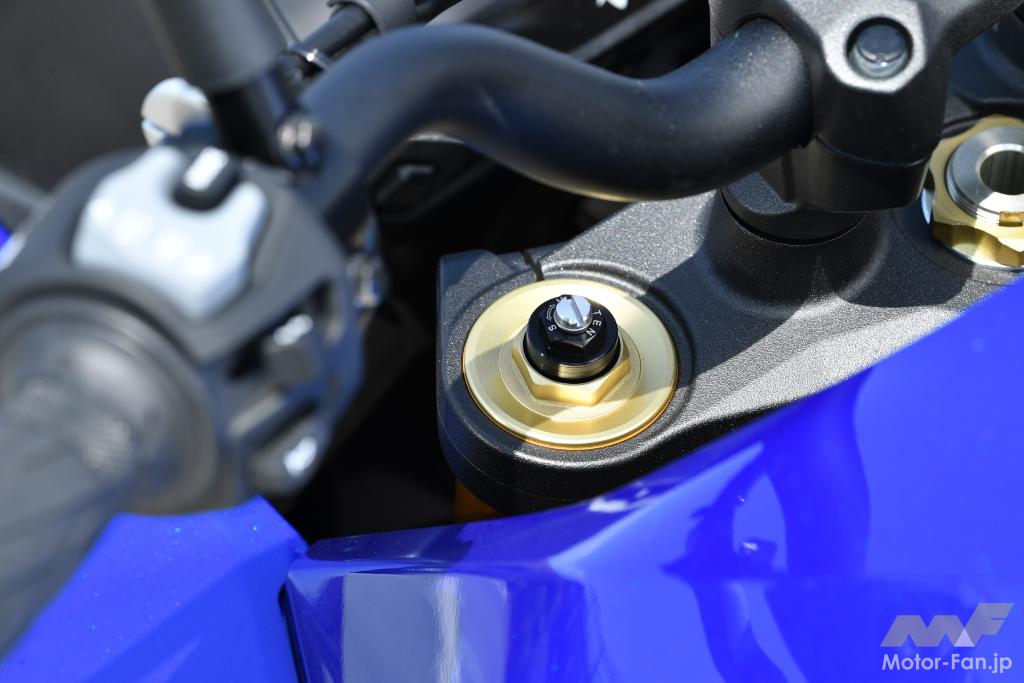
The φ43mm inverted front forks are fully adjustable, and the link-type monoshock rear suspension allows adjustment of preload and rebound damping. The standard setting is on the stiffer side, but as I mentioned in the second article, I changed the settings to softer on both the front and rear, which gave me the feeling I liked. However, it seems that many owners are dissatisfied with the stock rear shock’s movement and adjustment range, and so they replace it with an aftermarket part.

In-vehicle tools ★★☆☆☆

The only tools attached to the underside of the seat base are a 14x17mm open-end wrench and a 5mm hex wrench. By comparison, the sister model GSX-S1000 comes with four tools: a 4mm and 5mm hex wrench, an interchangeable screwdriver, and a wrench for adjusting the rear shock preload.
Actual fuel consumption ★★★☆☆

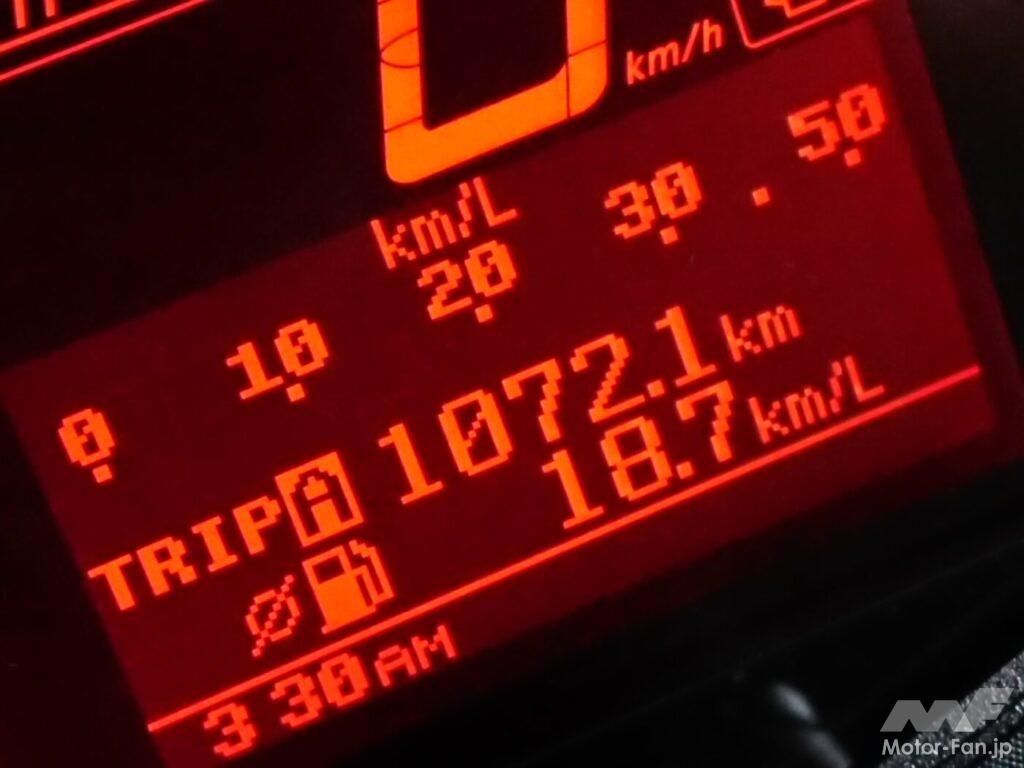
Many owners online have published figures of around 20km/L, so I initially thought the figures weren’t quite right. However, after checking the specs for each model year, I discovered that the WMTC mode fuel economy had dropped from 19.1km/L to 16.6km/L in 2022. Given that, the total fuel economy of 17.8km/L isn’t bad at all. For reference, the official fuel economy figures for other liter-class sports naked bikes from other manufacturers are: Honda CB1000 Hornet: 17.7km/L, Yamaha MT-10: 15.6km/L, BMW S1000R: 16.12km/L. The Katana is designed for premium gasoline, and the range calculated from the average fuel economy is 17.8km x 12 = 213km.
ADVERTISEMENT
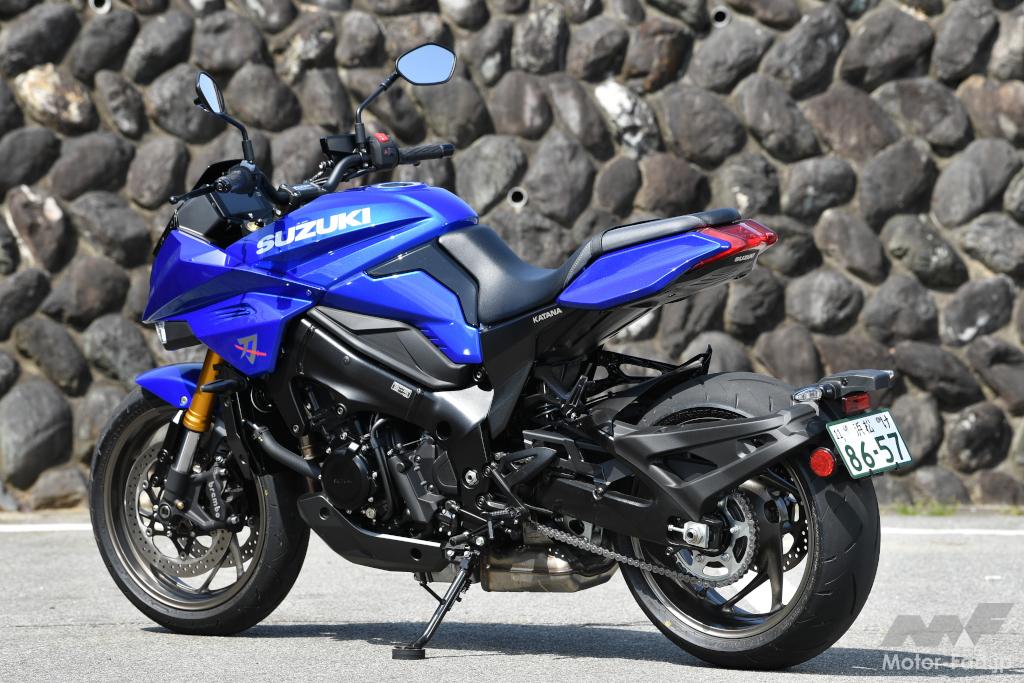
The license plate holder and rear turn signals are mounted on the swing arm. Perhaps many owners find this configuration uncomfortable, as several aftermarket manufacturers sell kits that relocate the license plate holder and rear turn signals to a more conventional position.
 The Suzuki Katana is six years old. Its supermotard-like handling is hard to imagine from its appearance. | 1000km test drive [1/3]
Although the exterior incorporates an atmosphere reminiscent of classic motorcycles of the past, the riding feel of the modern Katana is not neo-classical. This bike is a sports naked that inherits the DNA of super sports, and on mountain roads you can enjoy the lightness of a supermotard. REPORT: Nakamura Tomohiko PHOTO: Togashi Hideaki
ADVERTISEMENT
 Suzuki Katana 1000km Test Drive [2/3] Experience the charm of a custom-made bike that’s different from its siblings
In the world of custom bikes, it is a common belief that if you gain something, you also lose something. Whether or not you recognize this fact will affect your evaluation of the Katana, which was born from the repurposed basic design of the GSX-S1000. REPORT: Nakamura Tomohiko PHOTO: Togashi Hideaki
Main specifications
Model: KATANA
Model: 8BL-EK1AA
Length x Width x Height: 2130mm x 820mm x 1100mm
Wheelbase: 1460mm
Ground Clearance: 140mm
Seat Height: 825mm
Caster/Trail: 25°/100mm
Engine Type: Water-cooled 4-stroke in-line 4-cylinder
Valve Type: DOHC 4-valve
Total Displacement: 998cc
Bore x Stroke: 73.4mm x 59.0mm
Compression Ratio: 12.2
Maximum Power: 110kW (150ps) / 11000rpm
Maximum Torque: 105N・m (10.7kgf・m) / 9250rpm
Starting Method: Self-starter
Ignition Method: Full Transistor
Lubrication Method: Wet Sump
Fuel Supply Method: Fuel Injection
Transmission Type: Constant Mesh 6-speed Return
Clutch Type: Wet Multi-plate Coil Spring
Gear Ratio
1st: 2.562,
2nd: 2.052
3rd gear: 1.714
4th gear: 1.500
5th gear: 1.360
6th gear: 1.269
1st and 2nd reduction ratios: 1.533 and 2.588
Frame type: Diamond (aluminum twin spar)
Front suspension: Telescopic inverted type φ43mm
Rear suspension: Bottom link mono shock
Front tire size: 120/70ZR17 Rear
tire size: 190/50ZR17
Front brake type: Hydraulic double disc
Rear brake type: Hydraulic single disc
Vehicle weight: 215kg
Fuel used: Unleaded high-octane gasoline
Fuel tank capacity: 12L
Passenger capacity: 2 people
Fuel consumption rate (Ministry of Land, Infrastructure, Transport and Tourism notification value): 21.2km/L (with 2 passengers)
Fuel consumption rate (WMTC mode value, class 3): 16.2km/L (with 1 passenger)