
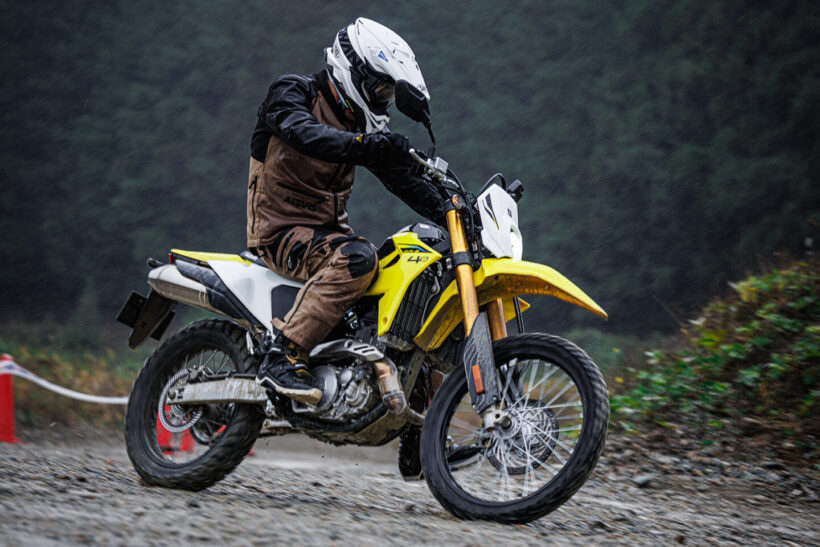

Suzuki DR-Z4S…1,199,000 yen

Two body colors are available: Champion Yellow No. 2/Solid Special White No. 2 and Solid Iron Gray.
The high hurdles I felt with my previous car
I apologize for starting off with a personal story, but until recently my motorcycle life was 90:1 on-road:off-road, but in recent years it has changed to about 7:3. To be more specific, for the past three years I have been going on regular forest road tours, and this year I have ridden on closed off-road courses five times.

However, the vehicle I use for such purposes is a 1997 Honda SL230 that is showing signs of wear in many parts, so when I test off-road bikes for work, I recently have the secondary theme of considering whether it could be my next car.
The same sentiment was expressed during a test drive of the DR-Z4S, which Suzuki began selling in October.
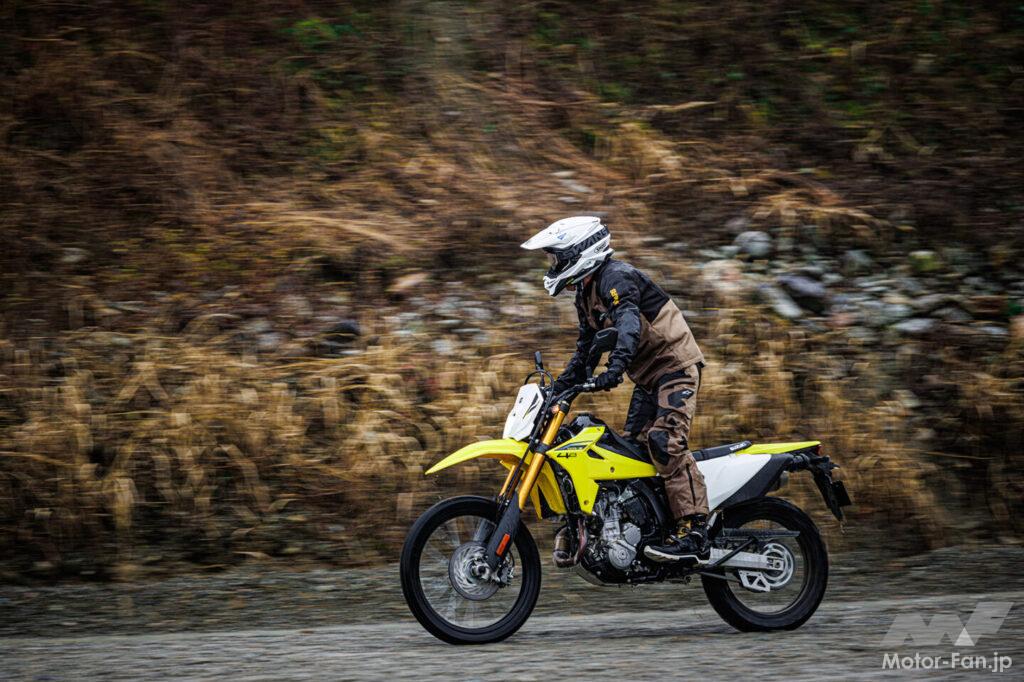
Looking back at the ride feel of the DR-Z4S’s predecessor, the DR-Z400S, which was sold from 2001 to 2008 (and was in service in the North American market until 2024), it seems unlikely to suit my needs.
The reason is that the previous DR-Z400S had a manly, expert-oriented character, and unfortunately, with my skill level, I didn’t find it fun to ride off-road.
Most parts are new and the latest electronic controls are used.

Words like “resale” and “revival” are being used in the world, but the only thing the DR-Z400S and DR-Z4S have in common is the basic configuration of the engine (although many of the main parts are new), and most of the parts are different. And unlike its predecessor, which emphasized off-road performance, the keyword “dual-purpose” is written in the DR-Z4S’s public relations materials.

The two types of semi-double cradle frames are: the left one with a single backbone pipe is for the old DR-Z400S, while the right one, which has a structure reminiscent of the RM-Z motocrosser, is for the new DR-Z4S. The aluminum seat rails and swingarm are also completely different.
However, considering that the tire diameters remain unchanged at 21 inches in the front and 18 inches in the rear, and that there is not much difference in the size and power of the vehicle, the basic direction is probably the same. By the way, the wheelbase, seat height, front and rear wheel travel, and maximum power of the old and new DR are as follows.
●New DR-Z4S: 1490mm・890mm・280/296mm・38ps
●Old DR-Z400S: 1475mm・875mm・288/295mm・40ps
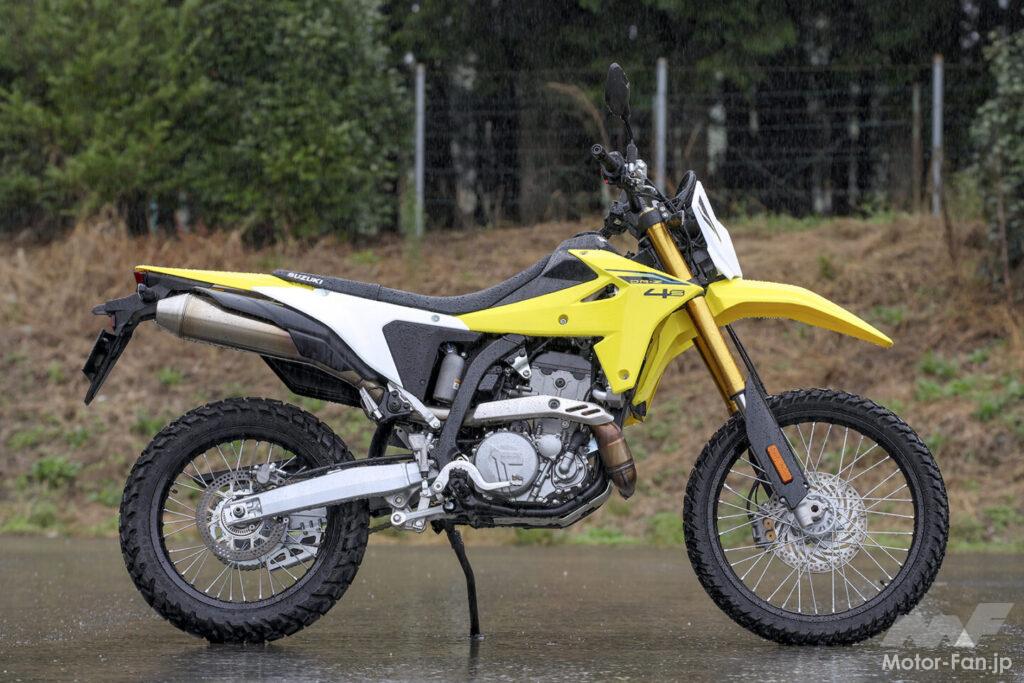
However, unlike its predecessor, the DR-Z4S incorporates a wide range of electronic devices, including the SIRS: SUZUKI INTELLIGENT RIDE SYSTEM. The highlight of this system is the ability to choose between three engine characteristics (A/B/C) and four traction control settings (2/1/G (gravel) + off), but from the perspective of off-road enthusiasts, the ability to choose between three ABS settings (front and rear on/front and rear off/rear only off) will also be a welcome addition.
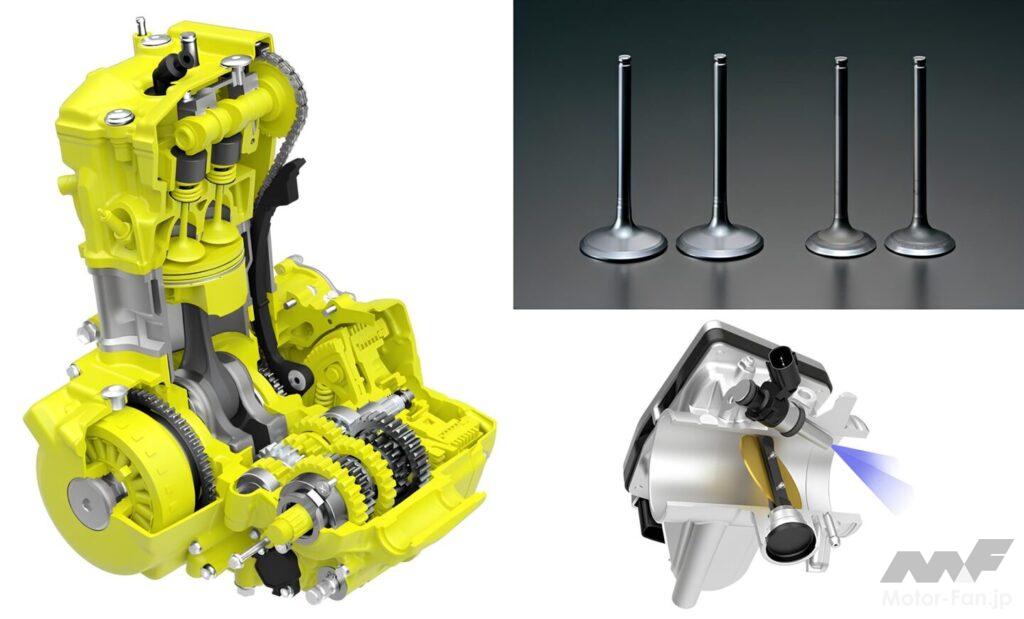
The parts of the engine highlighted in yellow are new. The intake valves are made of titanium, and the exhaust valves are made of heat-resistant steel with sodium inside. The throttle body is 42mm in diameter, 6mm larger than the previous model’s carburetor.
Although the throttle valve is electronically controlled, a cable is used from the throttle to the throttle position sensor to make it easier to fit the rider’s sensibilities and to allow for easy adjustment of play.
The structure is similar to that of the GSX-R1000/R, Hayabusa, and probably the MotoGP racer GSX-RR, and to put it bluntly, the DR-Z4S and its sister model, the SM, were developed with the same attitude as the top-of-the-line on-road models.
I was surprised at how easy it was to ride.
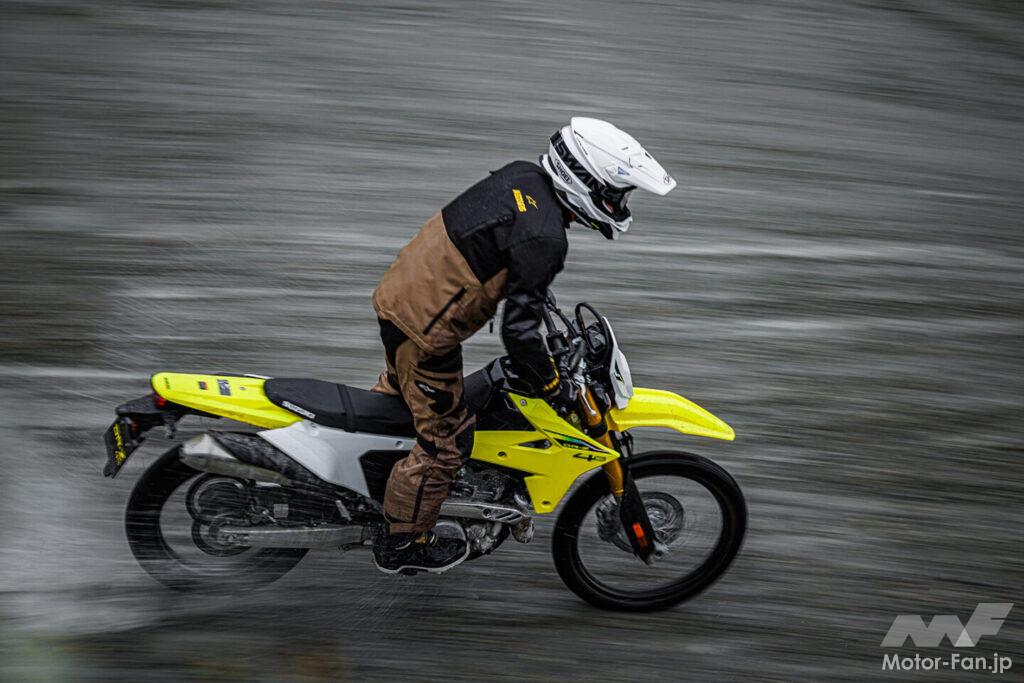
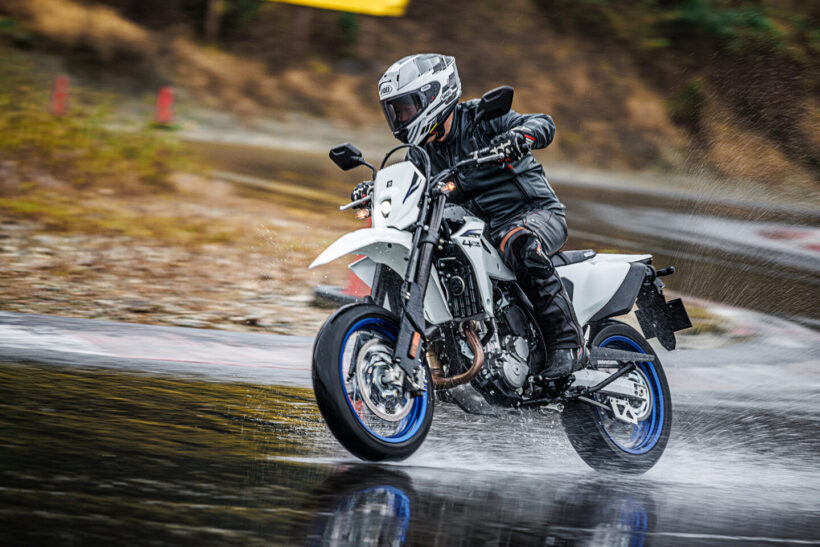
Although it’s a little late to explain, this article is a report on the test drive event held in mid-October at Maruwa Autoland Nasu in Tochigi Prefecture. As you can see from the photos, it was raining on the day, and the roads were muddy from the morning.
Although Suzuki had set four 20-minute sessions for each media outlet, I felt that the previous DR-Z400S was a high hurdle, so before the test ride I thought I would only be able to manage two sessions at best.
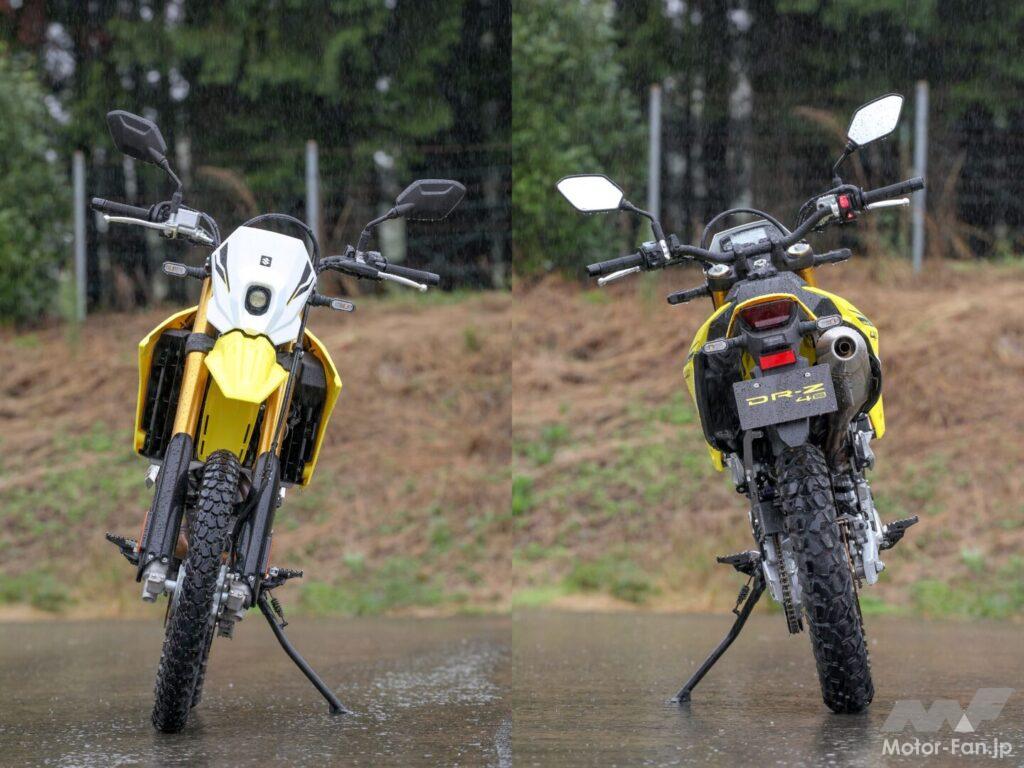
However, even though the photographer gave the OK to take photos on the second run, I managed to complete the full 80 minutes (20 minutes x 4 runs). The reason I was able to do that was because the DR-Z4S was surprisingly gentle, something you’d never expect from its exterior or size. Thanks to that, I was able to ride with confidence, with almost no worry about falling over.

However, initially, as a safety measure, I set the engine characteristics to the gentlest setting, C, and the traction control to the most interventional setting, 2. However, because it was too easy to open the throttle, too easy to brake, and the information from the front and rear suspension was too easy to understand, I chose B+1 mode for the second run and A+G mode for the third run.

The traction control has three levels of adjustment, with S and SM having different flavors. G mode prioritizes moving the vehicle forward rather than suppressing rear wheel spin.
I got carried away and set it to A+ traction control off on the fourth run, but it was beyond my skill level, but the DR-4ZS gave me a completely different feeling from my previous bike, a feeling I had never expected, and I ended up really liking it.
Three engine modes that give everyone a place

What impressed me most was the way the three engine modes were designed. While it’s common for these types of mechanisms to have modes that seem unnecessary, in the case of the DR-Z4S, all three modes (A, B, and C) have their place, and at least in my case, I didn’t get the impression that mode A was excessive, and I didn’t feel that mode C was obviously lacking.

SDMS: SUZUKI DRIVE MODE SELECTOR image. Looking at the graph, some people might get the impression that the low opening of A and the high opening of C are a bit peaky, but that wasn’t the case at all.
Applying this to my usual forest road touring, I would alternate between A and B from morning until around noon, and then use C more frequently in the afternoon when my body and mind are moderately tired.

I was also very impressed with the G mode of the traction control, which keeps the rear wheel from slipping while maintaining driving force and pushing the vehicle forward. It also holds up well when it matters most, and the front and rear suspension settings seem easy to get used to even for beginners to off-road bikes.

Actress and model Miyu Kitamuki also participated in the test ride event through her motor fan slot. Although she doesn’t have much off-road experience, thanks to the DR-Z4S’s ease of handling, she didn’t stall or fall even once.
That’s why the DR-Z4S has become one of my candidates for my next bike. That said, there are some things you can’t learn just by riding it on a closed course, so I plan to find an opportunity to try it out on long runs, including forest road touring.

While the front wheel size remains the same at 80/100-21, the rear wheel has been changed from 120/90-18 to 120/80-18. The original tire specification is the IRC GP410. If you want to choose a specific tire from the same brand, the GP-210 would be a good choice for on-road enthusiasts, while the GP-21/22 or GP-610 would be a good choice for off-road enthusiasts.
Riding position

ADVERTISEMENT


The riding position is a standard configuration for off-road vehicles. However, if we compare the seating position with the previous model, the handlebar grip position has been moved 28 mm higher and the footpegs 23 mm further back. The seat height is 890 mm, and even I, who am 182 cm tall and weigh 74 kg, don’t have both my feet flat on the seat, but the vehicle is light (151 kg, which is 10 kg heavier than the final model of the previous model), so it’s easy to shift your butt, so I don’t think it’s as difficult as you might imagine from the numbers.

Detailed explanation

The highly visible instrument cluster is a simple monochrome LCD. Below the clock on the far right, the engine mode and traction control level are displayed. The handlebar lock has been changed from a separate unit on the right side of the head pipe to an integrated unit in the ignition key cylinder.
ADVERTISEMENT

The Japanese model uses a low seat that is 30mm lower than the standard for overseas models. The reason for this is not only consideration of foot reach, but also the need to comply with the JASO standard of a seat height of 900mm or less in order to obtain the Japanese model certification. If the SM seat is used, the seat height will be 920mm, the same as the overseas model.
ADVERTISEMENT
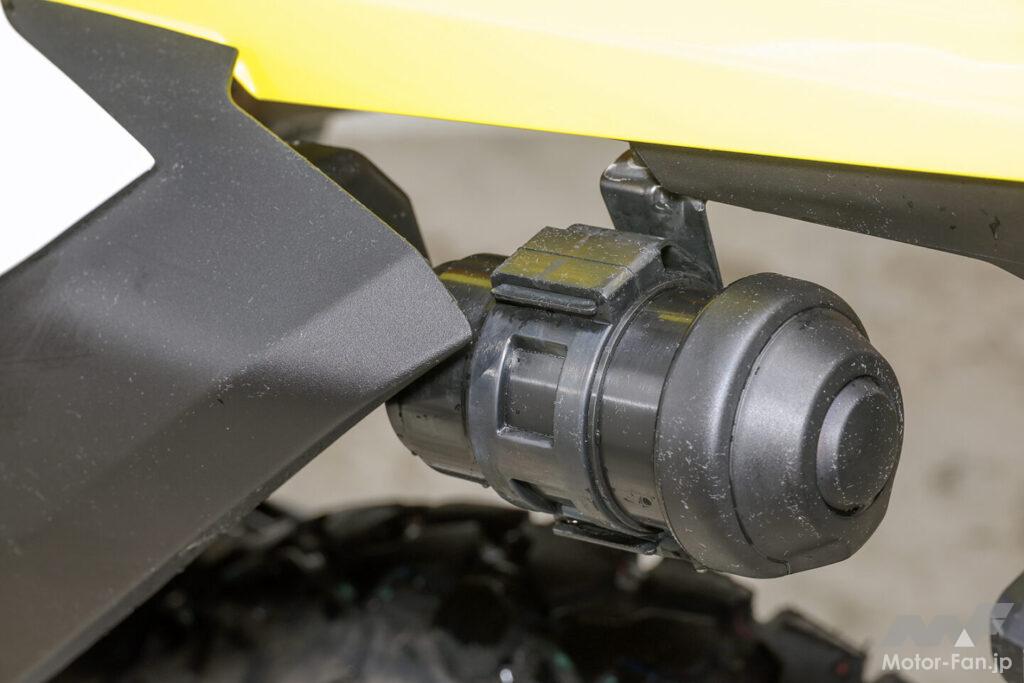
Some people may mistake it for an on-board tool box, but the plastic part on the left side behind the seat is actually a canister that prevents evaporated gasoline from escaping into the atmosphere.
ADVERTISEMENT

Although it has been removed in the photo, the jagged steps on the outer periphery are designed for aggressiveness and are made of removable rubber. The width of the previous model was 33 mm, but the new model is 49 mm wider.
ADVERTISEMENT

In keeping with the style of off-road vehicles, the shift and brake pedals are foldable, and the rear brake master cylinder with integrated reserve tank is adapted from the RZ-M motocrosser.
ADVERTISEMENT

ADVERTISEMENT

The previous model had a 47mm upright front fork, but the new model has been changed to a 46mm inverted fork. The top has an extension damper adjuster and the bottom has a compression damper adjuster.
ADVERTISEMENT

The rear suspension is also different from the previous model, although it retains the bottom-link structure. Preload, rebound, low-speed compression, and high-speed compression dampers are adjustable. The previous model’s front and rear shocks were manufactured by Showa, but the new model uses KYB.
ADVERTISEMENT

The previous model’s brake discs were φ250mm front and φ220mm rear, while the new model’s are φ270mm and φ240mm rear.
ADVERTISEMENT

The brake calipers are Nissin, the same as the previous model. The front calipers are single-piston, while the rear calipers are single-piston.
Main specifications
Model: DR-Z4S
Model: 8BL-ER1AH
Length x Width x Height: 2270mm x 885mm x 1230mm
Wheelbase: 1490mm
Ground Clearance: 300mm
Seat Height: 890mm
Caster/Trail: 27°30’/109mm
Engine Type: Water-cooled 4-stroke single cylinder
Valve Type: DOHC 4-valve
Total Displacement: 398cc
Bore x Stroke: 90mm x 62.6mm
Compression Ratio: 11.1
Maximum Power: 28kW (38ps) / 8000rpm
Maximum Torque: 37N・m (3.8kgf・m) / 6500rpm
Starting Method: Self-starter
Ignition Method: Full Transistor
Lubrication Method: Pressure-fed dry sump
Fuel Supply Method: Fuel injection
Transmission Type: Constant mesh 5-speed return
Clutch Type: Wet multi-plate coil spring Gear
Ratio
1st: 2.285
2nd: 1.733
3rd gear: 1.375
4th gear: 1.090
5th gear: 0.863
1st and 2nd reduction ratios: 2.960 and 2.866
Frame type: Semi-double cradle
Front suspension: Telescopic inverted φ46mm
Rear suspension: Link-type monoshock
Front tire size: 80/90-21
Rear tire size: 120/80-18
Front brake: Hydraulic single disc
Rear brake: Hydraulic single disc
Vehicle weight: 151kg
Fuel: Unleaded regular gasoline
Fuel tank capacity: 8.7L
Passenger capacity: 2 people
Fuel consumption rate (reported by the Ministry of Land, Infrastructure, Transport and Tourism): 34.9km/L (with 2 passengers)
Fuel consumption rate (WMTC mode value, class 3-1): 27.7km/L (with 1 passenger)