

Suzuki Address 125…280,500 yen
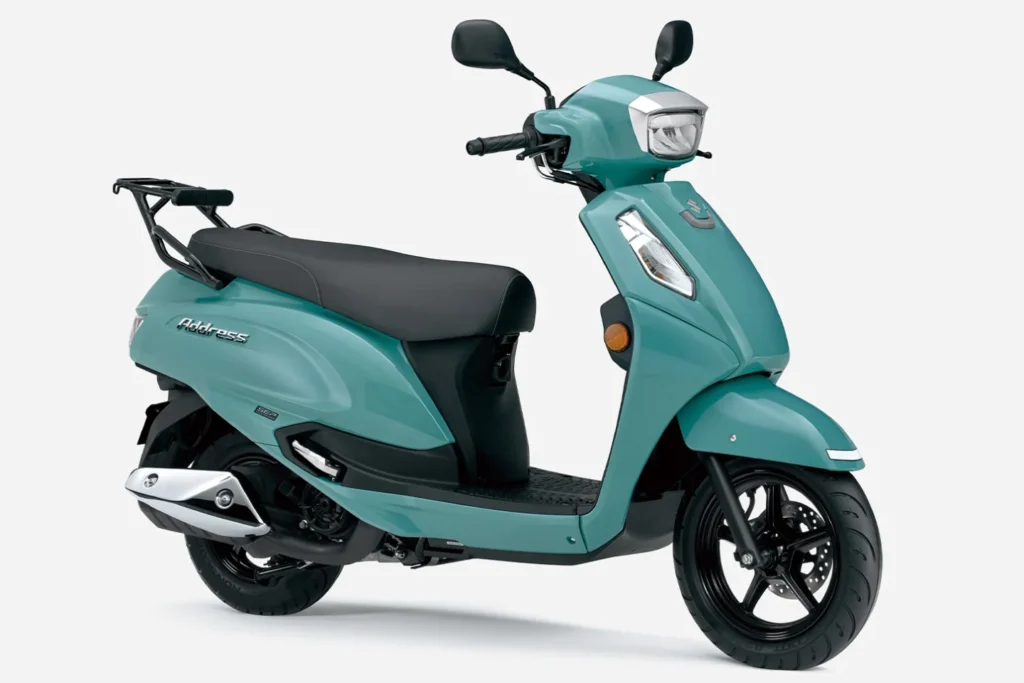
The test vehicle this time was in Matte Stellar Blue Metallic, but the body color that has attracted the most attention on the new Address 125 is the striking Solid Ice Green. Other colors available are Pearl Grace White and Matte Black Metallic.
The price difference with the previous model is only 6,600 yen.
When I saw pictures of the new model, the Access 125 for India and the next-generation Address 125 in Japan and Europe, on the Internet about six months ago, I thought it was a minor change.
However, I was surprised when I saw the article about the domestic launch event posted on this website a while ago. The changes to the new Address 125, which was introduced to the Japanese market in September, are almost a complete model change.

Differences from the previous model that can be seen from the exterior include horizontally oriented headlights, a front inner rack added to both the left and right sides, a rear carrier/grab bar that comes as standard equipment on the Japanese model, taillights/rear blinkers that have been changed from integrated to separate units, and a lid-type fuel filler cap that eliminates the need to insert and remove the key.
However, in addition to that, the new Address 125 has many newly developed parts.

SEP: The forced air-cooled single-cylinder engine, named SUZUKI ECO PERFORMANCE, has newly developed parts marked in yellow. The intake and exhaust systems and ECU are also different from the previous model.
What surprised me most was that most of the power unit, including the intake and exhaust systems and drivetrain, has been improved, and the underbone frame structure is different from the previous model.
Additionally, the fact that the gasoline tank capacity has been increased from 5 to 5.3 liters and the trunk space capacity has been increased from 21.8 to 24.4 liters is also an essential element when talking about the new Address 125.

The new frame (above) features two thick pipes under the floor that extend rearward to form seat rails. Compared to the previous model (below), it is 1kg lighter and has 25% more torsional rigidity.
ADVERTISEMENT

However, perhaps the most surprising thing about this model is its price of 280,500 yen. In the world of motorcycles these days, it’s common for prices to increase by around 10-15% when a model change occurs, but the price difference between the new Address 125 and its predecessor is only 6,600 yen (a 2.4% increase).

The reason behind this is that around 800,000 units are sold annually in India, the main market for the bike. However, in these days when the prices of everything are rising, the price of the new Address 125 is sure to impress everyone.
The first impression is high-end and elegant

When I first came face to face with the new Address 125 during this test ride, my first impression was that it was “luxurious and elegant.”
That said, the somewhat retro style is a continuation of the previous model, but the changes to the lighting have tightened the look when viewed from the front and rear, and perhaps because the seat cowl and muffler cover have a sharper design, a different image came to mind from the previous model.

Moreover, when I pressed the starter button, the start felt luxurious and elegant. The main reason for this seems to be that the starter motor pinion gear has been changed from a jump-in type to a constant mesh type, but I also feel that the easy start system inherited from the previous model, which starts the engine with one push, also contributes to the luxurious and elegant feel.

Furthermore, I was equally impressed by how comfortable the center stand was. Unlike the previous model, which required a certain amount of strength, the new model, with its optimized mounting position and redesigned grab bar, lifts the rear wheel smoothly and easily with just a little force from your right foot and right hand.
So, even before I drove it, I noticed some surprising qualities that were different from the previous model. And in terms of ride quality, the new model also had some surprising qualities that were different from the previous model.
Lively and brisk running

Before I give my impressions, let me state the basic premise: I didn’t have a particularly good impression of the previous Address 125.
That said, it’s not that I had a bad impression of it, and I felt that its performance was sufficient and necessary, but like the old Address series, I just didn’t  feel like I had to have it.
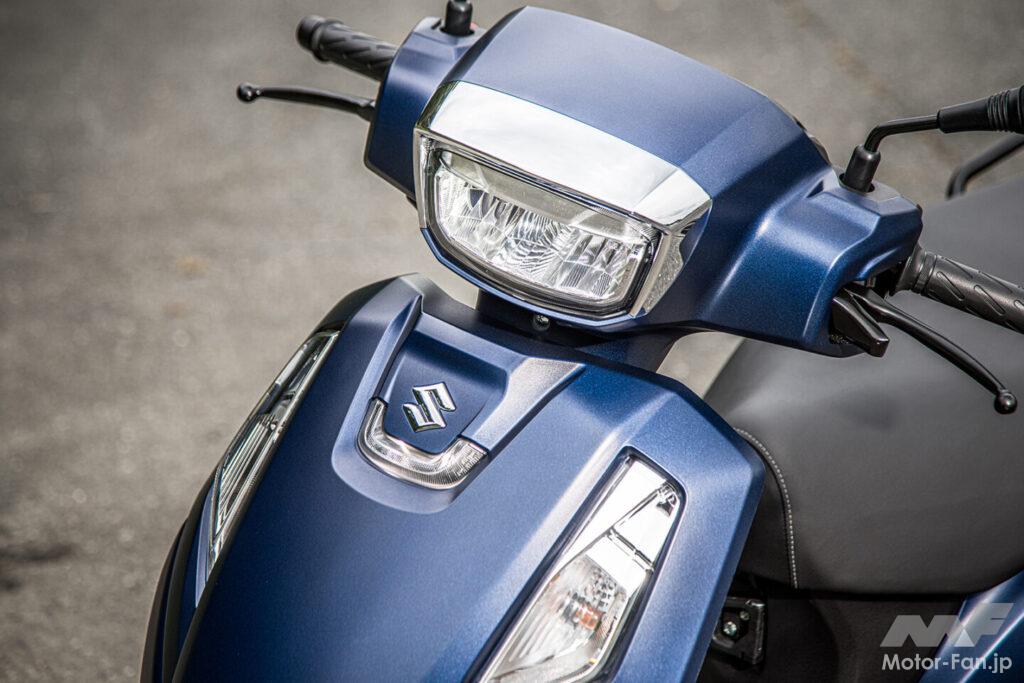
Unlike the previous model, which had a soft and gentle look, the new model’s front mask has a sharper impression. It has a U-shaped position lamp under the S mark, and the same design is used for the tail lamps.
However, the new model offered a level of enjoyment in driving that set it apart from its predecessor and rivals.
First of all, regarding the power unit, to put it simply, it is powerful.
Although the maximum output is slightly lower than the previous model (8.7ps/6750rpm to 8.4ps/6500rpm), the torque in the low and mid-range is substantial (the maximum torque remains at 1kgf-m, but the generated speed has been reduced from 5500 to 5000rpm), and its characteristics and drivetrain settings are perfectly matched, allowing it to run smoothly through crowded city streets and rough residential areas.

However, as a result of the improved performance in the low and mid-range, the power output in the high-speed range will not be as good as that of the previous model (although when we tried it on a closed course, we reached 80 km/h in no time).
However, I think the power unit of the new Address 125 has ideal qualities for riders who want good response to throttle operation and lively performance in the normal range.

Next, let’s talk about the body. Compared to the previous model, the new model has been thoroughly refined in both maneuverability and stability.
The wheelbase has been shortened by 5mm (from 1265 to 1260mm), resulting in crisper movement, while the improved frame rigidity and revamped suspension system mean that the shock absorber when going over bumps in the road is significantly quicker, and the bike behaves more calmly when the rider takes action.
On the other hand, when driving the new model, one gets the feeling that with the previous model, it may have been necessary to be more conscious of waiting and going easy depending on the situation.
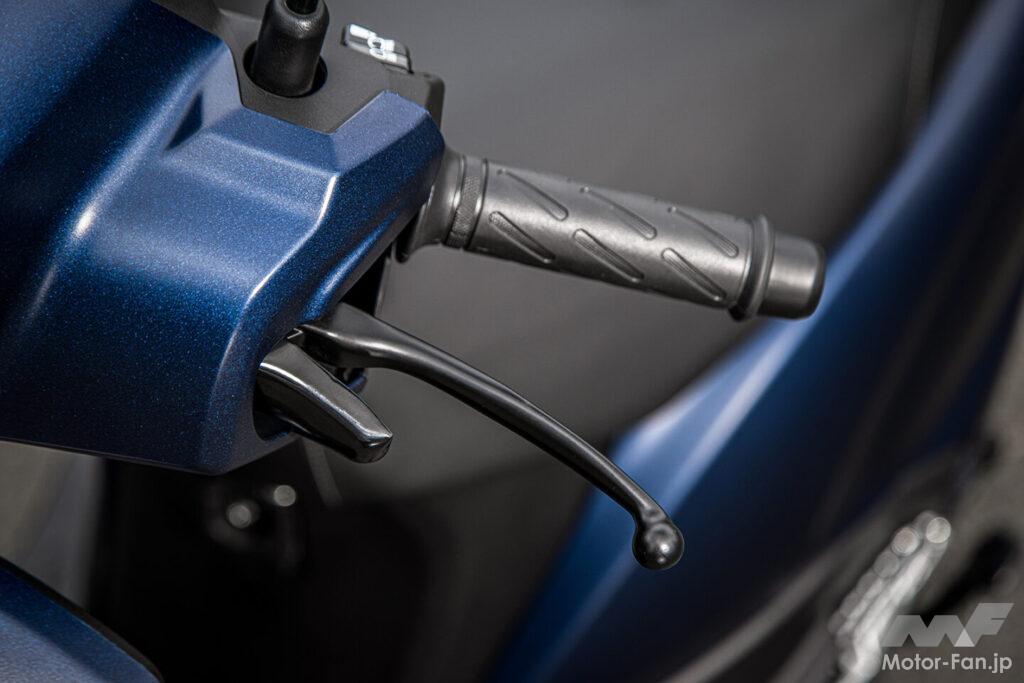
The brake lock lever located in front of the left brake lever is designed so that it cannot be locked with one hand for safety reasons. This feature reduces anxiety when parking, but it takes some practice to lock it smoothly.
Well, I don’t want to just praise it, so I’ll just mention a few things that bothered me. I think there is room for improvement in the feel of the combined brake operation (the front brake is surprisingly effective when you grip the left lever), the ease of use of the brake lock lever used when stopping, and the shape of the backrest-like rubber on the rear carrier.
But those are the three points I’d like to mention, and during this test drive I was very impressed with Suzuki’s conscientiousness and attention to detail.

Although the basic body posture is the same as the previous model, the new model’s wheelbase is 5mm shorter than the previous model at 1260mm, and the trail is 1mm shorter than the previous model at 89mm.
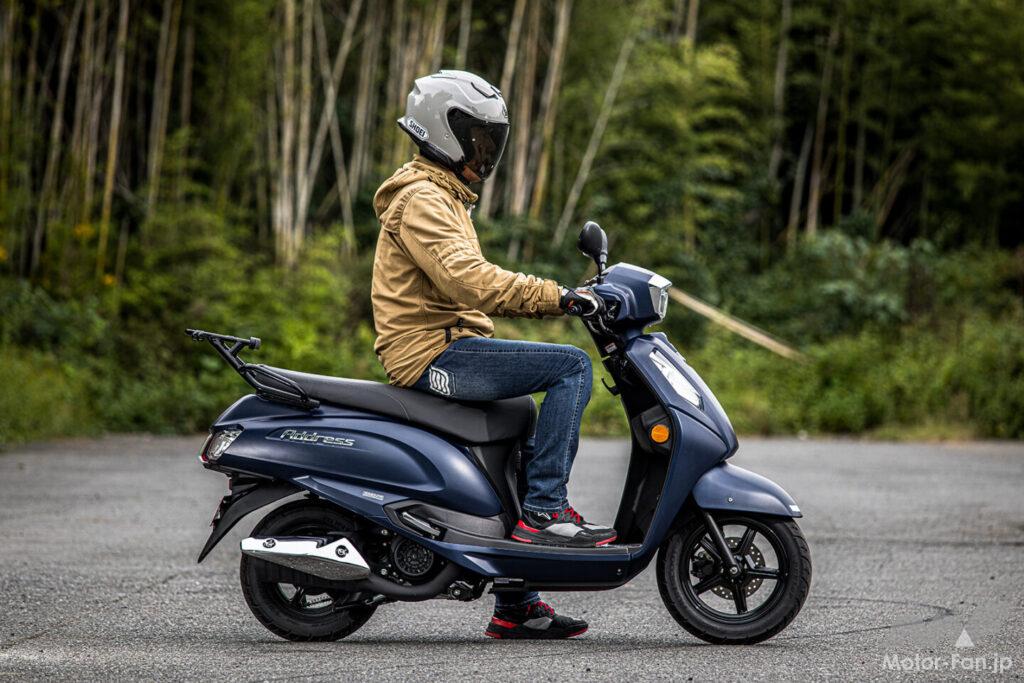
Riding position (height 182cm, weight 74kg)
ADVERTISEMENT
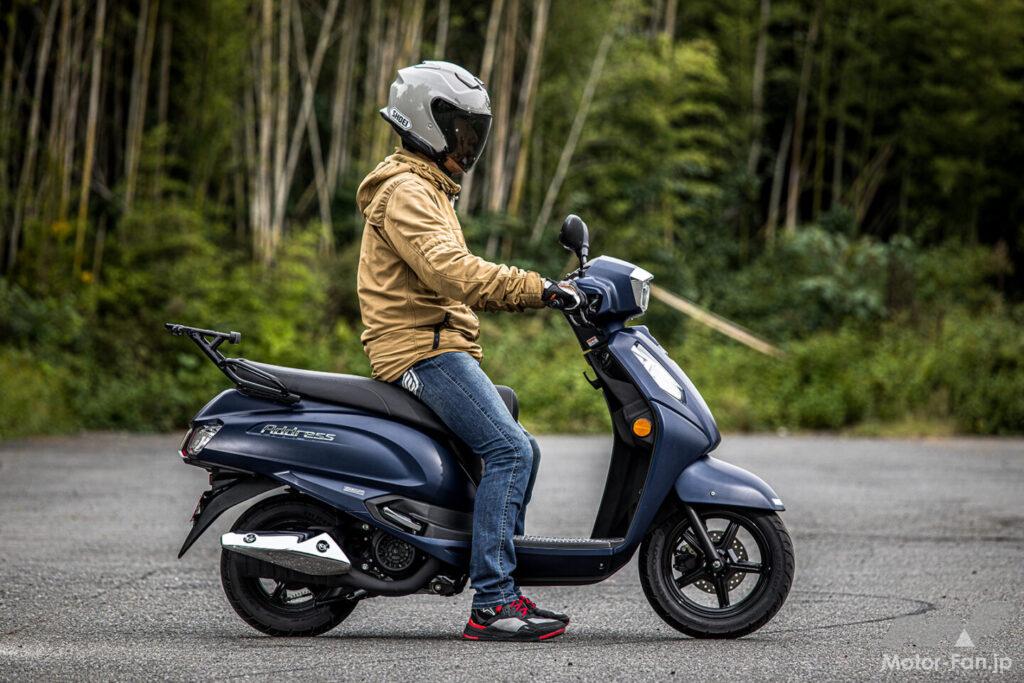

Following the style of the Address 125 series, the riding position offers an incredible level of freedom. This is mainly due to the seat, which is almost flat, allowing you to sit in any position you like, but the step-through floor also provides more than enough space. However, the seat height is 770mm, which is average for recent 50cc scooters, so riders under 160cm tall may feel a little uneasy.

Detail explanation
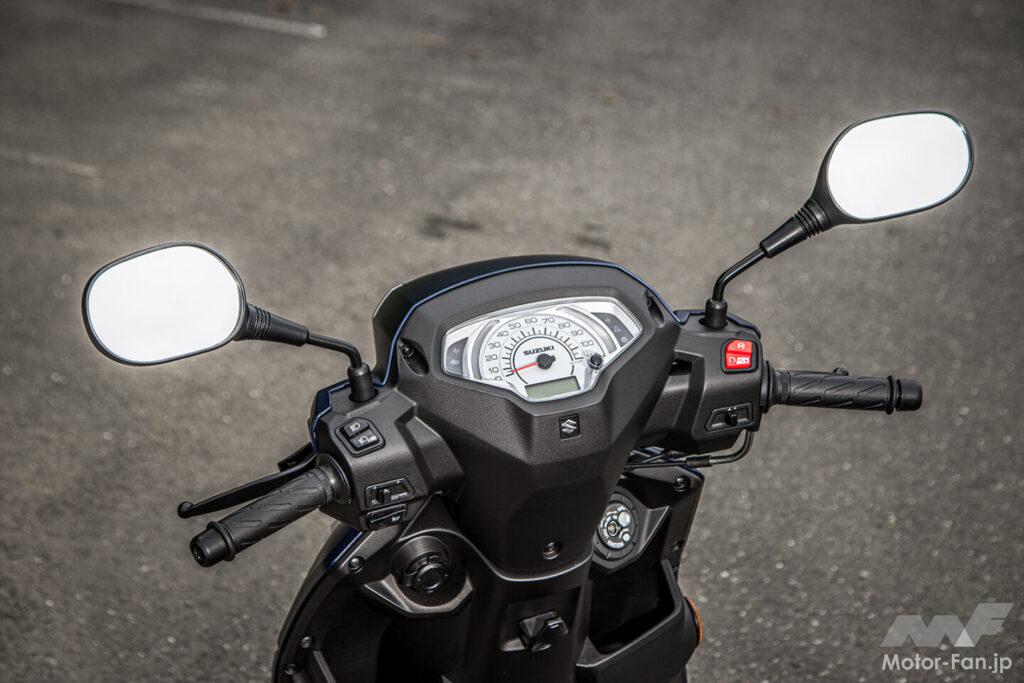
The cockpit atmosphere is the same as the previous model, but the hazard switch and front inner rack on the right side are unique to the new model. There is a front hook in the center and a USB power port on the left.
ADVERTISEMENT
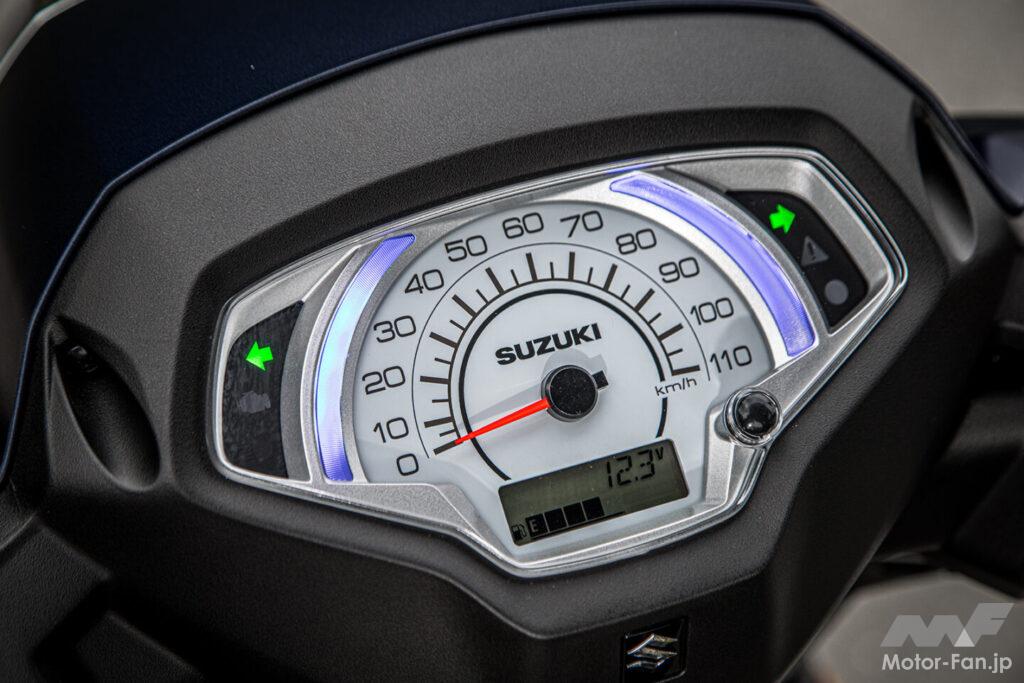
The meter design is also the same as the previous model. The Eco Drive illumination, located around the outer periphery of the needle-type speedometer, lights up blue under normal conditions and green when driving in a fuel-efficient manner.
ADVERTISEMENT

The seat is almost flat and spacious, and the grab bar is very comfortable to hold when riding pillion or pushing and pulling. There is also a foldable hook under the front of the seat.
ADVERTISEMENT

The trunk capacity has increased by 2.6 liters to 24.4 liters compared to the previous model, but it is not yet big enough to fit a standard helmet. Instead, there are helmet holders on both sides of the front.
ADVERTISEMENT

Unlike the previous model, which was a combination type, the new model has three independent lamps. The headlights, position lamps, and taillights are LED, but the turn signals are incandescent bulbs.
ADVERTISEMENT
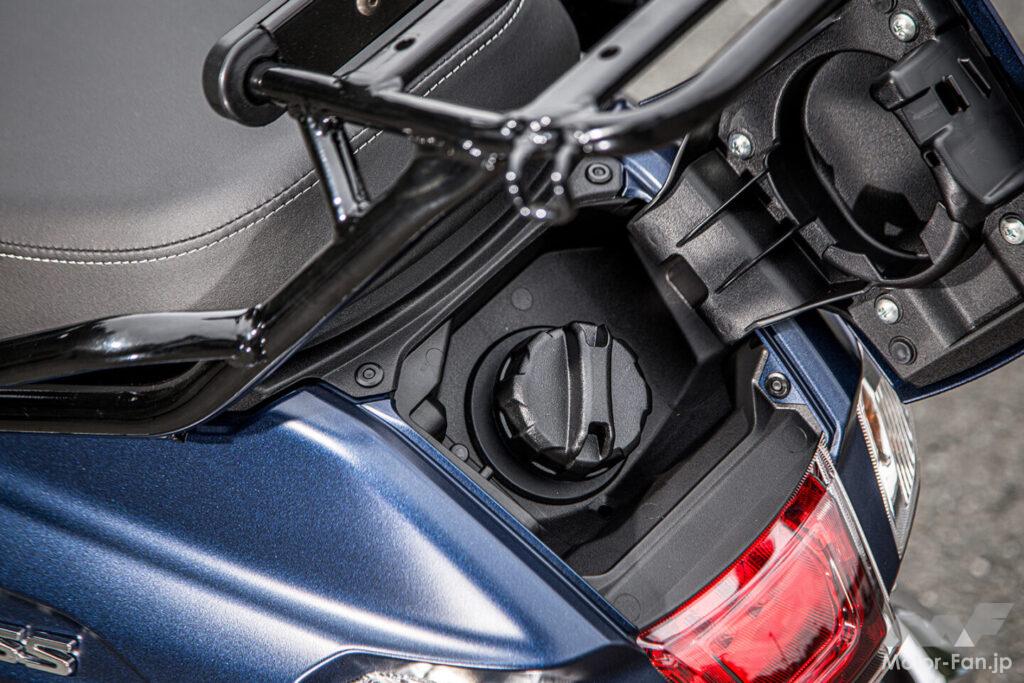
The position of the gas tank cap remains unchanged, but the new model uses a lid that opens and closes by operating the ignition key cylinder, so there is no need to insert or remove the key like the previous model.
ADVERTISEMENT

Today’s 125cc scooter engines typically have a bore of 52-54mm and a stroke of around 56-58mm. The Address 125’s forced air-cooled single-cylinder engine also falls into this category, measuring 52.5 x 57.4mm.
ADVERTISEMENT

The kick lever for starting the bike is useful in case of an emergency, but is a feature that is often omitted on modern scooters. The center stand is a new model with careful consideration given to its installation position and lever ratio.
ADVERTISEMENT

The brakes are a combined type with a φ190mm disc + single-piston caliper in the front and a φ120mm mechanical drum in the rear, with both front and rear brakes activated by squeezing the left lever.

The muffler is designed to make it easier to remove and install the rear wheel. The tire sizes are 90/90-12 front and 90/100-10 rear, and the test vehicle is fitted with Dunlop Lancecoot D307 tires.
Main specifications
Model: 8BJ-EN11J
Overall length x width x height: 1880mm x 690mm x 1155mm
Wheelbase: 1260mm
Ground clearance: 160mm
Seat height: 770mm
Caster/trail: 26°30′/88mm
Curb weight: 108kg
Engine type: Forced air-cooled 4-stroke single cylinder
Bore x stroke: 52.5 x 57.4mm
Valve type: OHC 2-valve
Total displacement: 124cc
Maximum power output: 6.2kW (8.4PS) / 6500rpm
Maximum torque 10N・m (1.0 kgf・m) / 5000rpm
Fuel supply device: Fuel injection
Starting method Kick/self-operated
Clutch type: Dry automatic centrifugal shoe type
Transmission type: V-belt continuously variable
transmission Frame type: Underbone
Suspension type (front): Telescopic upright type φ31mm
Suspension type (rear): Unit swing type
Brake type (front): Hydraulic disc
brake, rear: Mechanical drum
Tire size (front): 90/90-12
Tire size (rear): 90/100-10
Fuel tank capacity: 5.3 liters
Passenger capacity: 2 people
Fuel consumption rate (reported by the Ministry of Land, Infrastructure, Transport and Tourism): 53.4 km/L (60 km/h, 2 people)
Fuel consumption rate (WMTC mode value): 53.4 km/L (Class 1, 1 person)