
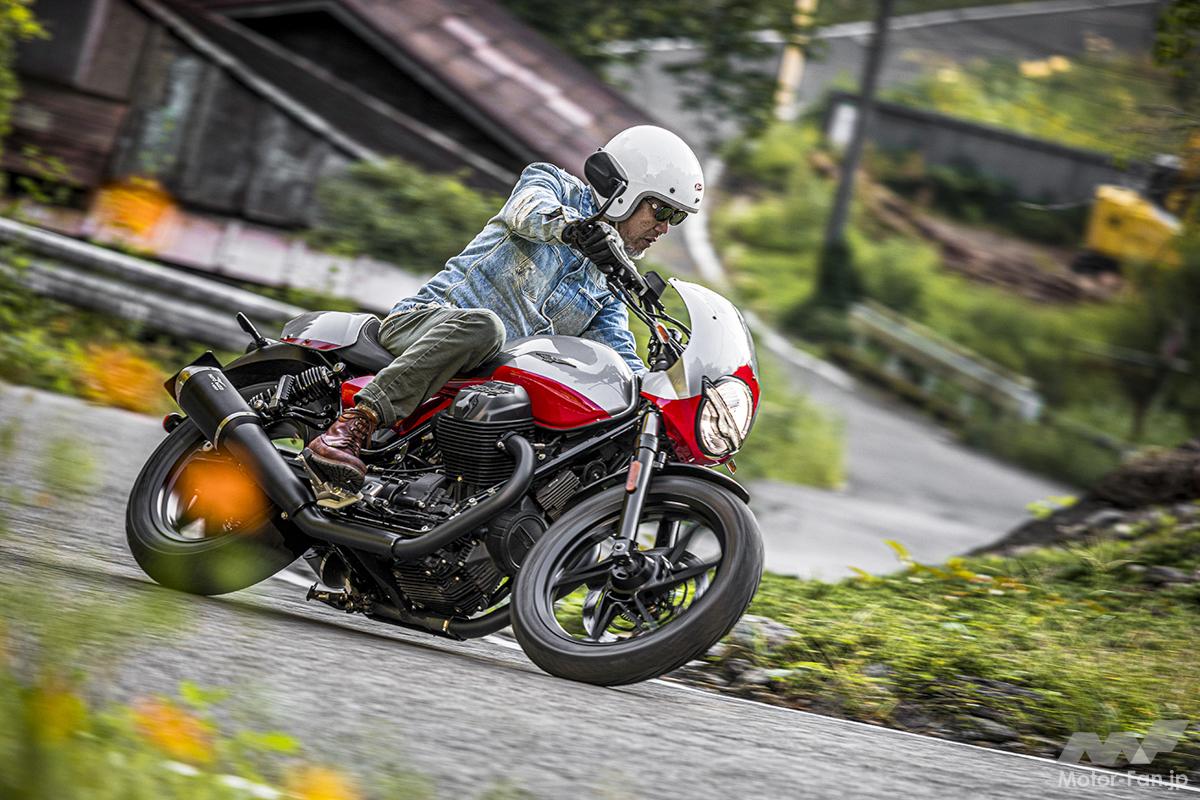
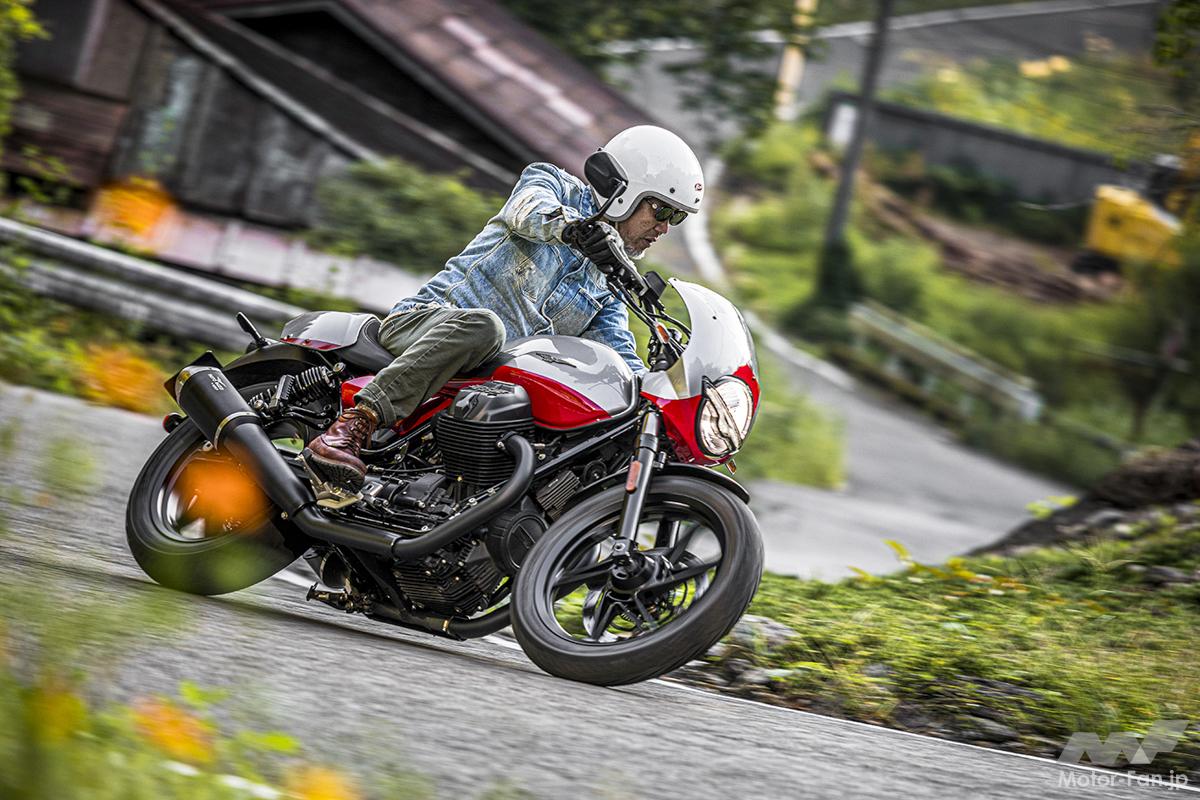
Moto Guzzi V7 Stone Corsa… 1,518,000 yen (including consumption tax)

V7 was originally the name of a model released by Moto Guzzi in the 1960s. This machine, which was the first to feature a longitudinally mounted V-twin engine, became popular around the world for its high performance and reliability, leading to the creation of a variety of different models. The best known is the V7 Sport, which was released in 1973. This sports model was an evolution of the V7, and was one of the most popular V7 models.

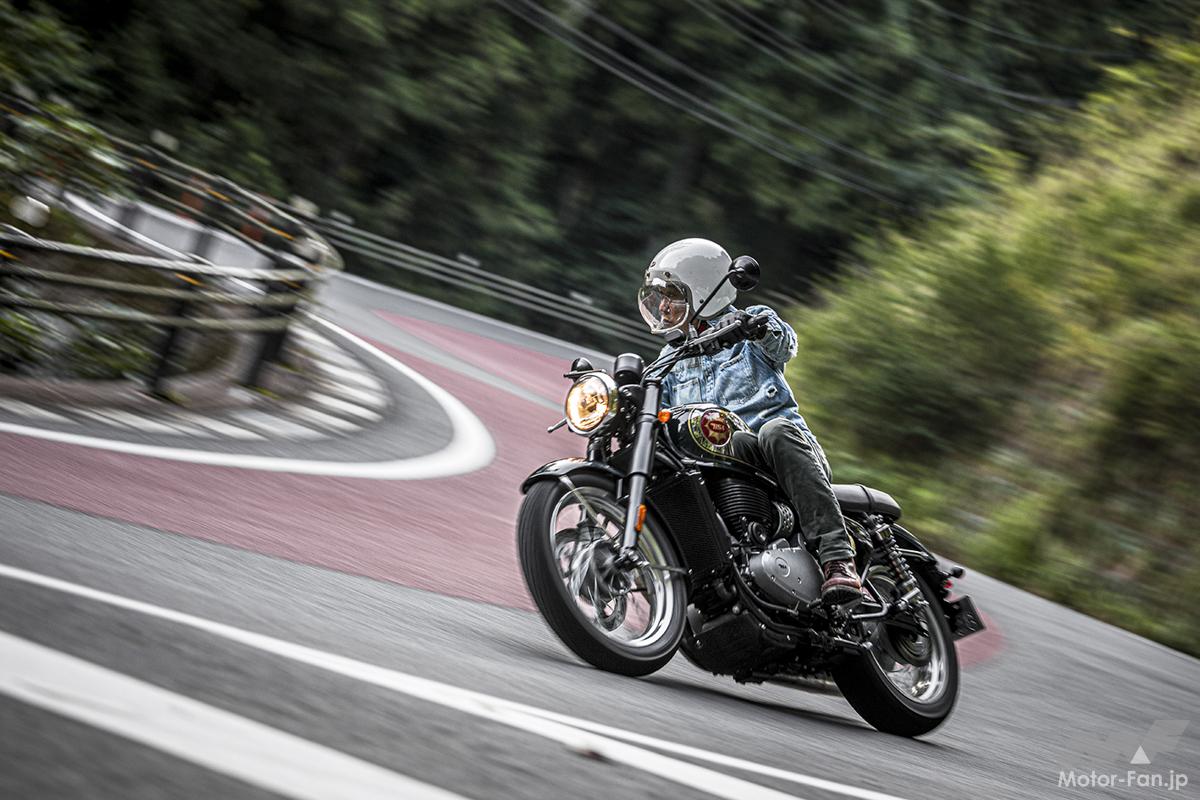
The current V7 has a design that strongly evokes the image of the classic V7 Sport. The narrow design, with slender 18-inch bias tires mounted on both the front and rear, exudes a classic atmosphere.

The V7 engine is the smallest of the V-types currently in Moto Guzzi’s lineup, at 853cc, and inherits the traditional air-cooled OHV 2-valve mechanism.

There are many different variations of the V7, and the model I test drove this time was the V7 Stone Corsa.

Corsa, which means competition in Italian, is often thought of as a name given to machines that are suited to racing, but the V7 Stone Corsa has the same specifications as other V7s. The model is fitted with a bikini cowl, a seat with a tail cowl-style cover, bar-end mirrors, and other features to create a cafe racer feel.


A fun engine at low and medium speeds

Moto Guzzi V-twins have very different characteristics depending on the displacement. The V7 has a rather relaxed engine characteristic. This engine is just right in many ways for riding at a moderate pace on the street.

Although the low and mid-range torque is strong, Moto Guzzi V-twin engines have always had a large flywheel mass, so the engine does not react too sensitively. When you open the throttle, the torque comes out gently. In addition, the flywheel mass stores inertia, which creates a unique sense of power.
The fun part about the V7 is only until it gets past 4000 rpm. Even at this speed, there’s enough torque to make for a sporty ride while enjoying the pleasant pulsating feel and exhaust sound.
Once you exceed 5000 rpm, the exhaust starts making a continuous noise, and it becomes difficult to rotate up to the 7000 rpm rev limit. It’s usable when you want to increase the rotation and go fast, but it’s not very fun to use it in the high rev range all the time.
Because of these characteristics, when riding a V7, I usually only use it at mid-range speeds, but when riding this bike, I feel completely satisfied with that. Some bikes have engine characteristics that are so extreme that it makes the rider feel as if they are being rushed, but the V7 is the exact opposite. It feels as if the V-twin engine is telling me, “Let’s ride at this pace.”
Handling that makes driving fun

The handling is generally straightforward, but the flavor is a little different. The large offset of the stem reduces the trail that contributes to straight-line stability, resulting in stronger steering response when the bike is banked . Instead, the caster of the front fork ensures straight-line stability.
With slim 18-inch bias tires, the front steering angle adjusts naturally and quickly just by leaning the bike slightly, which is probably due to the effect of the large offset stem. When riding on winding roads at a moderate pace, it’s great fun to use this steering movement at a shallow banking angle. The bike changes direction smoothly without having to lean too much.
The soft, well-acting suspension is also set up to be ideal for controlling the bike at low speeds. The low-to-mid-range engine is also a perfect match for this handling, making it a lot of fun to ride over mountain passes at a moderate pace.
However, it becomes difficult when you increase the pace and try to attack winding roads. If you forcefully turn, the soft suspension becomes unsettled, and the engine can be difficult to use when revved up. The quirks of the longitudinally mounted shaft drive are hardly noticeable, but if you regularly use high revolutions, the rear shock can feel a bit stiff when the power is on, depending on the timing. Bias tires also do not have as much grip or stability as radial tires, so when you try to attack, handling becomes severe.
However, this does not diminish the V7’s reputation. While many sports bikes have high performance that cannot be fully utilized, the V7 simply does not pursue such excess performance. As a result, it is a bike that can be enjoyed in practical use.
The V7 may not be enough for riders looking for an exciting bike, but I think it will be very attractive for riders who enjoy riding on the street at reasonable speeds.
As mentioned above, Moto Guzzi V-twins have very different characters depending on the engine displacement and model. If you’re interested, I recommend trying out a variety of models. You’ll find that they have a unique character and fun that you won’t find in bikes from other manufacturers.
Position & foot grounding (height 178cm, weight 75kg)

The riding position is slightly forward leaning, which allows for a natural and comfortable riding position even over long distances.
The longitudinally mounted V-twin engine gives the impression that the center of gravity is higher and further forward than usual, which can make the bike feel heavy when leaning or lifting.

The body is slim, so it’s easy to reach the ground with your feet. The seat height is 780cm, but the suspension is low, so both feet can be placed flat on the ground and your knees can bend.

detail

The front tire is 100/90-18. The short front fender gives it a sporty look.
ADVERTISEMENT
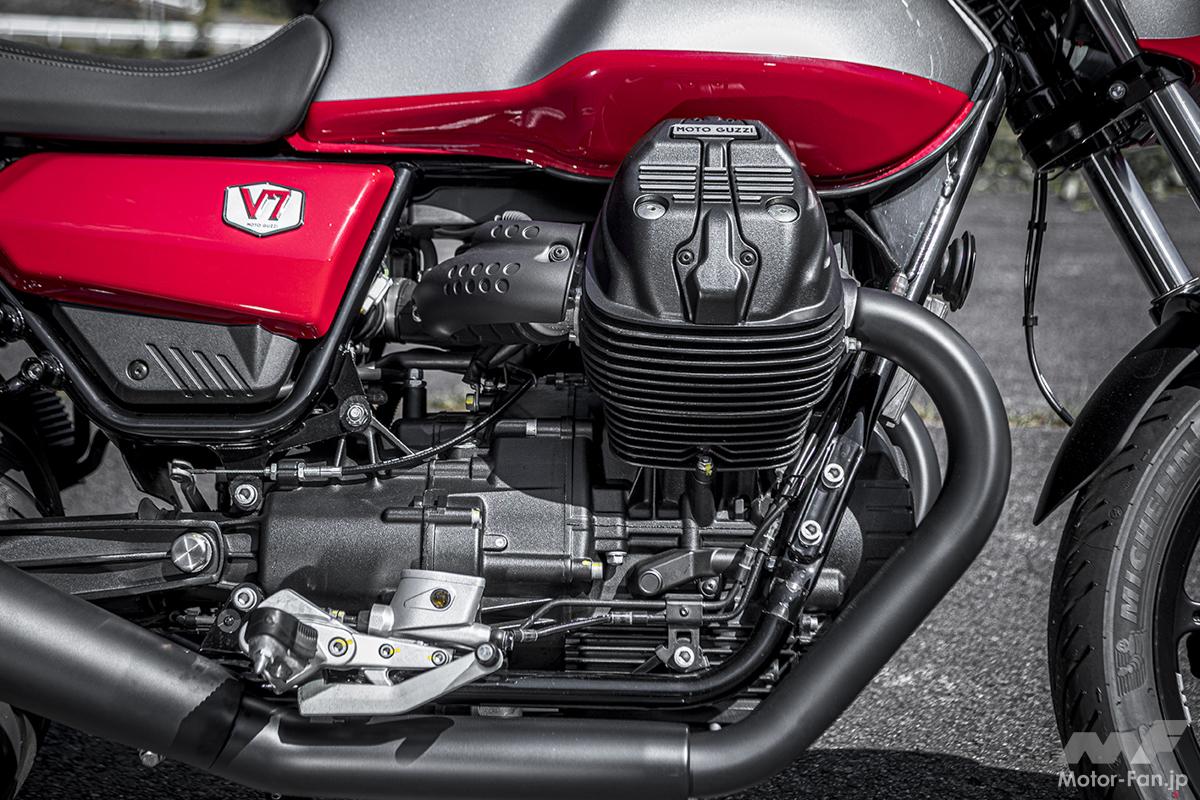
The engine is an air-cooled, four-stroke, 90° V-twin OHV with two valves, displacing 853cc. The bore and stroke are 84mm x 77mm. It produces a maximum output of 65 HP (48 kW) at 6,800 rpm and a maximum torque of 73 Nm at 5,000 rpm, with a focus on mid-range performance.
ADVERTISEMENT

There are two silencers on the left and right. The elegant yet powerful exhaust sound is a Moto Guzzi’s charm. You can see the shaft that drives the rear wheel.
ADVERTISEMENT

The rear brake is a combination of a Φ260mm rotor and a two-piston caliper.
ADVERTISEMENT

The rear suspension is a conventional design without a reservoir tank, with smooth, soft settings.
ADVERTISEMENT

The single-seat style seat cowl is an optional item.
ADVERTISEMENT

If you remove the seat cowl, you can also ride tandem.
ADVERTISEMENT

The battery and electrical components are stored under the seat.
ADVERTISEMENT

The front brake is a combination of a Φ320mm disc and a Brembo 4-pot caliper with different diameters.
ADVERTISEMENT

The LCD meter is simple and easy to read.
| engine | Air-cooled 4-stroke 90° V-twin OHV 2-valve |
| Total displacement | 853cc |
| Bore x Stroke | 84mm x 77mm |
| Maximum output | 65 HP (48 kW) / 6,800 rpm |
| Maximum torque | 73 Nm at 5,000 rpm |
| Fuel supply method | Electronically controlled fuel injection system |
| Starting method | Self-service |
| transmission | 6-speed return |
| clutch | Dry veneer |
| Frame | High-tensile steel double cradle |
| Front Suspension | Φ40mm hydraulic telescopic fork |
| Rear Suspension | Die-cast aluminum swing arm Hydraulic twin shock absorbers |
| Spring preload adjustment | |
| Front brake | 320mm stainless steel floating disc |
| Brembo unequal diameter opposed 4-piston calipers | |
| Rear brake | 260mm stainless steel disc with floating 2-piston caliper |
| Front tire | 100/90-18″ lightweight cast aluminum wheels |
| Rear tire | 150/70-17″ lightweight cast aluminum wheels |
| Overall length / height | 2,165 mm / 1,160 mm |
| Seat height | 780 mm |
| Wheelbase | 1,450 mm |
| Fuel tank capacity | 21 L |
| dry weight | 198 kg |
| Vehicle weight | 218 kg *Drivable condition (fuel is 90% loaded) |
| Main equipment | Full LED light package with DRL, LCD meter, MGCT traction |
| Controls, Dual Channel ABS, Front Fairing, Bar End Mirrors, | |
| Aluminum billet fuel cap, handlebar clamp with “CORSA” plate | |