
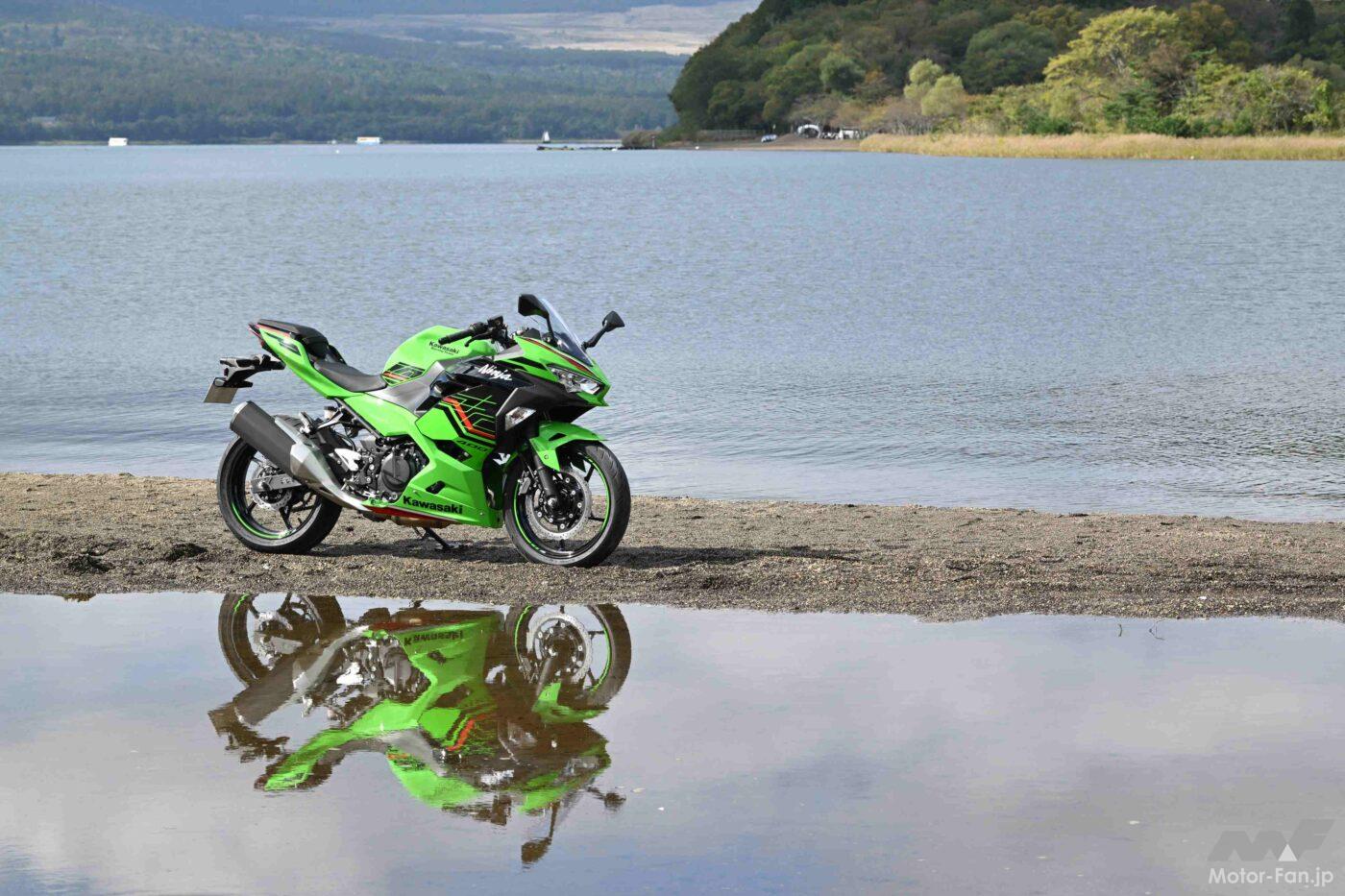

Kawasaki Ninja 400…770,000 yen
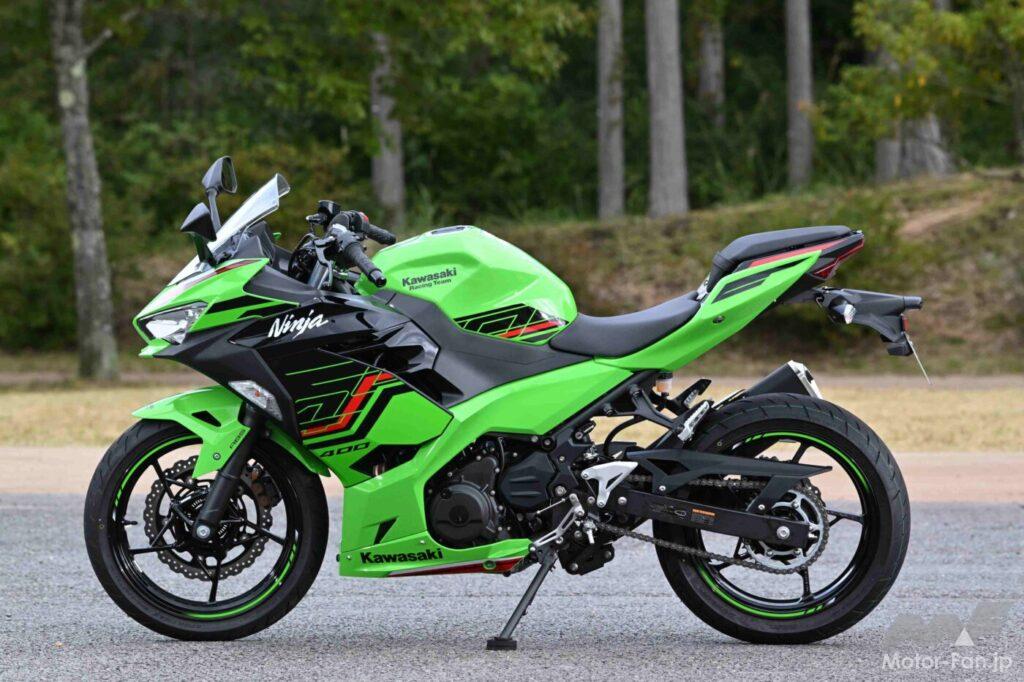
The test ride vehicle was the KRT Edition, a reproduction of the pre-2023 Works ZX-10RR. The standard colors are Pearl Ivory x Metallic Matte Dark Gray and Metallic Magnetic Dark Gray x Metallic Spark Black.
Advantages that are different from the in-line 4-cylinder ZX-4R
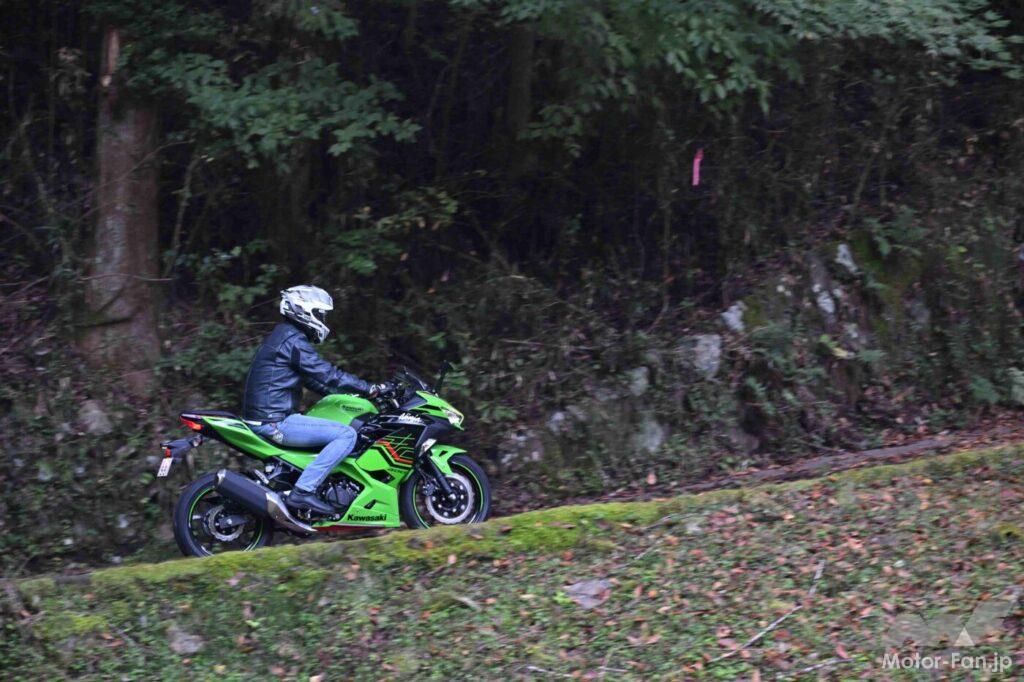
As I mentioned in the first article, I have been going to circuits regularly since 2010 (although I have been taking a break recently due to financial difficulties), and I find the in-line twin-cylinder Ninja 400 quite appealing as a current model that I can just about bring out its potential with my skill level. However, when I talk about it with friends and acquaintances around me, I am surprised at how often they respond, “Wouldn’t the in-line four-cylinder Ninja ZX-4R be better?” However, while I acknowledge the capabilities of the ZX-4R, I still think the Ninja 400 is more suited to me.
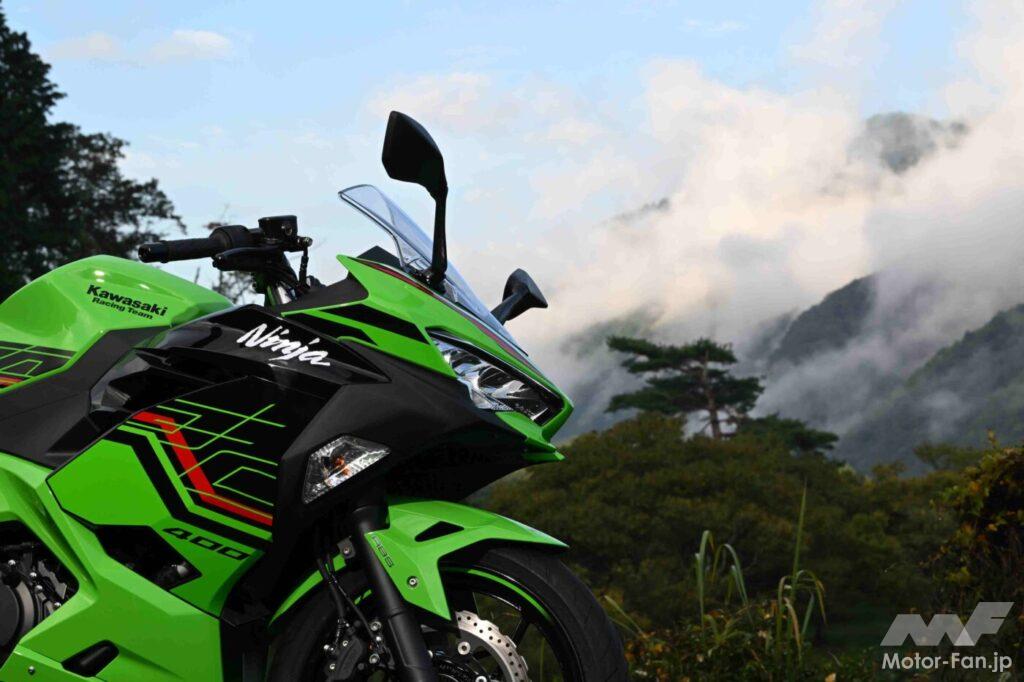
That’s because the ZX-4R weighs 190kg, which is 23kg heavier than the Ninja 400. However, on the other hand, the ZX-4R’s maximum output is 77/80ps, which is 29ps higher than the Ninja 400 (32ps when ram air is applied), but having driven it on the circuit and truly realizing the importance of lightness, I’m still drawn to the Ninja 400.
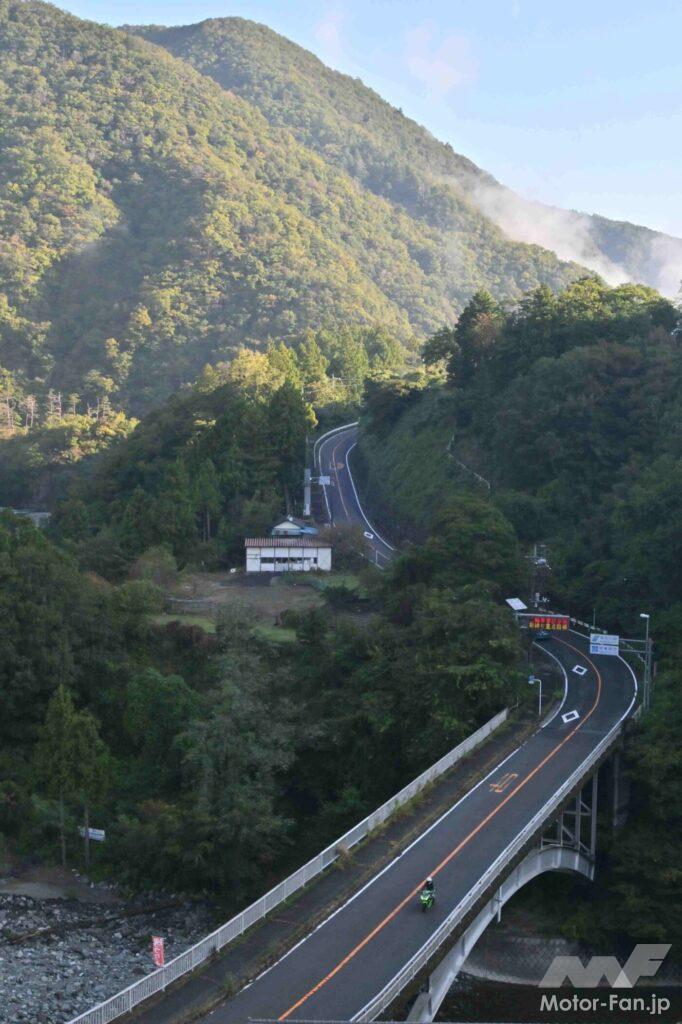
In addition, the Ninja 400 also has the merit of being able to enjoy long runs without excess or lack. When using the ZX-4R, which is equipped with an ultra-high-revving in-line four-cylinder engine (maximum power and torque are generated at 14,500 and 13,000 rpm, while the Ninja 400’s are at 10,000 and 8,000 rpm), for touring, there are many situations where you can’t enjoy the engine’s full potential, or it’s difficult to match your pace with your fellow riders, which can be stressful. However, during the second half of this test ride, I went on a 700km tour (a two-day, one-night trip from western Tokyo to Joetsu City, Niigata Prefecture) with three friends, mainly on public roads, and I hardly encountered any of these problems.
Ground contact and security around the front
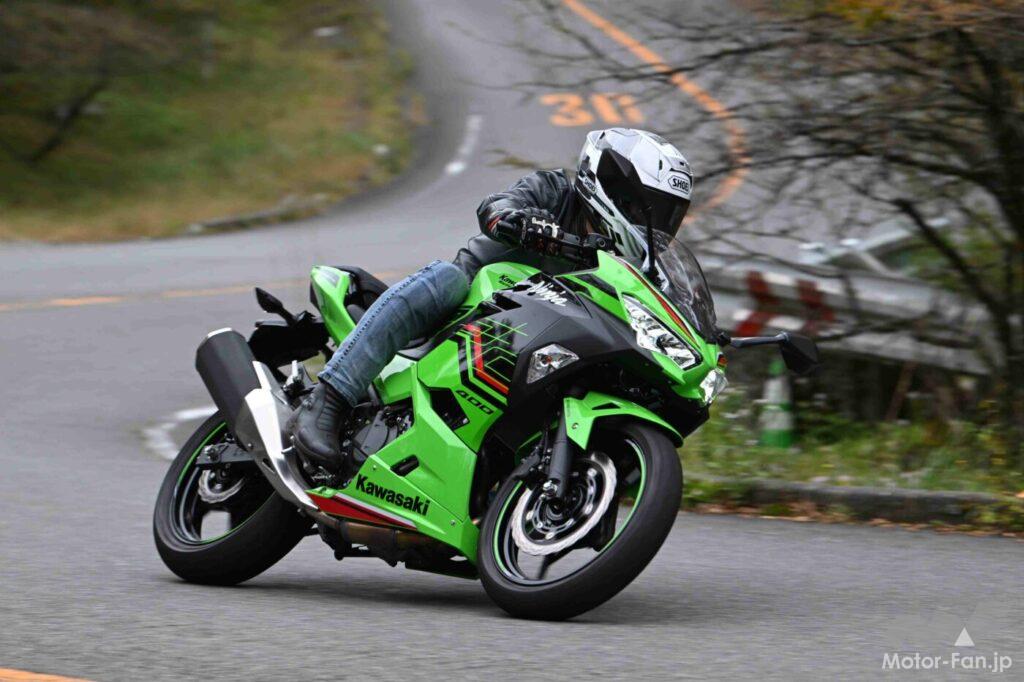
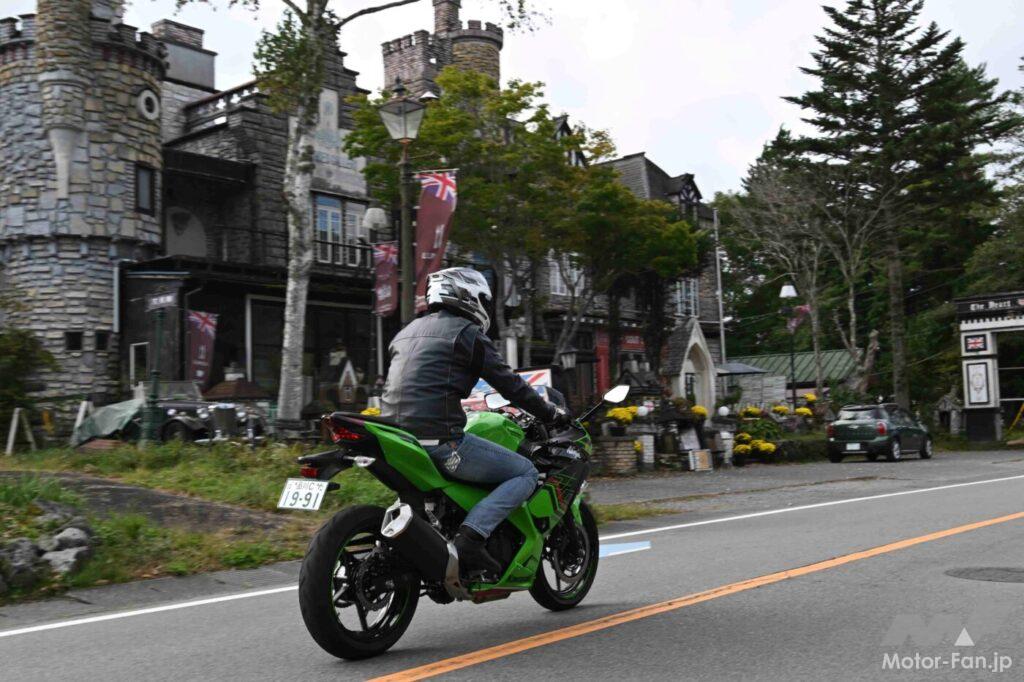
By the way, as I rode through various situations on my approximately 700km tour, one thing that really impressed me was the feeling of the front end gripping the ground when decelerating. I had vaguely noticed this before, but when you apply the front brake on the Ninja 400, or close the throttle after it had been moderately open, the weight naturally and just rightly shifts to the front end, and that weight doesn’t easily drop, regardless of the speed range or road conditions. This gives you a great sense of security when entering corners on mountain roads, and it’s also easy to lean the bike from there. This is a continuation of what I said in the first article, but I think it’s these qualities that have made me fall in love with the Ninja 400.
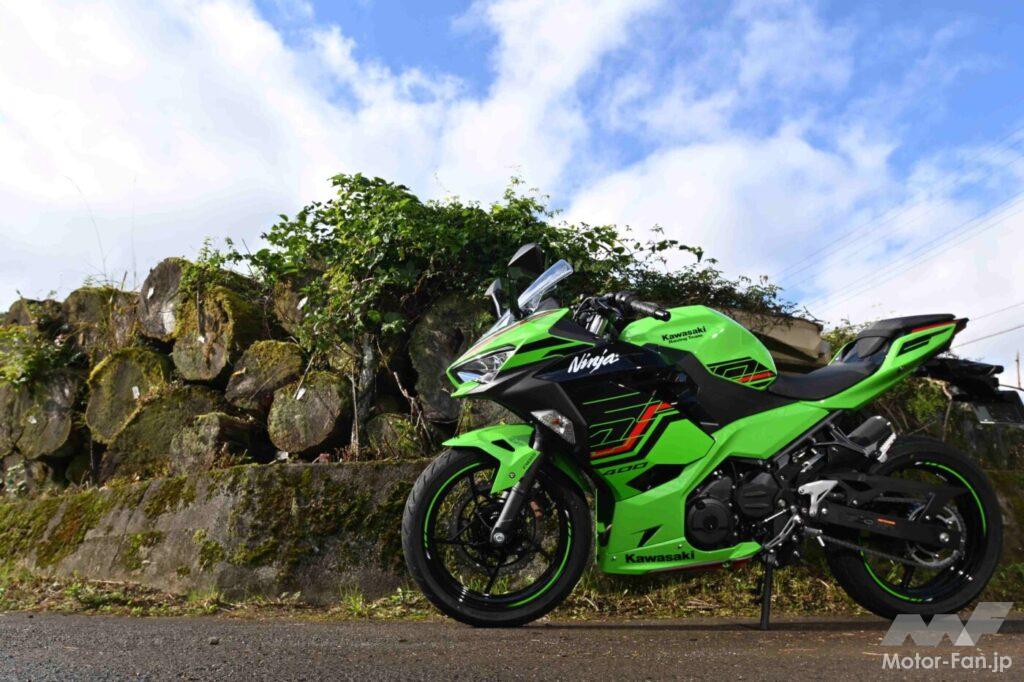
On the other hand, however, the feeling around the rear when opening the throttle on cornering wasn’t the best. At higher engine speeds, traction is clearly apparent, but below 6000 rpm, it feels a bit muffled. This issue could be resolved with a high-quality aftermarket rear shock or an aftermarket muffler that emphasizes the engine’s thrust, but perhaps a more favorable impression could be achieved by using high-grip sports tires (the original specification is Dunlop GPR-300) or shortening the final drive ratio.
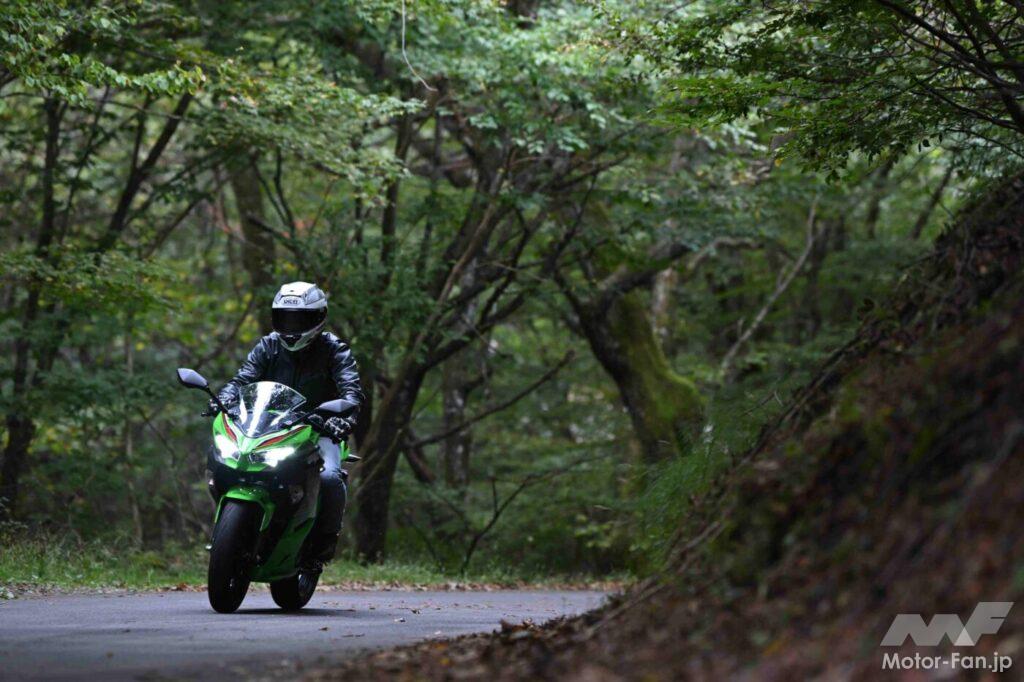
In addition to that, one other thing that bothered me a little about the Ninja 400 was the physical fatigue after a long ride. That said, I didn’t feel any obvious pain anywhere in my body, and any bike will get tired to a certain extent when you ride about 700km mainly on public roads, but looking back, the Ninja 400 before 2017, which shared the same basic design as the Ninja 650, had a thick seat and a high windscreen (seat height and overall height: 805/1180mm for the 2017 model and earlier, 785/1120mm for the 2018 model and later), and it had a more relaxed ride feel, so I feel that its qualities as a sports tourer were superior to those of the current Ninja 400 from 2018 onwards.
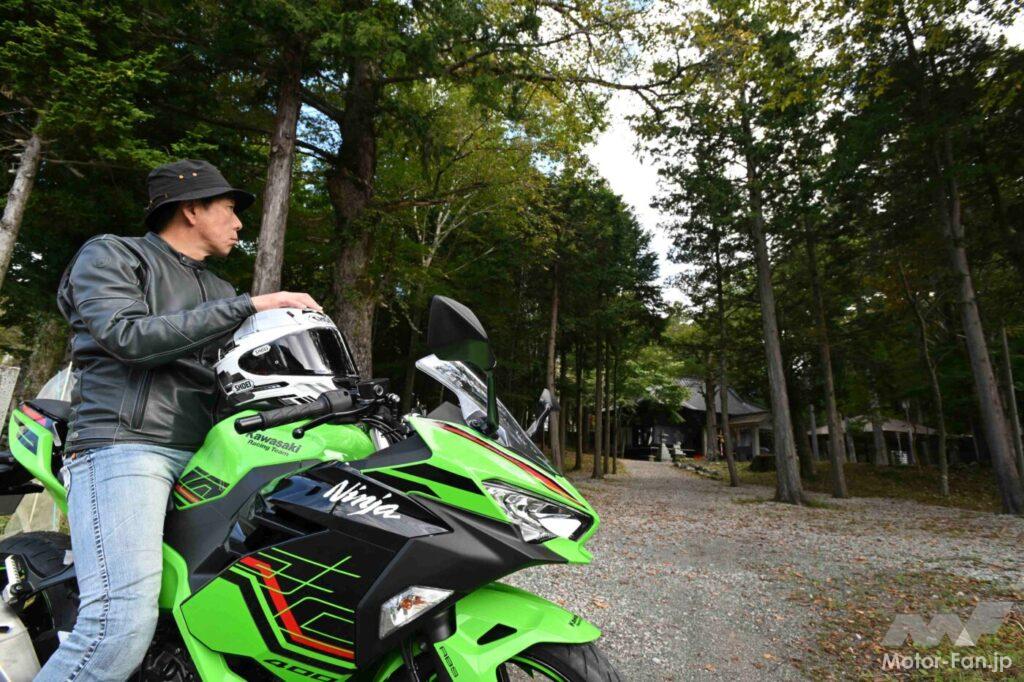
Well, I originally fell in love with the current Ninja 400 because of its maneuverability, so I’m not sure if it’s appropriate to express any objections to this bike from that perspective. Also, considering the difference in size (curb weight and wheelbase for 2017 and earlier models: 211 kg and 1410 mm, and for 2018 and later models: 167 kg and 1370 mm), the reason I was able to easily push and pull the bike and ride along the narrow prefectural roads, farm roads, and paved forest roads during this test ride was probably because the current Ninja 400 is light and small.
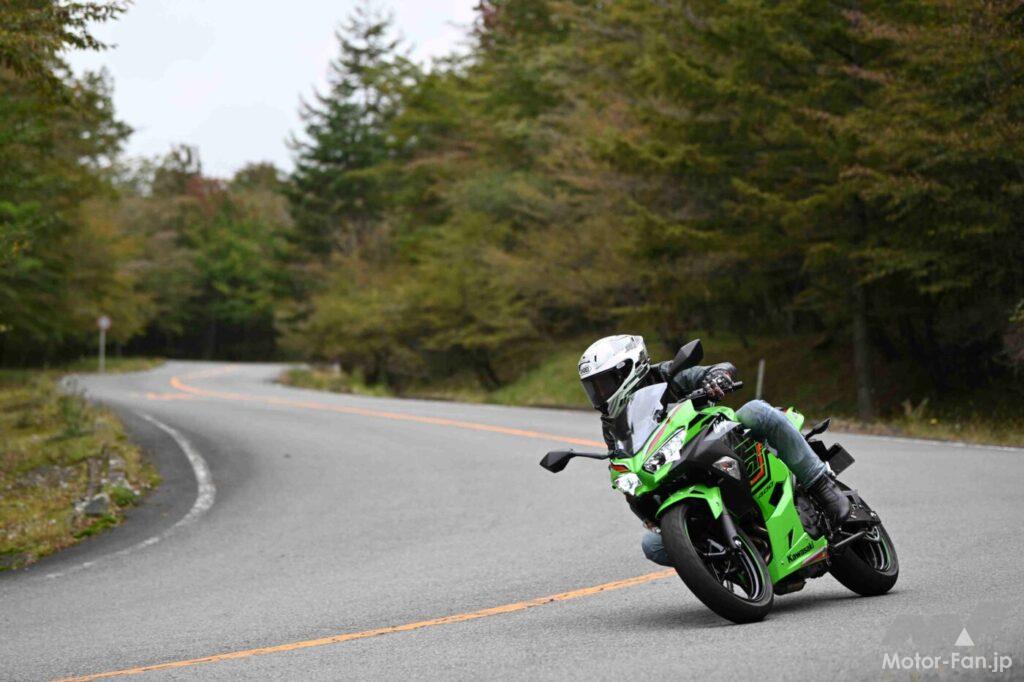
In any case, through this test ride, I’ve come to like the Ninja 400 more than ever, and if I were to own this bike, I think I would customize it to improve its maneuverability and comfort. Writing this might give the impression that I’m rejecting the stock version, but it could be said that the desire to customize something during a test ride is a characteristic of Kawasaki motorcycles, and it’s precisely because the stock version has such excellent qualities that I want to customize it to my liking.
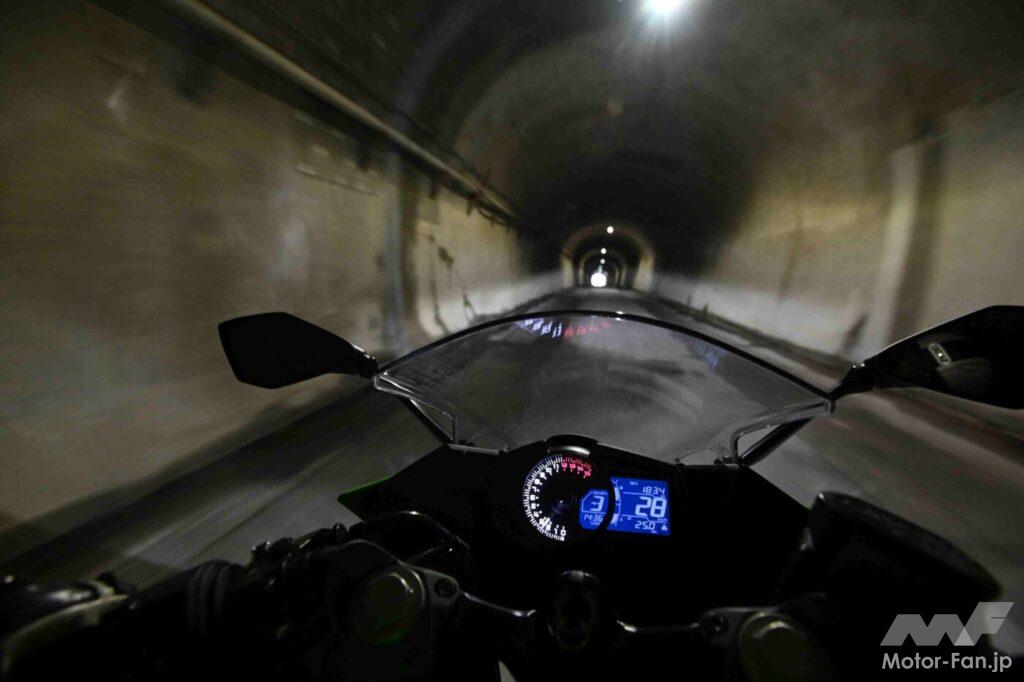
Have you come across your ideal customization by chance?
While I was thinking about this, I happened to come across a perfect example at a convenience store near my house. I met Mr. Komatsubara, the owner of a current Ninja 400, and when he showed me his bike, I found that the direction of the customization was quite similar to my preferences. What particularly impressed me was the aftermarket high seat and rearsets, which provide an excellent riding position that seems to allow for both sports riding and touring (I was bold enough to sit on the seat and check the riding position), but I also really like the high windscreen, which is expected to reduce the wind when riding, and the Yoshimura muffler, which gives you a clear, explosive exhaust sound with each hit.

I’m sorry that the photos I took with my smartphone are so poor quality, but Komatsubara’s beloved bike was full of elements that can be used as reference when customizing a Ninja 400. A stay for a top case is installed in the pillion seat area.
By the way, there are plenty of aftermarket parts for the Ninja 400, and if you search the internet you’ll find a lot of different customizations. Komatsubara’s theme for his bike is that it can be used for touring comfortably, and since settling on the current specifications, the mileage has steadily increased, and he’s grown more and more attached to it. After hearing his story, I fell in love with the Ninja 400 even more.
*In the third installment, which will be published soon, the author will explain each part from his own unique perspective, as well as introduce the actual fuel consumption measured after driving approximately 1,200 km.

The current Ninja’s light and nimble ride is also greatly contributed to by the wheel dimensions of F: 3.00 x 17, R: 4.00 x 17, and tire dimensions of F: 100/70R17, R: 150/60R17. Incidentally, the Ninja 400 before 2017 had F: 3.50 x 17, R: 4.50 x 17, F: 120/70ZR17, R: 160/60ZR17, and these dimensions are the same as those of the ZX-4R, which is equipped with an in-line four-cylinder engine.
ADVERTISEMENT
 Now is the time to ride the Ninja 400. After realizing my own inadequacy, an ordinary middle-aged rider
  felt that this was the one. | Kawasaki 1000km Serious Test Ride [1/3]
The Ninja 400 has a racing look, but is also a versatile bike that can be used for a variety of purposes, and is popular with many riders. However, what first caught my eye about this model was the exquisitely tuned weight and maximum output. REPORT: Nakamura Tomohiko PHOTO: Togashi Hideaki
Main specifications
Model: Ninja 400
Model: 8BL-EX400L
Length x Width x Height: 1990mm x 710mm x 1120mm
Wheelbase: 1370mm
Ground Clearance: 140mm
Seat Height: 785mm
Caster/Trail: 24.7°/92mm
Engine Type: Water-cooled 4-stroke parallel twin
Valve Type: DOHC 4-valve
Total Displacement: 398cc
Bore x Stroke: 70.0mm x 51.8mm
Compression Ratio: 11.5
Maximum Power: 35kW (48ps) / 10,000rpm
Maximum Torque: 37N・m (3.8kgf・m) / 8,000rpm
Starting Method: Self-starter
Ignition Method: Full Transistor
Lubrication Method: Wet Sump
Fuel Supply Method: Fuel Injection
Transmission Type: Constant Mesh 6-Speed
Return Clutch Type: Wet Multi-Disc Coil Spring
Gear Ratio
1st Gear: 2.830
2nd Gear: 1.930
3rd gear: 1.420
4th gear: 1.140
5th gear: 0.960
6th gear: 0.840
1st and 2nd reduction ratios: 2.218 and 2.928
Frame type: Trellis (diamond type)
Front suspension: Telescopic upright type φ41mm
Rear suspension: Bottom link mono shock
Front tire size: 100/70R17
Rear tire size: 150/60R17
Front brake type: Hydraulic single disc
Rear brake type: Hydraulic single disc
Vehicle weight: 167kg
Fuel used: Unleaded regular gasoline
Fuel tank capacity: 14L
Passenger capacity: 2 people
Fuel consumption rate (Ministry of Land, Infrastructure, Transport and Tourism notification value): 31.1km/L (2 people)
Fuel consumption rate (WMTC mode value, class 3-2): 25.7km/L (1 person)