
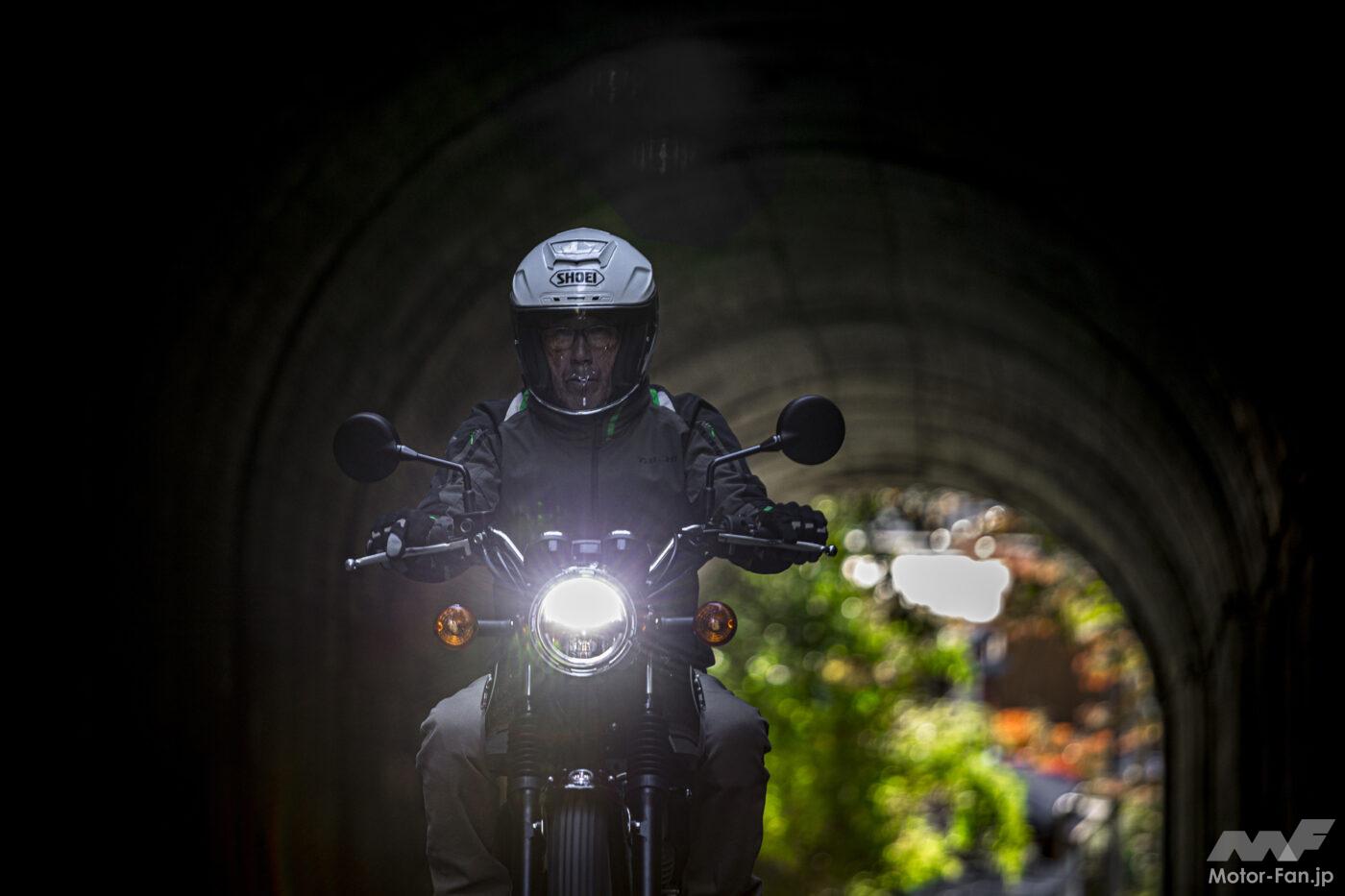
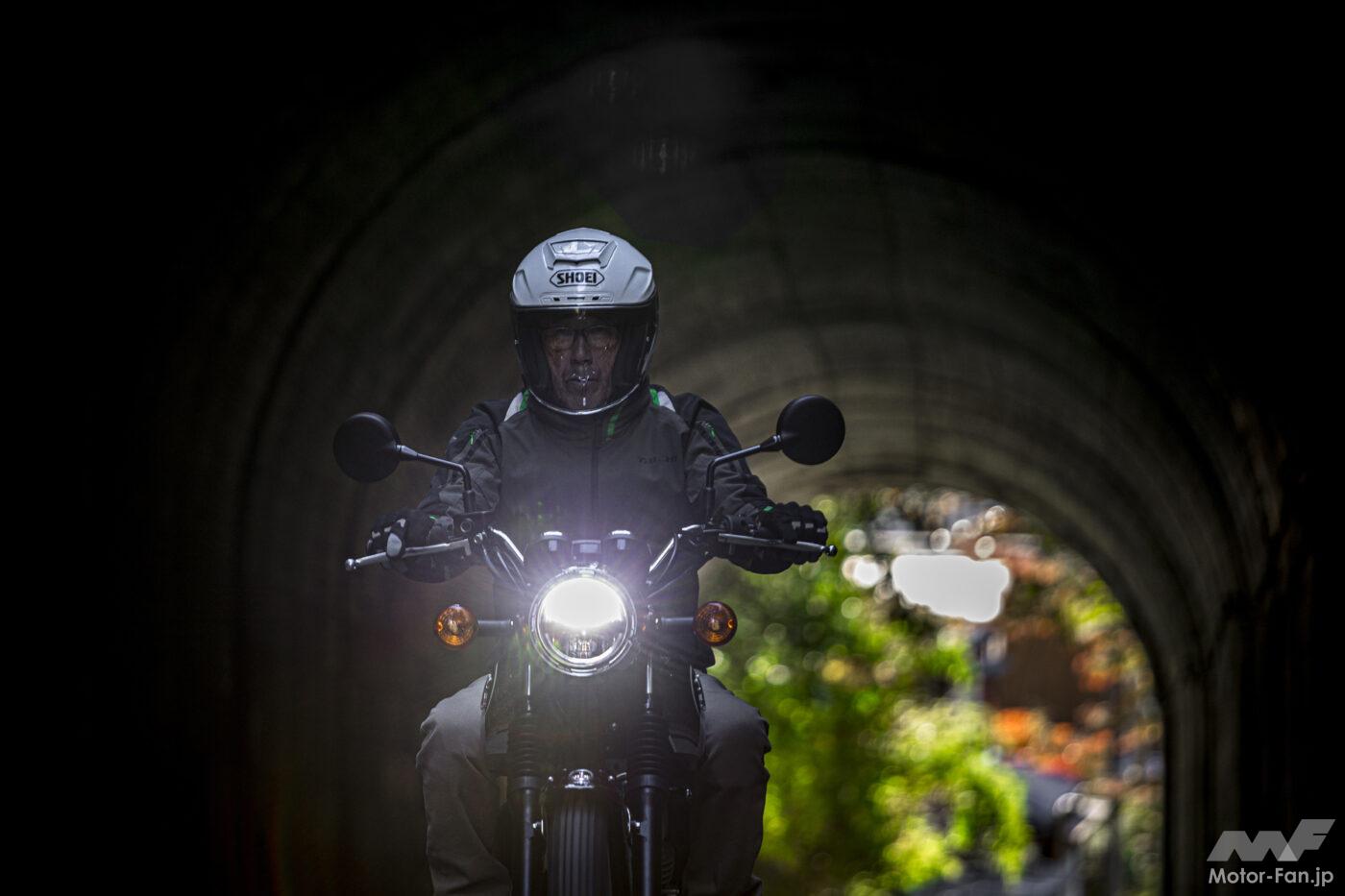
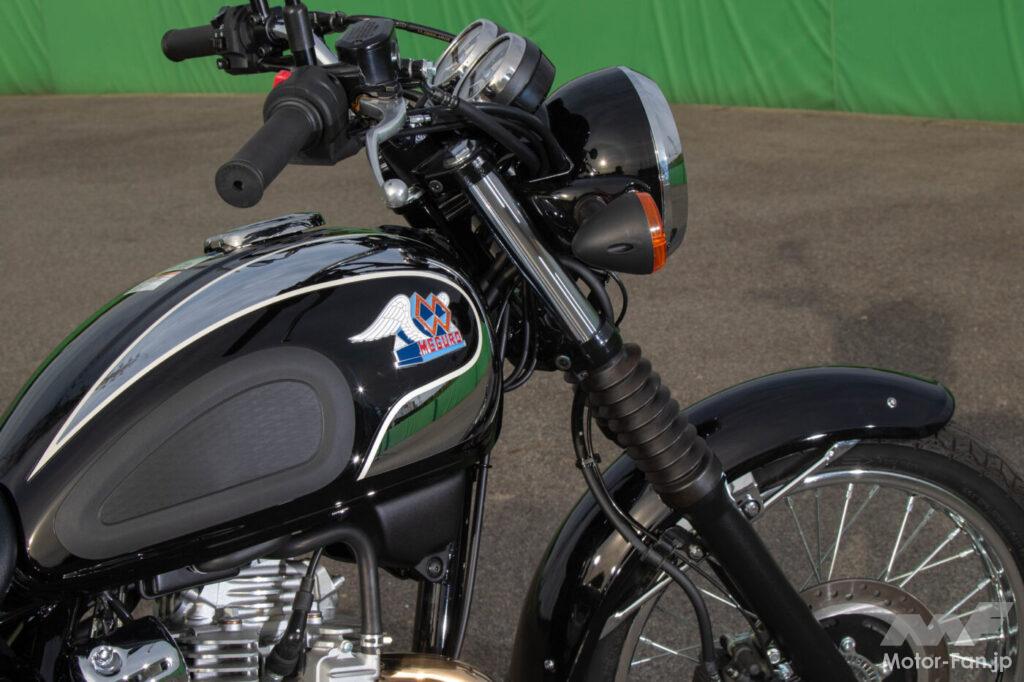
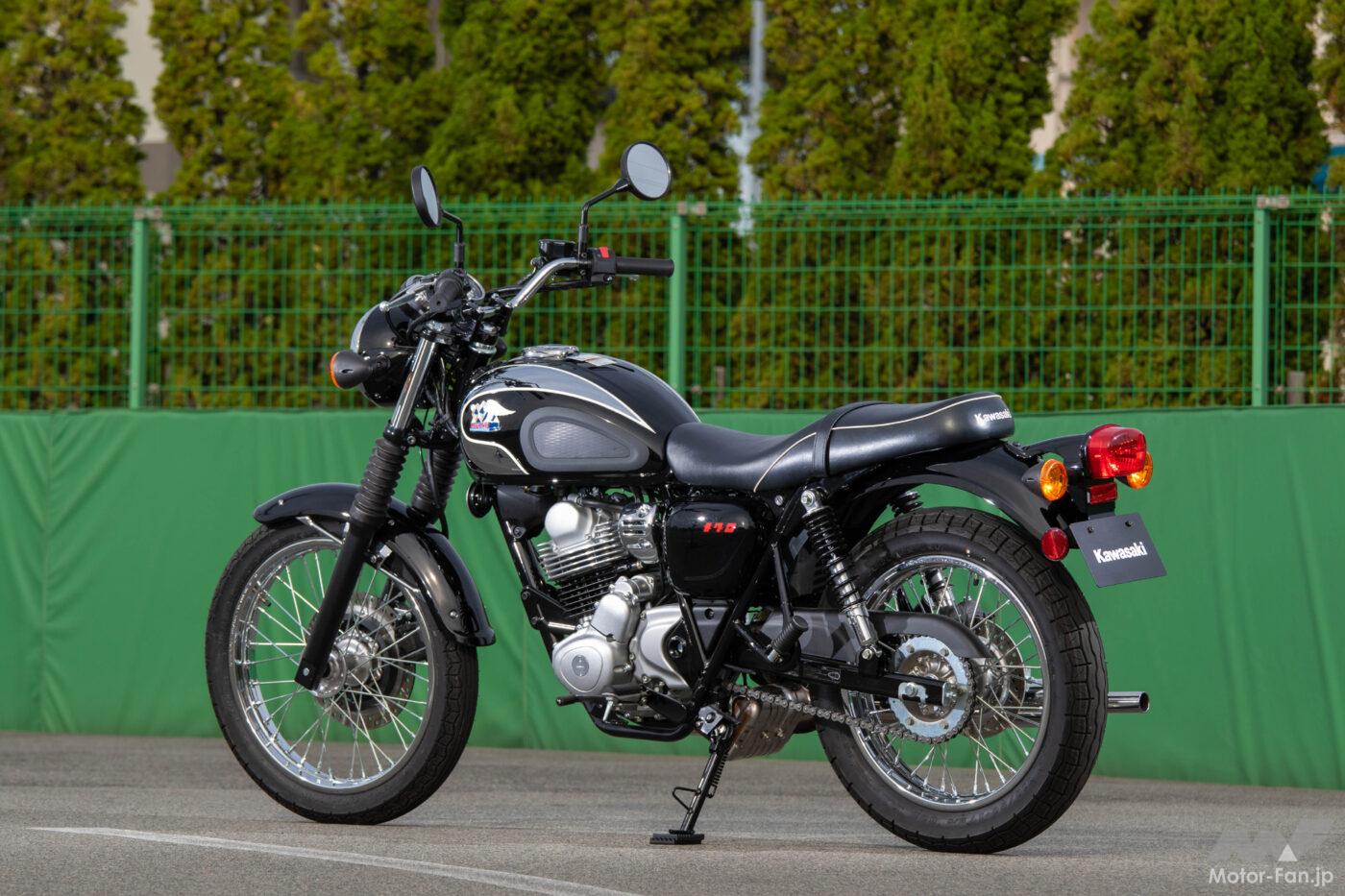
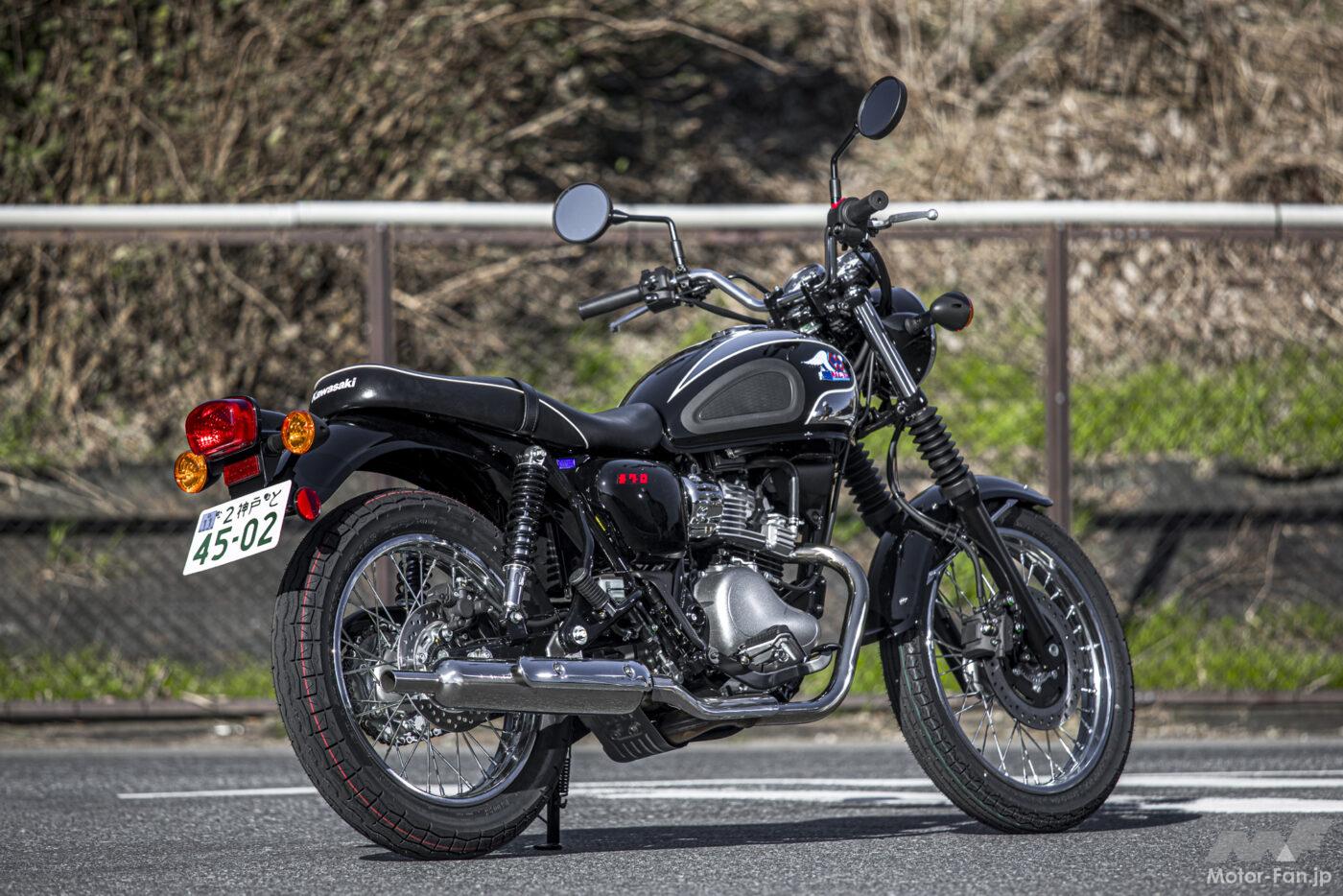
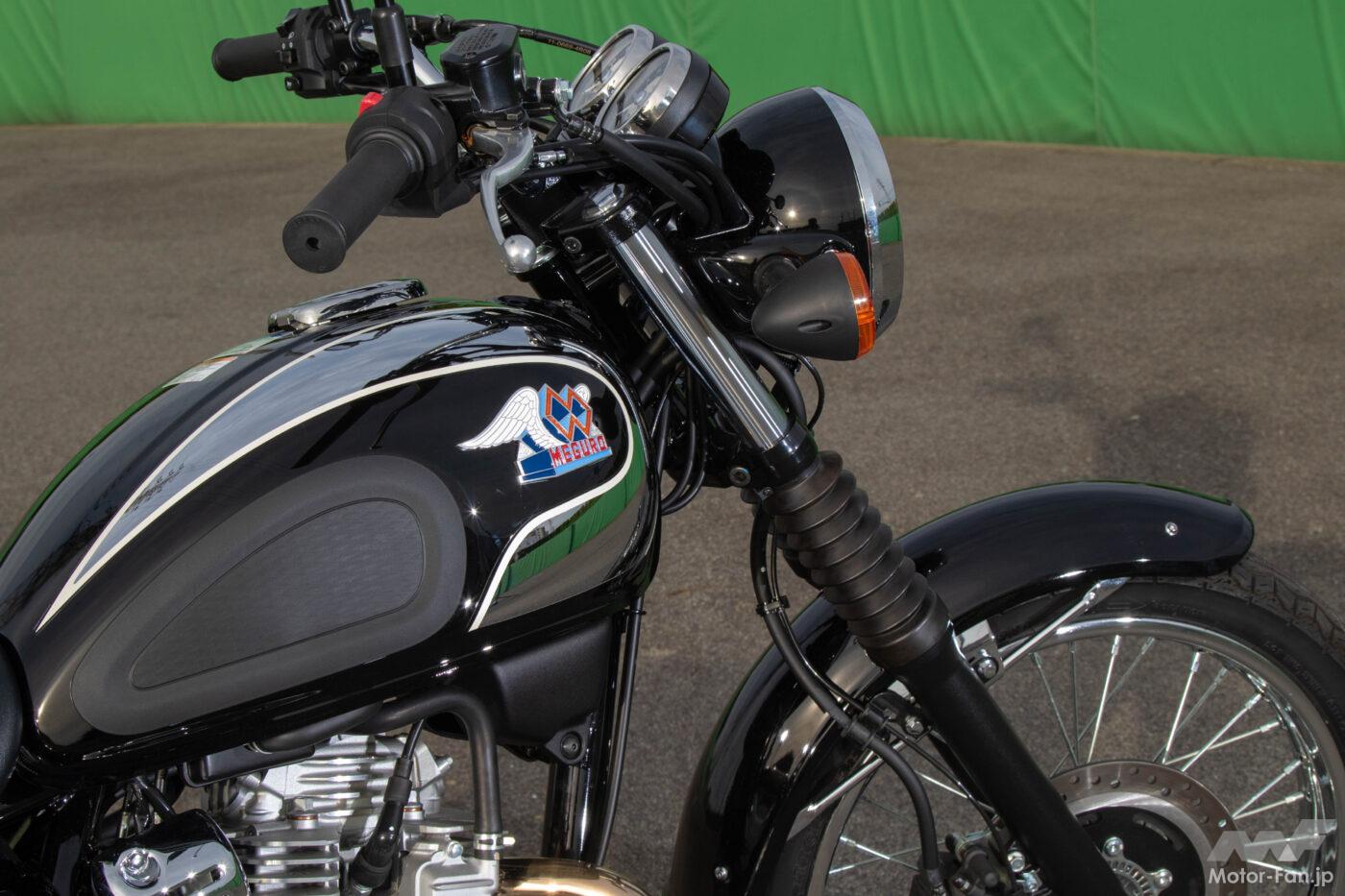
The fenders, rubber boots on the front forks, headlamp and meter, and chrome-plated fuel tank with knee grip rubber all contribute to a retro look.
Kawasaki MEGURO S1: 720,500 yen (including 10% consumption tax)

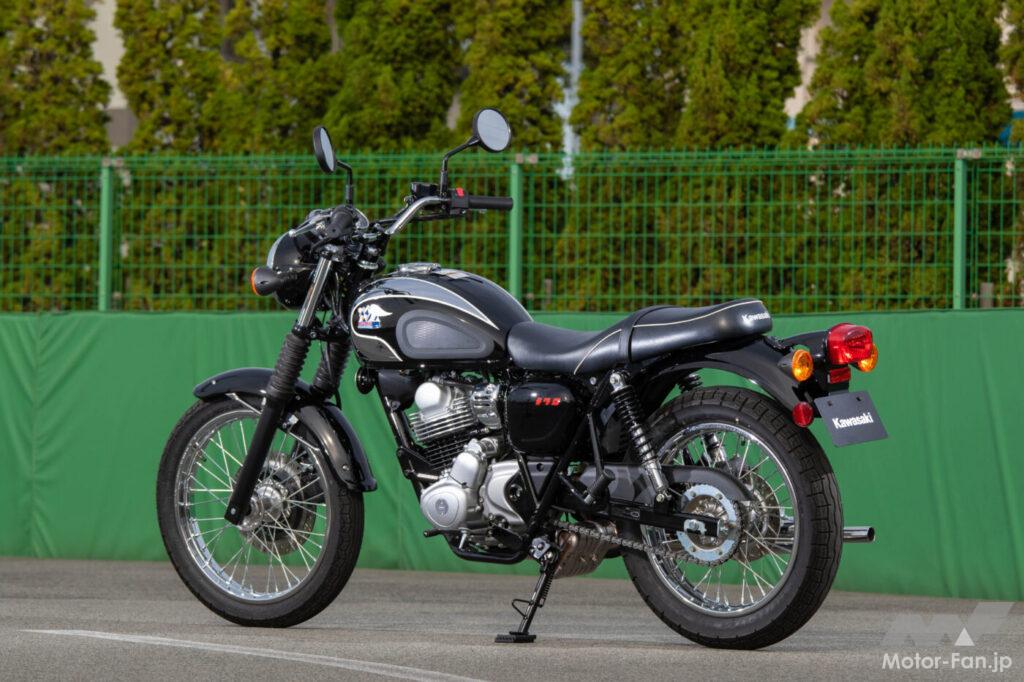


Ebony x Chrome Plated


ADVERTISEMENT
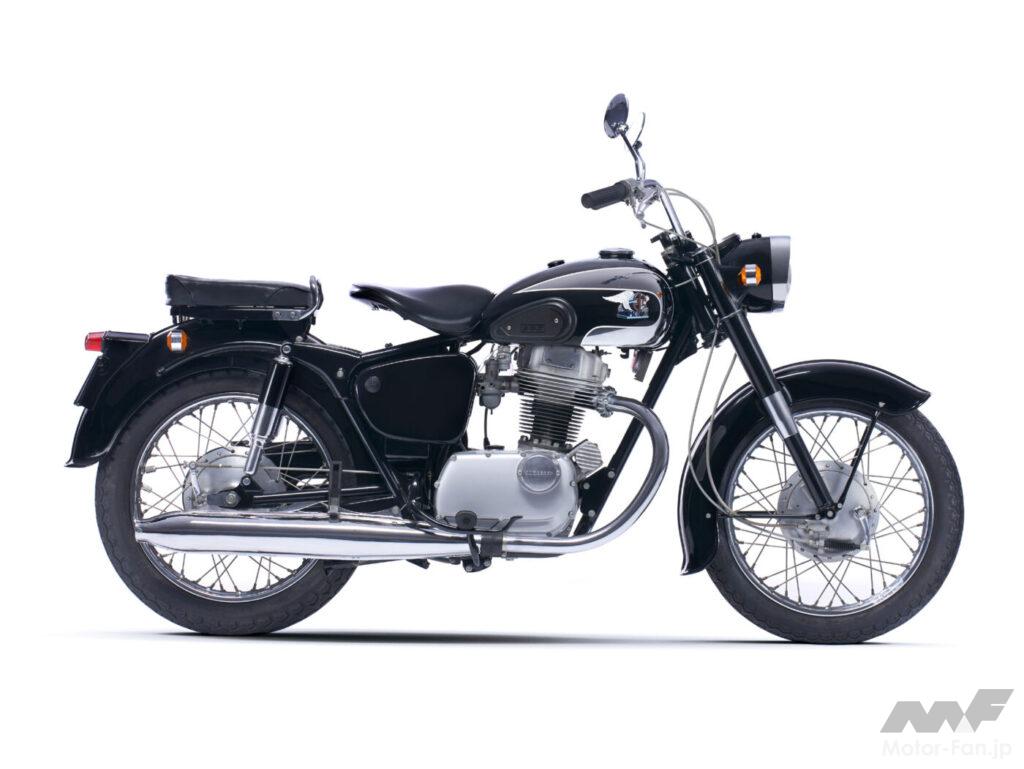
A classic Meguro 250cc single-cylinder bike. The photo shows a 1964 Kawasaki 250 Meguro SG. The saddle-style seat evokes the era. The rear seat has an additional passenger seat mounted on a sturdy cargo bed.
The February 2021 launch of the K3 marked the revival of the Meguro brand. The S1, released in November 2024, is the brand’s second, younger brother model.
It features a 232cc air-cooled single-cylinder engine. According to the press release, it’s the legitimate successor to the Kawasaki 250 Meguro SG, which existed 60 years ago. The accompanying text reads, “The three-dimensional ‘MEGURO’ emblem represents the Meguro, a retro-classic model that inherits 100 years of history and style.” The
Meguro 250SG mentioned here is the model pictured above. This is a 1964 model produced at the Akashi Plant by Kawasaki Heavy Industries, which took over the Meguro brand after forming the Kawasaki Meguro Factory following a capital alliance with Kawasaki Aircraft Co., Ltd. in 1961.
Meguro was known as one of the leading motorcycle manufacturers before the war, and after the war, it actively developed new models, including racing activities. The Junior S series (1953-1962), equipped with an OHV engine, was a highly acclaimed 250cc model leading up to the SG. It continued to evolve and mature, eventually developing into the S8.
Its successor was the Kawasaki 250 Meguro SG, equipped with an OHV engine that delivered a maximum output of 18 horsepower at 7000 rpm. Incidentally, a sports-type SGT model with a standard double seat was also released.
Many motorcycle manufacturers emerged after the war, but the 1960s were a time of culling. Market demand for motorcycles shifted from commercial use, primarily for transportation and transport, to light four-wheel vehicles, while the search for recreational sport bikes began. As
an aside, in 1992, Kawasaki released the “Estrella,” equipped with a 249cc OHC single-cylinder engine. At the time, it boasted a unique appeal unrivaled by rivals.
The long-stroke engine, with a bore and stroke of 66 x 73 mm, which is almost identical to the SG, and the adoption of a built-in seat, boast a presence that can be said to be a rebirth of the Meguro SG, and the unique, gentle yet powerful torque feeling provides a rich ride in the practical range.
At the time, in an article introducing the Estrella, I wrote, “If the brand power from the Meguro era had been utilized, the product would have been even more appealing. It was a bit of a shame, but I look forward to future product strategies.”
Development leader Satoshi Takaya explained, “We focused on creating a ride quality suited to long-stroke engines, including those used in the Estrella, while also maintaining Meguro’s signature powerful sportiness.” While
the development team was unable to test drive the SG or Estrella (they were unable to arrange for an existing model), they utilized simulation technology to achieve flexible and powerful output characteristics that rivaled those of the two. By tuning the crank mass and combustion, the engine achieved its unique output characteristics. As shown in the power/torque curve (green line) below, the result is an engine that, unlike the KLX230, excels in the mid-to-low speed range.
Incidentally, peak power is generated at 18hp/7000rpm, lower than the KLX. Coincidentally, these figures are identical to those of the SG. The rounded crankcase side covers and the use of a Cabton muffler appear to be modeled after the Estrella. The
distinctive Meguro presence is enhanced by the chrome-plated tank design with knee-grip rubber and the striking three-dimensional emblem. The value that is unique to the Meguro brand can be found in the old-fashioned atmosphere in a good way.
The frame is a semi-double cradle type made of steel pipes. While the body size is slightly larger than the Estrella, the S1’s strikingly lower profile. The seat height is 30mm lower than the Estrella’s at 740mm. As shown in the comparison photo below, the S1’s stable stance is inherited from the K3.
The engine is an air-cooled, OHC, two-valve, single-cylinder engine with a slightly short stroke of 67mm x 66mm. The six-speed return transmission is also basically the same as the KLX230 series, but the secondary reduction ratio is higher, with a 38-tooth driven sprocket compared to the KLX’s 45.
The suspension is mounted on 18-inch front and 17-inch rear spoke wheels with IRC tires. The telescopic front forks are equipped with rubber boots. The rear is a twin-shock suspension with an oval cross-section steel swingarm and double-pitch springs. Both front and rear brakes are single disc. The front calipers are equipped with two-piston, rear-mounted pin-slide hydraulic calipers.
The Meguro has been revived as the S1, inspired by the SG, the last Meguro brand released by Kawasaki. What kind of riding experience will it offer?
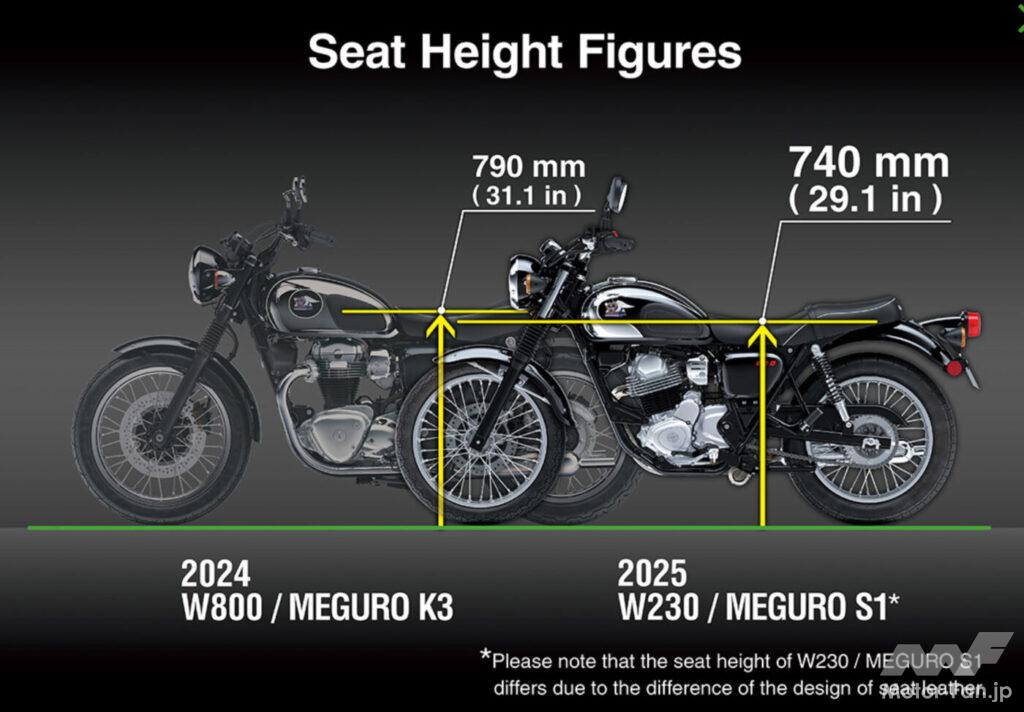
The low seat height symbolizes its friendliness, making it suitable for any rider.

It is clear that the focus is particularly on torque characteristics in the mid-to-low speed range.
The easy and familiar ride is comfortable.
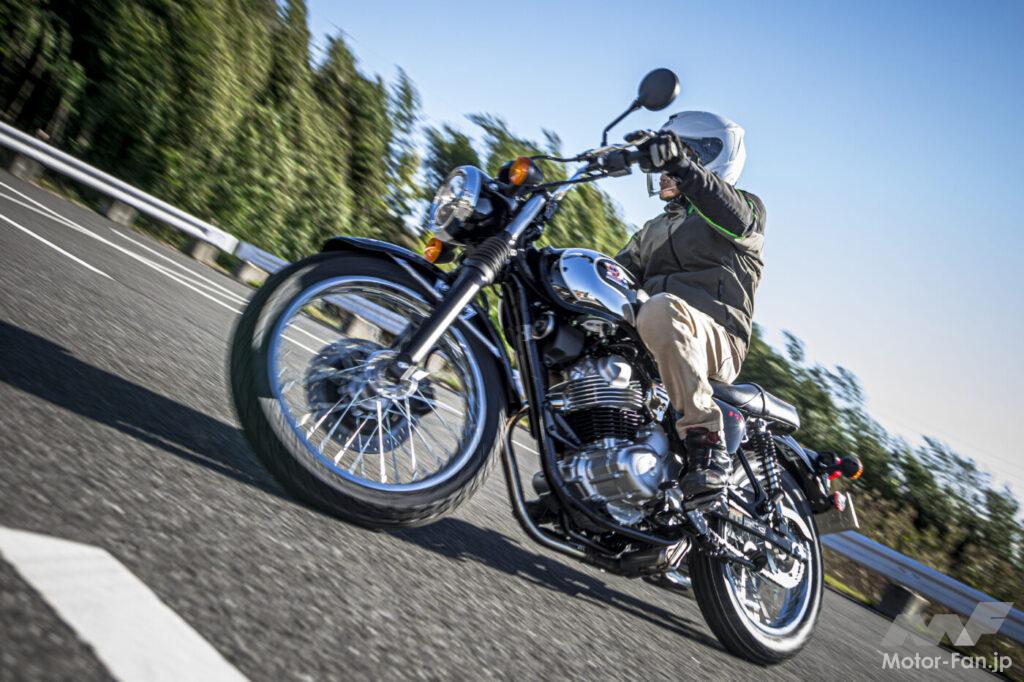
The first thing I noticed when I straddled the test bike was the incredibly friendly ride. While much of this is undoubtedly due to the low seat height, the subtle balance between its lightweight construction and that of a full-size 250cc bike is impressive. It
boasts a presence that’s in a league of its own compared to the 125cc class, and yet its appearance is imbued with a solid presence. That said, it’s a very approachable and just-right size for a 250cc bike. From the get-go, I was impressed by the sense of scale of the S1, which, in a good way, comes from its rather odd-sized engine displacement.
As you can see from the foot reach check photo, the riding position is quite upright (standing upright). I tend to sit closer to the front of the seat, so my upper body leans slightly backward.
The width of the bike, due to the bulging side covers, means my feet land a little further away from the bike, but I can still comfortably plant my heels firmly on the ground. The sense of security provided by this excellent foot placement is truly appealing.
The moderately elevated handlebar position felt a little close, but the freedom to move the bike forward or backward meant it wasn’t particularly cramped, and even smaller riders could handle it well.
The effortless handling, even when pushing and pulling, makes it suitable as a bike for everyday use, substituting for the rider’s feet. Its ease of handling is outstanding, suitable for riders of all ages, from physically weaker senior riders to physically weaker female beginners.
The steering angle is 40 degrees. The minimum turning radius is 2.6 meters. While not as good as the SG’s 2.2 meters, its maneuverability is still quite impressive for a modern bike. Making a U-turn immediately after starting and backing up and reversing gears was quite easy.
Starting the engine produced a lively exhaust note, and the response when blipping was also quite good.
The exhaust note when cruising is said to have been tuned to resemble the SG, but to be honest, I don’t really understand it, as I don’t remember the original sound clearly. Especially for a young development team, the sound development must have been within the realm of imagination.
Comparing it to my memory of the Estrella, it had a more rhythmic, lively, and crisp continuous sound, with a fairly sharp acceleration. The responsiveness was clearly different from the KLX, with a slightly sluggish and heavy feel. Reliable torque was flexibly delivered from low rpm, making it very easy to handle, from starting and shifting to slowing down in traffic.
Going back to my impression of the Estrella, I remember the throttle response and rev-up speed being more relaxed, with a sense of ease, as if always running at half power. In contrast,
the S1 revved up briskly into the high rpm range, and when pushed hard, the rev counter needle reached 9,000 rpm. The redline was at 8,500 rpm, and even at normal speeds, it delivered satisfying high performance at around 7,000 rpm.
The S1’s engine delivers powerful and flexible performance in the mid-range, while remaining lively even at high RPMs.
One thing that bothered me was that when decelerating with the throttle fully closed using engine braking, the engine sometimes struggled to drop in speed. When I asked about this, I was told that this control is sometimes activated depending on weather conditions (hot or cold). My
usual low gear, running at 5,000 rpm, gave me a speed of 23 km/h. Cruising at 100 km/h in top sixth gear, the engine speed was just under 6,000 rpm. Top gear seemed to be set for cruising, and coupled with the gear-driven balancer mechanism, high-speed travel was comfortable.
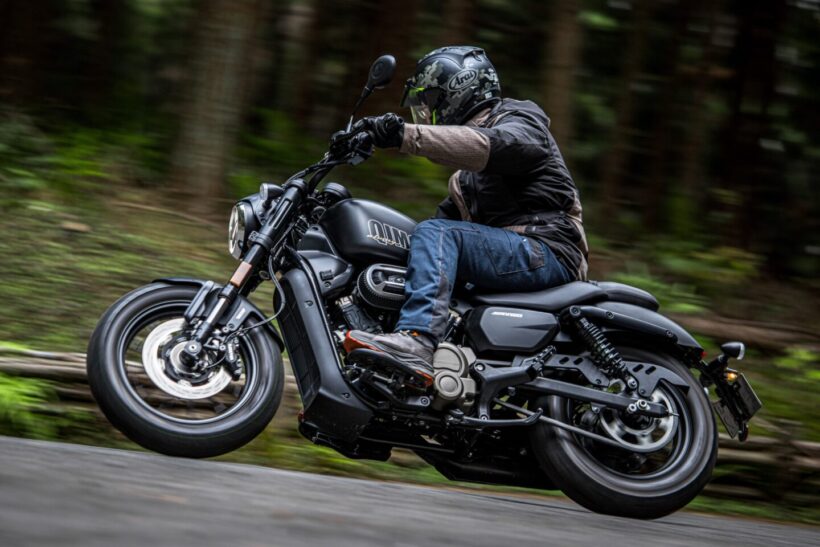
The handling and braking feel were just right for anyone, even on mountain roads. Its straightforward maneuverability and easy use make it appealing for everyday use, suitable for all riders. And the
black-and-chrome exterior design will evoke nostalgia depending on your generation, or perhaps a fresh, premium feel. I thought this would be a worthwhile choice for users who see brand value in this.
Foot reach check (rider height 168cm/weight 52kg)
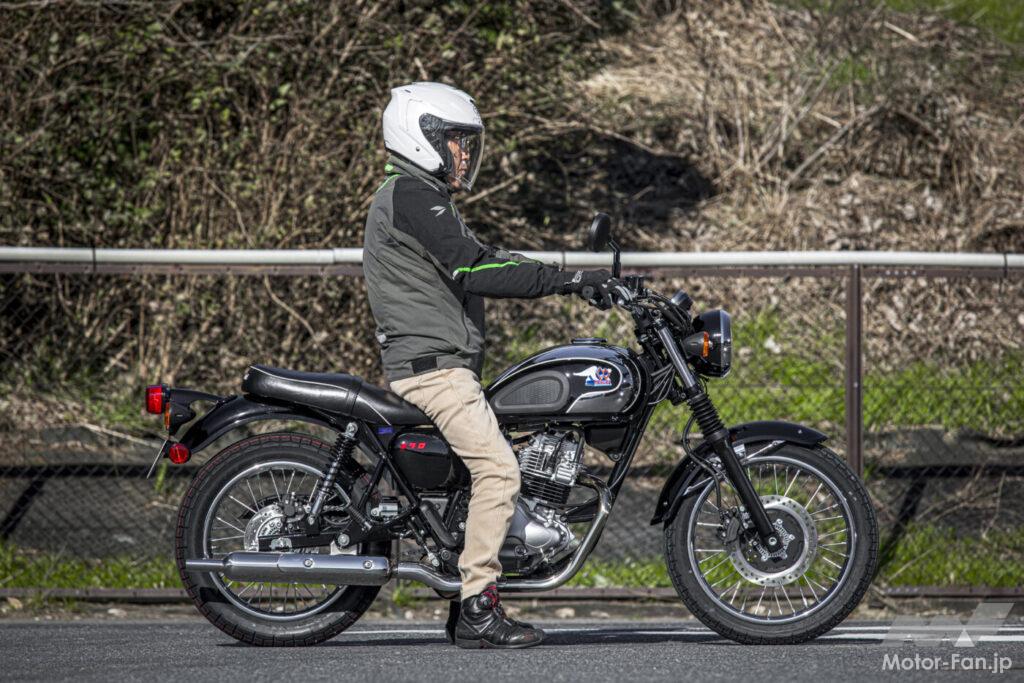
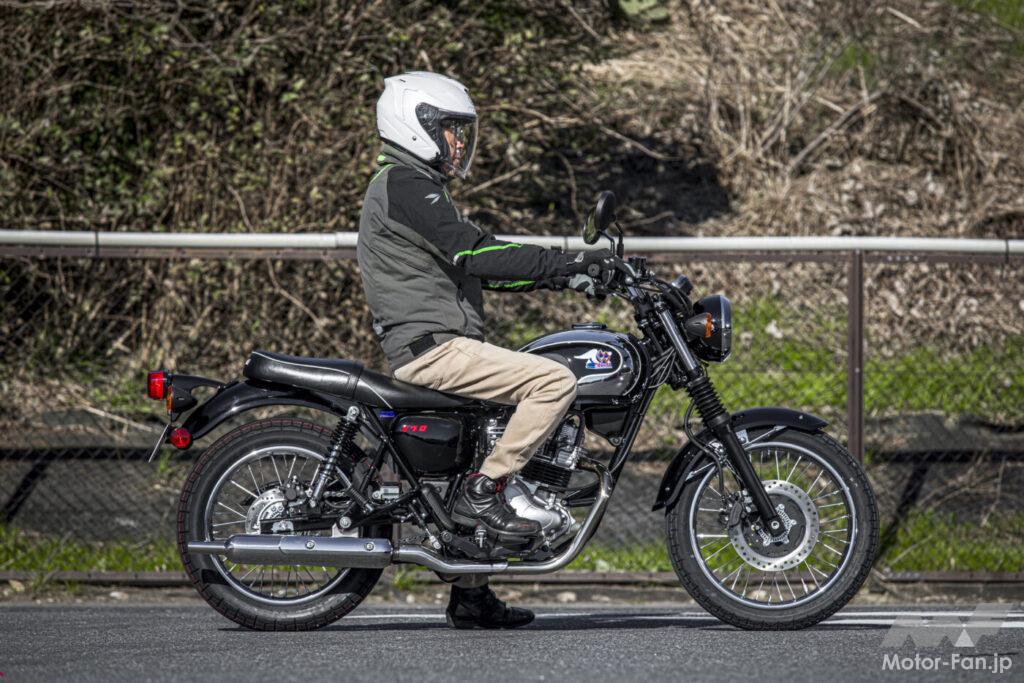

Because the body is wide, the ground contact points of both feet are a little far away. However, both feet can still touch the ground with plenty of room for the knees. The seat height is low at 740mm, making it easy to reach the ground.