
![Seriously consider choosing a scooter for commuting. A thorough comparison of four 125cc scooters! [Video: Moto Champ TV]](https://motopeek.com/wp-content/uploads/2025/02/3531-1760872258310.jpg)


From left, Kenny Sagawa, editor-in-chief Chabo, and MC Shimo provide commentary.
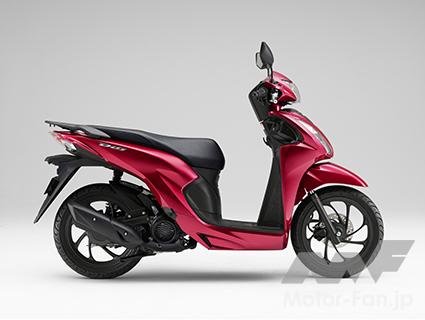
In our previous article , we provided a detailed introduction to the Honda Dio110 Basic, the cheapest bike in the 125cc class. The Dio110 Basic is essentially a model specifically tailored for commuting and school commuters, with a low new car price. While the price was revised in 2024 to just over ¥250,000, the launch price was an astonishing ¥210,000. While it’s great to know that a new bike can be purchased for ¥210,000 these days, what sets it apart from its rivals, which are also geared toward commuting and school commuters? This time, we’ll compare four models: the Honda LEAD125, and the Yamaha Axis Z and JOG125. As usual, this article is a digest of a video released in 2024 on Moto Champ TV , a free YouTube channel, titled ” Comparative Test Ride of the Best 125 Scooters for Commuting! “
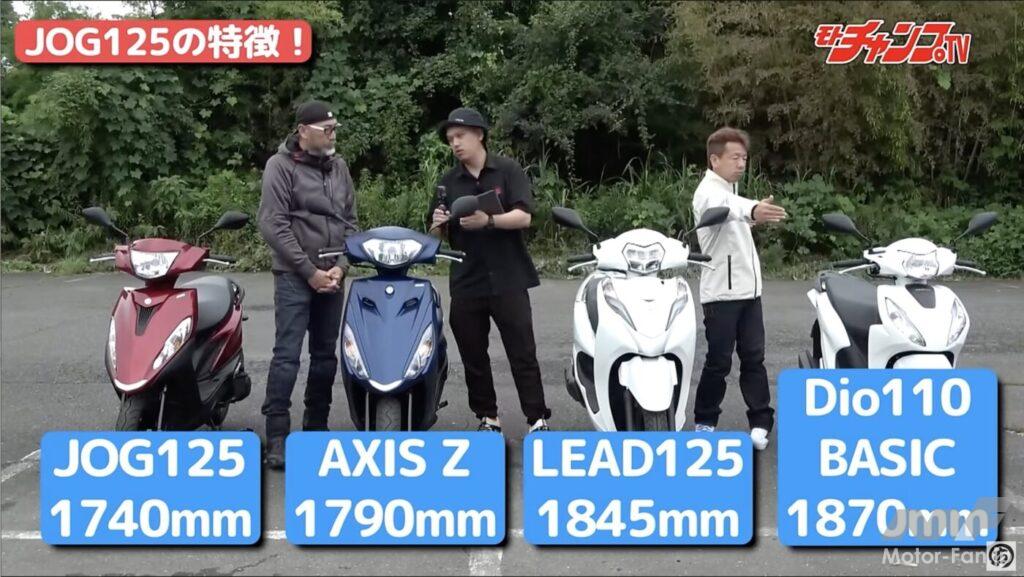
Comparing the overall length of each vehicle, the Jog 125 is the most compact.
The four bikes featured here are ideal for commuting to work or school, with the Dio 110 Basic being the cheapest at 250,800 yen (tax included, same below). Next is the Jog 125 at 267,300 yen. The Axis Z is 283,000 yen, and the Lead 125 is the only one over 300,000 yen at 341,000 yen. The Dio and Jog are head-to-head in terms of price range, but the Jog’s overwhelmingly compact body size with 10-inch wheels front and rear is what makes it so appealing compared to the Dio’s 14-inch wheels. At just 1,740 mm, it is the shortest of the four.
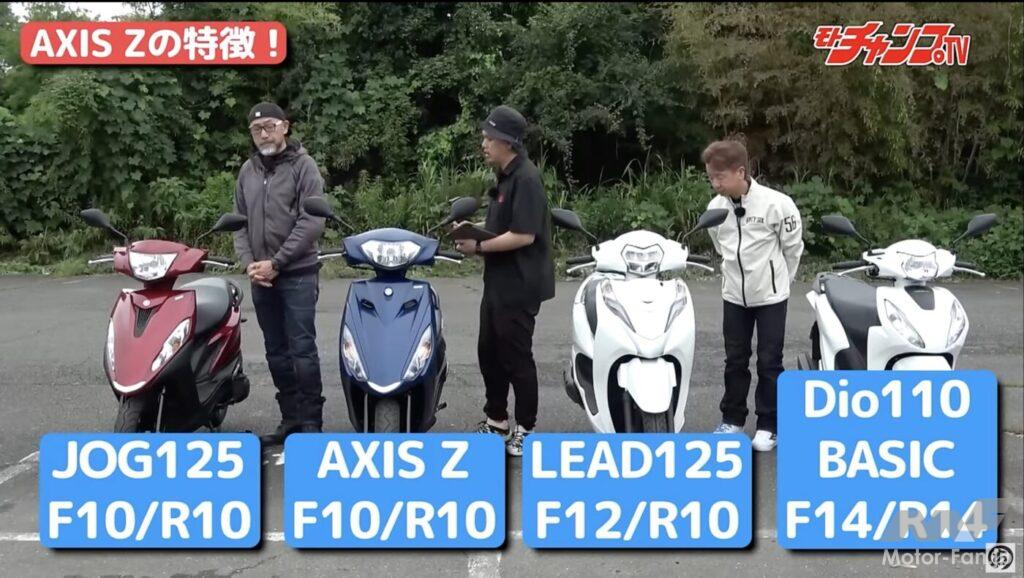
Comparing the wheel sizes of each vehicle, the two Yamaha models have 10-inch wheels both front and rear.
Looking at tire size alone, the two Yamaha models use the old-fashioned 10-inch wheels front and rear. In contrast, Honda’s Lead uses different diameter sizes of 12 inches in the front and 10 inches in the rear, while the Dio has 14-inch wheels front and rear. So, the question arises as to weight. In order of lightest, the Jog weighs 95kg, the Dio 96kg, the Axis Z 100kg, and the Lead 116kg. Since these are commuter and school models whose appeal is their ease of use, a light weight is best. In that sense, the Jog and Dio are both highly rated for being under 100kg.
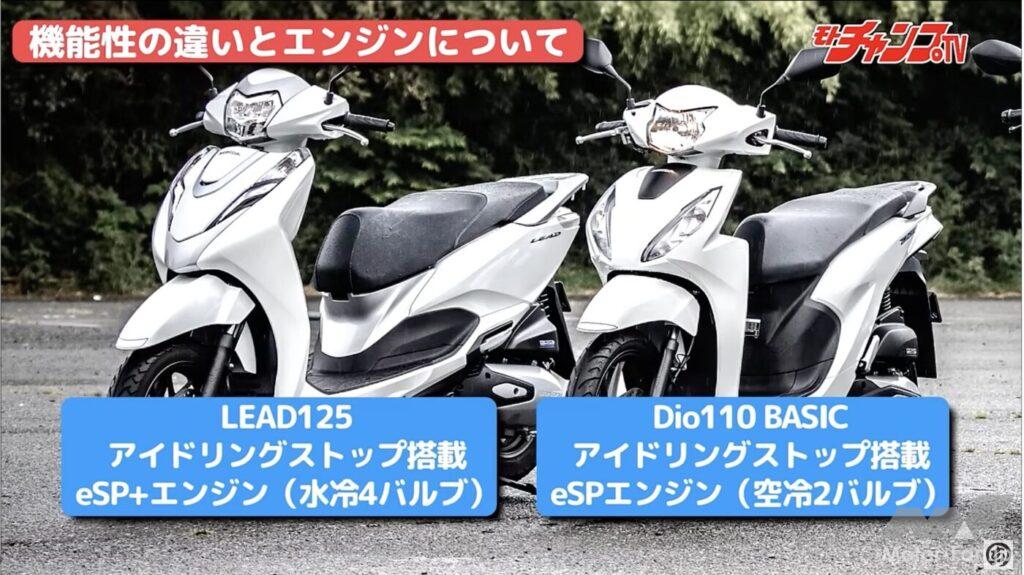
Although the two Honda vehicles differ in whether they are water-cooled or air-cooled, they are both equipped with idle stop systems.
When it comes to engines, the two Honda vehicles are completely different. The cheaper Dio has an air-cooled, two-valve, single-cylinder engine and the smallest displacement. Thanks to its idle stop system, its fuel economy is 55.6km/L in WMTC mode (same below). At the other end of the spectrum, the Read has a water-cooled, four-valve, single-cylinder engine that produces 11ps, the most powerful of the four. Even so, it achieves a fuel economy of 49.2km/L.
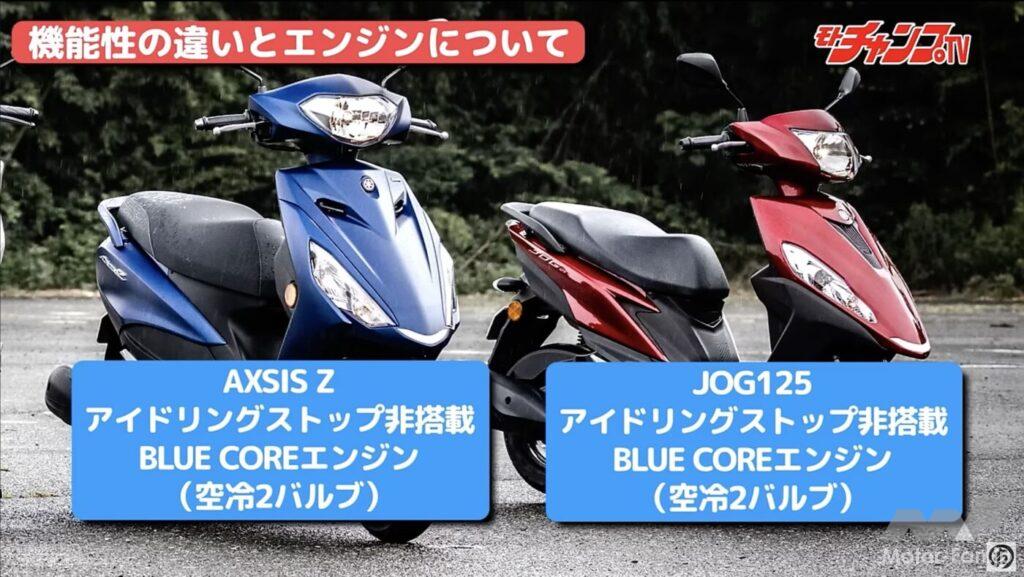
The two Yamaha vehicles share the same base, so they both have the BLUE CORE engine, which does not have an idle stop function.
On the other hand, Yamaha’s Jog and Axis Z are both equipped with the same engine. It’s an air-cooled, two-valve, single-cylinder engine with the same specs of maximum output of 8.3ps. The Jog is the most compact bike, but its fuel economy is the same as the Axis Z at 51.9km/L. That said, all four bikes get close to 50km per liter, and this varies depending on riding style, so it’s not an exaggeration to say that it’s an error.

Only the cheaper Dio110 Basic has the fuel filler cap under the seat.
So what about practicality? All models run on unleaded regular gasoline, with a tank capacity of 4.9L for the Dio, 4.0L for the Jog, 5.5L for the Axis Z, and 6L for the Lead. The Jog has the smallest fuel tank, so you’ll likely need to fill up more often. The problem, however, is the fuel filler cap. The other three models have the cap located inside the front cowl, but the Dio is the only one that’s located under the seat. This means you have to raise and lower the seat every time you fill up.
Axis Z test drive impressions
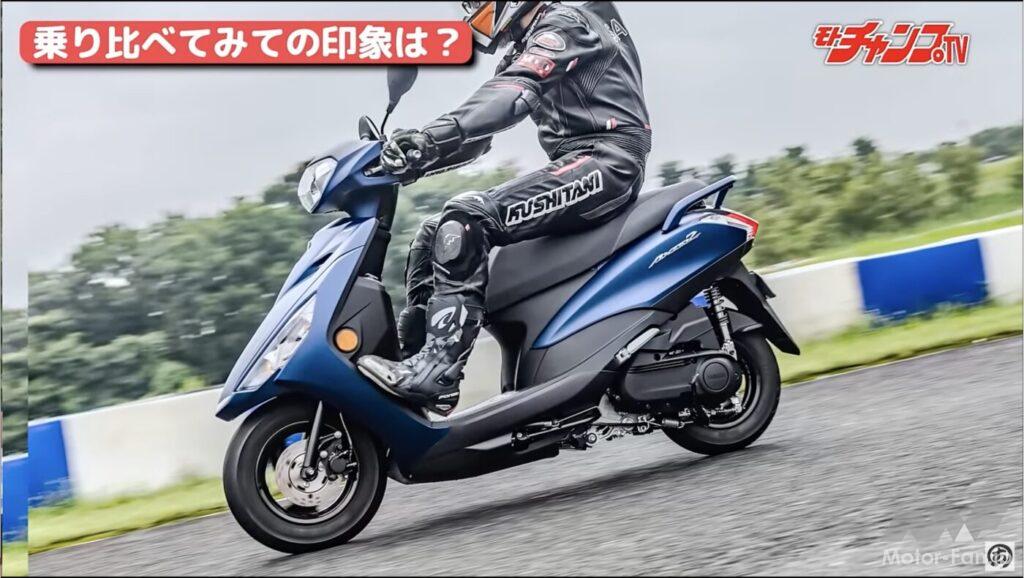
The impression when riding the Axis Z is that it is characterized by the lightness that is typical of 10-inch wheels.
So what were his impressions after a test ride? MC Shimo, who has experience in scooter racing, liked the Axis Z the most. It’s only a few thousand yen more expensive than the Jog, which has the same base, but it uses a disc front brake and has ample space under the seat, making it the most well-balanced vehicle for the price. The quick maneuverability provided by the 10-inch tires is an appealing feature that gives it the feel of a traditional moped. Another feature is the floor shape, which makes it easy to put your feet forward, which should lead to more room to ride.
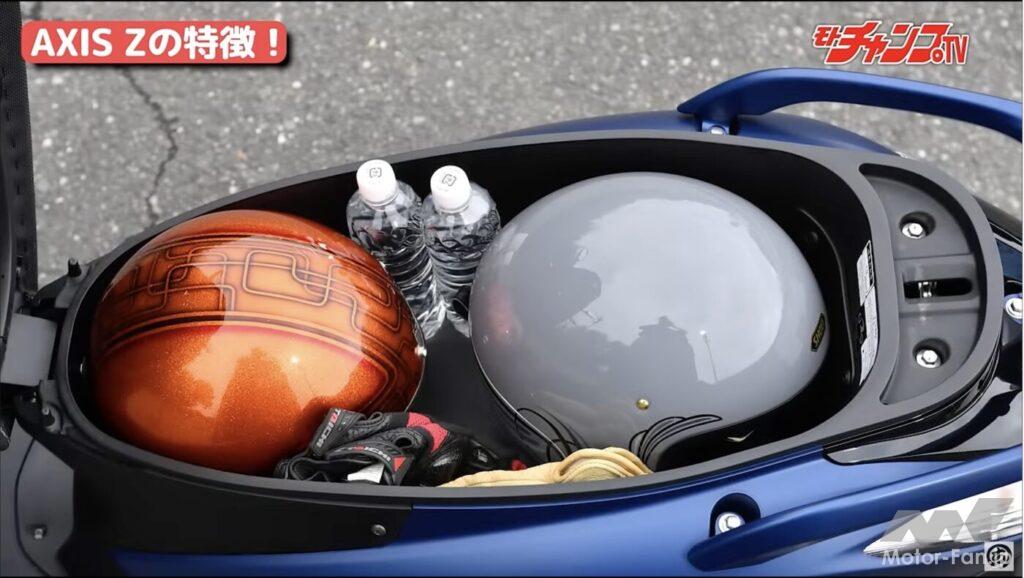
Another feature of the Axis Z is that it has the largest under-seat space of the four cars.
Kenny Sagawa was concerned about the unique characteristics of the 10-inch wheels; for example, if he braked hard using only the front brake, the tires would lock up and he would fall over. While the quick maneuverability was certainly appealing, he said the sharp handling of the small diameter wheels didn’t suit him. However, he was attracted to the fact that out of the four vehicles, the space under the seat was the largest, and while none of the four vehicles could fit a full-face helmet, the Axis Z was the only one that could fit two jet helmets. This was a major advantage.
Jog 125 test ride impressions
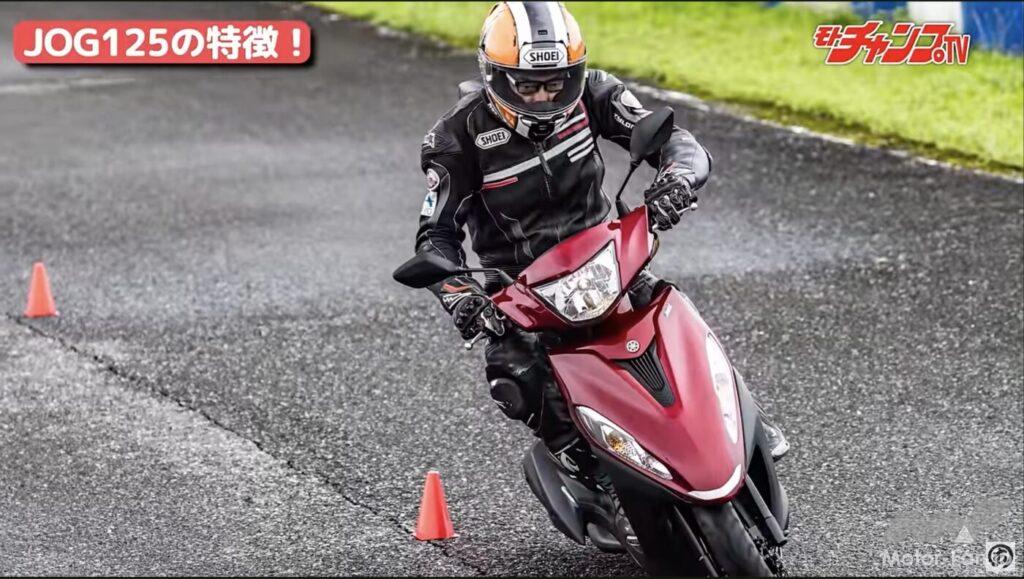
The Jog 125 is attractive for its compact body and easy to reach the ground.
Next, what about the Jog? Its compact size is an appealing feature, but even the petite MC Shimo said it was just right for him, and that larger riders might find it cramped. While it is certainly compact, his opinion was that a 50cc scooter would be fine. While the Jog certainly has excellent turning ability in pylon slaloms and the like, the quickness of the 10-inch tires can sometimes lead to the bike swinging back after a turn. Apparently, the fact that this behavior is somewhat contained was one of the reasons he chose the Axis Z.
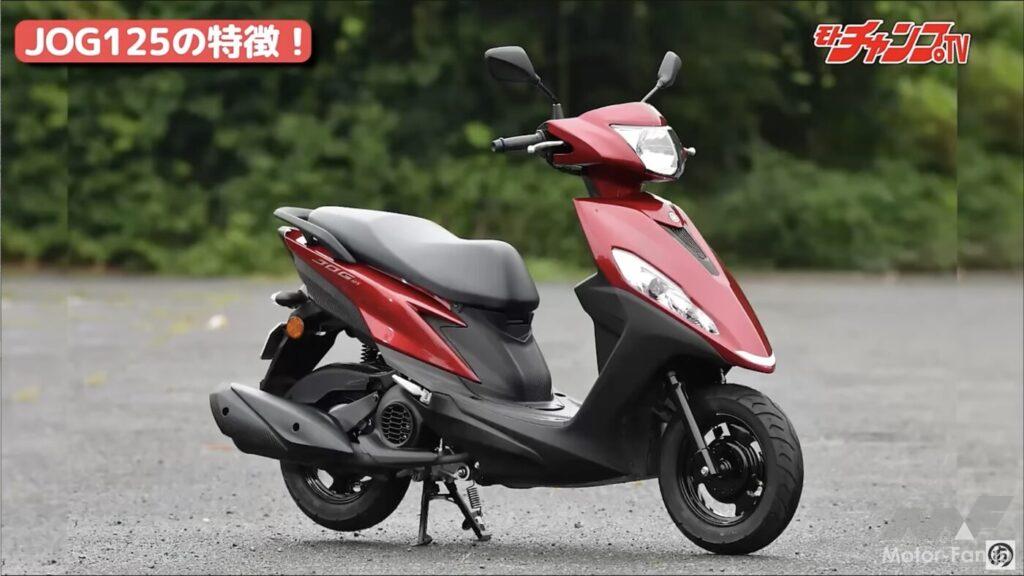
It may not be suitable for larger riders due to its compact size.
For the large Kenny Sagawa, turning the handlebars almost to full lock did indeed cause interference with his knees. It’s a perfect match for users who are happy with a 50cc scooter but want a little more displacement. MC Simo also pointed out that the centrifugal clutch disengages too early when the throttle is released, not just for the Jog but also for the Axis Z, which uses the same engine. While not a major issue, if the clutch disengages while cornering, the lack of traction can lead to loss of balance.
Test ride impressions of the Lead 125
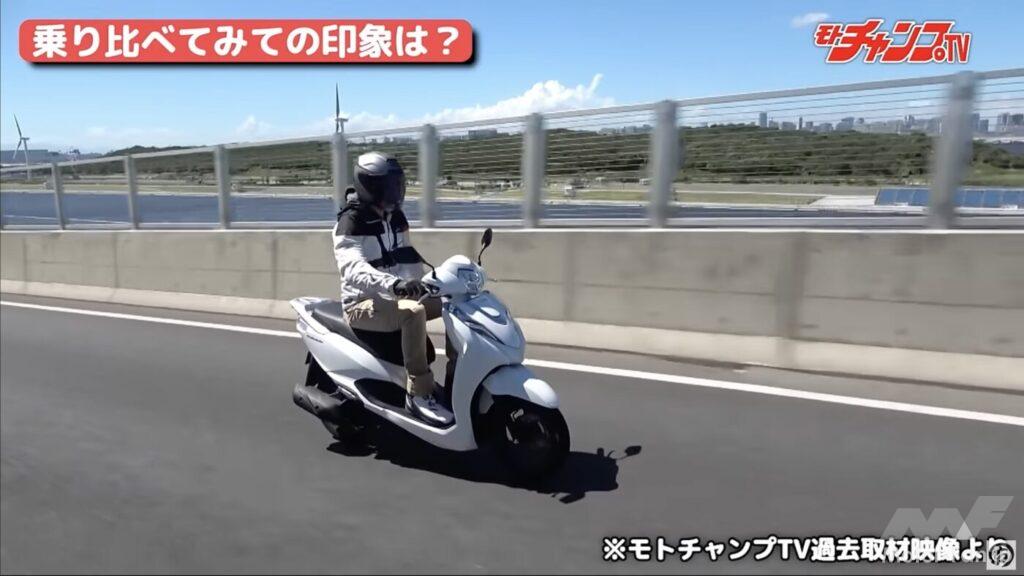
The most expensive model, the Lead 125, also has a luxurious feel when riding.
Reed agreed that the bike has a premium feel in terms of riding, position, and equipment. The power of the water-cooled engine is an overwhelming advantage, and everyone unanimously described it as powerful. MC Simo said it’s fun to feel the engine’s power even when accelerating again from a partial-throttle cruising position. The 10-inch rear tire also makes it easy to turn, allowing you to take advantage of its power when exiting corners. Kenny Sagawa agreed, saying that the bike is very stable when turning, allowing you to take the line you want. It also has excellent stability when braking, so you can ride it with confidence. However, as MC Simo said, it’s understandable that some people are hesitant to buy one, considering the price of nearly 350,000 yen.
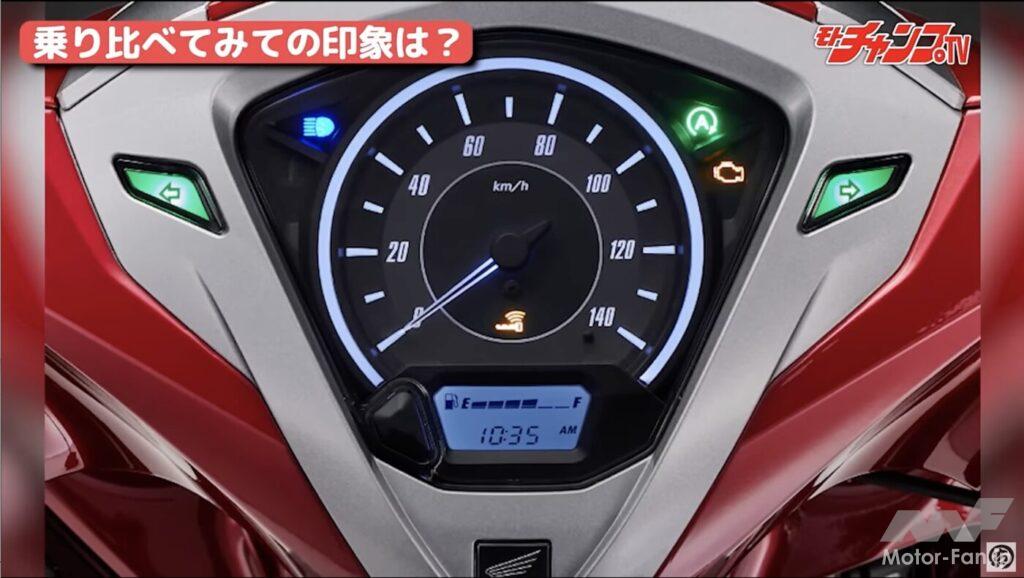
It’s the only one equipped with a watch, making it convenient for commuting to work or school.
Editor-in-Chief Chabo’s favorite was actually the Lead. It’s true that the Lead is around 100,000 yen more expensive than the Dio or Jog, but he said, “If I’m going to buy a new car, I want to try a little harder.” Chabo is also quite large, so the Lead’s size would be just right for him. Furthermore, the Lead is the only one of the four cars featured in this article that is equipped with a watch. Chabo’s opinion that a watch is essential for commuting to work or school is convincing.
Test drive impressions of the Dio 110 Basic
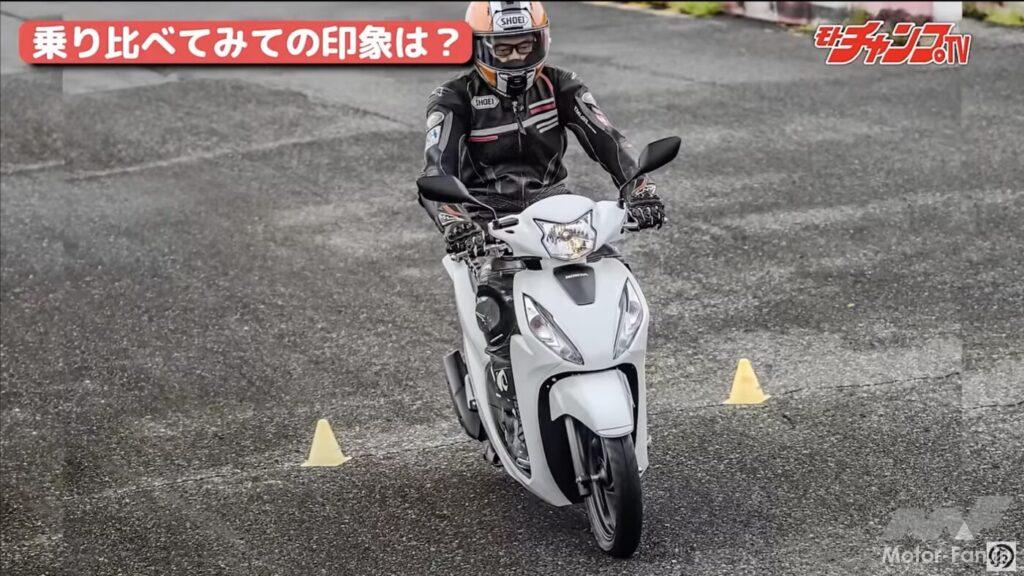
There are few notable features, but overall it is highly practical.
So what about the cheapest model, the Dio? After test riding in all sorts of scenarios, Kenny Sagawa actually chose the Dio as the best model. Although it doesn’t have outstanding performance, he cited the high stability provided by the 14-inch tires, the handling stability that anyone can feel at ease in, and the perfectly positioned handlebars that allow for a relaxed riding position as reasons for its high score. Both MC Shimo and Chabo acknowledged the ease of riding and the good riding position, but their impression was that it was “average.”
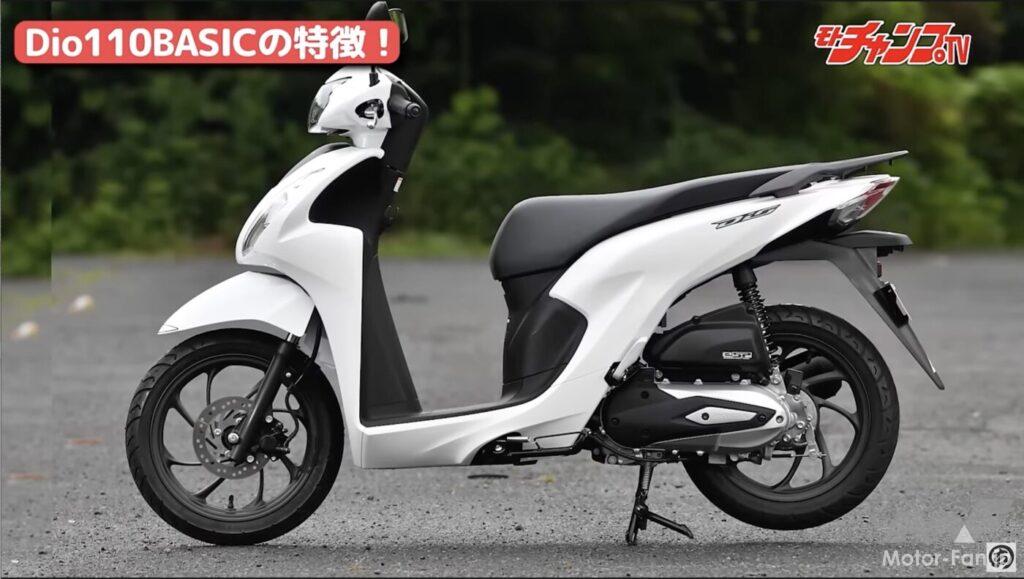
The 14-inch front and rear wheels make the body extremely stable.
According to MC Simo, the “lack of power” is a disappointing point about the Dio. Even with the throttle wide open, there is nothing remarkable about the acceleration it provides. This is actually a good point about it as a model for commuting to work or school that can be ridden normally, but those with experience in scooter racing will likely find it lacking. However, even when doing pylon slaloms, there are no protruding surfaces, so it gives the impression of being completely neutral. Also, as can be seen clearly from the side, the two Honda models have a flat carrier and the back of the seat. In terms of loading capacity, they are likely to have an advantage over the two Yamaha models.