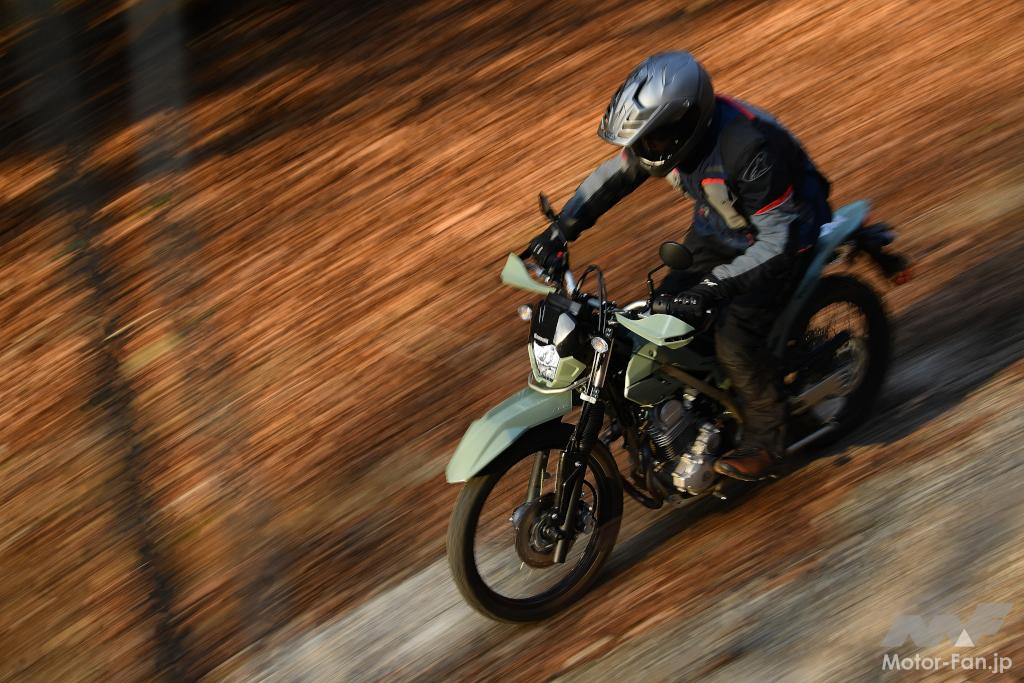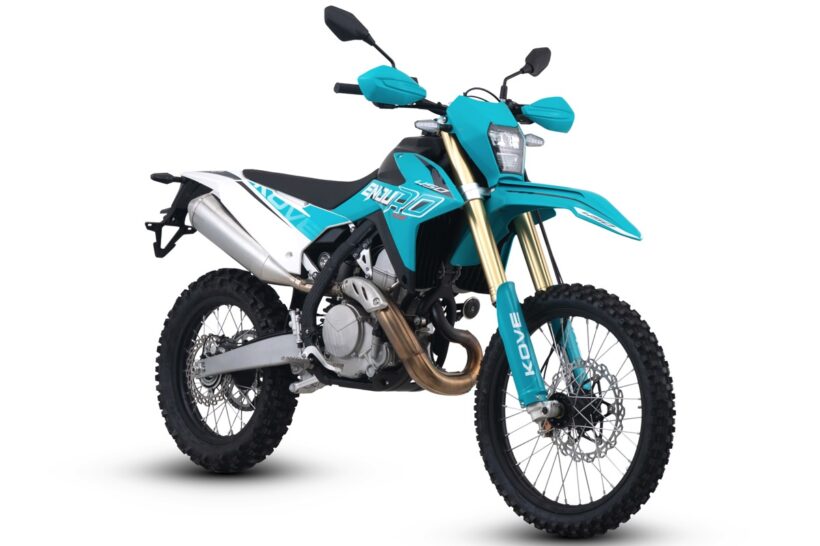


Kawasaki KLX230 Sherpa…638,000 yen
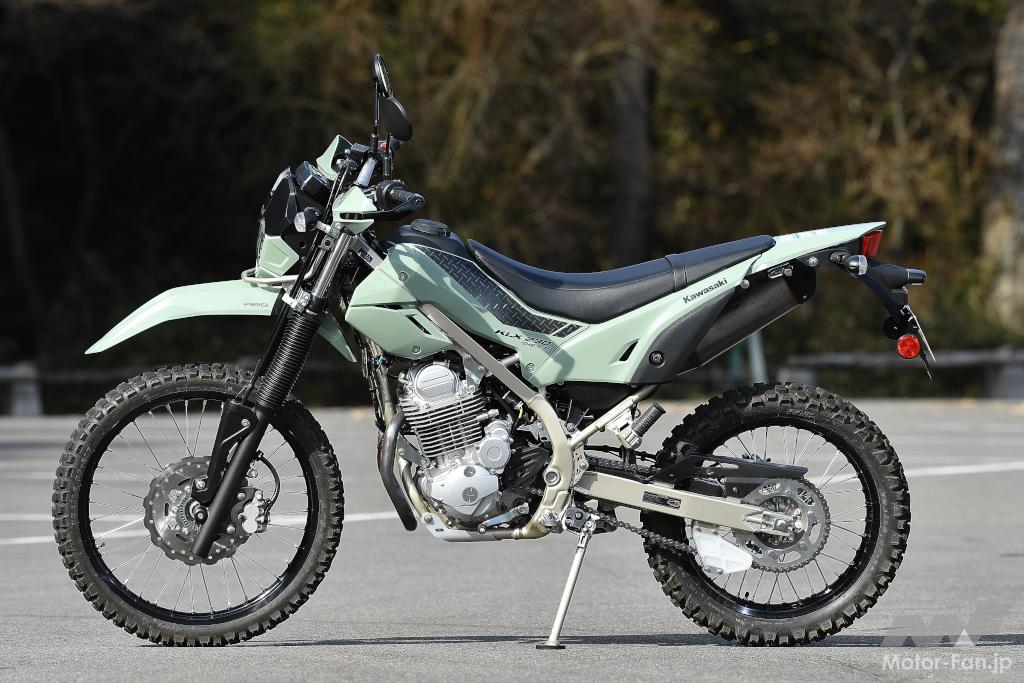
Although the seat rails have been redesigned, the perimeter-type semi-double cradle frame follows the structure of the previous KLX230. The Sherpa’s body colors, which are based on earth tones, are medium smoky green, whitish beige, and medium cloudy gray.
Performance unique to global models
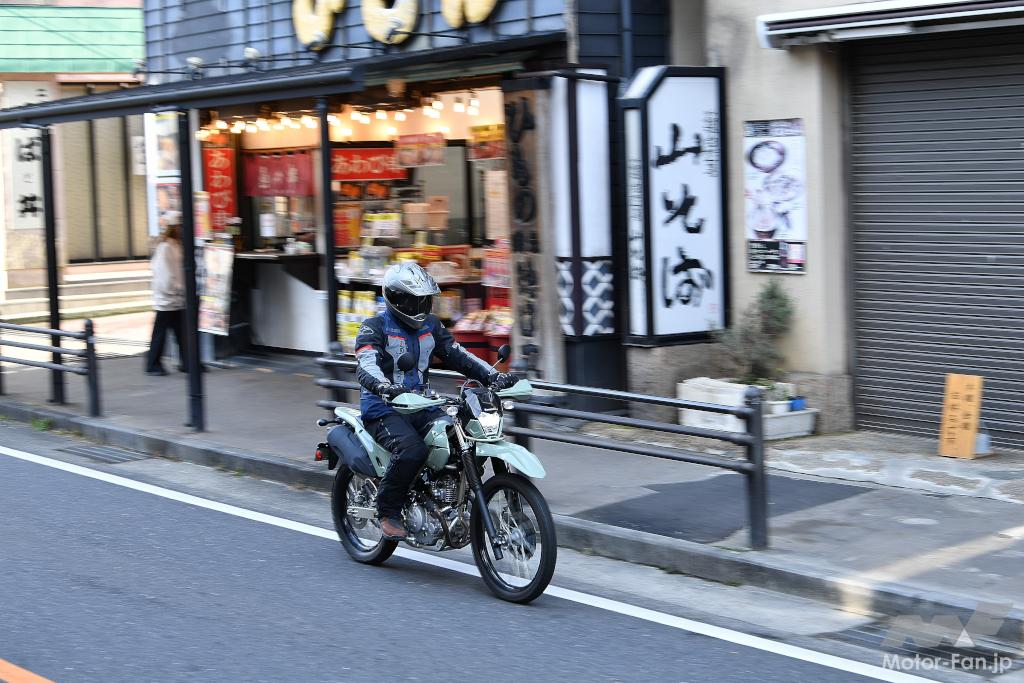
Although the total distance traveled wasn’t that great, during this test ride I went on (1) a touring trip that also included photography, (2) a touring trip mainly on forest roads with my friend E, who is a Serow 250 enthusiast, and (3) a solo touring trip on paved roads only, with (1) and (2) leaving early in the morning and returning home after sunset. What I really felt during these three long rides was the outstanding comfort and maneuverability, which makes me want to say that it’s because they didn’t take the easy way out and lower the vehicle height and seat height for the Japanese market.
That’s because existing light two-wheeled trail bikes often have seats that slope down at the front to make them easier to reach the ground (this is also true of the former popular models, the Honda SL230 and Yamaha Serow, introduced in the first article), or they often have a strange feeling of discomfort with front and rear suspension that has a shortened stroke (although I haven’t experienced this myself, it seems that the 2022-2023 KLX230S had this feeling).However, the KLX230 Sherpa has no noticeable issues with its riding position or body behavior, so you can fully enjoy sporty riding and long-distance riding.
Impressed by the seat and front and rear suspension

To get specific, first of all, the seat, which is a key part related to riding position, actually had a flat seating surface on the previous KLX230 as well, and my impression of it was not bad at all, but the Sherpa’s seat seems to be slightly wider from side to side (just to be clear, trail bike seats are typically narrow), so your butt is less likely to hurt even on long rides. Of course, this feeling cannot be explained by the seat alone, but also includes the perfectly positioned footpegs and handlebars, but with this bike, there is almost no need to stand on paved roads to relieve sore buttocks, which was a common task while touring with existing trail bikes.
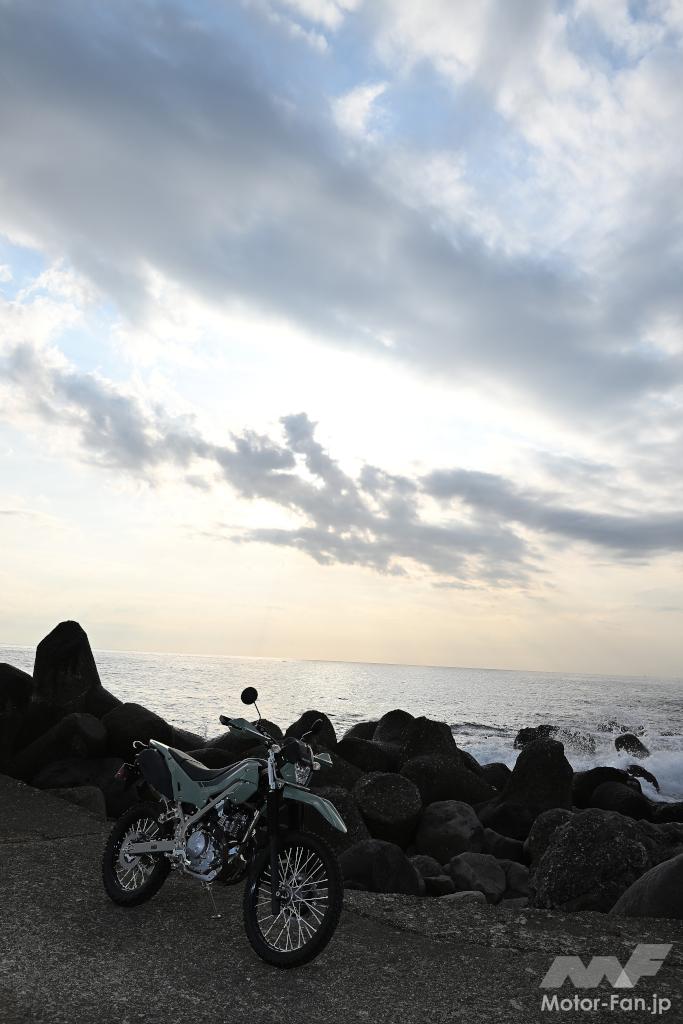
Regarding the vehicle’s behavior, what impressed me was the movement of the front and rear suspension. When off-road bikes come in two specifications with different suspension lengths, it’s not uncommon for the shorter model to be dissatisfied with its ride comfort and pitching, but when using the unadjusted KLX230 as the standard, the Sherpa’s suspension movement was natural and smooth, and I didn’t notice any of the negative aspects that are often associated with lowered models.
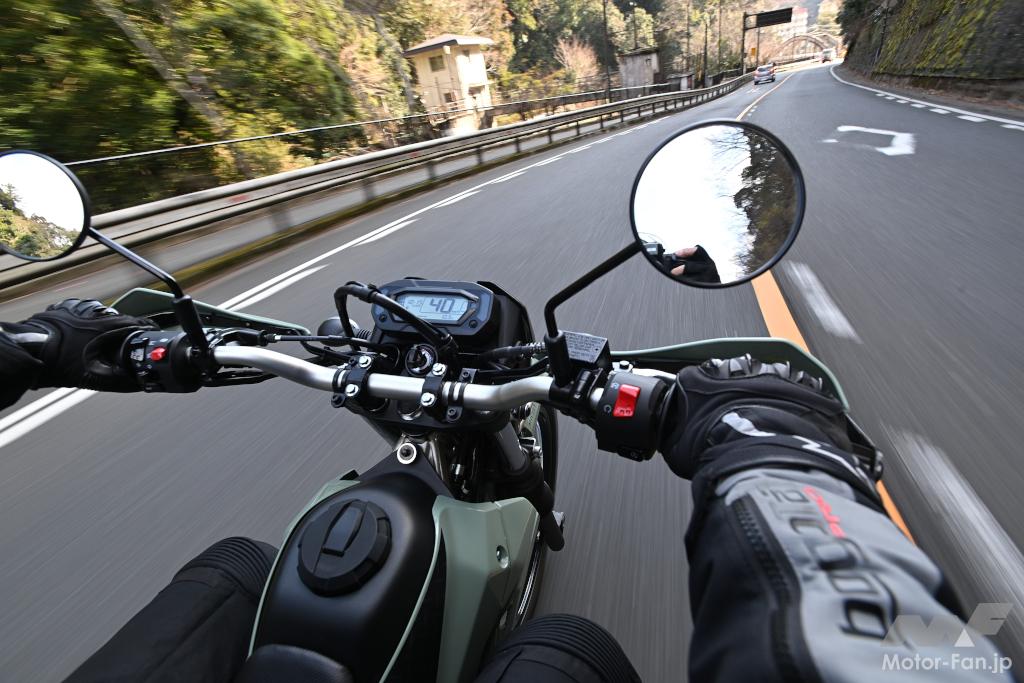
That said, if I were to try the KLX230 without the annotations, I might have a better impression. However, I feel that this series was not developed in the order of completing the main long-legged model first and then creating a short-legged model, but rather that the KLX230/S/Sherpa (and maybe the SM as well) were developed simultaneously.
The engine’s range was wider than expected
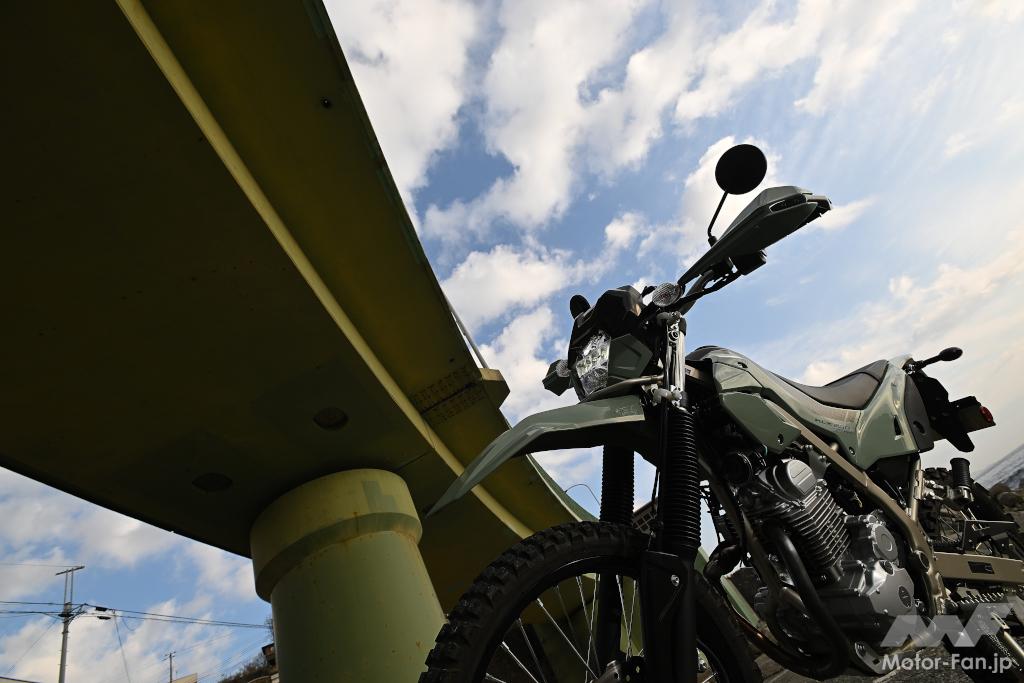
I’ve talked a lot about the chassis, but I was also very impressed with the power unit during this test drive. The KLX230 series is said to be high-rev-oriented, perhaps because the W230/Meguro S1, a car equipped with a similar engine developed around the same time, was designed with an emphasis on low-revving performance. Indeed, when I rode the Sherpa, I noticed that the power output from the mid-rev range was sharper and more powerful than the W230/Meguro S1.

On the other hand, the Sherpa’s engine showed plenty of tenacity and flavor at low rpm. Even without paying special attention to clutch work, the engine never stalled even when riding at walking speed, and cruising while listening to the pleasant takatakatakat of the exhaust was quite pleasant. In any case, it was a pleasant surprise for me that the OHC 2-valve 232cc air-cooled single-cylinder engine could achieve such a wide range of performance.
Qualities similar to those of the Serow and SL230

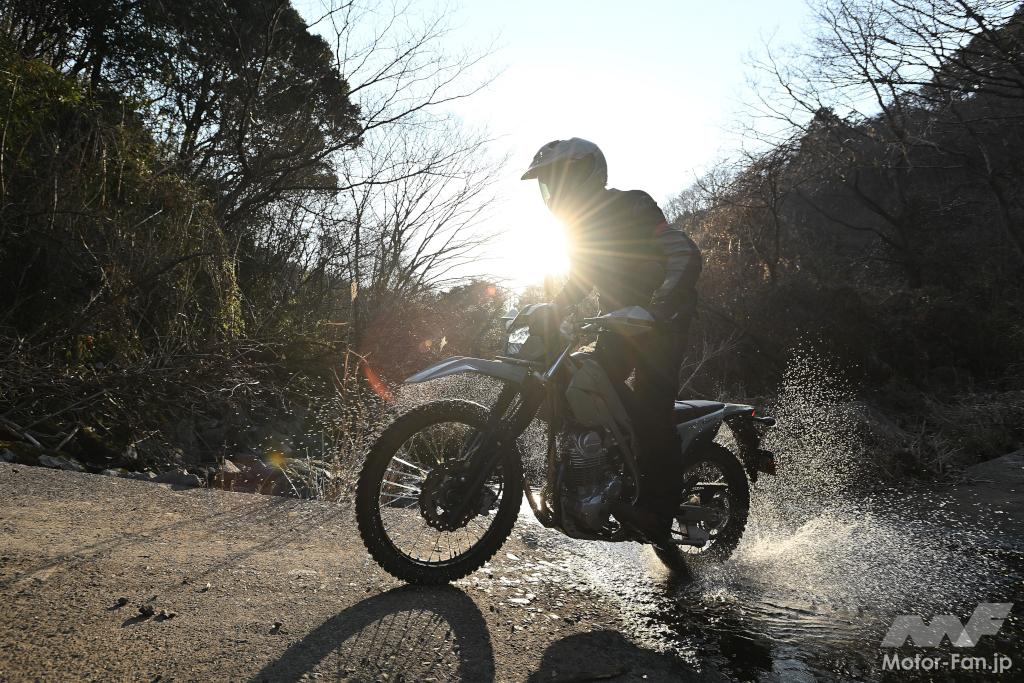
During this test ride, I went on a forest road tour with my friend E, who is a Serow 250 enthusiast. I was able to try it out along the way to check it out.
Next up is unpaved roads, and I’ll state in advance that of the light two-wheeled trail bikes I’ve experienced in the past, the top three that I found most enjoyable for forest road touring are 1st: Yamaha Serow 225, 2nd: Serow 250, and 3rd: Honda SL230. I admit that this is a biased lineup, but as someone whose off-road skills are always at a beginner to intermediate level, lightness, compactness, and friendliness are more important to me than absolute speed, agile response, or shock absorption capabilities.
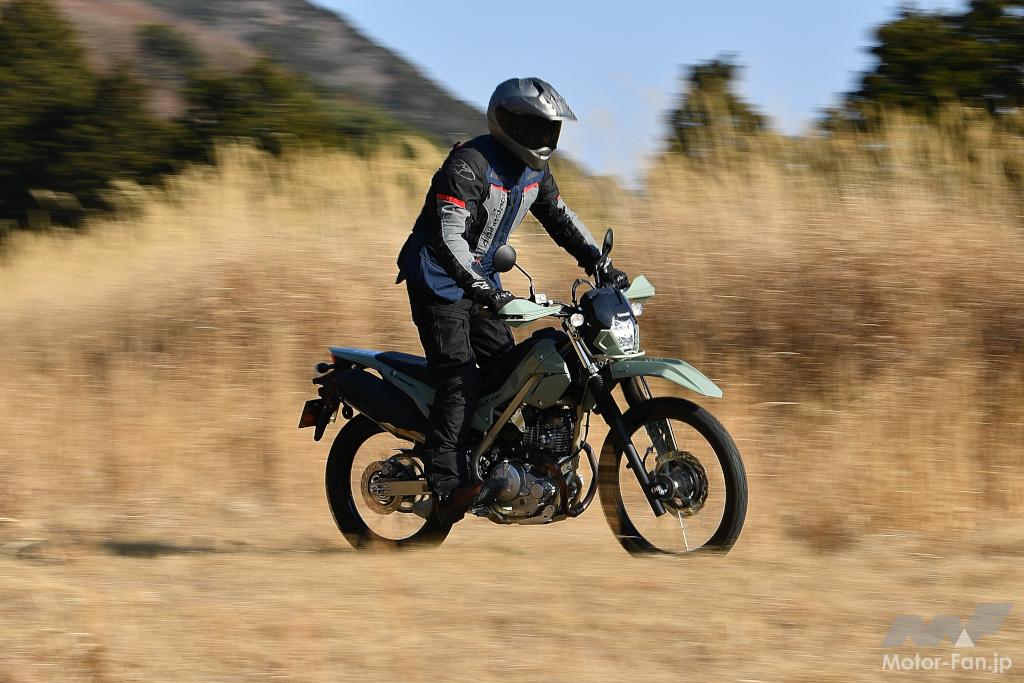
For someone like me, the KLX230 Sherpa had ideal qualities. After all, it had a similar feel to the Serow or SL230, allowing me to enjoy a leisurely ride while taking in the scenery and navigating tough conditions that would be difficult to traverse without two wheels and two feet. And yet, the body of this bike feels more solid than the Serow or SL230, and the afterglow of going over a gap settles down quickly, making me want to open the throttle wide when the moment demands. In other words, it also has qualities reminiscent of the KX motocrosser, and for me, the flavor was just right.
The appeal of rivals
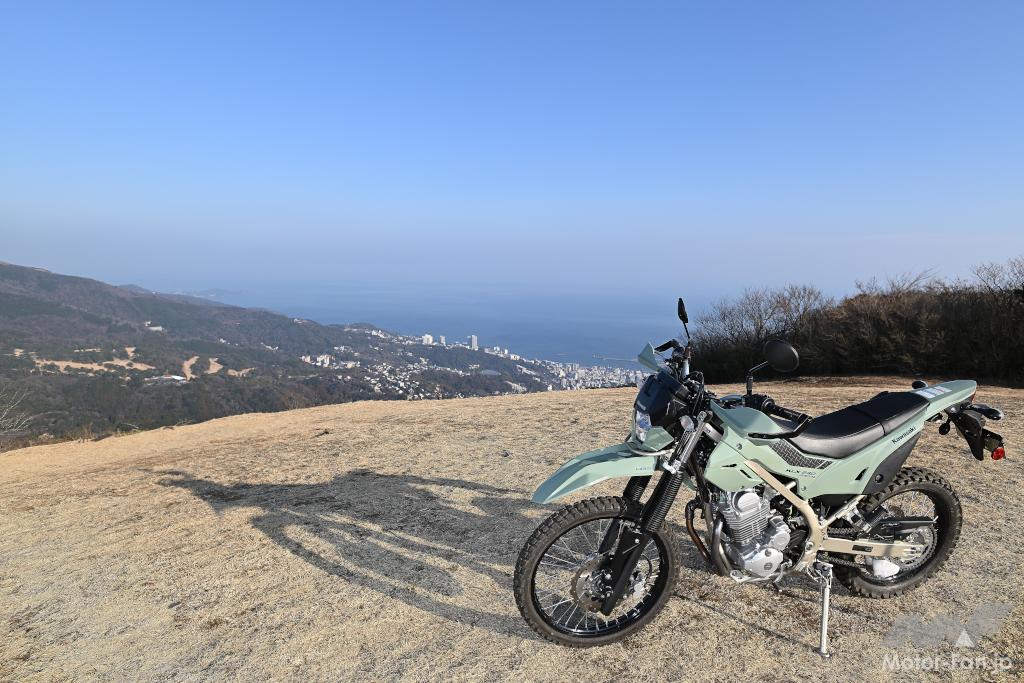
Well, this 1000km test ride ended with rave reviews, but that’s just my personal opinion. When you consider rival models on the market today, the KLX230 Sherpa isn’t superior in every aspect. For example, the Suzuki V-Strom 250SX is overwhelmingly superior in terms of stability and comfort on the highway, and if you want to seriously tackle forest roads and off-road courses, the Honda CRF250L (S) is probably the best. Also, when it comes to speed on mountain roads, which are known as smooth roads, I feel the CRF250L wins.
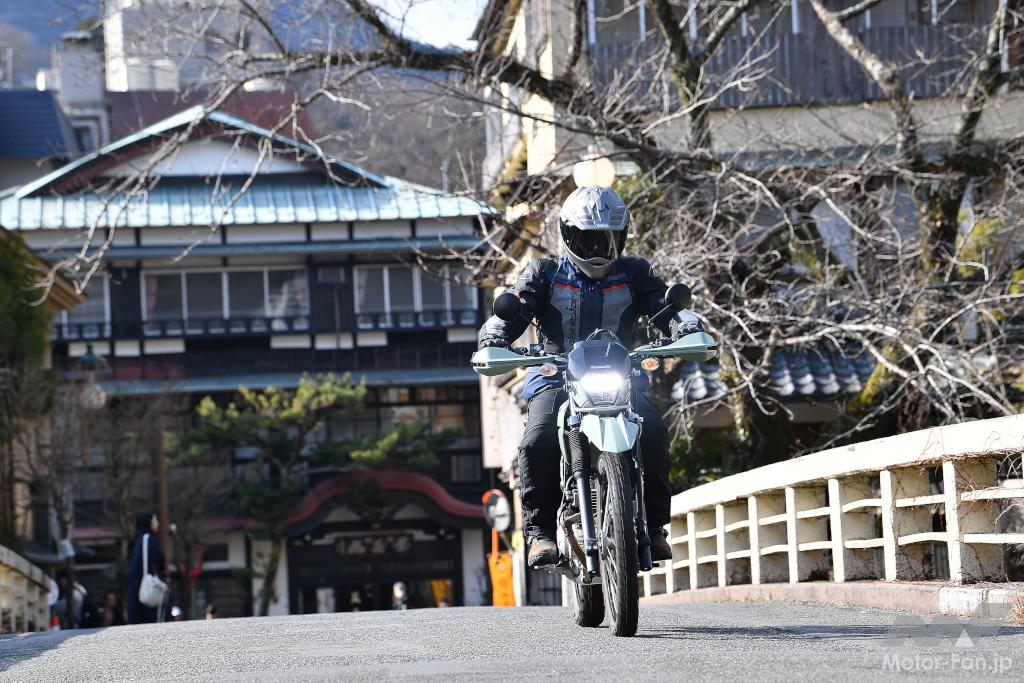
However, as I mentioned at the beginning of this first article, my off-road passion has been rekindled in the past few years, and recently I have been going on regular forest road touring trips, and the bike that I’m most drawn to at the moment is the KLX230 Sherpa. That’s why, when my current forest road touring machine, a 1997 SL230 with about 70,000 km on it and showing signs of wear, reaches the end of its life, I’m thinking of considering purchasing a KLX230 Sherpa.
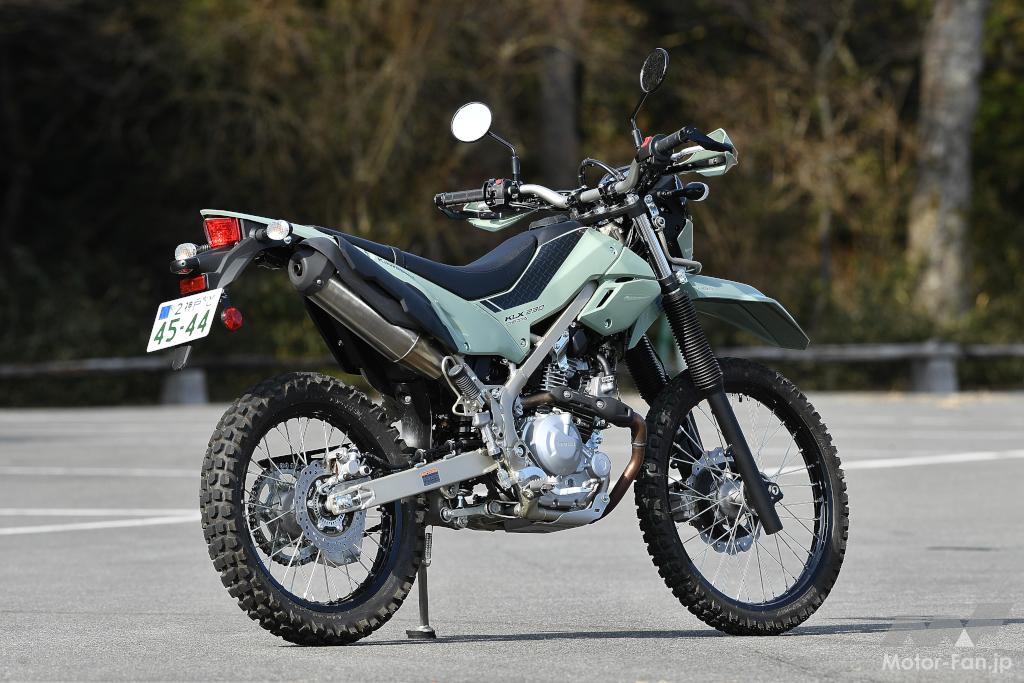
The KLX230 Sherpa offers an outstanding feeling of agility, but on mountain passes and forest roads, I sometimes felt that the front end moved too quickly. This problem can be somewhat improved by reducing the standard front fork extension, which is about 10mm, to zero and adjusting the caster/trail to be more stable. The caster/trail of the KLX230S and Sherpa is 24 degrees/96mm, similar to that of an on-road bike, while the unannotated KLX230 is 25 degrees/101mm. By comparison, the motocrosser KX250 is 27 degrees/118mm.
Main specifications
Model: KLX230 Sherpa
Model: 8BK-LX232A
Length x Width x Height: 2080mm x 920mm x 1150mm
Wheelbase: 1365mm
Ground Clearance: 240mm
Seat Height: 845mm
Caster/Trail: 24.6°/96mm
Engine Type: Air-cooled 4-stroke single cylinder
Valve Type: OHC 2-valve
Total Displacement: 232cc
Bore x Stroke: 67.0mm x 66.0mm
Compression Ratio: 9.4
Maximum Power: 13kW (18ps) / 8000rpm
Maximum Torque: 19N・m (1.9kgf・m) / 6000rpm
Starting Method: Self-starter
Ignition Method: Full Transistor Lubrication Method:
Wet Sump
Fuel Supply Method: Fuel Injection
Transmission Type: Constant Mesh 6-speed
Return Clutch Type: Wet Multi-plate Coil Spring
Gear Ratio
1st: 3.000
2nd: 2.066
3rd gear: 1.555
4th gear: 1.260
5th gear: 1.040
6th gear: 0.851
1st and 2nd reduction ratios: 2.870 and 3.214
Frame type: Semi-double cradle (perimeter)
Front suspension: Telescopic upright type φ37mm
Rear suspension: Bottom link mono shock (New Unitrack)
Front tire size: 2.75-21
Rear tire size: 4.10-18
Front brake: Hydraulic single disc
Rear brake: Hydraulic single disc
Vehicle weight: 134kg
Fuel: Unleaded regular gasoline
Fuel tank capacity: 7.6L
Passenger capacity: 2 people
Fuel consumption rate (MLIT notification value): 45.5km/L (2 people)
Fuel consumption rate (WMTC mode value, class 2-1): 34.7km/L (1 person)