
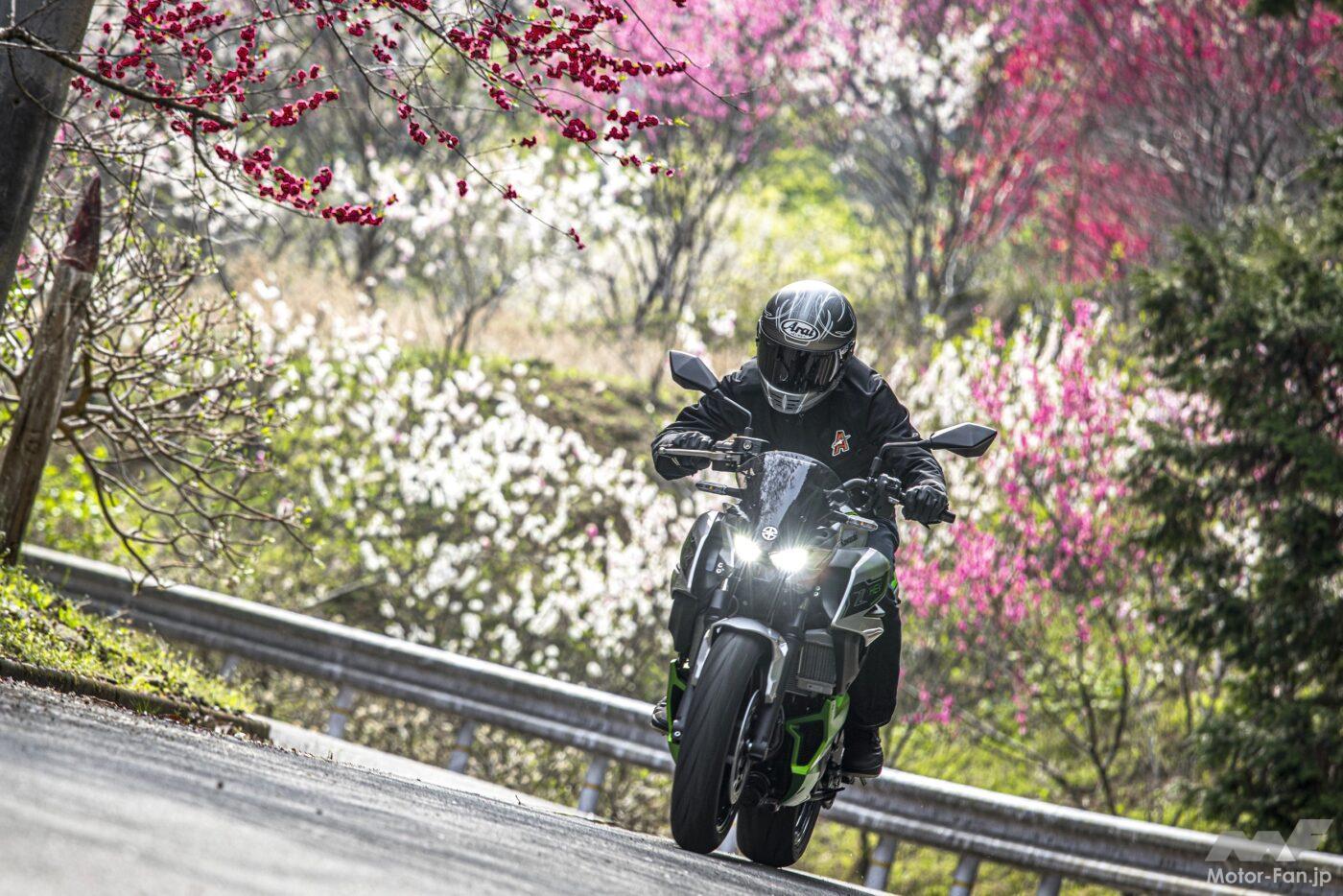

Kawasaki Z7 Hybrid… 1,848,000 yen (released February 15, 2025)
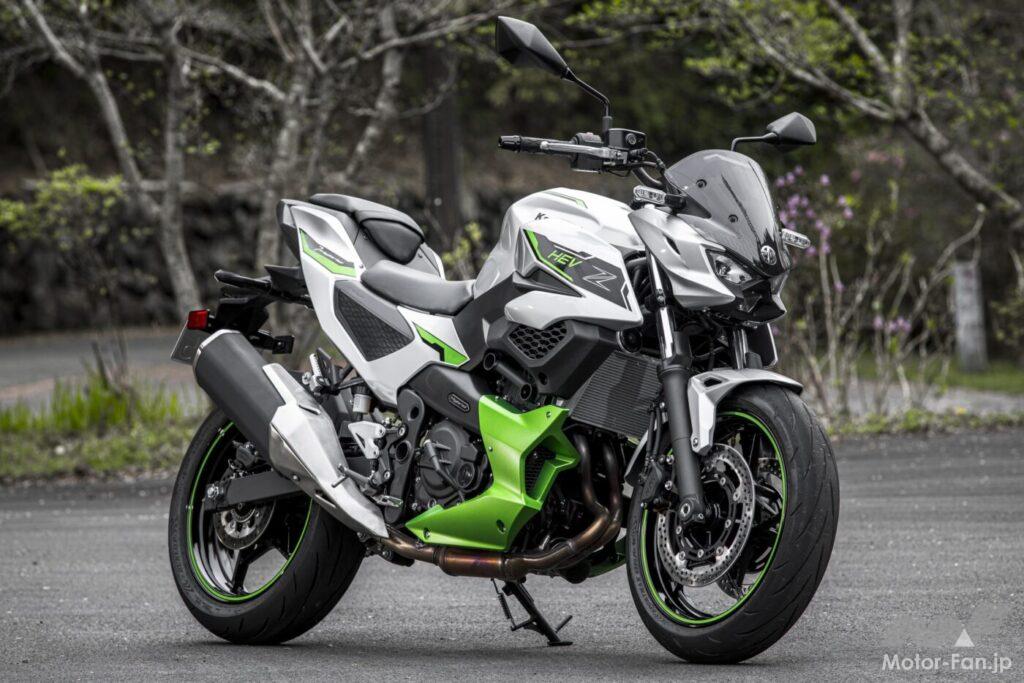
the Ninja 7 Hybrid (see test drive report here ). As part of Kawasaki’s efforts to achieve carbon neutrality, it is equipped with an in-house developed power unit that combines a gasoline engine and an electric motor.

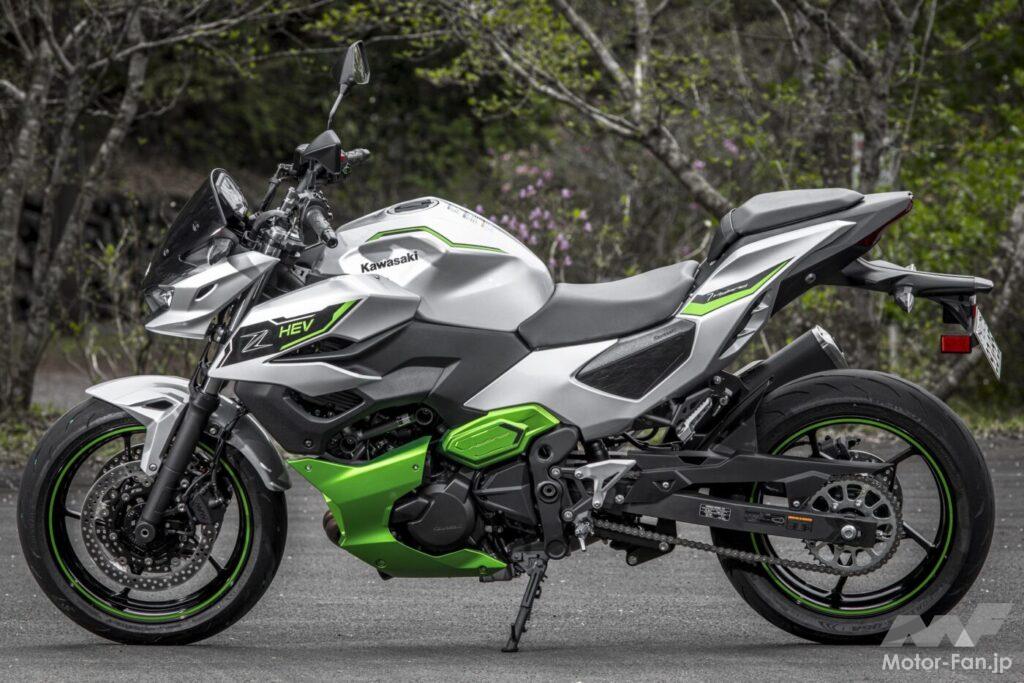
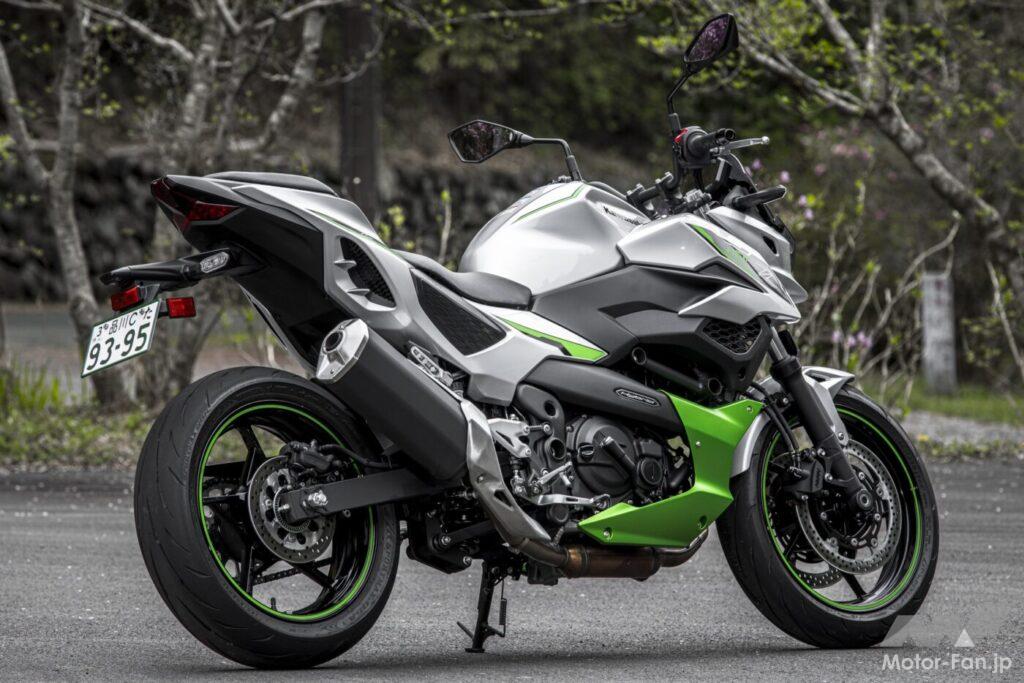

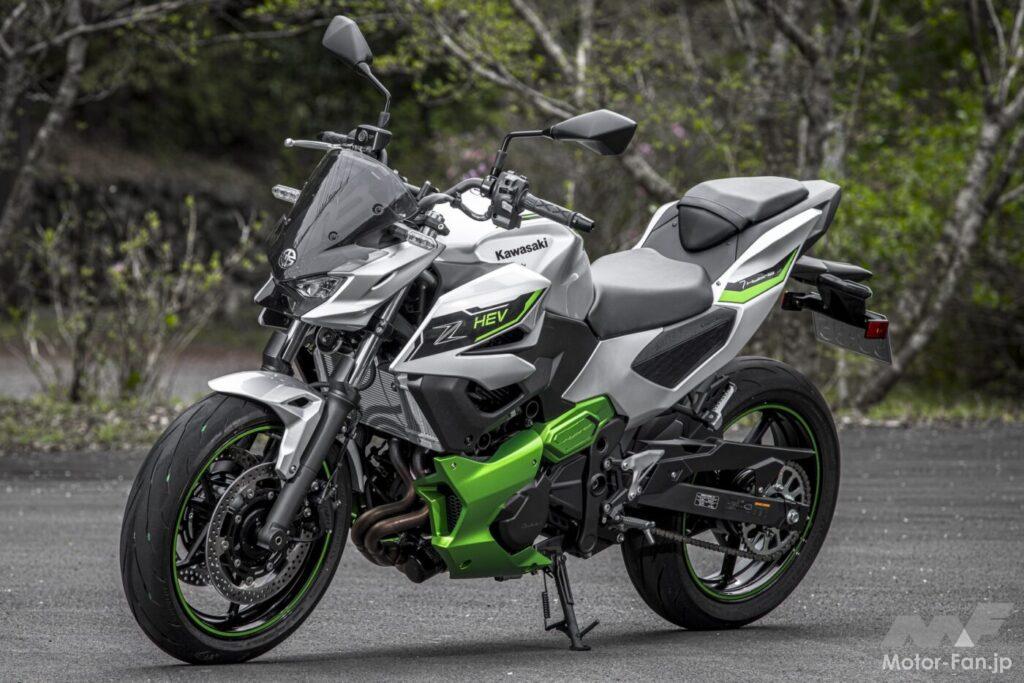
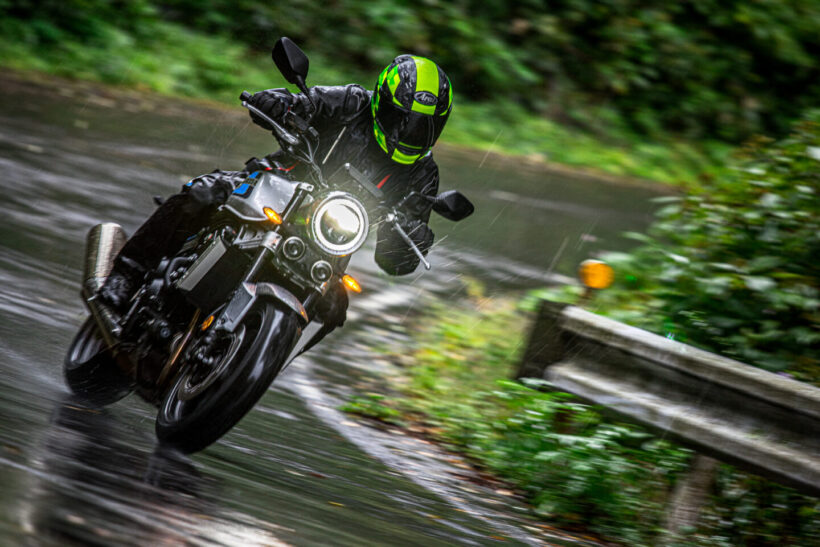
It follows the “Sugomi” design that has become a symbol of the recent Z series. The only body color available is the metallic bright silver x metallic matte lime green shown in the photo. It is a “Kawasaki Care Model” that comes with three years of aftercare, and is priced at 1,848,000 yen, the same as the Ninja 7 Hybrid.

Z7 Hybrid

Eliminator Plaza Edition
The wheelbase is officially 1535mm, 15mm longer than the Eliminator. The vehicle weight is 226kg. The Z650, which has excellent handling, weighs 1410mm and 189kg, so it must have been quite difficult to make the Z7 Hybrid a sports bike.
Easy riding with no clutch lever or shift pedal
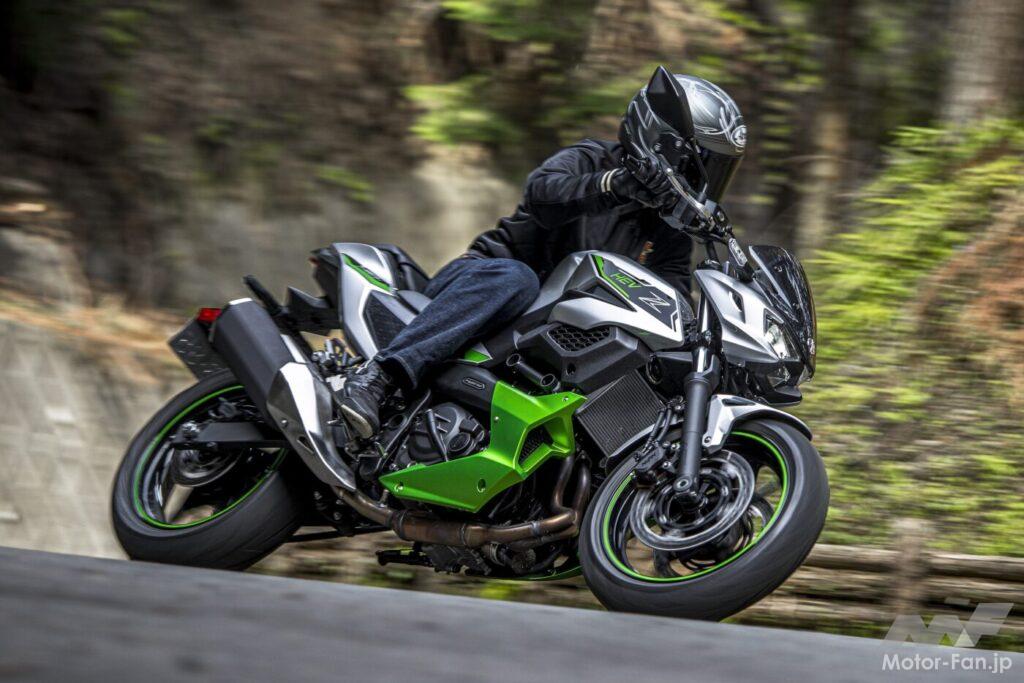
Turn on the main switch. If the gear is engaged at this point, you will hear a faint clicking sound from the engine and it will automatically switch into neutral. Next, press the start button and the engine will start up with a “rumble,” but the reason it doesn’t make the “whirble” sound that is unique to starter motors is probably because it uses an ISG (Integrated Starter Generator) that also functions as a starter. This system has been used in scooters and other commuter bikes for about 15 years, so its introduction to motorcycles can be said to be groundbreaking.
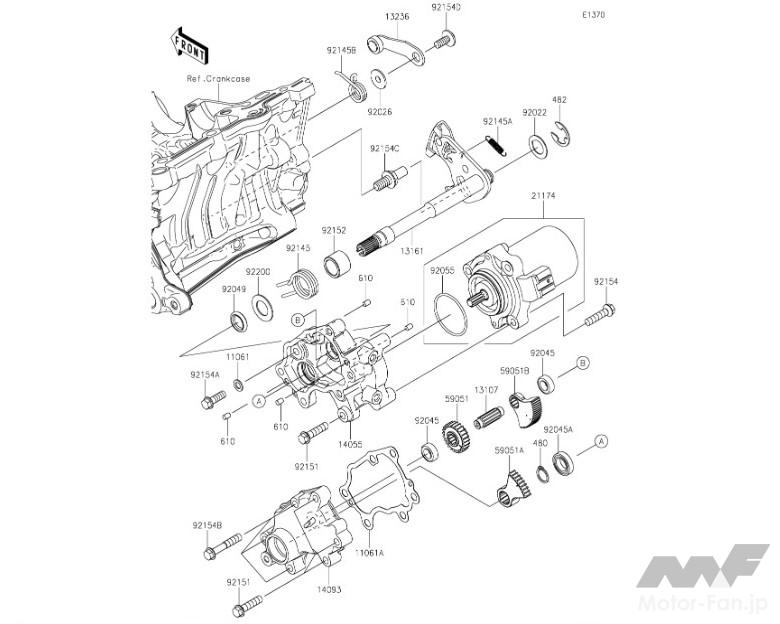
Taken from Kawasaki’s parts catalog. The part circled is the gear change motor.
There are three riding modes: Sport HV, Eco HV, and EV. There are also two shift modes: AT and MT. Sport HV is MT only, Eco HV is available with both AT and MT, and EV is AT only (up to 4-speed).
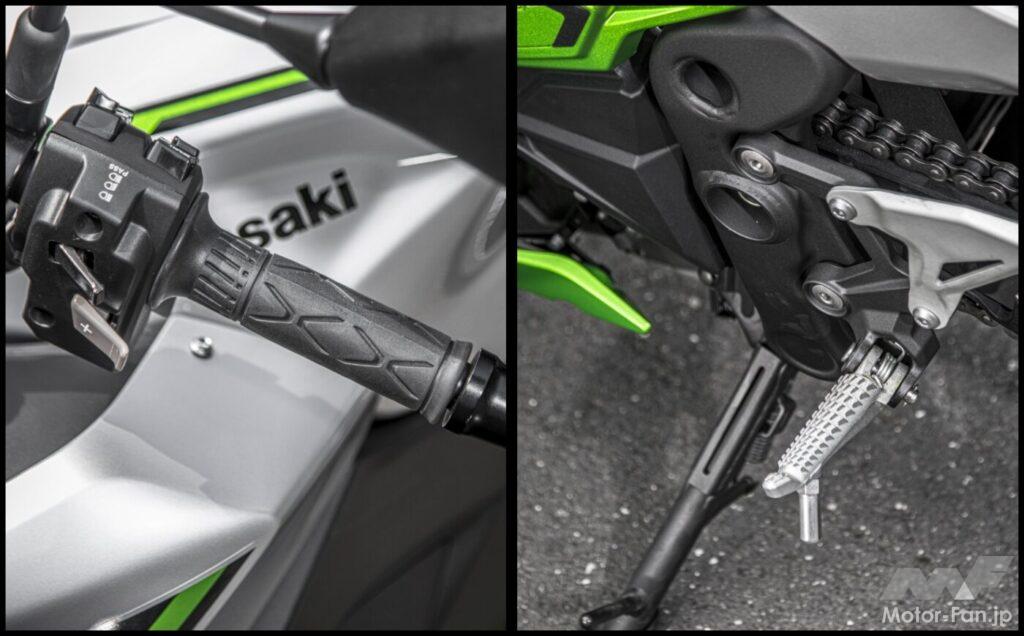
It uses Kawasaki’s unique electronically controlled transmission, so there is no clutch lever or shift pedal.
ADVERTISEMENT
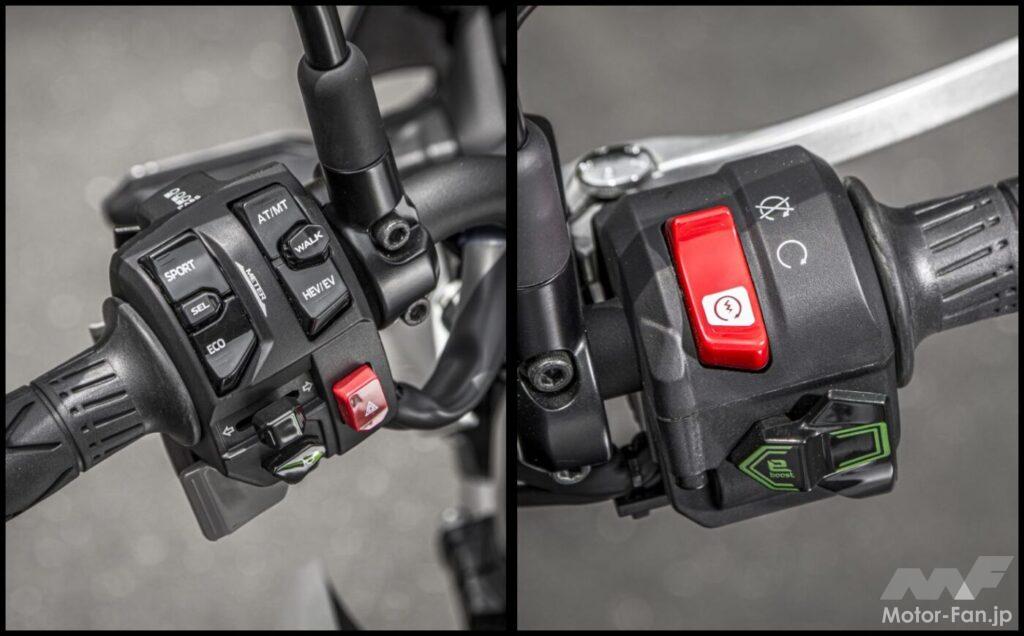
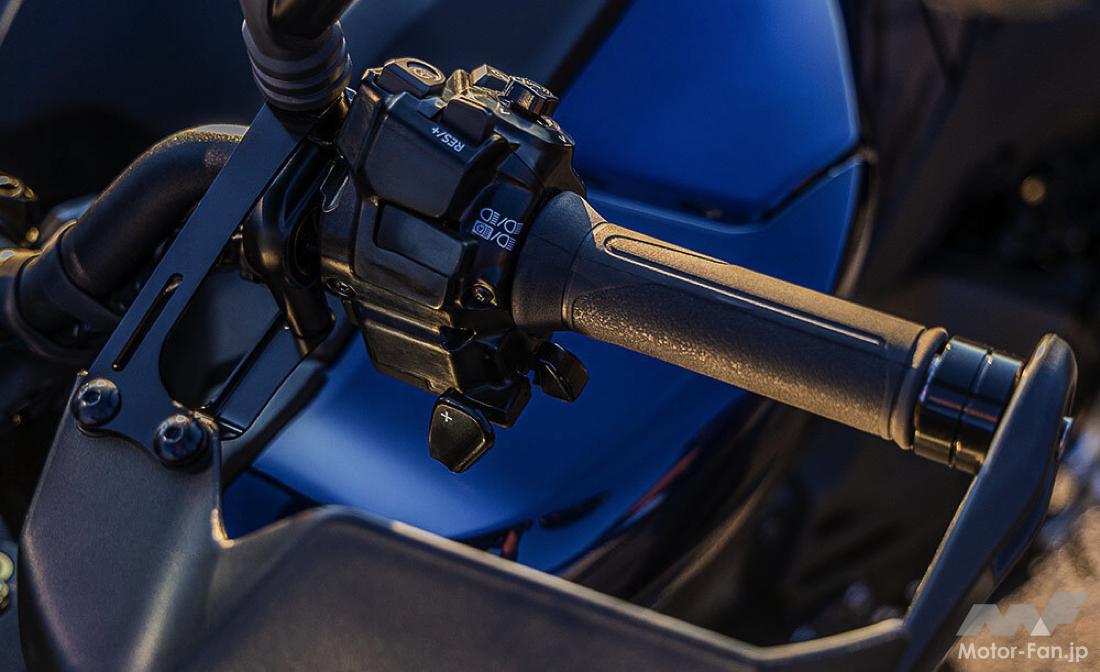
Riding modes and AT/MT mode switching are all concentrated on the left side. It also features ALPF (Automatic Launch Position Finder), which automatically returns to first gear when the vehicle comes to a stop.
I put the side stand up. Then, with my index finger, I pull the shift selector (+) on the left switch box. I hear a click from the engine, and the shift indicator changes from “N” to “1.” Above it, the word “SPORT” appears, indicating that I’m in sports hybrid mode. Now I’m ready to start. I gradually increase the throttle, and at around 2000 rpm, the vehicle starts moving smoothly, and I’m impressed by how smoothly the mechanical clutch engages.
The Sports HV only has manual transmission mode, so if you don’t operate it, the gear will remain in first gear. Pull the shift selector (+) to shift up to second and then third gear. Many cars equipped with quick shifters experience a large shock, especially when shifting from low to second, but the Z7 Hybrid’s shock is extremely small, and it’s so well-made that it’s hard to believe it’s the first electronically controlled transmission. Upshifts are only possible when the throttle is open, and downshifts are only possible when the throttle is closed, so if the gears don’t change as you expect, check the movement of your right hand.
The engine is a 451cc water-cooled parallel twin with a 180-degree phase crank, and the vibrations and exhaust noise transmitted to the body are only slightly louder than those of the Z400. However, the acceleration feeling in sports hybrid mode is close to that of a 600cc class bike, and the difference in power compared to what you might imagine from the vibrations makes you really feel the assistive power of the drive motor. When you release the throttle, the regenerative system kicks in and the deceleration energy is charged into the battery, but the engine braking, or rather the deceleration, is very natural, and the response to the movement of your right hand is generally good.

The drive motor, which generates 9kW (12.2PS), is mounted behind the cylinder and a 48V lithium-ion battery is located under the seat. The system has a maximum output of 69PS and a maximum torque of 60Nm, which is the same spec as the Z650 (68PS, 63Nm).
And what’s more, e-Boost is only available in Sport HV mode. When the vehicle speed is over 10km/h and the throttle is open at 20% or more, pressing the e-Boost button increases the drive motor’s output for about five seconds. The acceleration force when using this is clearly different from that of the engine alone, and can be described as being kicked or rushing forward. The remaining e-Boost is displayed as a bar graph, and once used, it takes a while to recover. Currently, it takes skill to press the e-Boost button with the throttle open at more than 20%, so it’s difficult to use it every time you exit a corner on a mountain road. However, it’s a very unique gimmick that shows off the performance of a strong hybrid, and you can feel Kawasaki’s playfulness.
Eco Hybrid mode is often used for everyday travel, especially in urban areas. Only in this mode can you choose between automatic and manual transmissions, with the former being quite clever for driving on public roads. When stopped at a red light, the engine automatically stops idling, instantly bringing silence to the area around the bike. When the light turns green and the throttle is opened, the bike first takes off with a roar, powered only by the drive motor. Once the speed exceeds 20km/h, the engine automatically starts up with a roar. It then shifts up sequentially, reaching third gear at 30km/h and fourth at 40km/h. When throttle opening below 25% is sufficient, the automatic transmission shifts extremely smoothly, and downshifts are also performed appropriately as speed decreases. However, when frequently using throttle opening above 50% for vigorous driving, the hydraulic clutch disengages for a long time, causing a shock that pitches the bike with each gear change. Furthermore, when the load changes significantly, such as on a gradient, the optimal gear is sometimes not selected.
In such situations, even in AT mode, you can change the gear at will with the shift selector, so as long as you know that, you won’t have any problems. At present, the impression is that the hardware is almost complete, so it will likely be greatly improved once the software is refined.
In EV mode, which runs solely on the drive motor, the car automatically shifts up to fourth gear when you open the throttle and start moving, with a top speed limited to 60km/h. The sense of power is comparable to that of the Z250 in the low to mid-range, and it moves smoothly uphill even at gradients of over 10%. It’s quite refreshing to move forward with only the “mewn” sound of the motor, and the benefit of being able to travel quietly is enormous. Once the battery is used up to the extent of a driving range of about 10km, it takes quite a while to recover, but it’s still a very practical mode.
What is the difference between the performance of the Ninja 7 and Z7 with or without a cowling?

The Ninja 7 Hybrid and Z7 Hybrid are identical twins, and the only differences between the two are the presence or absence of a front cowl and the shape of the handlebars. However, even with just these, there are some differences in handling. The Ninja 7 has a stable front end and is also effective at blocking wind, giving it a more touring feel compared to the Z7. In contrast, the Z7 has a responsive, naked feel, and is the bike to choose if you mainly ride around town.
Regarding the handling of both models, perhaps this is to compensate for the lack of turning ability due to the long wheelbase. The front steering angle is quick, and if you make sure not to interfere with the steering movement when trying to turn to the inside, you can turn smoothly through corners both large and small. It’s undeniable that the handling stability of a sports bike is somewhat of a struggle, mainly due to the weight of 226 kg. However, just as Toyota, the pioneer of hybrids, has spent many years perfecting its handling with the Prius, I believe that Kawasaki, which has produced masterpieces such as the Ninja 650 and Z650, will eventually solve this problem.
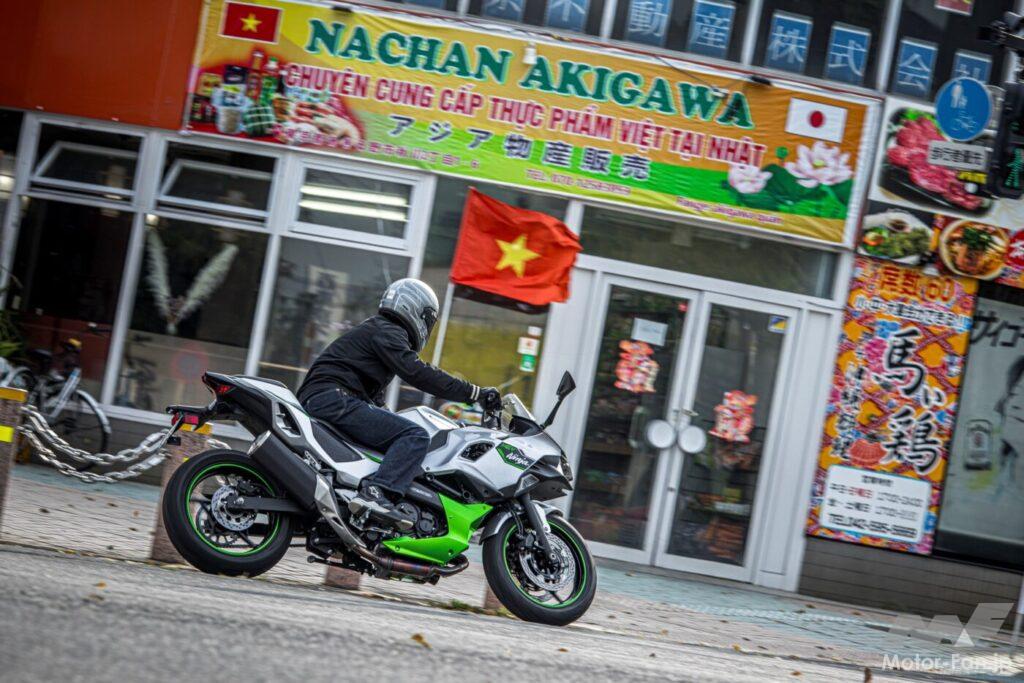
We look forward to the handling of both the Ninja 7 and Z7 being further refined.
A likely rival for the Z7 Hybrid is Yamaha’s MT-07 Y-AMT, which was released in February this year, due to the fact that it has similar engine specifications and uses an electronically controlled transmission.
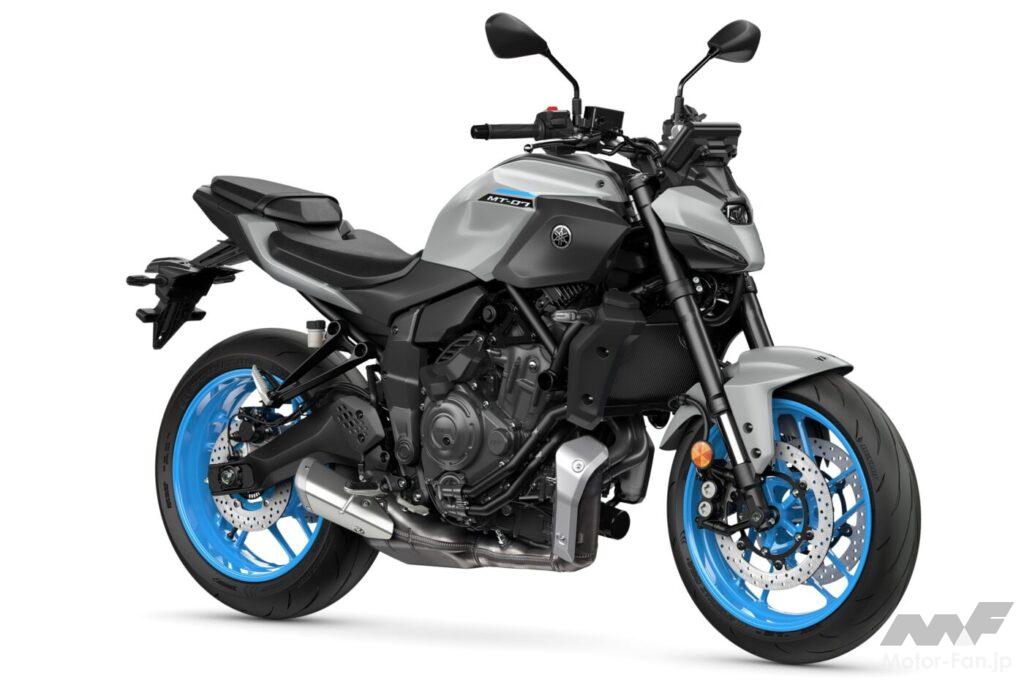
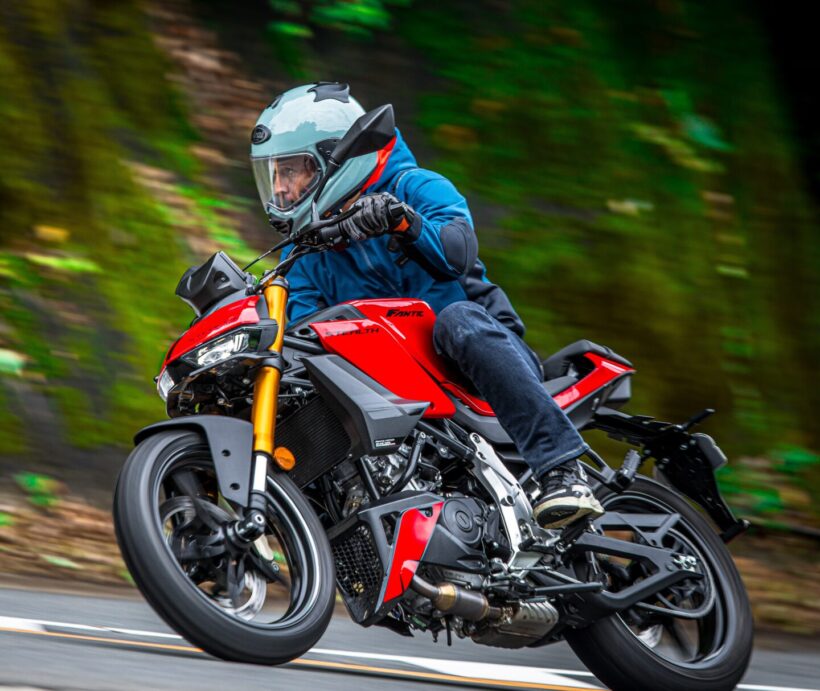
Yamaha MT-07 Y-AMT ABS. Priced at 1,056,000 yen. Equipped with cruise control, traction control, navigation display function, etc. The suspension is also very luxurious with radial mount calipers and Spin Forged wheels.
Both of these cars share the same feature of easy riding thanks to their automatic transmissions, but with a significant difference in vehicle price of 792,000 yen, it’s unlikely that anyone would have any trouble deciding between them. I personally like the Z7 Hybrid for its walk mode, which is handy when maneuvering, and its EV mode, which allows for quiet movement, something that wouldn’t be possible with an internal combustion engine alone. I applaud Kawasaki for their enthusiasm in adding this strong hybrid vehicle to the history of the great “Z” series, which began with the legendary Z1.
Riding position and foot reach (175cm/68kg)
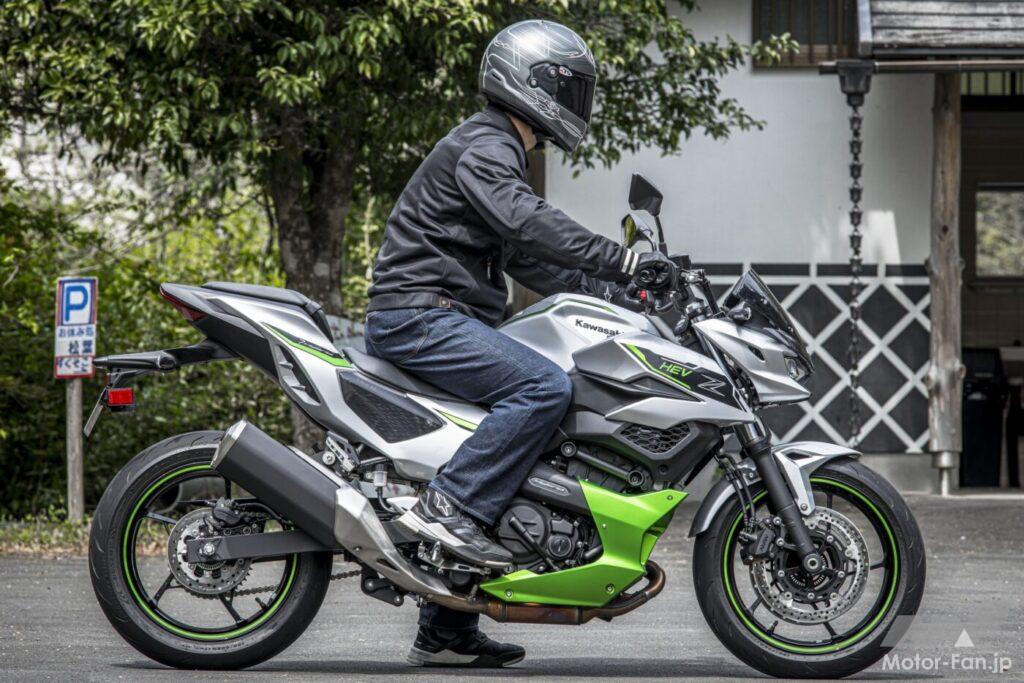
The use of bar handlebars makes the upper body more upright than the Ninja 7.

The seat height is 795mm, which is 5mm higher than the Z650, but as you can see, the foot reach is good.