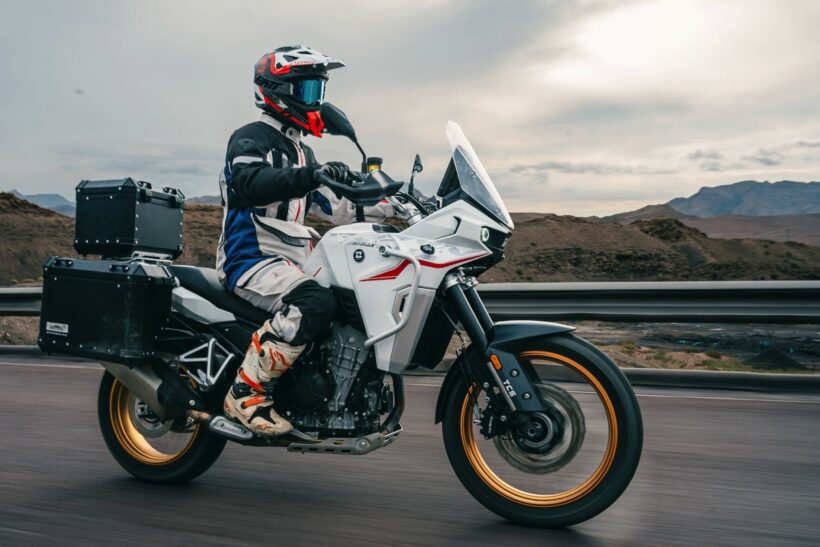


Yamaha Tracer 9 GT+ Y-AMT ABS… 1,980,000 yen (released May 28, 2025)

The price has increased by 154,000 yen from the previous Tracer 9 GT+, and the annual domestic sales plan has increased from 1,000 units to 700 units. The test vehicle was equipped with genuine accessory side cases (total 254,100 yen). The rear frame (seat rail) has been extended by 50 mm to expand the passenger’s living area, and the pillion step is equipped with rubber to improve overall comfort.


ADVERTISEMENT

The CF aluminum die-cast frame follows the previous model, but the stay at the rear of the head pipe and the cross tube at the top of the rear shock have been optimized. The former contributes to improved maneuverability and stability, while the latter contributes to improved maneuverability and rear suspension operability.
ADVERTISEMENT

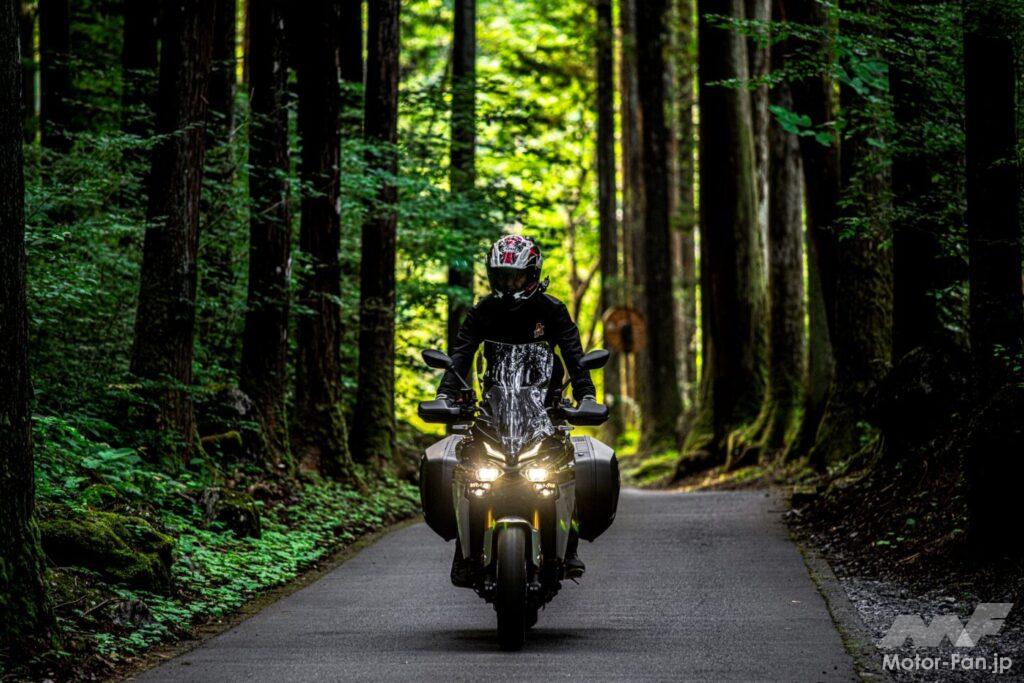
In addition to the Black Metallic X shown in the photo, Dark Purplish Blue Metallic U is also available as a body color. The seat, which can be adjusted to two different heights, is a new model, and the seat height has been increased from 820mm/835mm to 845mm/860mm. However, the manufacturer explains that by slimming down the front of the seat compared to the previous model, the step arch length has been shortened.
Y-AMT’s AT mode tends to maintain a higher rotation speed.

The previous Tracer 9 GT+ was Yamaha’s first model to be equipped with ACC (Adaptive Cruise Control). To maintain a constant distance from the vehicle ahead, the engine brake is used first when decelerating, and the front and rear brakes are automatically applied as needed. At that time, the electronically controlled suspension adjusts the damping force to prevent unnecessary forward leaning. It even automatically accelerates to assist in overtaking when the turn signal is turned on, and the level of perfection is so high that it’s hard to believe it’s the first time it’s been adopted, and I was impressed every time I used it.
However, as I got used to it, I started to notice some things that bothered me. For example, when cruising on the highway at 120km/h in sixth gear, the traffic ahead slowed down to around 60km/h, and even after the ACC resumed acceleration, the gear remained in sixth gear. As a result, acceleration was inevitably slow.
Although it is possible to change gears with the quick shifter even while the ACC is operating, it is difficult to intuitively know “what gear is optimal at that moment.” There are many situations where you are unsure whether to drop down to 5th gear or 4th gear, and conversely, if you drop down too much, the acceleration becomes abrupt and unnatural. Ultimately, to achieve smooth acceleration, the rider had to keep selecting the “correct gear” each time.

The Tracer 9 GT+ was released in October 2023. It was sold for 1,826,000 yen.
Perhaps there were many such requests from users, as the automatic transmission “Y-AMT” has been added to the Tracer 9 GT+, following on from the MT-09 and MT-07.

Based on the 888cc water-cooled, four-stroke, in-line three-cylinder engine known as the “CP3,” a shift and clutch actuator for the Y-AMT has been added to the back of the cylinder. The primary/secondary gear ratios and each gear ratio of the six-speed transmission are the same as those of the standard Tracer 9 GT. The maximum output is also the same at 120 PS (the image shows the MT-09 Y-AMT).
ADVERTISEMENT

The electronically controlled shift mechanism, Y-AMT (Yamaha Automated Manual Transmission), is a system in which clutch and shift operations are handled by an actuator, so there is no clutch lever or shift pedal. MT mode and AT mode can be selected, and this model has a special automatic setting that takes into account luggage loads and tandem riding. It also works in conjunction with ACC (adaptive cruise control), automatically shifting gears depending on vehicle speed. This is the world’s first control for a motorcycle (according to Yamaha Motor Sales research, as of March 2025).
When I returned to riding without a clutch lever, the first thing I felt wasn’t a sense of discomfort, but a sense of freedom.
The new Tracer 9 GT+’s Y-AMT and ACC. The combination of these two cannot be summed up in simple terms as simply convenient or comfortable. The bike moves naturally and predictively, to the point that it could be called a “machine with a will.”
Take, for example, ACC-enabled following. When the vehicle ahead slows down, the bike immediately closes the throttle, applying engine braking and then braking again. The gear changes are also impressive, with the downshifts coming in with exquisite timing. The entire process is so smooth that the moment I tried it for the first time, I couldn’t help but mutter, “This is perfect, isn’t it?”
Of course, it’s not omnipotent. For example, ACC is automatically deactivated when the speed drops below 25km/h, and there are times when the cornering assist function relaxes distance control when turning. But that’s actually a good thing. Because the control remains within a range that doesn’t interfere with the rider, you can leave it to it with peace of mind. There’s no doubt that Y-AMT has taken the perfection of this ACC to the next level.
The first time I experienced a Y-AMT was with the MT-09. At that time, I was concerned about the gear shift shock when driving aggressively on the circuit. In particular, the sudden jerk when shifting up seemed a bit rough. However, the Tracer 9 GT+ was a little different.
Shifting is smooth in all situations, from city streets to highways and winding roads. Of course, there are still some shocks depending on the conditions. When riding tandem up a steep hill or accelerating with the throttle open, you may feel a slight jolt from a strong shock. However, this is the “realistic feeling of drive” and is not an unpleasant sensation.
When you’re going downhill and barely opening the throttle, the gears change surprisingly smoothly. Not only is it comparable to Honda’s DCT or E-clutch, but it actually feels like a typical Yamaha ride.
This time, I mainly drove in AT mode. Both D mode and D+ mode are programmed to shift up at slightly higher rpm, and at first I thought, “That’s a bit of a drag,” but I soon understood why. This is a setting designed for tandem riding or carrying luggage. For example, in D mode, the car is kept in third gear up to around 60 km/h, and then the engine is revved up to nearly 4000 rpm before shifting up. Furthermore, the system is controlled so that the car will not shift up to fourth gear or higher even when the shift lever is operated.
And then I realized something. Although I was enjoying the feeling of the CP3 engine as always, for some reason it didn’t leave much of an impression on me.
The CP3 is an engine that changes its character at each rev range. It has tenacity in the low rev range, a pulsating feeling in the mid-rev range, and a thrilling extension in the high rev range. All of these are appealing, and I particularly like the crisp feeling between 3000 and 4000 rpm. So, I actually enjoyed carefully selecting the gears to keep the engine in that range.
However, in AT mode, efficiency takes priority, which can result in a mismatch between the gear the bike selects in AT mode and the desired RPM range, which can drown out the full power of the CP3.
This is not just an issue with the Y-AMT. It’s a challenge that all AT mechanisms face. The Y-AMT offers the new possibility of “freedom of the left hand,” but in order to change gears, the now-free left hand must still be used to operate the shift lever. This leaves a small contradiction.
Even so, the future of this mechanism is exciting. One day, “smooth shifting that feels good even when you leave it to the bike” will become the norm. It’s fair to say that Yamaha is leading the way.
The electronically controlled KADS suspension combines sportiness and comfort at a high level

The handling is stable throughout, both in straight lines and corners, thanks to the wheelbase being 70mm longer than the MT-09 (swingarm is 60mm) and the inertial damping effect of the cowling. Despite its apparent volume, it moves lightly, and the way the steering angle responds to the lean of the body is natural and easy to handle, similar to that of a naked bike.
The electronically controlled KADS suspension has four modes: A-1 which is more sporty, A-2 which is more comfortable, and C-1 and C-2 which can be freely set by the rider. For C-1/C-2, you can choose between an automatic map and a non-automatic map, which gives you a sense of the flexibility of an electric suspension.

The KADS electric suspension, jointly developed with KYB, automatically adjusts the damping force according to the riding conditions. The system has four control maps. The preload is manually adjustable for both front and rear, with the standard setting being 2 turns from the minimum for the front and 13 clicks for the rear.
The A-1 responds sharply on mountain roads, yet is not too stiff when cruising. It is also said to be suitable for wet roads, likely due to the automatic damping force adjustment. The A-2 has even more supple movement, improving tracking on rough roads. Yet pitching is not significant, and there is almost no impact on maneuverability.
The brakes are equipped with UBS, which distributes front and rear braking force according to speed, and radar-linked UBS, which adjusts braking force according to the distance between vehicles.The brakes work so naturally that you don’t even notice them operating, and there’s no sense of discomfort during normal driving.
The VHC, which is being adopted for the first time on a Yamaha domestic model, can be selected between Advanced, which automatically detects slopes, and Standard, which activates when a certain input is applied. While it is a convenient function in many situations, Advanced also activates when you want to reverse the vehicle on a slope, which left me in a panic when I tried to give way and was unable to move back. Owners need to fully understand how to use the functions, such as which functions activate in what situations and how to cancel them.

The front fork has a modified axle bracket structure. The braking system is equipped with ABS and UBS (front and rear linked and automatically adjusts braking force when cornering), radar-linked UBS (adjusts braking force by integrating information on the distance to the vehicle ahead), BC (adjusts braking force when cornering using cornering assist brakes in addition to the standard ABS), and VHC (assists braking operation on slopes and when stopped, a first for a Yamaha domestic model).
ADVERTISEMENT

Yamaha’s unique Spin Forged wheels have a revised rear rim thickness, including the base model Tracer 9 GT. The standard tires are the Battlax Sport Touring T32, jointly developed with Bridgestone, which are approximately 200g lighter in the front and 300g lighter in the rear. A tire pressure monitoring system (TPMS) is also included as standard equipment.
One of the notable features of the new model is the matrix LED headlights, which change the illumination area depending on the traffic situation. A camera mounted on the top of the front mask monitors the surroundings and automatically adjusts the light distribution. Although we were unable to test driving at night, we were able to confirm the operation of the cornering lights in a photo taken from the front.

Adaptive high beam illumination.
ADVERTISEMENT
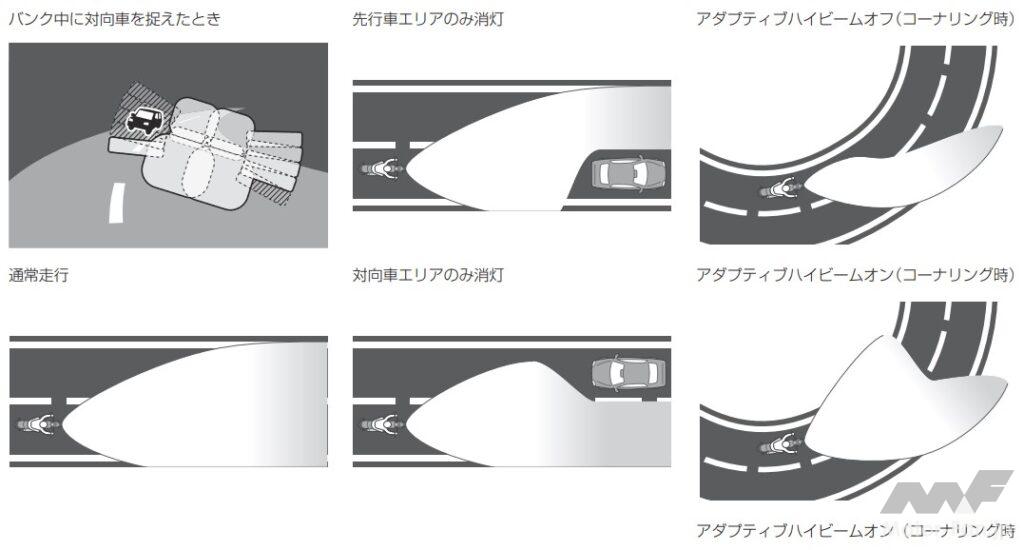
Image of cornering light illumination.

You can see that more LEDs are lit on the leaning side. These are cornering lights.
In addition, there are plenty of advanced features, such as the YVSL (Yamaha Variable Speed Limiter) that can limit the maximum speed, and the BSD (Blind Spot Detection) that warns of approaching vehicles from behind. The price of less than 2 million yen is surprising, and the current level of perfection is undoubtedly at the forefront of sports tourers.
Riding position and foot reach (175cm/68kg)

The handlebar position has been changed to prevent stiff shoulders. In addition, there are two positions to choose from for the footpegs and handlebars. The riding position is relaxed and seems like it would be comfortable even on long tours. In addition, the wind protection effect seems to have been further improved, and it was more than comfortable enough without having to raise the electric windscreen.

The electric suspension incorporates a “suspension damping system for getting on and off,” which automatically reduces the damping force for 30 seconds when the vehicle is turned on or the engine is stopped with the kill switch. The photo shows the seat set to low (845mm), which is higher than the previous model’s 820mm, but the impression is that foot reach is the same or even improved.
Detailed explanation

A new smart key system has been adopted. It also works in conjunction with the locking mechanism of the genuine accessory side case and top case. The BSD (Blind Spot Detection) displayed in the corner of the mirror now has millimeter-wave radar units added not only to the front but also to the rear of the vehicle. The steering angle has been increased from 32° to 35°.
ADVERTISEMENT

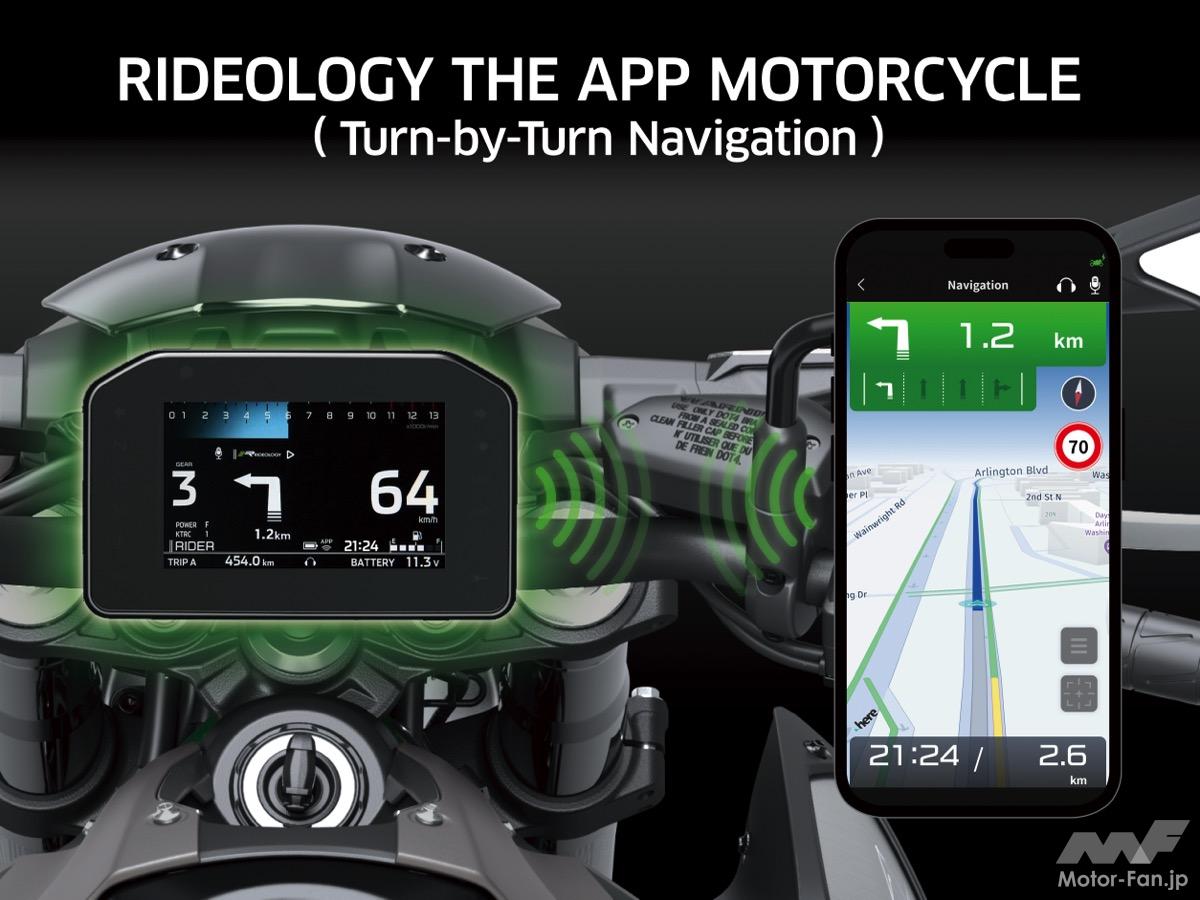
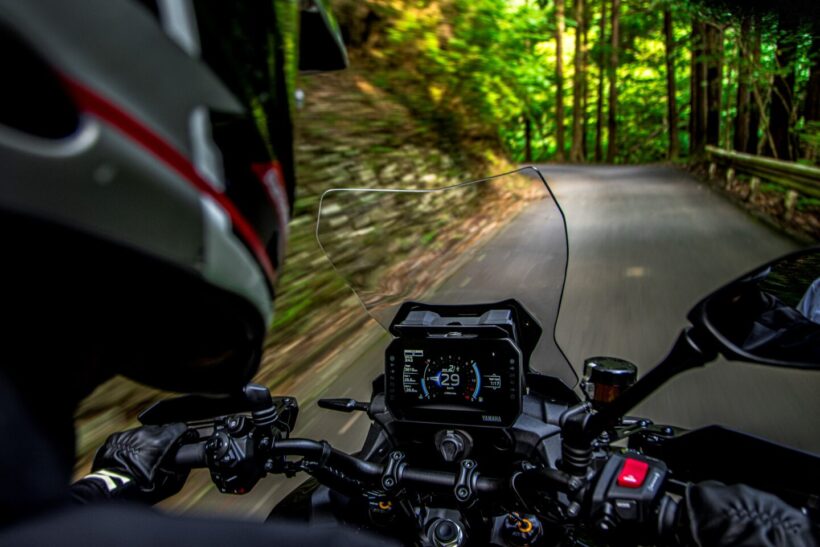
It features a 7-inch high-brightness TFT display with a slimmer body than its predecessor. The screen layout can be selected from three themes. By pairing it with a smartphone that has the dedicated apps “Y-Connect” and “Garmin Motorize” installed, it can display navigation, audio, email, and incoming call notifications.
ADVERTISEMENT

YRC (Yamaha Ride Control) settings screen. PWR (Power Delivery Mode), TCS (Traction Control), SCS (Slide Control), LIF (Lift Control), EBM (Engine Brake Management), BSR (Backslip Regulator), and SUS (Electronic Suspension Control) can be finely adjusted.
ADVERTISEMENT

The turn signal switch now has a two-stage function. A short press causes it to flash three times, while a long press causes it to flash continuously. It will automatically cancel if it flashes for 15 seconds or more and you have driven 150 meters since it started flashing. An emergency stop signal function has also been newly adopted. The heating wire pattern of the standard grip heater has been changed. There are now 10 temperature settings (3 settings while riding).
ADVERTISEMENT
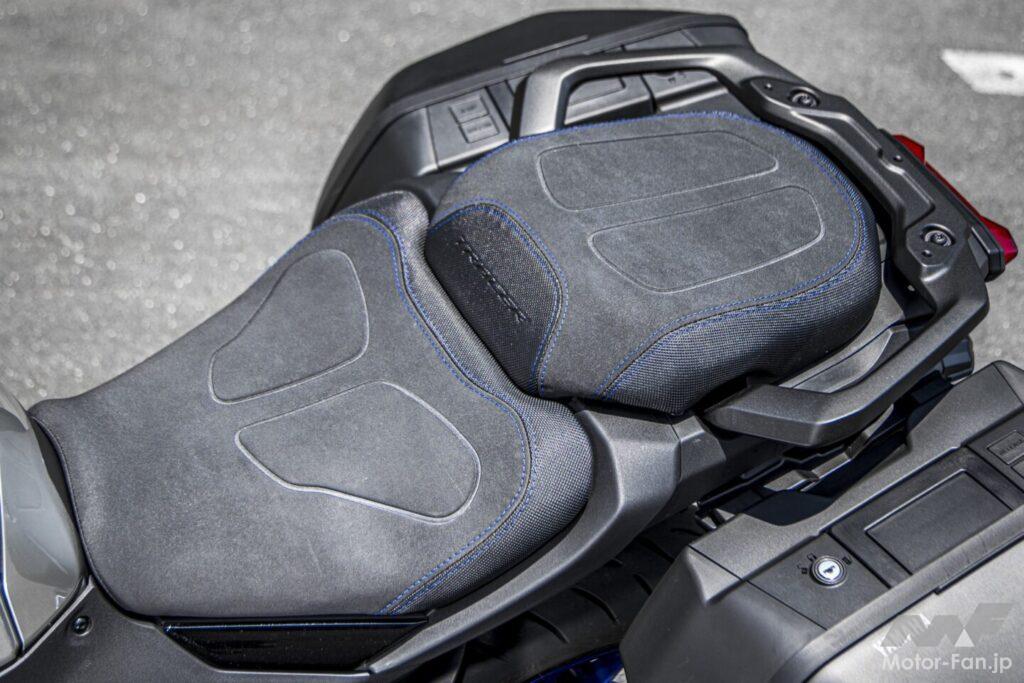
The rider’s seat height can be adjusted to two levels: 845mm and 860mm. Genuine accessories include a heated seat (rider’s side: 30,800 yen, passenger’s side: 38,500 yen) and a comfort seat (rider’s side: 26,400 yen, passenger’s side: 22,000 yen).
ADVERTISEMENT

The passenger seat can be removed by unlocking the key lock, and the rider can remove it by operating a lever hidden inside.

The system employs matrix LED headlights that automatically adjust the illumination area by linking multiple high/low beam LEDs with a camera located below the screen. In addition to automatically switching between high and low beams, the system also features a cornering light function that automatically adjusts the light distribution pattern according to the lean angle.

The radar wave unit is located at the bottom of the taillights.

The large windscreen has been redesigned and is now a stepless electric type with a 100mm range of motion.

The pannier cases can be mounted simultaneously with a top case thanks to the mounting bracket with built-in dampers. The interior is equipped with lighting, which is useful for loading and unloading luggage in the dark. Although it is linked to the smart key, you must press the unlock button on the keyless switch on the left side of the vehicle to open the lid or remove the case.
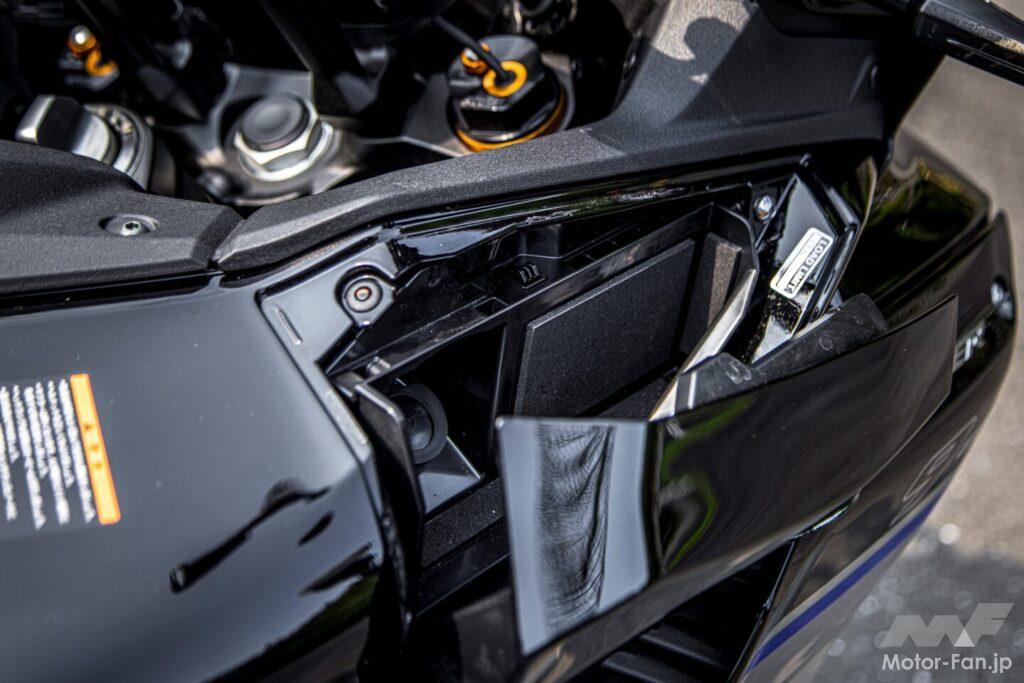
A box for storing small items such as smartphones is provided on the right side of the front cowl. There is a USB Type-A terminal inside. In addition, a USB Type-C compatible socket is provided below the meter.

The louvers added to the inside of the side cowlings are a device to increase internal pressure and prevent wind from being drawn in while riding.

A new low-maintenance chain made by DID with DLC coating on the rollers has been adopted.
Yamaha Tracer 9 GT+ Y-AMT ABS Main Specifications
Certified model / Engine stamped model 8BL-RNA1J / N722E
Length / width / height 2,175mm / 900mm / 1,440mm
Seat height 845mm (low position) 860mm (high position)
Wheelbase 1,500mm
Ground clearance 135mm
Vehicle weight 232kg
Fuel consumption rate Notified by the Ministry of Land, Infrastructure, Transport and Tourism
Constant fuel consumption value 31.1km/L (60km/h) with two occupants
WMTC mode value 21.1km/L (Class 3, Subclass 3-2) with one occupant
Engine type Water-cooled, 4-stroke, DOHC, 4 valves
Cylinder arrangement Inline, 3-cylinder
Total displacement 888cm3
Bore x stroke 78.0mm x 62.0mm
Compression ratio 11.5:1
Maximum output 88kW (120PS) / 10,000r/min
Maximum torque 93N・m (9.5kgf・m) / 7,000 r/min
Starting method: Self-
lubrication method: Wet sump
Engine oil capacity: 3.50L
Fuel tank capacity: 19L (unleaded premium gasoline required)
Intake/fuel system/fuel supply method: Fuel injection
Ignition method: TCI (transistorized)
Battery capacity/type: 12V, 8.6Ah (10HR) / YTZ10S
Primary reduction ratio/secondary reduction ratio: 1.680/2.812 (79/47 x 45/16)
Clutch type: Wet, multi-plate
transmission / Shift method: Constant mesh 6-speed/return type
Gear ratios: 1st: 2.571, 2nd: 1.947, 3rd: 1.619, 4th: 1.380, 5th: 1.190, 6th: 1.037
Frame type: Diamond
caster/trail 24°25’/106mm
Tire size (front/rear): 120/70ZR17M/C (58W) (tubeless)/180/55ZR17M/C (73W) (tubeless)
Braking system (front/rear): Hydraulic double disc brake/Hydraulic single disc brake
Suspension system (front/rear): Telescopic/Swing arm (link type)
Headlamp bulb type: Headlamp LED/LED
Passenger capacity: 2