
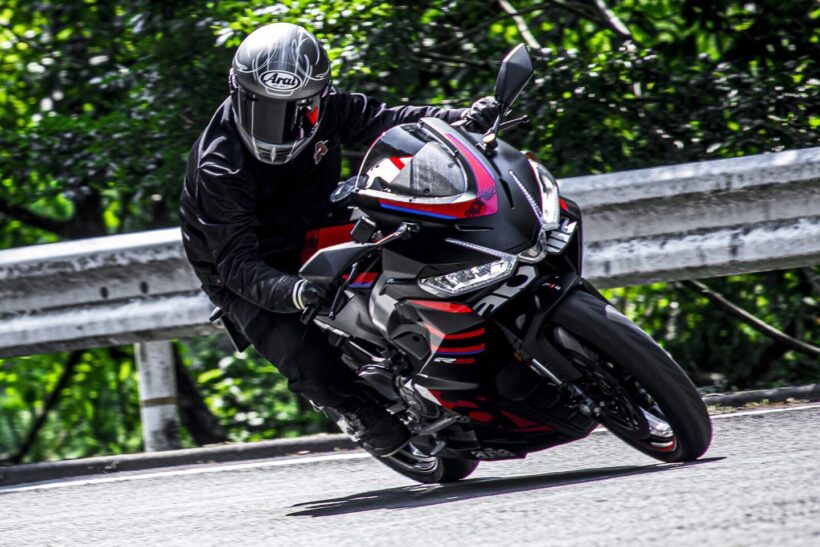

Aprilia RS457… ¥858,000 (shipments start in February 2025)

It features a pivotless aluminum twin-spar frame, the only one in this segment. The standard tires are “Protorque Extreme” from Eurogrip, an Indian tire manufacturer, and because they are specially designed for this model, the Aprilia logo is printed on the sidewall.


ADVERTISEMENT

ADVERTISEMENT

The only body color sold in Japan is the “racing stripe” shown in the photo. The coloring, which sets it apart from Japanese manufacturers, such as the winglets with the large Aprilia logo and the front wheel with a red rim decal, will stimulate the desire to own it.
ADVERTISEMENT

The Aprilia RS660 began shipping in May 2021. It is the big brother of the RS457 and is equipped with a 659cc water-cooled, four-stroke, parallel twin-cylinder engine. The current model is priced at 1,595,000 yen. Check out our test ride impressions here .
You’ll be captivated by the torqueful and lively engine feel

The RS457’s water-cooled parallel twin engine, slightly over 400cc, neither barks nor whispers, but rather raises its voice in just the right place. It’s rough and elegant, and the sound that weaves between these two elements tickles your ears every time you open the throttle.
The response to the movement of the right hand is fresh and smooth, yet it never makes the rider feel rushed. In particular, the tempo of acceleration from the low RPM range to the mid-RPM range is like taking brisk steps. Suddenly, the image of the Ducati Monster 696 from back then crossed my mind.
The crank phase angle of this parallel twin engine is 270°. The standard for parallel twins in the 250-400cc class is 180° phase, which is probably why the RS457 reminded me of the feeling of a 90° V-twin. It’s manufactured in India, but nationality doesn’t matter when you drive it. There was definitely a hint of Italy mixed in with the heat rising from the scorching asphalt.
The 300-500cc market is expanding, especially in emerging countries. Aprilia, which has had success with the lightweight sports car “RS660,” has launched a brand new model, the “RS457,” into this market. The three-digit number in the model name indicates the engine displacement, which means that unfortunately, in Japan, it cannot be ridden with a regular motorcycle license.
As a manufacturer, it is primarily targeted at riders who have stepped up from an A1 license (up to 125cc/15HP) in EU member states, and is positioned as a so-called entry model. However, now that I have actually completed the test ride, I am truly surprised by the performance that even veteran riders will be impressed with.

The 457cc water-cooled, four-stroke, in-line twin-cylinder engine is a new design, and like the RS660, it uses a 270° phase crank. The coolant bypass circuit and blow-by circuit are integrated into the engine, and these hoses are not visible from the outside, which is different from the RS660. The cylinder offset is 6.5 mm, and the piston pins are DLC coated. The clutch is a wet multi-plate type with assist and slipper functions.
It was actually Aprilia that introduced ride-by-wire (throttle-by-wire = TBW) to the world’s first mass-produced motorcycle. The Shiver 750, which appeared in 2008, led the way and also featured a riding mode switching function. Looking back, this was a symbolic moment when electronic control began to make serious inroads into the world of motorcycles.
Of course, the RS457 also features TBW and a mode selector. The level of perfection in this electronic control is quite extraordinary. For example, on an uphill slope exceeding 10%, even at around 2000 rpm in third gear, or a speed of less than 30 km/h, the engine continues to produce power without a hint of complaint. An experienced rider would immediately shift down a gear or use the clutch halfway to avoid stalling. However, the RS457, as if it “knows” about it, does not allow you to engage the clutch.
Aprilia’s ease of handling for beginners goes beyond mere gentleness. It is sensitive even down to the very low RPM range, building trust between the engine and the rider. The precision of the settings will leave you speechless.

The switch box is backlit for easy nighttime operation. It features an electronically controlled throttle and three riding modes: Eco, Sport, and Rain. Traction control can be adjusted to three levels, and the rear ABS can be cut off.
The strength of the torque that surges from the low to mid-range is clearly in a different league to the Honda CBR400R or Kawasaki Ninja 400, perhaps due in part to the 14% larger displacement. There’s a truly rich thrust when you open the throttle, and once you exceed 6000 rpm, the engine begins to exude a sporty allure as it revs up. And that momentum continues to surge all the way up to 10,500 rpm, where the redline begins.
Of course, technically, it would have been possible to extract even more power. However, Aprilia chose to stick to the A2 license limit of 35kW (47.6HP), achieving both power in everyday use and spectacular performance at high revolutions. The adoption of a 270° phase crankshaft is what made this possible. The unique beat that gives the engine a somewhat “undulating” feel gives it a distinct character.
Another thing not to be overlooked is the excellent shift feel. Simply describing it as smooth would be a waste. There’s a satisfying click and the gears click into place. The act of shifting itself is enjoyable. While clutchless and shiftless technologies have been emerging one after another in recent years, Aprilia has always honed its technology to convey the joy of manual operation. This attitude gives a glimpse of the pride of Italian sports cars.

Regarding the gearbox, roller bearings are used on the synchro gear shaft to reduce sliding resistance. In addition, a patent-pending lubrication system is used for the fork axle. Also, a quick shifter is available as an original accessory, which is rare in this segment.
Not only is it easy to handle, but it also has handling that goes beyond that.

You fall in love with its sharp looks at first sight, and before you know it, you’ve signed the contract… The RS457’s handling easily exceeds the expectations of such riders. Compared to the CBR400R or Ninja 400, the agility of turning and leaning into corners is a cut above the rest. It’s so sharp you might even want to use the word “sharp,” allowing you to freely control your line even while cornering. And yet, there’s no sense of testing the rider’s skill like with the old racer replicas. Rather, you can almost feel a gentleness, as if the bike is reaching out to you and saying, “Have fun.” Here, too, Aprilia’s clear intention to bring the fun of sports riding to as many people as possible is apparent.

The Honda CBR400R has undergone a complete redesign in 2024. Check out our test ride impressions here . The 471cc CBR500R is sold overseas, with a claimed maximum output of 48 HP (35 kW) at 8600 rpm and maximum torque of 43 Nm at 6500 rpm.
The source of this agility is not simply the light weight of the bike. Aprilia did not go in the direction of “bulking” the tire size. Compared to the CBR400R, both the front and rear tires are one size narrower, and they also use specially designed radial tires. In other words, it shows their attitude of tuning the entire bike functionally.
And the excellent response to the rider’s control is undoubtedly due to the aluminum frame, which is rare in this class. It responds sharply to inputs and conveys your intentions precisely at the entrance to corners. It invites you to take it to the circuit.
On the other hand, when you enter a rough mountain road, the stiffness of the suspension becomes apparent. The body may tend to bounce a little over joints and bumps in the pavement. In such situations, the CBR400R, with its linked monoshock in the rear, high-grade forks in the front, and a flexible steel frame, is the better choice. If you’re looking for touring-like comfort, go for the Honda, and if you’re looking for agile responsiveness, go for the Aprilia; each bike has a clear position.

The φ41mm inverted front forks are adjustable only for preload, with 120mm of wheel travel. The front brake is a single disc with a φ320mm disc diameter. The caliper is a radially mounted, opposed 4-piston caliper made by Vibra, combined with a Bosch 2-channel ABS and stainless steel mesh hose.
ADVERTISEMENT
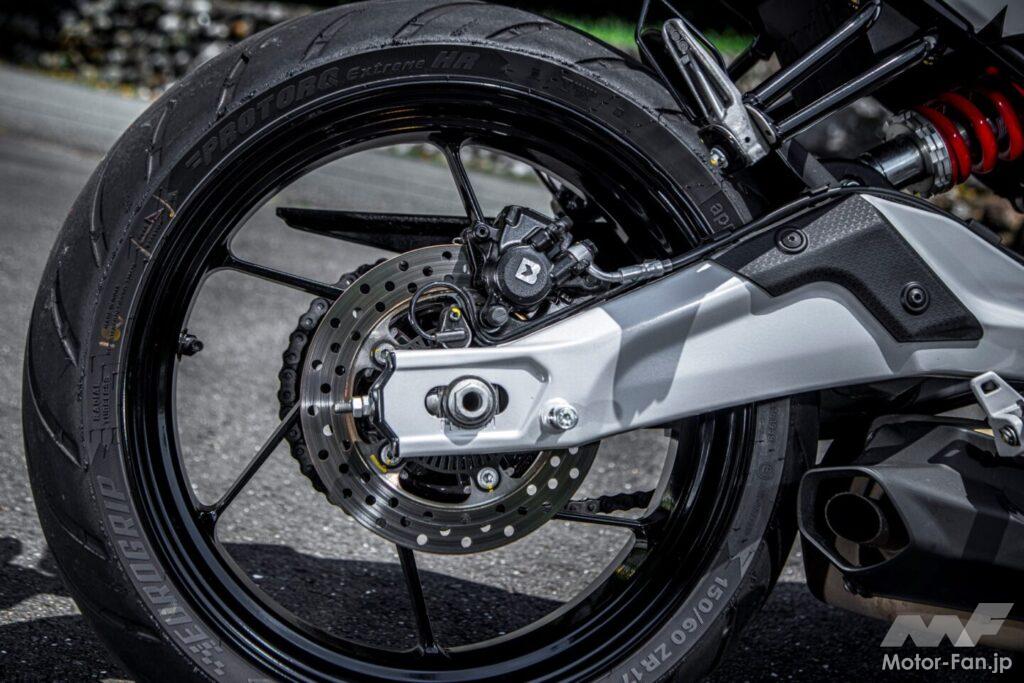
The rear suspension is a linkless monoshock. The swingarm is made of steel and pivots on the crankcase. Wheel travel is 130mm. The rear brake is a combination of a φ220mm disc and a Vibra single-piston caliper.
ADVERTISEMENT

The rear shock unit can also only be adjusted for preload.
I’d also like to mention the brakes. There’s a single disc at the front, but it has absolutely no lack of stopping power. In fact, because the body is so light, it’s more than effective enough. In addition, there’s no doubt that the reduction in unsprung weight contributes to the bike’s nimble handling. The dogleg-shaped lever is easy to operate, and the adjuster allows for precise settings. You can feel the attention to detail.
In Japan, the advantages of the RS457 tend to be somewhat overlooked due to the restrictions of the license system. However, the RS457 is unique in terms of its completeness as a product, its concept, and its positioning. It will appeal to veteran riders who are considering downsizing from a supersport bike, and for Aprilia fans who find the RS660 a bit out of reach, this could be a solid “option.”
Riding position and foot reach (175cm/68kg)

The fuel tank is designed to fit the rider’s helmet and chest, making it comfortable even when in a prone position. The forward-leaning position is slightly deeper than that of the CBR400R, but it is a well-balanced riding position that is also suitable for riding in urban areas.

The official seat height is 800mm. It is higher than the CBR400R’s 785mm, but the front of the seat is slim, making it easy to reach the ground with your feet. The genuine accessory comfort low seat gives the impression of a seated position closer to the front.
Detailed explanation

The handlebars are separate, the top bridge is boldly hollowed out, and the dogleg brake levers are equipped with adjusters.
ADVERTISEMENT

It uses a 5-inch TFT color LCD display. When the engine temperature is low, the tachometer bar graph turns blue between 6,000 and 10,500 rpm, letting the rider know that the engine is warming up.
ADVERTISEMENT

The screen allows you to check maintenance schedules, water temperature, battery voltage, etc. By connecting the genuine Aprilia MIA accessory, you can link it to your smartphone.
ADVERTISEMENT

The left is the standard rider seat, and the right is the comfort low seat, which uses a special gel. The latter lowers the seat surface by approximately 20 mm.
ADVERTISEMENT

The pillion seat can be removed by unlocking the key lock, and the rider seat can also be removed. Genuine accessories include a single-seat cowl-style passenger seat cover, side panniers, and a comfort passenger handle.
ADVERTISEMENT

It features a double fairing design similar to the RS660. The side slits and large spoiler provide excellent wind protection. The headlights are integrated with front turn signals.
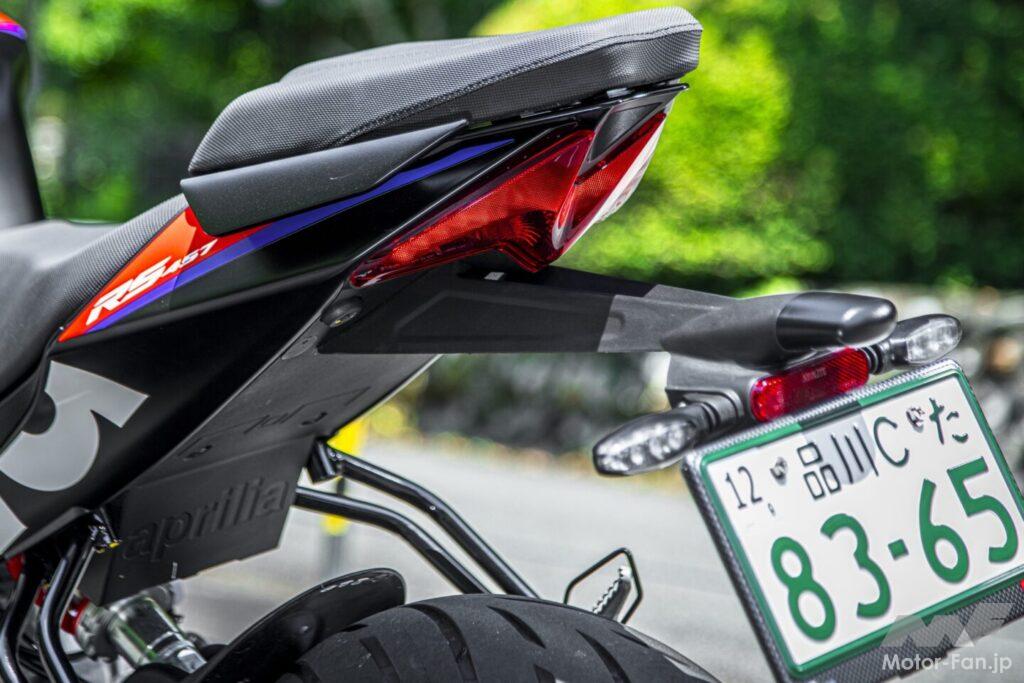
All the lights are LED, and there are winglet-style grab bars on both sides of the tandem seat.
Aprilia RS457 main specifications
Engine type: 4-stroke, water-cooled, in-line twin-cylinder, DOHC, 4-valve,
Total displacement: 457cc,
Bore x stroke: 69mm x 61.1mm,
Maximum power: 47.6HP (35kW) at 9,400 rpm
, Maximum torque: 43.5Nm at 6,700 rpm,
Fuel supply system:
Electronic
fuel injection system, φ36mm twin throttle body, ride-by-wire accelerator management system, Lubrication system
: Wet sump, Starting system: Self-acting, Transmission:
6-speed return (Aprilia Quickshift UP/DOWN available as an option), Clutch: Wet multi-plate
clutch with assist and slipper system, Frame: Double-spar aluminium
frame, Front suspension: φ41mm telescopic inverted
fork, adjustable spring preload, wheel travel: 120mm, Rear suspension: Steel swingarm, mono shock absorber, adjustable spring preload, wheel travel: 130mm,
Front brakes: 320mm discs, ByBre radial mount 32mm 4-piston caliper
brake (R) 220mm diameter disc, ByBre 1-piston caliper
Overall length/width 1,982.5 mm/760 mm
Seat height 800 mm
Wheelbase 1,350 mm
Tires (F) 110/70 ZR 17 Aluminum wheels 3.0″ x 17″
Tires (R) 150/60 ZR 17 Aluminum wheels 4.5″ x 17″
Weight Equipped weight: 175 kg (with 90% fuel load), Dry weight: 159 kg
Fuel tank capacity 13 L
Country of manufacture India