

Isn’t it a jumpsuit for the first generation RZ and TZR?

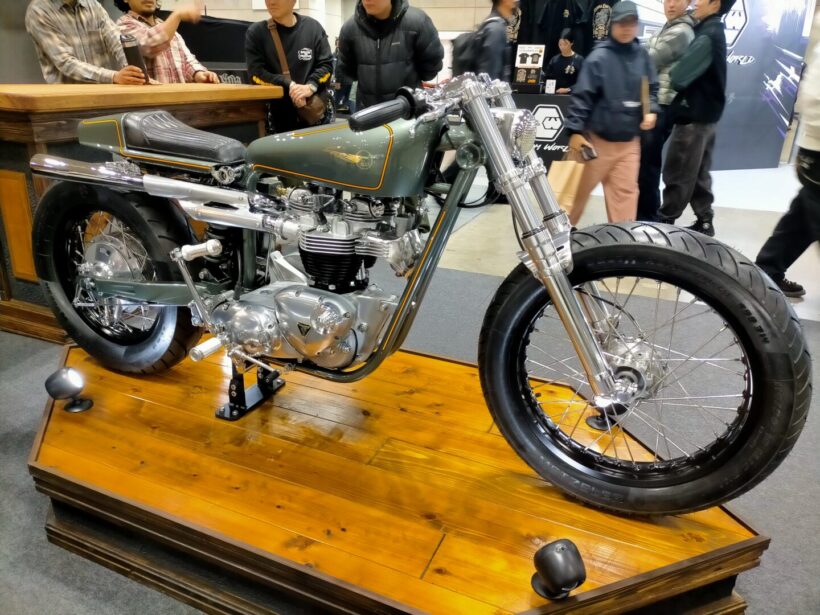
The vehicle used in the title photo is a custom RZ250R made by Quality Works. Details of this vehicle will be introduced in the second installment, which will be released soon.
A while ago, I was talking about 1980s two-strokes with a fellow rider in his early 40s, and he asked me, “Isn’t the RZ-R like a cross between the original RZ and the TZR?” I couldn’t quite put my finger on the question or comment. His words made me feel quite uneasy, but thinking about it again, it’s true that the RZ250R/350R, which went on sale in 1983, possessed qualities somewhere between the original RZ250/350 that appeared in 1980 and the TZR250 (1KT) that debuted in 1985.

1980- RZ250: Compared to its predecessor, the RD, the first-generation RZ was a model that was dramatically modernized. The RZ name was only used in certain regions, including Japan, and in many other countries it was called the RD, the same as its predecessor, or the RD-LC.
That said, the term “overalls” probably isn’t quite appropriate. After all, the RZ-R had a different appeal than either the original RZ or the TZR250. However, compared to the original RZ, which rekindled the flame of two-stroke sports bikes that had been fading in the late 1970s, and the TZR, which led the two-stroke racer replica market in the mid-1980s with its outstanding maneuverability, it feels like there are no words to describe the RZ-R’s true character. So, in this three-part series of articles, starting from this one, we’ve decided to delve deeper into the appeal of the RZ-R.

1985- TZR250 (1KT): While the original RZ and RZ-R incorporated technology from the TZ production racer, the TZR250 was developed by reusing the design concept of the YZR500 works racer.
Just as groundbreaking as its predecessor and successor

1959- YDS1: Yamaha’s first 2-stroke parallel twin was the YD-1, which appeared in 1957. However, the 1959 YDS1 was the first model designed for sports riding.
Before we get to the main topic, let me explain the basic premise: the original RZ, RZ-R, and TZR250 are part of the Yamaha 2-stroke parallel twin road sports series, which began with the 1959 YDS1 and evolved into the YDS2/3, DS, DX, and RD.

1973- RD250: The RD series, which began sales in 1973, was the final model of Yamaha’s air-cooled two-stroke road sports bikes. There was a wide variety of engine displacement models available, including 50, 90, 125, 175, 250, 350, and 400cc. The photo shows a 1977 250.
What set the first-generation RZ apart from its predecessor, the RD, were features such as the water-cooling system inherited from the TZ production racer, the Monocross rear suspension, a frame that connected the head pipe and swingarm in a straight line, and flame-shaped cast wheels, while the selling points of the first-generation TZR, which followed a path similar to but different from the RZ-R, were its aluminum Deltabox frame modeled after the GP racer YZR500, 17-inch hollow three-spoke wheels front and rear, and an engine that changed the intake system from piston reed valves to crankcase reed valves. Needless to say, these were groundbreaking features at the time.

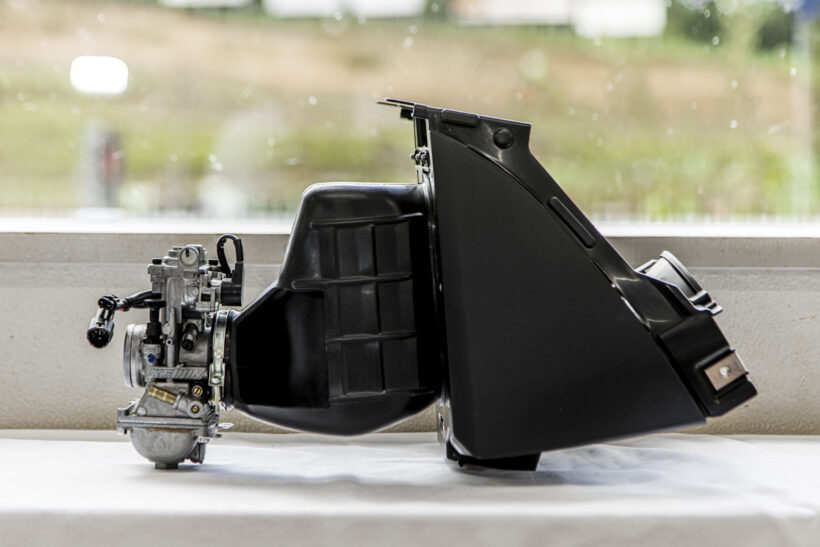
A perspective view of the first-generation RZ, with its large radiator and cantilever rear suspension eye-catching. The air cleaner box was located above the engine.
However, if we’re talking about revolutionary aspects, the RZ-R was no slouch either. The most notable features were the YPVS exhaust system installed in the engine to achieve both ease of handling in the normal range and revving up in the high-rpm range, and the dramatic increase in maximum output (250: 35 → 43ps, 350: 45 → 55ps), but just like its predecessor and successor, the RZ-R was a bike packed with highlights, including a wide frame that was closer to the TZ than the first-generation RZ, front forks with built-in variable dampers, and bottom-link rear suspension.

The YPVS exhaust device is a mechanism that varies the timing of the exhaust port according to engine speed. Although it has already been adopted in racers, the RZ-R is the first to use it on a street bike. Of course, the TZR also incorporates a similar mechanism.
ADVERTISEMENT

Perhaps to emphasize the significant increase in rigidity achieved through a revised structure, the early RZ-R and RR had red-painted frames. The rear suspension was a bottom-link type that would become standard on sports bikes in the future, and the air cleaner box was located under the seat.
In any case, the RZ-R is a completely different vehicle from the original RZ. Nowadays, some people mistakenly assume from the name that it is a higher-end version of the original RZ, but the RZ-R, which has a newly designed engine, frame, and almost all of its other parts, has achieved a level of performance that is on a completely different level from the original RZ (of course, the same can be said for the TZR as well).

Because a steel down tube is used for the engine mount, the TZR250 frame is described in the catalog as an aluminum Deltabox semi-double cradle, but in fact it is a so-called twin spar type.
Achieved top popularity in its class from 1983 to 1985

1983- RZ250R (29L): Like the original RZ and TZR250, the 1983 RZ-R was a dramatic improvement over its predecessor. The model code for the 250 was 29L, and for the 350 it was 29K.
Looking back at the RZ-R’s active days, what’s most interesting is that despite the explosive popularity of the original RZ prompting a succession of other companies to release two-stroke racer replicas equipped with innovative features such as aluminum frames, half and full cowls, 16-inch front wheels, anti-nose dive mechanisms, and separate handlebars, Yamaha’s dominance remained unshakable.

1983- RG250Γ: Although it lost out to the RZ250R in sales by a narrow margin, the RG250Γ, Suzuki’s first full-scale racer replica, recorded sales of over 20,000 units in its first year.
To give some specific examples, the Suzuki RG250Γ debuted in 1983, and the Honda NS250R and Kawasaki KR250 in 1984, but the RZ-R was the top-selling two-stroke bike in the light motorcycle class from 1983 to 1985 (the overall top-selling bike in the light motorcycle class at the time was the RZ250 in 1981, the four-stroke V-twin Honda VT250 series from 1982 to 1985, and the TZR250 in 1986).

1983- RZ350R: Unlike its hugely popular younger brother, the RZ350R was not particularly popular in the Japanese market. The RZ350R’s engine was later used in the Banshee four-wheeled buggy.
One theory is that the main reason for this is its low price. Indeed, compared to the RG250Γ’s 460,000 yen, NS250R’s 539,000 yen, and KR250’s 498,000 yen, there must have been many riders who felt that the RZ250R’s 399,000 yen and RZ350R’s 458,000 yen prices were affordable. But perhaps the more important factor was that they were faster than their rivals on mountain roads and circuits, yet versatile enough for everyday use around town and on tours.

1984- RZ250RR (51L): Different equipment from the standard model includes a half cowl, a separate silencer chamber, separate handlebars, and an opposed 2-piston front brake caliper. The maximum output is 45ps (29L + 2ps), and the price is 439,000 yen.
To put it another way, while its rivals incorporated new innovations everywhere and still seemed incomplete, the RZ-R, which followed the tradition since the YDS1 of a steel double cradle frame, 18-inch wheels front and rear, and handlebars, with a bikini-type cowl and a conventional front fork (however, mindful of the trends of its rivals, the RZ250RR, equipped with a half cowl and clip-on handlebars, was also sold in 1984 and 1985), was a completely new design that was exceptionally well-made.
A historic car

1984- RZ250R (1AR): Initially, the RZ-R was only available in bikini cowl spec, but in August 1984, the 1AR debuted as a naked version of the RR.
Another interesting thing about the RZ-R’s active years is that even after the TZR250 was released in 1985 as a new generation two-stroke parallel twin racer replica, it continued to be steadily refined and sold until the end of the 1980s (the Japanese version of the RZ350R disappeared from the catalogue with the 1984 model, but continued to be sold overseas until the mid-1990s). Needless to say, this was unusual, and there was probably a sense within Yamaha at the time that “not everyone wants a racer replica” and “we need to continue selling basic two-stroke sports bikes.”

1986- RZ250R (1XG): From 1986 onwards, the bikini cowl and half cowl specifications were discontinued for the RZ250R, and the RZ-R from 1986 onwards was unified into the naked style 1XG. The exterior and suspension were revised, and the dry weight was reduced to 155 kg, 7 kg lighter than the 1AR.
In 1990, the R1-Z was released as the successor to the RZ-R, featuring a newly developed truncated frame and the engine from the first-generation TZR250, but it’s hard to say whether the R1-Z is truly the successor to the RZ-R. This is because, compared to the RZ-R, which has a fairly wide range of modifications and many tuning parts sold by domestic and international manufacturers, the R1-Z has less room for modification.

1988- RZ250R (3HM): The 3HM, the final model in the RZ-R series, was the first in the series to feature 17-inch tires front and rear. The price was the same as the 29L/1AR/1XG, at 399,000 yen. The TZR250 (2XT) of the same year was 559,000 yen.
In any case, the RZ-R is not a model that can be described simply as a jumpsuit. Rather, the RZ-R, which achieved the top spot in its class during its active years, continued in production for a long time, and is still loved by many riders around the world today, is, like the first-generation RZ and TZR, an indispensable classic when talking about the history of Yamaha’s 2-stroke parallel twin road sports series… that’s what I feel.

1991- R1-Z: Although there are no common parts, the R1-Z, which was sold from 1991 to 1999, is the successor to the RZ250R.