

Current status and problems of used cars

Yamashita of Quality Works is 54 years old and was born in 1970, and is well-versed in a wide range of two-strokes, both old and new.
Although not a specialist, Quality Works, which cooperated with this article, is a shop that specializes in all types of two-strokes, and has performed maintenance and customization on hundreds of RZ-Rs. In the following article, we will introduce some RZ-R-related stories from Yamashita-san, the shop’s representative. The first topic is the recent used car market price.
“It’s hard to say what the used car market price is. The prices of classic cars have risen across the board in recent years, and while a while ago it was normal for an RZ-R to cost around 200,000 to 300,000 yen, recently prices have ranged quite a bit, from 400,000 to 1,000,000 yen. What’s more, cheap bikes aren’t necessarily bad, and expensive ones aren’t necessarily in top condition. So if you’re thinking of buying an RZ-R, don’t get too caught up in the price, and it’s best to buy it from a reliable shop that has experience with two-stroke bikes.”

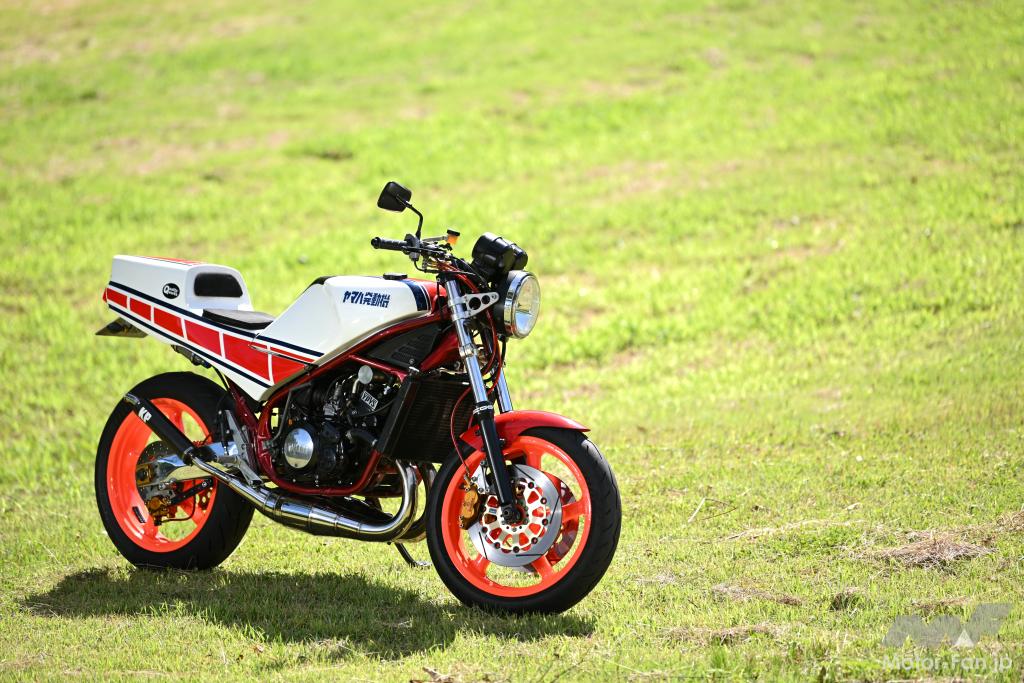
This RZ-R is used as a demo vehicle for Quality Works. The engine is a 347cc model that uses pistons and cylinders from the RZ350R, and the suspension has been completely redesigned using later model genuine Yamaha parts and aftermarket parts.
However, realistically speaking, there aren’t many riders like that, and Quality Works says that it’s not uncommon for riders who have purchased a malfunctioning RZ-R from another store or online auction to come to them asking for repair advice.
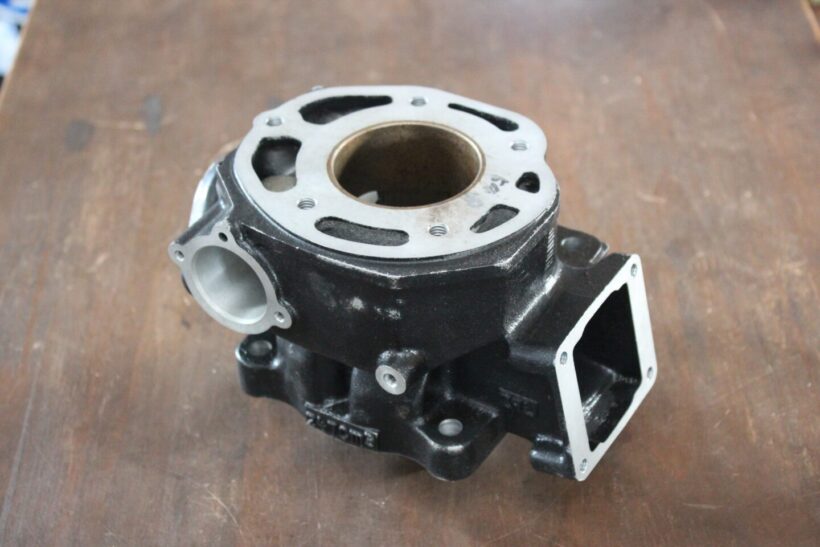
“There are a myriad of reasons why a bike might not be working properly, such as a piston and cylinder sticking or burning, loose crank bearings, a malfunctioning YPVS, a bent frame, or deterioration of electrical parts. However, with the RZ-R, most repair parts are readily available, both genuine and repro, and we have a large stock of used parts, so we’ve never faced a situation where we couldn’t repair it.”

In recent years, there have been many pistons for the RZ-R on the aftermarket market. The photo shows a TKRJ piston, a standard product at Quality Works, with the price for one cylinder being 14,520 yen for the 250R and 10,670 yen for the 350R.
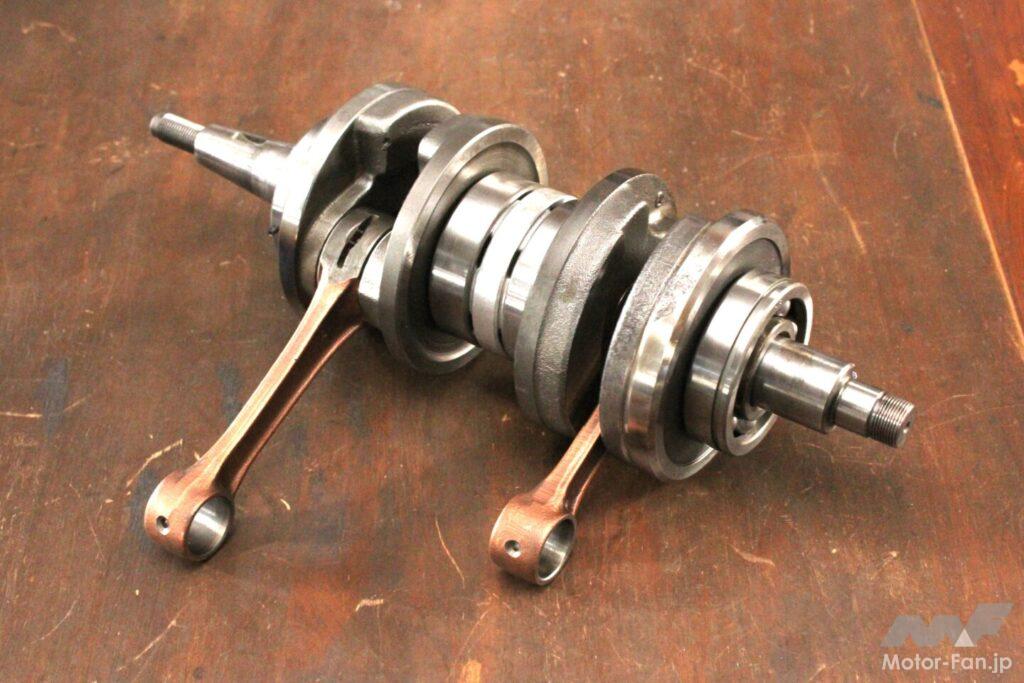
The original qualities of the assembled crankshaft can be restored by replacing the bearings and centering (and in some cases replacing the connecting rod). The center seal is an aluminum labyrinth structure, so there is no need to worry about it coming loose.
In addition to the problems Yamashita mentioned, searching the internet for RZ-R weaknesses brings up cases such as coolant leaking into the transmission compartment due to a broken water pump seal, a punctured regulator rectifier, and a hole in the bottom of the gas tank caused by rust inside.
“These three points are applicable to other Yamaha models of the same era, and the gas tank can be repaired or replaced with a reproduction, the regulator rectifier can be replaced with a corrective part, and the water pump seal can be repaired using genuine parts, so I personally don’t think they are weaknesses.”

The Slovenian-made Zealtronic CDI was originally a tuning part, but it can also be used to repair the original CDI. The price is 42,900 yen.

The AS Wotani SPII Power Coil Kit + NGK Racing Plug Wire Set, which was originally designed by Quality Works, has been extremely popular among first generation RZ and RZ-R users. The price is 21,780 yen.
Custom Trends
The majority of the RZ-Rs owned by Quality Works’ customers have been customized in some way, with very few being fully stock vehicles. Perhaps this reflects Yamashita’s taste.
“No, it’s up to the customer’s taste (laughs). On the contrary, I personally think that stock is perfectly fine as it is. That said, it’s true that customization is appealing, and many RZ-R owners are conscious of creating specifications to their liking, so we often make suggestions for customization depending on the condition of the vehicle and their budget.”

Quality Works handles rear shocks from a variety of manufacturers, but in recent years has often recommended the YSS MZ362. It allows adjustment of ride height, preload, and rebound damping, and is priced at 66,000 yen.

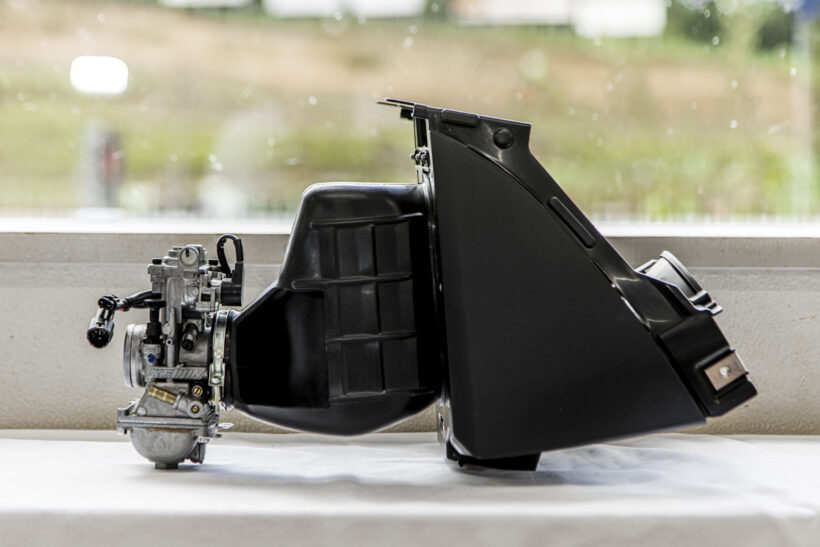
The shop recommends the Keihin PWK28 carburetor as a repair and custom part for the first-generation RZ and RZ-R. The stock air cleaner box can be used, and the kit costs 58,300 yen.
When it comes to customizing RZ-Rs, a few years ago, many vehicles were created with the sole aim of improving power performance, but recently there seems to be an increasing number of cases where customization is done in conjunction with repairs.
“I recommend replacing parts with aftermarket parts if the rear shock absorber is missing, the front brakes don’t have enough stopping power considering modern traffic conditions, the carburetor has a worn body or throttle valve, or the ignition system isn’t performing as well as it should. Sticking to genuine parts like these makes it difficult to enjoy the true potential of the RZ-R.”

When customizing the suspension of an RZ-R at Quality Works, Brembo and Sunstar are the standard for brake-related parts.
You can enjoy the same feeling as with current cars.
If you were to purchase a fully restored RZ-R from Quality Works, how much would it cost?
“It depends on the condition of the base vehicle and how much you want to keep it as stock, but if you’re aiming for a bike that’s as close to new as possible, it’ll probably cost over 1 million yen. However, with the RZ-Rs we’ve sold so far, there have only been a few cases where they were thoroughly restored before delivery. Most customers have chosen to make small adjustments to their bikes after delivery. I personally feel that this approach allows you to enjoy the bike for a long time.”

At the time of this interview, the shop had an RZ250R (1XG) in stock. At first glance, it looks normal, but the suspension parts, including the 17-inch wheels front and rear, have been replaced with parts for a newer Yamaha model.
If there are any riders who read this article and are thinking about buying an RZ-R, what advice would Mr. Yamashita have?
“Some people may have the image that two-strokes from the 1980s are prone to problems or are difficult to maintain, but if they’re properly maintained, they can be enjoyed in much the same way as current models, so if you’re interested, I’d definitely recommend it. Of course, there are other two-strokes produced in the same era that are similar, but in terms of everyday enjoyment, ease of maintenance, and customization possibilities, I don’t think there are many models that can beat the RZ-R.”

Yamashita built his own RG400Γ racer using stock parts from the shop. Yamashita has previously competed in the TOT ZERO1 class on an RG500Γ, winning multiple times.

In addition to the RZ and RZ-R series, Quality Works also receives a large number of RG400/500Γ models. The vehicle in the photo has had its suspension completely redesigned using modern parts.










![The child seat is retro and cute. But the 124cc straight-line leader is the Honda Chari! [Portrait of a 4MINI Enthusiast]](https://motopeek.com/wp-content/uploads/2025/10/4598-1762340867209.jpg)
![Only the frame and tank are genuine! A modified Ape finished with used parts [Portrait of a 4MINI Enthusiast]](https://motopeek.com/wp-content/uploads/2025/10/4604-1762340994544.jpg)