
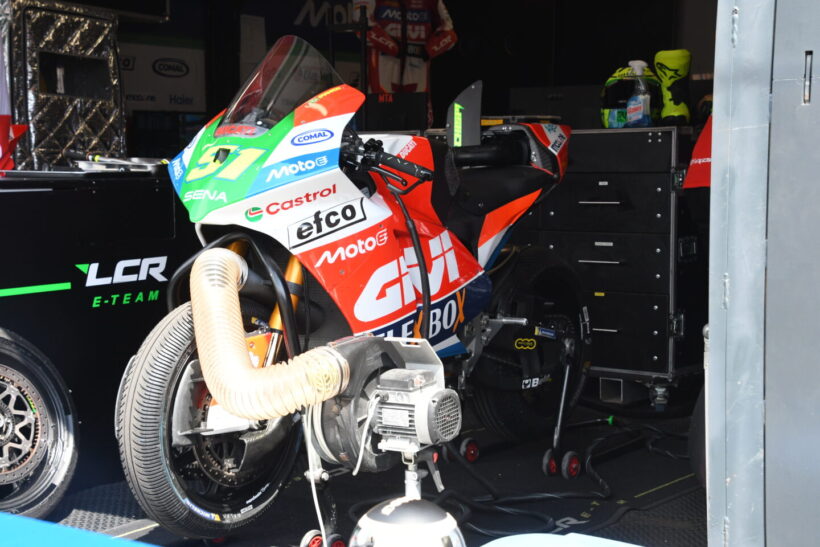

MotoE charging situation
The FIM MotoE World Championship is an electric motorcycle racing championship that began in 2019. The current machines are the V21L electric racer developed by Ducati for MotoE, and the tires are all Michelin (made from sustainable materials).
With two races per round, the 2025 season is scheduled to have a total of 14 races in seven rounds, starting with the French Grand Prix (held in conjunction with the French GP) and ending with the final round in Portugal (held in conjunction with the Portuguese GP). MotoE will be held in conjunction with the European MotoGP, and so far it has only traveled overseas in the UK (2023).
So how much battery life is left in MotoE machines after a race? We investigated the charging situation for MotoE machines at the Austrian event (held in conjunction with the 13th round of MotoGP, the Austrian Grand Prix), held at the Red Bull Ring from August 15th to 17th.
Ducati’s electric racer, the V21L, delivers a maximum output of 110kW (150hp) and a maximum torque of 140Nm. The 2025 model’s battery pack has evolved while output remains unchanged. Cells with improved energy density, from the previous 4.2Ah to 5Ah, have been adopted, and the number of cells making up the battery pack has been reduced by 192 from 1,152 to 960. As a result, the battery pack has become 8.2kg lighter.
Let’s briefly touch on the evolution of charging systems. Each V21L MotoE machine requires an output of 20kW. With 18 cars competing, a total of 360kW is required, with a further 400kW needed for spare machines and other equipment.
Before MotoE started in 2019, MotoE Executive Director Nicolas Goubert asked how much electricity could be supplied to the circuit, but was told, “400kW is absolutely impossible.” As a result, Enel, which has been the title sponsor since 2019, built a special charger with a battery. Enel’s charger makes it possible to charge cars both in the pits and on the grid at any circuit.
However, this situation changed in 2025 when Enel, which served as title sponsor from its first year in 2019 to 2024, withdrew. Enel’s largest shareholder is the Italian government’s Ministry of Economy and Finance (holding 23.6% of the shares), and although it is privatized, the government has influence over the company. When the Italian government changed, Enel’s management also changed, and the current head has expressed his intention to sponsor football.
In 2025, Enel withdrew from the grid, meaning MotoE lost its Enel chargers. However, the situation at the circuits had changed in the six years since. This year’s calendar took into account these circumstances, namely the availability of electricity at the circuits. This is why the 2025 season calendar will have seven races, one fewer than the 2024 calendar.
This season, chargers are being used by EVESCO, the EV charging and energy storage division of American battery technology company Power Sonic. These chargers do not have built-in batteries, and charging is via the EVESCO charger from the circuit’s power grid.
Battery remaining after the race
So, how much battery will actually be consumed at the Red Bull Ring in Round 3 in Austria?
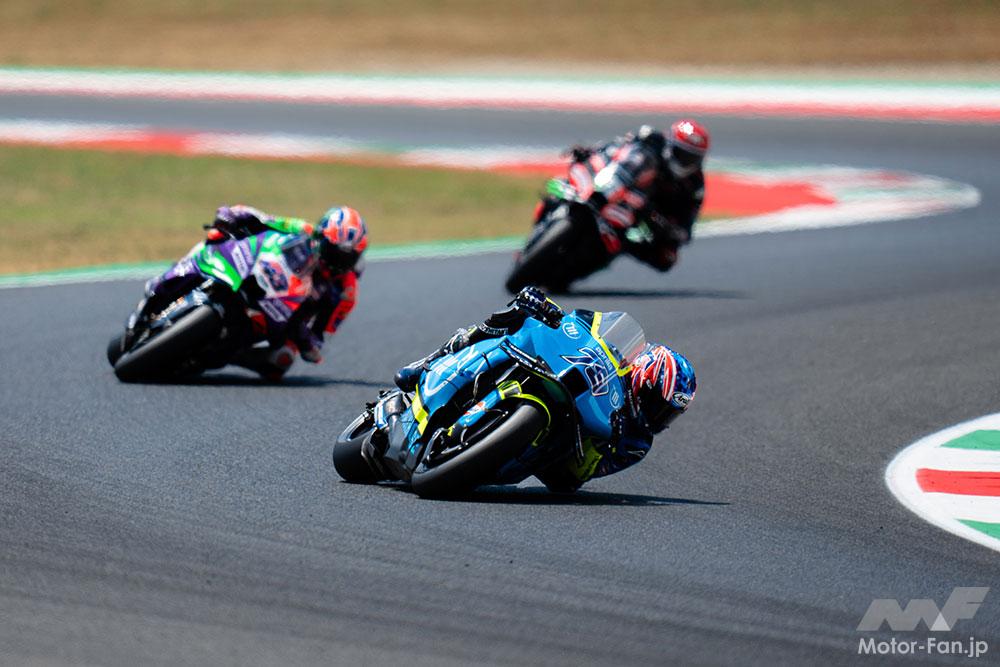
The number of laps in a MotoE race is set at seven to eight. The Austrian race was seven laps. This is set as the number of laps that allows riders to attack and compete at full power from start to finish without having to manage their battery consumption. This is the concept of MotoE. MotoE is not a race where you have to think about the remaining battery power.
Furthermore, until 2024, after the sighting lap, it was possible to charge the amount of electricity consumed during the sighting lap on the grid using an Enel portable charger, but as mentioned above, this season the portable chargers can no longer be used, so charging on the grid will not take place.

On the grid, a small battery powers the tire warmers. The blue box on the right is the battery. It does not charge the car.
After Race 1, which started at 12:10 on Saturday, the battery levels of winner Matteo Ferrari, second-place finisher Hector Garzo and third-place finisher Eric Granado, the 2024 champion, were checked.
The total time for Race 1 was approximately 12 minutes, with Ferrari’s best lap being 1 minute 38.146 seconds, Garzo’s best lap being 1 minute 38.220 seconds, and Granado’s best lap being 1 minute 38.133 seconds. The all-time lap record for the Moto3 class at this circuit is 1 minute 39.639 seconds, and the best race lap is 1 minute 40.048 seconds, so these lap times are slightly faster than the Moto3 class.
After seven laps of racing, Ferrari’s battery was at 27%, Garzo’s at 23% and Granado’s at 23% before charging began.

The winning Ferrari’s battery level is shown on the right. On the left is his teammate’s battery level. Since he returned to the pits earlier than the top three, he started charging first, which explains the difference in battery levels.
ADVERTISEMENT

The remaining battery level of the Garso is shown on the left. Charging started at about 23%.
ADVERTISEMENT
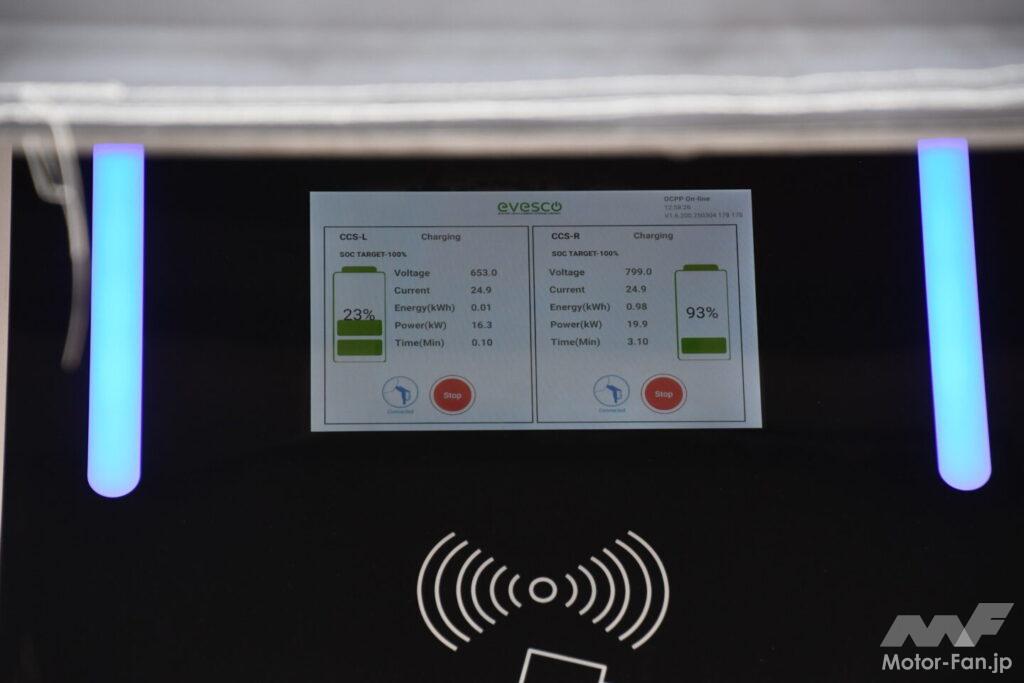
Granado’s battery level is shown on the left. The top three riders’ battery levels are roughly the same.
When I asked the Ducati staff in Paddock E about this, they told me that the Red Bull Ring is not a circuit with particularly poor power consumption, so it’s normal for the battery to be at around 20%. Indeed, when I checked at other circuits, there were some places where the battery was below 10%.
Charging time is approximately one hour. Although the number of battery cells has been reduced, the amount of energy has not changed, so charging time has also remained the same as before. MotoE has two races on Saturday, with Race 1 starting at 12:10 and lasting 12-13 minutes. Charging begins before 1:00 pm, meaning charging will be complete by 2:00 pm at the latest. Race 2 starts at 4:10 pm, so there is plenty of time.
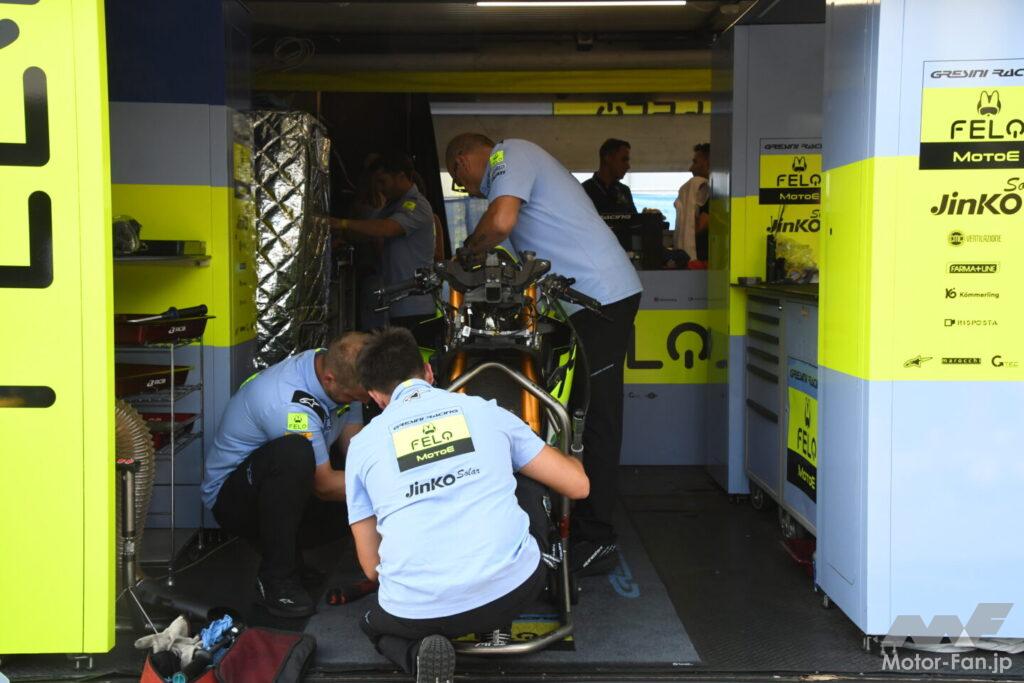
After the race, the mechanics first prepare the car.
The charging situation was a little different for the fourth race in Hungary, which was held consecutively after the Austrian race, as there was a slight shortage of electricity at the circuit.
For this purpose, ten Battery Storage Systems (BBS) will be used. Each one has a capacity of 100kWh and is attached to wheels. They charge the battery outside the circuit, then return and transfer the power (100kWh x 10 = 1MWh) to a larger battery. The battery will then be charged via an EVESCO charger. This will only be available for the Hungarian event.
This time, we focused on the charging situation of MotoE and the actual remaining battery level. It is true that MotoE faces various challenges because it uses an electric motorcycle, a form of mobility that is just beginning to develop, but if you follow it over the years, you can see that there has been definite progress. And this progress is not limited to the circuit.

The “E Paddock” where the MotoE pits are located is a little far from the course, so the machines have to be pushed around like this.
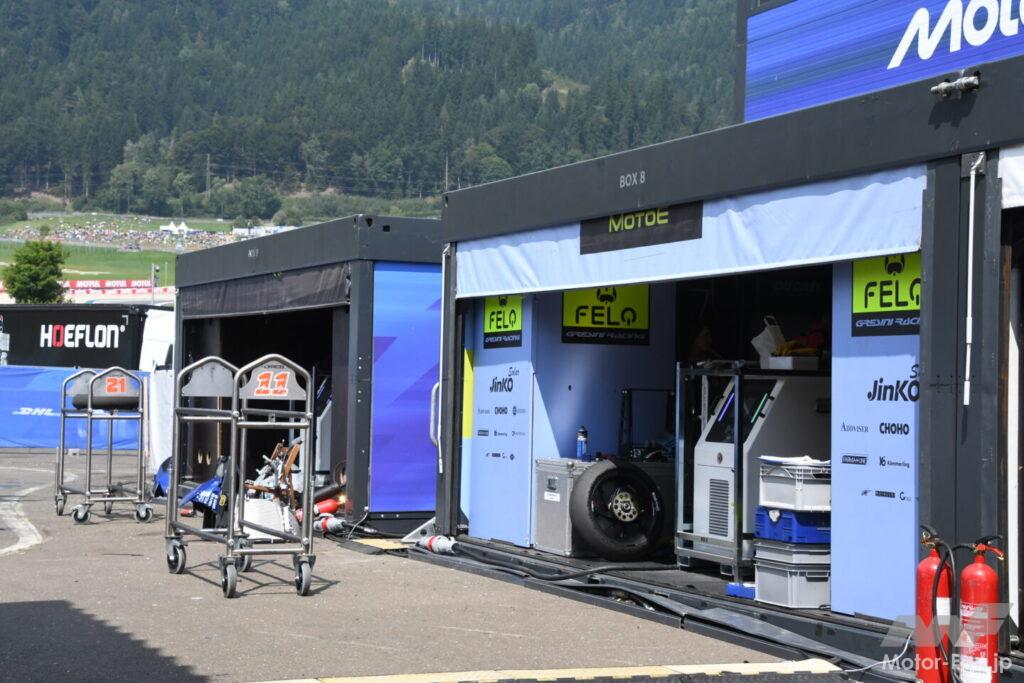
EVESCO chargers are installed behind each pit. Each team has one charger for each of their two cars.