
Original Box, a company that has made a name for itself in the world of four-wheeled vehicles, is proposing a new world of front and rear shock absorbers for two-wheeled vehicles.
I don’t mean to brag, but I consider myself to have a fair amount of experience when it comes to customizing and setting up front and rear suspension for motorcycles. I’ve made some kind of modifications to the front forks and rear suspension of most of the bikes I’ve owned, and I’ve interviewed professional shops for front and rear suspension, as well as test-riding many custom bikes with completely redesigned suspensions. So, what was my impression of the D-Tracker with its original box?

To put it bluntly, I think it embodies the ideal front and rear shock absorbers for motorcycles. What’s more, the improvements that the company made to the stock front and rear shock absorbers were innovative and original methods that did not fit into existing conventional motorcycle concepts.
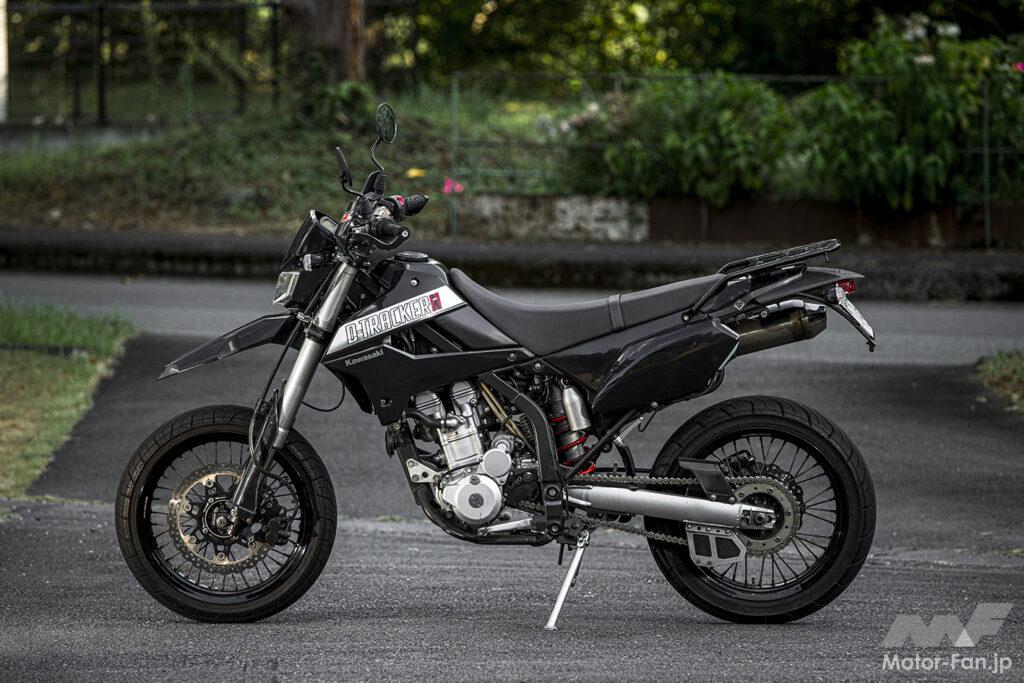
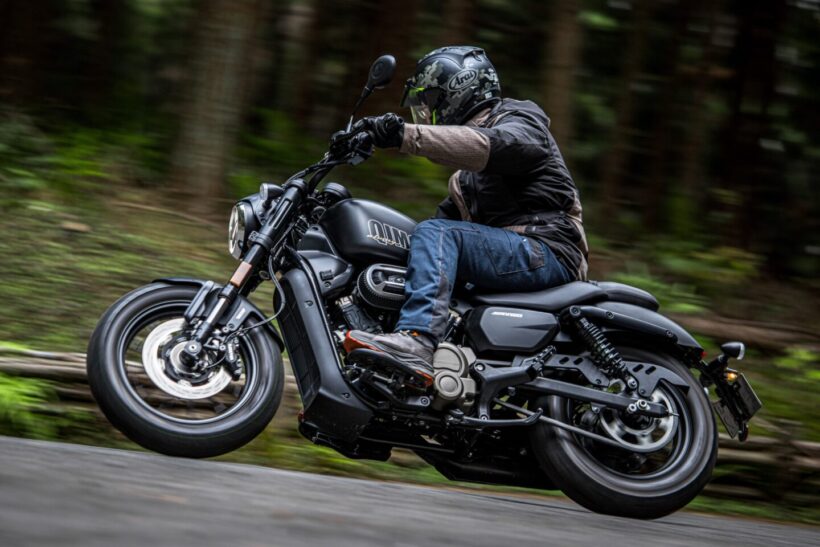
The test vehicle was a Kawasaki D-Tracker X. The front forks were φ43mm inverted type, and the rear suspension was gas pressurized with a reserve tank.
The purpose of this article is to provide details on this in two parts. The actual riding feel will be provided in the second part, which will be released soon, so in this first part, we will introduce the outline of the front fork, which uses a through-rod type pressurized piston, and the rear shock, which has changed the damping force generation mechanism from a disc valve to a poppet valve.
Completely different structure from existing cartridge type
Before we get to the main topic, let’s start with the basic premise: Original Box is a shop that is well-known in the world of four-wheel vehicles, and is particularly known for its shock unit maintenance and tuning, which has earned it tremendous support from drivers and racing teams all over Japan. What was the background behind this shop’s decision to start working on front and rear shocks for two-wheel vehicles?

Kuma Kunimasa is not only a specialist in four-wheel vehicles, but is also well-versed in two-wheel vehicles. In his younger days, he was absorbed in tuning scooters, and in recent years has been competing in four-wheel dirt trials with vehicles that he has built himself.
“That’s simply because my father and I both love motorcycles (laughs). Of course, we know that many manufacturers, both in Japan and overseas, sell motorcycle suspensions, but we thought that if we applied the know-how we’ve accumulated in four-wheel vehicles, we could create a ride feel that had never been seen before. The reason we chose Kawasaki’s D-Tracker X as the development vehicle is because the length of the front and rear suspension strokes is easy to understand, and similar characteristics can be created for other models as well.”
So says Kuma Kunimasa of Original Box. The work he did with his father, Hisao Kunimasa, the founder of the shop, began with the installation of a through-rod type pressure piston inside the front fork. After that was completed, they changed the main damping force generating mechanism from a disc valve to a poppet valve, thus renovating the inside of the rear shock.

A conceptual diagram of a conventional cartridge damper installed inside the front fork. The volume and pressure of the upper and lower chambers change with stroke, and the negative pressure causes cavitation. Illustration: Shigeru Chikada
“The greatest feature of the through-rod pressurized piston is that it hardly generates cavitation (air bubbles), which inhibits the generation of damping force. To be more specific, by not installing a fixed valve at the bottom, but instead attaching a pressurizing piston to the tip of the through-rod, the volume and pressure of the upper and lower chambers inside the cartridge do not change, so negative pressure, which causes cavitation, does not occur.”

The through-rod type pressure piston does not change the volume or pressure of the upper and lower chambers even when it strokes. The pressure piston, which contributes to maintaining positive pressure, is attached to the lower end of the through-rod. Illustration: Shigeru Chikada
When I heard that, the first things that came to mind were Showa’s Balance Free and Ohlins’ TTX. The gas-pressurized suspensions that these two companies have developed in recent years also list suppression of cavitation as an important advantage.

Showa’s Balance Free front fork, sold by Astemo, has a completely different structure from existing products that use cartridge-type dampers, with a gas chamber at the bottom.
“For suspension manufacturers, cavitation is a major enemy. However, in the case of the Balance Free and TTX, a special body with a gas chamber is required, which makes maintenance more difficult and requires the oil seal to be tightened (as gas is used to pressurize the interior), but the through-rod pressure piston is used in place of the existing cartridge, so there is no need for special bodies or oil seals, and maintenance can be carried out in the same way as with regular front forks.”
The unique advantages of poppet valves

ADVERTISEMENT

A cutaway model and exploded photo of a disc valve, which has become standard in high-performance front and rear shock dampers in recent years (the latter is not for the D-Tracker X).
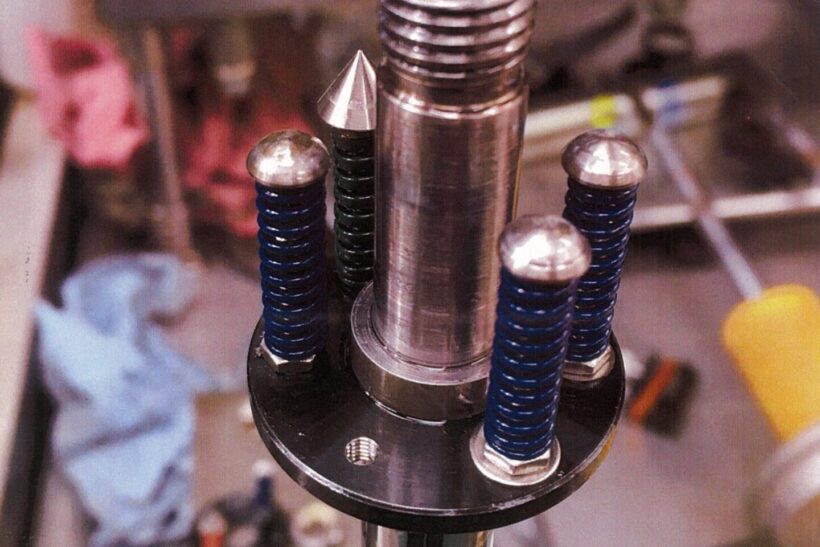
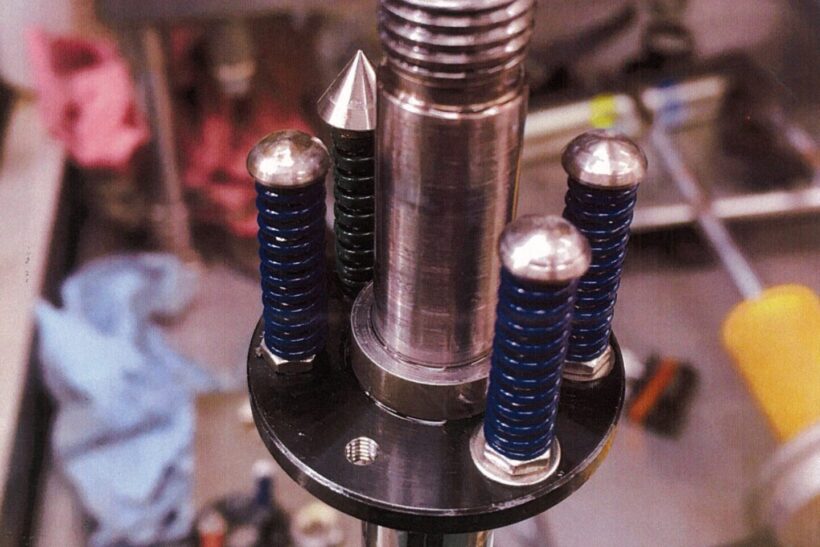
Next, let’s talk about the rear suspension. Conventional disc valves use donut-shaped, extremely thin plates stacked above and below a piston with complex holes, with the “warping” of these plates being the main source of damping force, whereas the source of damping force for poppet valves is the “gap” between the straight hole in the piston and the hemispherical/conical material. Also, while settings for disc valves are made by disassembling the body and changing the stacking method, number, outer diameter, and thickness of the plates, for poppet valves, the key to adjusting the damper characteristics is the rate and preload of the spring that supports the hemispherical/conical material.

This time we are focusing on the poppet valve, but the original box uses DLC coating as a means of reducing the friction resistance of the disc valve.
“For several decades, disc valves have played a major role in generating damping force in high-performance suspensions above a certain level. However, when you consider the frictional resistance of stacked plate materials, disc valves are not necessarily the best. That’s why we turned our attention to poppet valves. However, we wanted theoretical support before introducing them, so we had the Computational Fluid Dynamics Institute, Inc. analyze the differences between the two types of valves. They confirmed that poppet valves outperform disc valves in terms of good responsiveness and low temperature dependency.”

ADVERTISEMENT

Poppet valves currently being produced for the original rear suspension of the D-Tracker X. In the photo above, all of the valves are facing upwards, but in reality half of the valves face upwards and half face downwards.
Responsiveness and temperature dependency are also important themes for shock manufacturers, and looking at the diagrams and graphs produced by the Computational Fluid Dynamics Institute, it is clear that povette valves have performance that surpasses that of disc valves. However, can the average rider experience the benefits that come from the difference in structure?

A simulation diagram of oil flowing through the gap between the piston hole and the poppet valve, conducted by the Computational Fluid Dynamics Institute, Inc.
ADVERTISEMENT
“I think it’s possible. The beauty of the technology we initially proposed is that, while we have circuits and motocross courses in mind, it was primarily developed for the street. For example, with regard to temperature dependency, some people may think that it’s for racing, where heat dissipation while riding is a major issue, but by introducing a poppet valve, changes in damping force caused by temperature fluctuations are greatly reduced (normal shock absorbers become softer in summer and harder in winter), so you can get stable characteristics all year round.”

This is compression and extension damping force data for the D-Tracker’s stock rear suspension (disc valve type), measured using a shock dyno at temperatures of 0, 20, 50, 80, and 100°C. The damping force on the upper extension side varies greatly depending on the temperature.

This is compression and extension damping force data for the stock rear suspension of the D-Tracker X with a poppet valve installed. A simple comparison cannot be made because the conditions are different (measured at 20/50/80/100°C), but there is almost no change in damping force due to temperature differences.
I was very impressed by what Kuma had to say, and it occurred to me that it was strange that through-rod pressurized pistons and poppet valves had not become widespread in the world of front and rear shocks for two-wheeled vehicles up until now (putting aside the presence or absence of pressurized pistons, there are examples of through-rod suspensions, and poppet valves have been adopted in some four-wheeled suspensions).
“I’m not sure why, but I’ve always found it strange that there is so little technical exchange between two-wheeled and four-wheeled vehicles. In fact, when a company whose main business is four-wheeled vehicles starts working on two-wheeled suspension, some people wonder why. However, as someone who is in contact with a wide variety of front and rear shock absorbers for four-wheeled vehicles on a daily basis, I feel that there is still room for improvement in front and rear shock absorbers for two-wheeled vehicles, so I made this modification as an example of that.”