
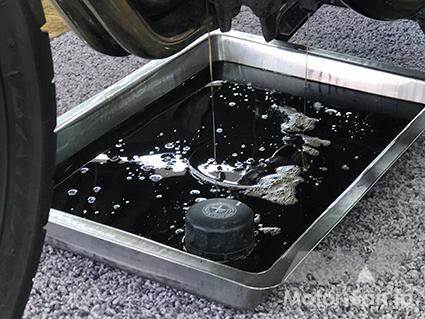
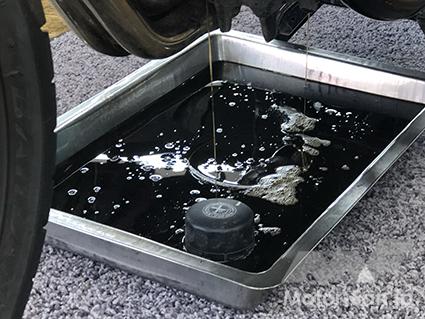

I think everyone’s motorcycle life is different. However, every motorcycle needs an engine oil change. As we all know, engine oil plays an important role.
In addition to the five functions that keep the engine in good working order — lubrication, cooling, sealing, cleaning and dispersion, and rust prevention — oil also has a similar effect on the transmission and clutch. It also has a buffering and acid-neutralizing effect.

Although I don’t do any noticeable customizations or tuning on my bike, I’ve always been particular about engine oil. I always change the oil every season, even if I don’t drive it that much. I also change the oil every 4,000km on my CB1300SF, and every 1,000km on my CT125, which is used frequently and requires a lot of gear changes.
So, what do you look for when choosing engine oil? First, viscosity. I think the viscosity of the stock oil is the standard, and it’s changed depending on the season or to improve performance. Next is the grade. This is determined by the JASO standard, and most people would choose MA or higher, especially MA2 for high-performance bikes.
There is also the difference between mineral oil and synthetic oil. These days, unless you have an older car, you may not choose mineral oil. If you are going to replace your engine oil, many people may choose synthetic oil. However, the difference between mineral oil and synthetic oil is actually not clear, and there are manufacturers that sell products using Group 3 base oil as mineral oil and manufacturers that sell them as synthetic oil, so the definition is sometimes vague.
In any case, users will likely distinguish between oils based on these differences, but it is well known that even if there are two types of “10W-40” and “MA2” oil, for example, they do not have the same performance. Because the so-called ingredients, such as base oil and additives, vary depending on the manufacturer and product, it can be difficult to find the one that suits your car and your preferences.
My current bikes are a CB1300SF and a CT125, and I used to use different oils for them. However, at one point I also had an F800GS, so I bought a 20L oil can (10W-50 MA2) and made them all use the same oil.
This worked reasonably well on all the bikes, but one problem arose: the gear change feel on the CT125 was no longer as good. It’s true that the movement when you stepped on the pedals felt smooth, but the clicky feeling of control was gone.
There used to be a saying that “heavy oil is best for Cubs.” This was because using expensive oil could cause problems like the centrifugal clutch slipping due to the additives. For this reason, Honda’s former basic oil, “G1 (semi-synthetic oil),” was said to be the most compatible.
However, recently, manufacturers have been reviewing the performance of oils and developing engines based on that, so it is said that this is no longer the case. Honda has also revamped its former G1 into a product called “Honda Pro Standard.”
So I asked the staff at Honda Dream Ogikubo, who have been so kind to me, about this.
“Compared to the past, I think there are fewer incompatibilities like this, but there are still differences in additives depending on the oil, which affects not only the engine but also the feel of the clutch and transmission. I’m sure each owner will feel it differently, but it’s undeniable that if you put the same oil as a CB1300SF into a CT125, you’ll notice a strange feeling in the gear pedal operation.”
So, this time I chose a high-performance motorcycle oil (10W-40 MA2) from a Japanese manufacturer and put it in both models. The CT125’s engine and gears felt better, but the CB1300SF’s feeling was not bad, but was rather vague.
The engine rotation feels more frictional, and the gear pedal feels stiff. This is especially true since the CB1300SF is equipped with a quick shifter. The viscosity should be lower, but that doesn’t necessarily mean the feeling is milder.
Of course, it’s not that the oil’s performance is bad, but it works well with the CT125, but not so well with the CB1300SF. This reminds me of the words of the motorcycle shop staff mentioned above.
“They say that if you start getting too picky about oil, you’ll get stuck in a quagmire, but to get a feeling that you’re satisfied with, it might be a good idea to change the oil for each bike. The compatibility with oil varies depending on the engine model and displacement. Trying to find that compatibility can get you stuck in a quagmire of oils.”
Since I just bought a pail, I’ll be using this oil for the time being, but the next time I go on a long tour, I might decide to change the brand. However, I personally find this oil quagmire fun. The effect of changing engine oil is not a placebo effect; there is definitely a difference compared to before the change. This is even more noticeable when changing the brand.
By the way, some manufacturers state that mechanical problems caused by not using genuine oil are not covered by the warranty, so please be aware that if you use aftermarket products, you do so at your own risk.










![The child seat is retro and cute. But the 124cc straight-line leader is the Honda Chari! [Portrait of a 4MINI Enthusiast]](https://motopeek.com/wp-content/uploads/2025/10/4598-1762340867209.jpg)
![Only the frame and tank are genuine! A modified Ape finished with used parts [Portrait of a 4MINI Enthusiast]](https://motopeek.com/wp-content/uploads/2025/10/4604-1762340994544.jpg)