

Ninja 7 Hybrid… 1,848,000 yen

Although the car is called the Ninja 7 Hybrid, this model is classified as a strong hybrid because it can run on the motor alone. If the motor is used solely for assist, it is classified as a mild hybrid.
I was impressed by the perfection of the electronically controlled automatic clutch.

The front mask has an atmosphere similar to that of the Ninja 400 and Ninja 600, but the river mark in the center of the upper cowl is proof that it is a high-performance vehicle that Kawasaki has put the latest technology into. Existing models that use this mark include the H2 series and ZX-10R/RR.
I didn’t mention this in the first article because it might have made things complicated, but the Ninja 7 Hybrid is the world’s first strong hybrid bike, and Kawasaki’s first vehicle to feature an electronically controlled automatic clutch and paddle shifters.
Moreover, Eco HV mode has two types of transmission systems: a 6-speed manual shift and a 6-speed automatic (Sport HV mode only has a 6-speed manual shift, and EV mode only has a 4-speed automatic).

Incidentally, in recent years, the world of motorcycles has seen a revolution in clutches and transmissions, with Honda beginning to introduce E-clutches in addition to their existing DCTs, and Yamaha and BMW showing a positive attitude towards electronically controlled clutches and automatics.
However, I have never found manual shifting to be a hassle, so I’m not entirely happy about such a convenient mechanism…

In the case of this bike, the electronically controlled automatic clutch + paddle shift and automatic transmission match the characteristics of the power unit and I think they contribute greatly to its advanced and original nature.
However, while I was impressed with the paddle shifters, which allowed for smooth up and downshifts, I initially had doubts about the automatic’s shift timing (it upshifted too quickly immediately after starting, and tended to want to maintain a higher gear while driving, making downshifts a bit rough when slowing down strongly), but once I got used to it, I thoroughly enjoyed how easy it was to shift.

The Ninja 7 Hybrid’s electronically controlled automatic clutch not only interrupts power transmission, but also adjusts the distribution of power produced by the engine and motor (and, more importantly, is the core of the regenerative system that stores power in the battery), but its operation feels completely natural, and there is absolutely no sense of discomfort while driving.
This is the first time this mechanism has been adopted, and I think it’s amazing that they’ve managed to achieve such a high level of perfection.
If you stick to eco-driving, you can achieve 37.1km/L.

Hybrid = high fuel efficiency. This is the accepted wisdom in society.
It’s true that the Ninja 7 Hybrid’s fuel economy is quite good, with an actual measured 28.7km/L in Eco HV mode (24.7km/L in Sports HV mode), but when you consider that the Ninja 400, which we previously covered in a serious 1000km test drive, recorded a total of 29km/L, it does feel a bit disappointing.

So, with eco-driving in mind, we drove about 140km around town, mainly in EV mode… (when the battery level got low, it would run automatically in Eco HV mode to restore power), and recorded a better-than-expected figure of 37.1km/L.  The sense of accomplishment we could get from taking on such a challenge is one of the unique charms of the Ninja 7 Hybrid.
The mobility and comfort are lacking…

So, although I was very impressed with the power unit (details on the engine and motor were published in the first article), the handling on mountain roads was not particularly outstanding.
When entering a corner, you feel a strong tendency for the front end to lean inward, and when leaning the body over, the weight of the motor above the transmission and the battery under the seat is felt physically and mentally, making it difficult to take bold action. Also, because the wheelbase is very long, I encountered several situations where I felt like the car was not turning as well as expected in the latter half of the corner.

The steel trellis frame is specially designed. Above the transmission is a drive motor that produces 12ps and 3.7kgf-m, and under the seat is a 50.4V lithium-ion battery (13.4kg).
Also, perhaps to avoid the large changes in posture caused by the car’s weight, the front and rear suspension settings were a little stiff, which caused a dull pain in the arms, legs and hips towards the end of a long run.

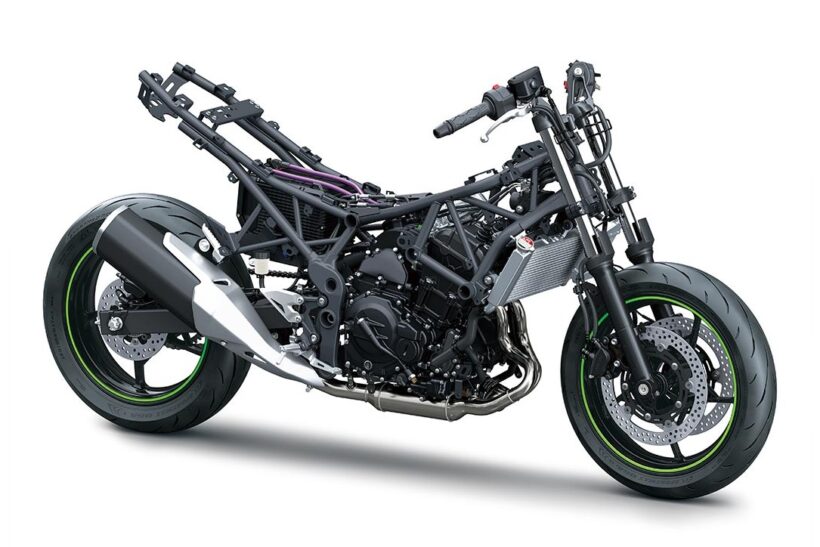
The stripped-down Ninja 400. Compared to the Ninja 7 Hybrid, it looks much cleaner.
While I was trying to understand the behavior of these vehicles, the vehicles that came to mind were the Ninja 400 and Ninja 650, which are natural and light in any situation and offer the turning ability unique to parallel twins on winding roads.

Although I think that it is not appropriate to compare the two bikes because they are different in both characteristics and price, the maneuverability and comfort of this bike are not as good as the existing Ninja 400 and Ninja 650.
By the way, the weight and wheelbase of each vehicle are Ninja 7 Hybrid: 228 kg, 1535 mm, Ninja 400: 167 kg, 1370 mm, Ninja 650: 194 kg, 1410 mm.

The positives outweigh the negatives
However, I personally thought that this was a trivial matter. I know that writing this might make some people question what I’m talking about, considering that I’m usually someone who writes about handling and comfort.

For me, the positive aspects that a strong hybrid, electronically controlled automatic clutch, paddle shifters, and automatic transmission provide to the rider far outweigh the negative aspects.

Regarding the new innovations adopted by the Ninja 7 Hybrid, I initially thought it might be interesting because it was a fresh combination that I had never experienced before, but during this test drive I didn’t feel bored at all.
That said, the freshness of the bike may gradually fade as I become the owner and the mileage increases, but right now I feel like I want to praise Kawasaki for opening up a new world for two-wheeled vehicles, and if I have the opportunity in the future, I would like to try riding this bike in more different situations.

Looking at the rear suspension area, it looks like the swingarm could be made shorter. On the other hand, I think the reason the development team made the swingarm longer was to ensure stability, optimize the front/rear weight distribution, and counter the e-boost for powerful acceleration.
*In the third installment, which will be published soon, the author will explain each part from his own unique perspective, as well as introduce the actual fuel consumption measured after driving approximately 1,000 km.
 Who would have thought that an engine and a motor could create such an interesting bike? | Ninja 7 Hybrid 1000km Test Drive [1/3] | Motor-Fan [Motor Fan] A media platform that distributes automotive-related articles
Kawasaki Ninja 7 Hybrid… ¥1,848,000 Kawasaki’s innovation and originality I’ve been working in the motorcycle media for almost 30 years, and recently I’ve been feeling less and less excited and thrilled when I see photos and specs of new models.
Main specifications
Model: Ninja 7 Hybrid
Model: 8AL-CX500A
Length x Width x Height: 2145mm x 750mm x 1135mm
Wheelbase: 1535mm
Ground Clearance: 130mm
Seat Height: 795mm
Caster/Trail: 25°/104mm
Engine Type: Water-cooled 4-stroke parallel twin
Valve Type: DOHC 4-valve
Total Displacement: 451cc
Bore x Stroke: 70mm x 58.6mm
Compression Ratio: 11.7
Maximum Engine Output: 43kW (58ps) / 10500rpm
Maximum Engine Torque: 43N・m (4.4kgf・m) / 7500rpm
Maximum Motor Output: 9k W (12ps) / 2600-4000rpm
Motor maximum torque: 36N・m (3.7kgf・m) / 0-2400rpm
System maximum output: 51kW (69ps) / 10500rpm
System maximum torque: 60N・m (6.1kgf・m) / 2800rpm
Starting method: Self-starter
Ignition method: Full transistor
Lubrication method: Wet sump
Fuel supply method: Fuel injection
Transmission type: Constant mesh 6-speed return
(automatic with electronically controlled manual mode)
Clutch type: Electronically controlled
Gear ratio
1st gear: 2.235
2nd gear: 1.8000,
3rd gear: 1.500,
4th gear: 1.240
, 5th gear: 1.074
, 6th gear: 0.964,
1st and 2nd reduction ratios: 2.218, 3.071,
Frame type: Diamond (Trellis),
Front suspension: Telescopic upright type φ41mm
, Rear suspension: Swing arm monoshock,
Front tire size: 120/70ZR17,
Rear tire size: 160/60ZR17,
Front brake: Hydraulic double disc,
Rear brake: Hydraulic single disc,
Vehicle weight: 228kg
, Fuel: Unleaded premium gasoline,
Fuel tank capacity: 14L,
Seats: 2,
Fuel consumption rate (MLIT notification value): 31.0km/L (2 passengers, SPORT-HV),
Fuel consumption rate (WMTC mode value, class 3-2): 23.6km/L (1 passenger, SPORT-HV)










![Ninja 7 Hybrid achieves 37.1km/L in EV mode + Eco HV mode. 1000km serious test drive [3/3]](https://motopeek.com/wp-content/uploads/2025/10/1554-1761125544457.jpg)
![Ninja 7 Hybrid achieves 37.1km/L in EV mode + Eco HV mode. 1000km test drive [3/3]](https://motopeek.com/wp-content/uploads/2025/10/1607-1760788566523.jpg)