
![1989 Honda NSR250R | 1/12 scale pre-painted and assembled model in two genuine colors! [Aoshima]](https://motopeek.com/wp-content/uploads/2025/06/2501-1760840202119.jpg)

NSR250R joins the “PROSPEC EVOLUTION” complete bike series!
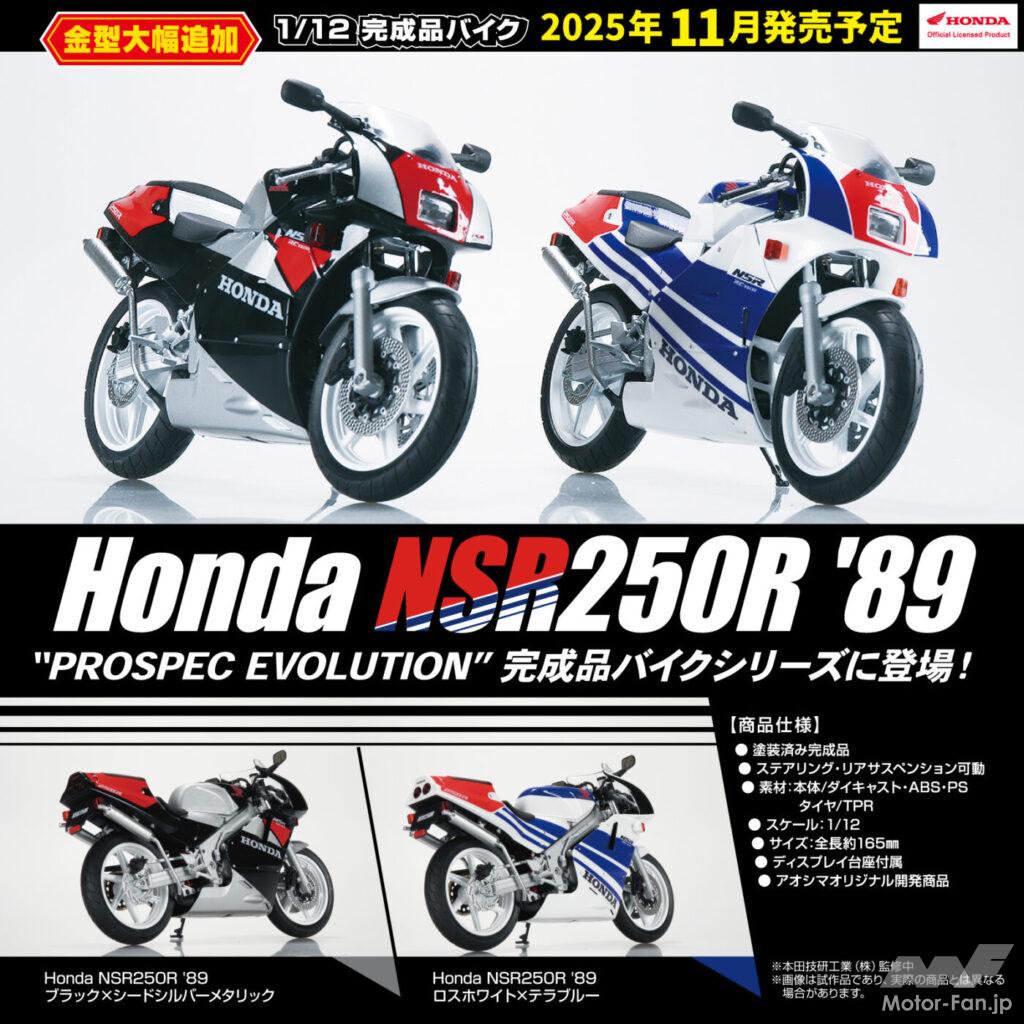
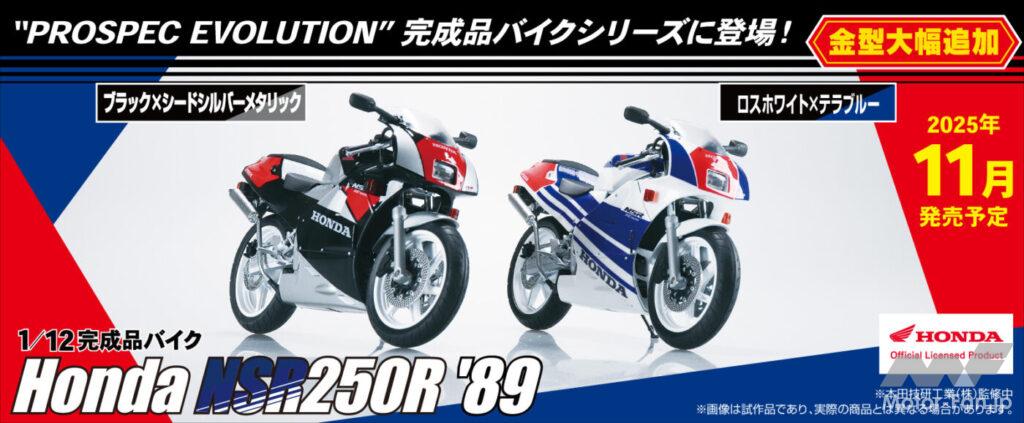
The Honda NSR250R is a full-fledged sports model equipped with a water-cooled, two-stroke, 250cc engine that was released in 1986. This vehicle gained popularity not only for city riding but also on circuits and mountain passes, and was a long-selling model that was produced until the 1996 model.
The NSR250R series has continued to evolve, changing its shape and components to suit the times. The MC18 NSR250R, which was released in 1989 with a completely new cowl design, is now joining the complete bike series.
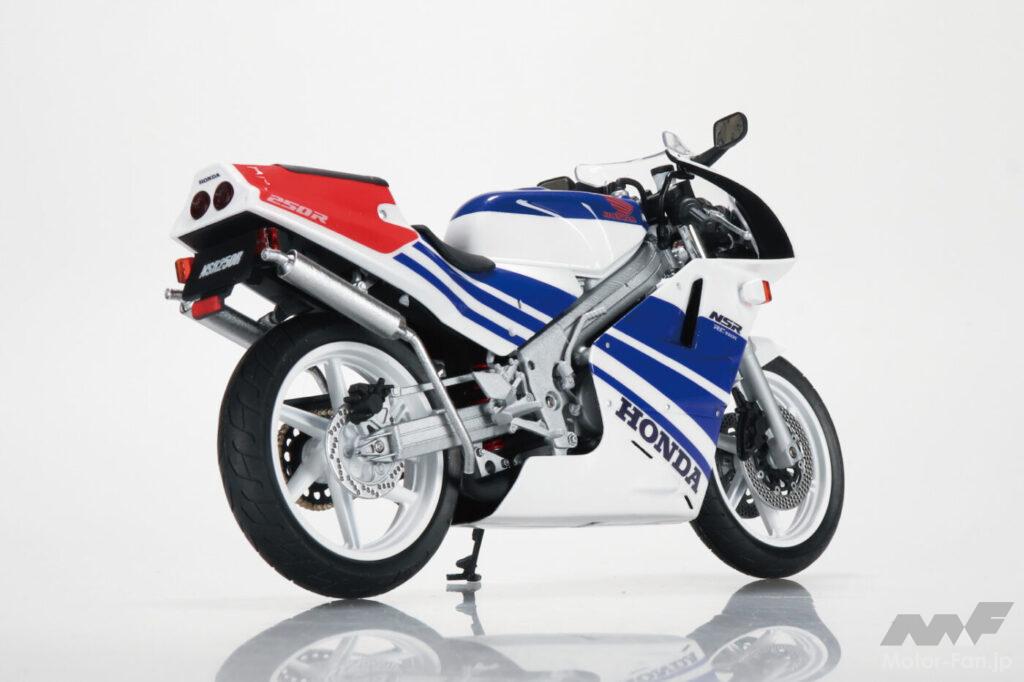
The silhouette unique to the 1989 model is faithfully reproduced, including the distinctive cowl shape, swingarm with pentagonal cross-section pipes, and color pattern. Die-cast parts are used for the frame and gas tank, resulting in a finished model with a high level of weight and texture. Two genuine colors from the time of release are available.
Aoshima 1/12 scale completed Honda NSR250R ’89 bike… 4,620 yen (tax included)
Black x Seed Silver Metallic
ADVERTISEMENT


Ross White x Terra Blue
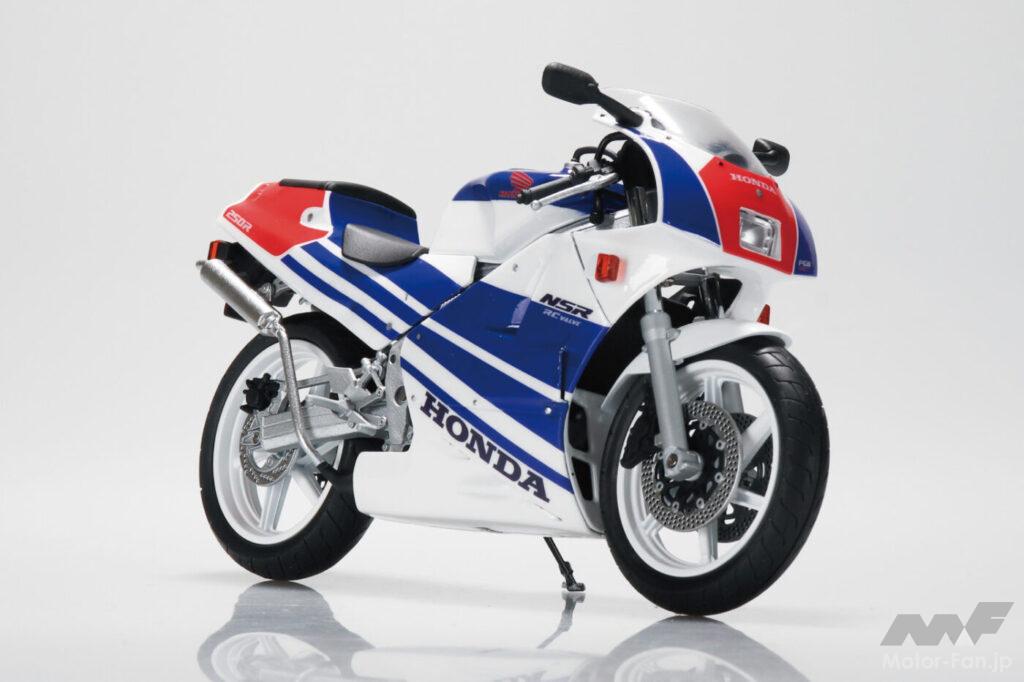
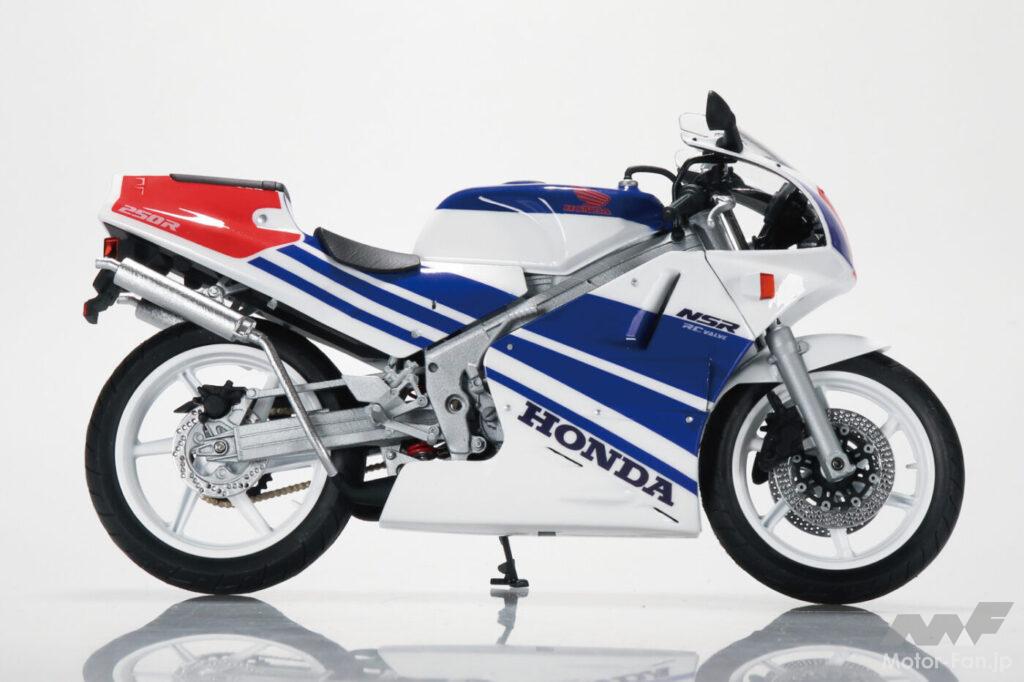
Product specifications
Price: 4,620 yen (tax included)
Release date: November 2025
Publisher: Skynet
Distributor: Aoshima Bunka Kyozai Co., Ltd.
– Pre-painted, finished product
– Scale: 1/12
– Size: Approximately 165mm in length
– Steering and rear suspension are movable
– Materials: Body: Die-cast, ABS, PS – Tires: TPR
– Display base included
– Aoshima original product
– Body colors: Black x Seed Silver Metallic, Ross White x Terra Blue
*The image is a prototype. It may differ from the actual product.
*Under supervision of Honda Motor Co., Ltd.
The Honda NSR250R, released in 1986 during the motorcycle boom
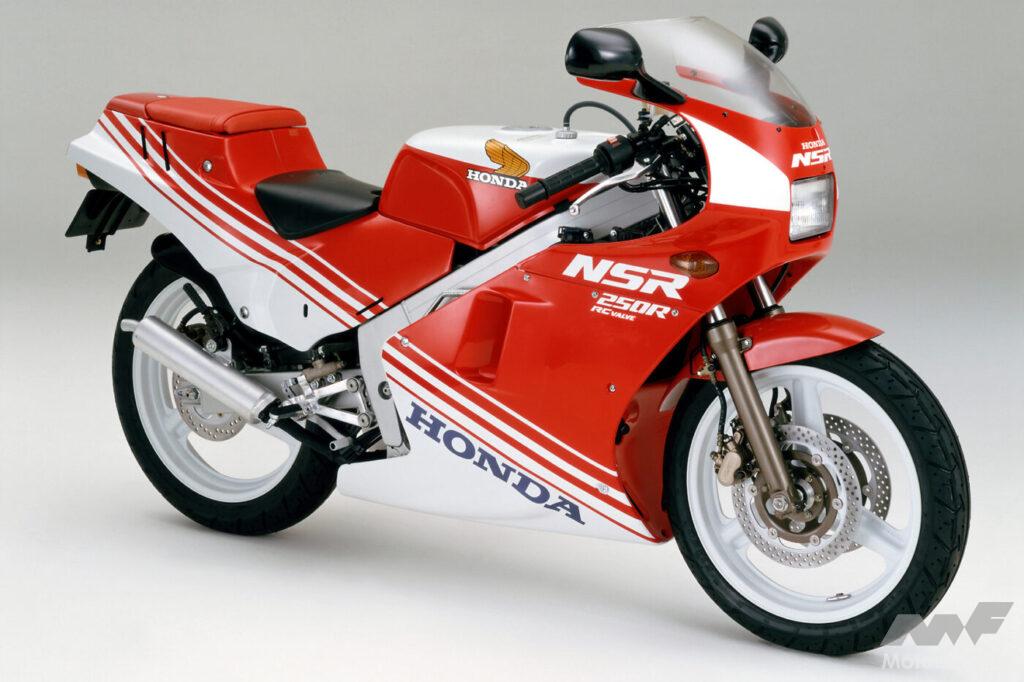
The photo shows the early model Honda NSR250R that was released in 1986.
ADVERTISEMENT
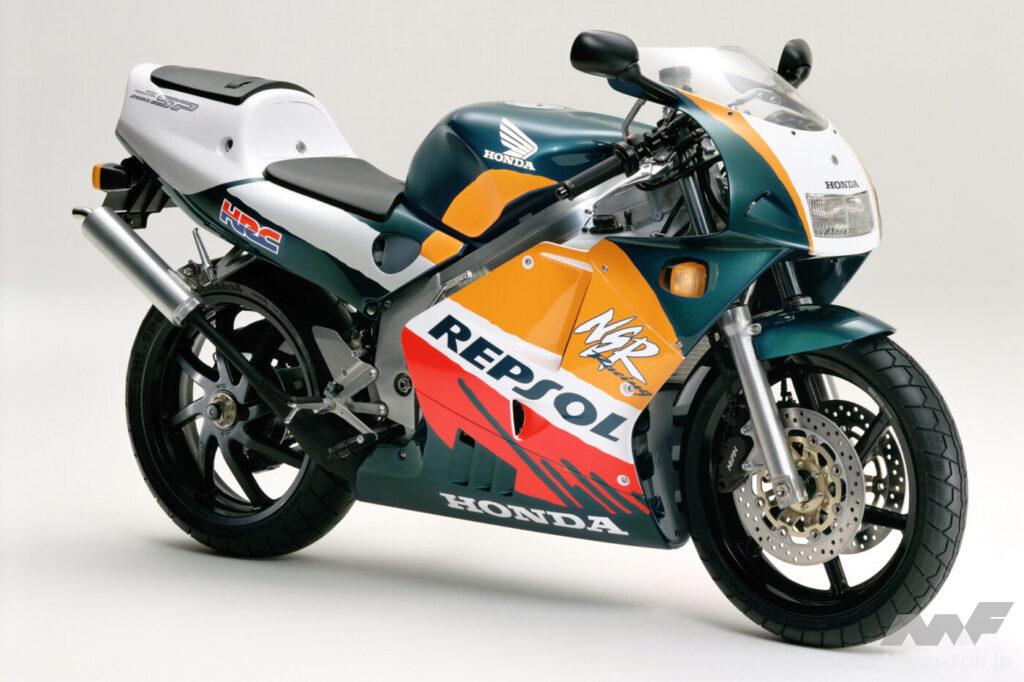
The photo shows the final model of the Honda NSR250R, which was released in 1996.
The Honda NSR250R was released in 1986 (Showa 61), amid the boom in motorcycles and racer replicas. It was a long-awaited 2-stroke 250cc model released by “4-stroke Honda” to take on the Suzuki RG250Γ (Gamma), a pioneer in the racer replica boom, and the TZR250, the successor to the Yamaha RZ250, which laid the foundation for the mid-range 2-stroke boom.
This bike achieved a “perfect” level of completion, which was the catalyst for Honda and Yamaha winning the so-called “HY Wars” in which they competed for domestic sales. It was based not on the NS250R, a racer replica model released in 1984 (Showa 59), but on the Honda Works RS250RW, which won the World GP 250cc class championship.
Aiming to create “the ultimate 2-stroke 250cc model that surpasses other companies’ models without any compromise,” the bike was given a completely new design of exterior parts, frame, front and rear suspension, and engine that was as close to a works racer as possible, showing Honda’s determination to go “this far!”
The engine is a water-cooled, two-stroke, V-twin, 249cc, with a reed valve crankcase, and a semi-long stroke with a bore diameter of 54.0mm and a stroke length of 54.5mm. The maximum output is 45ps/9500rpm, which is the full power of the 2-stroke 250cc domestic manufacturer’s self-imposed restrictions (from the 1993 model, the power was reduced to 40ps due to self-imposed restrictions by domestic manufacturers). The NSR250R’s potential is great, and by changing the aftermarket sports chamber and changing the carburetor settings, a significant power increase could be easily achieved.
The dry weight of the initial model was 127 kg. With a lightweight body and a powerful two-stroke engine with instantaneous power, the NSR250R was a bike that was suitable for a select few riders due to its high performance, and it demonstrated the potential to overwhelm other companies’ models not only on city streets but also on mountain passes and circuits. It was a long-selling model that evolved with each minor and full model change until production was discontinued with the 1996 model due to exhaust gas regulations.
The 1989 model was an ultra-high-spec model that further evolved from the “Hachi Hachi (1988 model).”
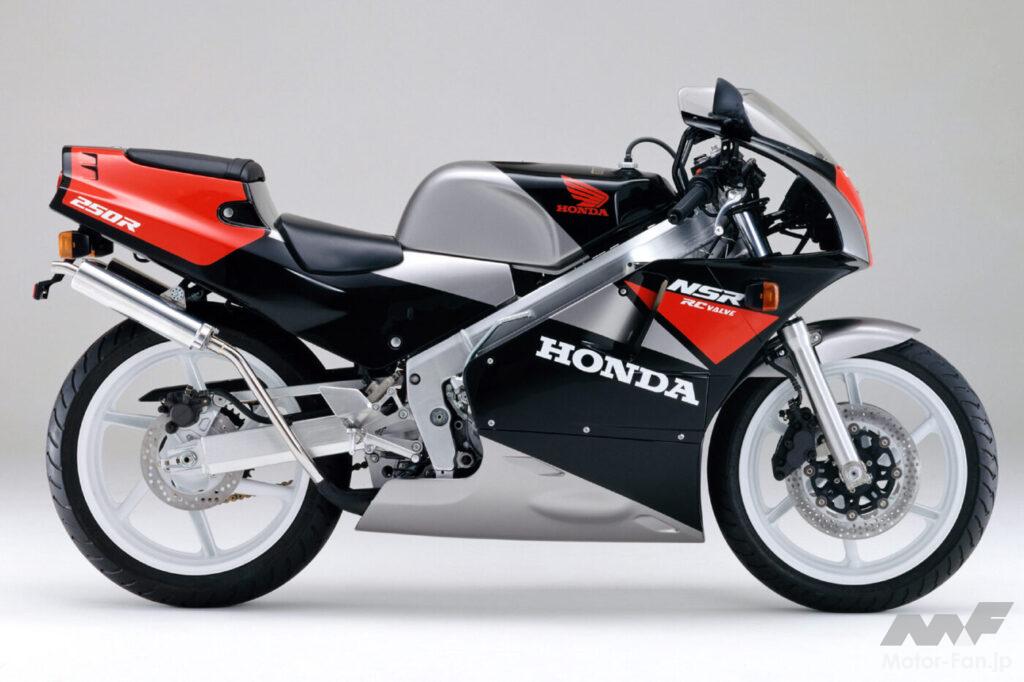
1989 Honda NSR250R (Black x Seed Silver Metallic)
ADVERTISEMENT
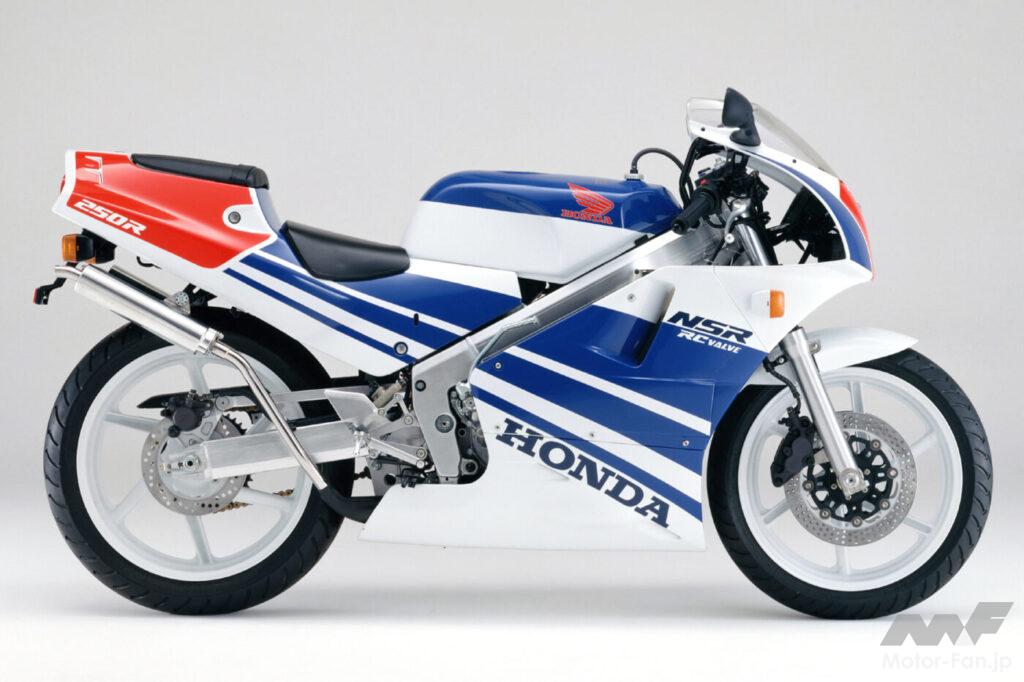
1989 Honda NSR250R (Ross White x Terra Blue)
The 1988 model MC18 is known as “Hachi Hachi” among NSR250R enthusiasts and is respected as a legendary model among all the NSR250R models. The 1989 model was released as an evolved version of the “Hachi Hachi”, with changes to the front cowl design, etc. The changes from the 1988 model are as follows:
In order to efficiently transmit engine power to the rear wheels, a close-ratio transmission is used, with the gear ratios of each gear closely matched.
The carburetor’s control unit detects engine speed and throttle opening, and opens and closes the air jet with a solenoid valve.The system also optimizes the intake mixture during transient conditions, and a new “PGM Carburetor II” with two variable air jets has been adopted to provide more precise air-fuel ratio control.
The ignition system uses a map-controlled digital ignition system that detects and calculates engine speed, throttle opening and speed, and can set the optimum ignition timing. The 1989 model introduced the “PGM Ignition II,” which independently calculates the ignition timing for two cylinders, enabling the setting and supply of appropriate ignition timing for each combustion chamber.
The exhaust system adopted a variable exhaust port valve system that changes exhaust port timing according to engine speed, improving filling efficiency. The 1989 model introduced a new map-controlled “PGM RC valve” that added throttle opening detection and calculation functions.
In addition to Honda’s unique aluminum twin-tube frame, which uses irregular pentagonal cross-section material with an extremely thick “eye” structure, a new aluminum pentagonal cross-section material is also used for the rear swing arm, promoting high rigidity.
The rear tire size has been increased (from 140/60R18 to 150/60R18), and the rim size has been widened from 4.00×18 to 4.50×18.
The rear brake has been changed from a disc caliper to a floating type, improving handling when braking. In line with these improvements to the suspension, the body geometry has also been changed, with the caster angle changed (from 24 degrees to 23 degrees 15 minutes) and the wheelbase shortened (from 1,355 mm to 1,345 mm), resulting in a lighter, sportier handling feel.
The styling has been changed to a new design with a low and long slant nose full fairing, and a slim and long tail-up exhaust expansion pipe has been adopted. Furthermore, the mounting holder (with luggage hook) on the rear step has been made neat and storable, further emphasizing the simple and light styling.
 When it comes to the Honda NSR, it’s all about Rothmans! The NSR80 and NSR250R-SP are still coveted. [Monthly Moto Champ December 2019 Issue] | Motor-Fan Bikes
Although it is unthinkable in recent years, in the racing world of the 1980s and 1990s, many tobacco manufacturers served as main sponsors. Among them, the British company Rothmans, which had a partnership with Honda, left a strong impression on the riders of the time. PHOTO: Masahiko Watanabe REPORT: Tomohiko Nakamura
ADVERTISEMENT
 The HachiHachi NSR comes in three colors. From Aoshima! This is a 1/12 scale painted and assembled model of the Honda NSR250R/R-SP.
Aoshima Bunka Kyozai Co., Ltd. (Aoshima), well-known for its plastic models and hobbies, will release the Honda NSR250R (1988 model) from its 1/12 scale completed motorcycle series under its brand “SKYNET” in September 2024 (planned). The 1988 model, the MC18, is known as “Hachi-Hachi” among NSR250R enthusiasts and is respected as a legendary model among all the NSR250R models. We will introduce the Hachi-Hachi along with its features. REPORT●KITA Hideaki Aoshima https://www.aoshima-bk.co.jp/
 Realistic reproduction! Aoshima’s 1/12 scale Hunter Cub. Available in four colors! JA65 Complete Model
Aoshima Bunka Kyozai Co., Ltd. (Aoshima), well-known for its plastic models and hobbies, has added the Honda CT125 Hunter Cub (2nd generation 2022 model), a popular moped for outdoor activities and solo camping, to its 1/12 scale completed motorcycle series under its brand “SKYNET.” It comes in four colors and is scheduled for release in October 2025. REPORT ● KITA Hideaki Aoshima Bunka Kyozai Co., Ltd. https://www.aoshima-bk.co.jp/
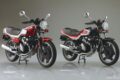 A miniature version of a rare, out-of-print motorcycle! Honda CBX400F (2nd generation) 1/12 scale completed model | Aoshima
Aoshima Bunka Kyozai Co., Ltd. (Aoshima), a company well-known for its plastic models and hobbies, will release the 1/12 scale completed motorcycle series of its brand “SKYNET” in September 2025 (planned). The highly prized vintage model Honda CBX400F, which was revived in 1984 (Showa 59), will be available in two colors for the second generation, and the pearl shell white used for the CBX550F will be released as an original color for the CBX400F (first generation). REPORT●KITA Hideaki Aoshima Bunka Kyozai Co., Ltd. https://www.aoshima-bk.co.jp/